
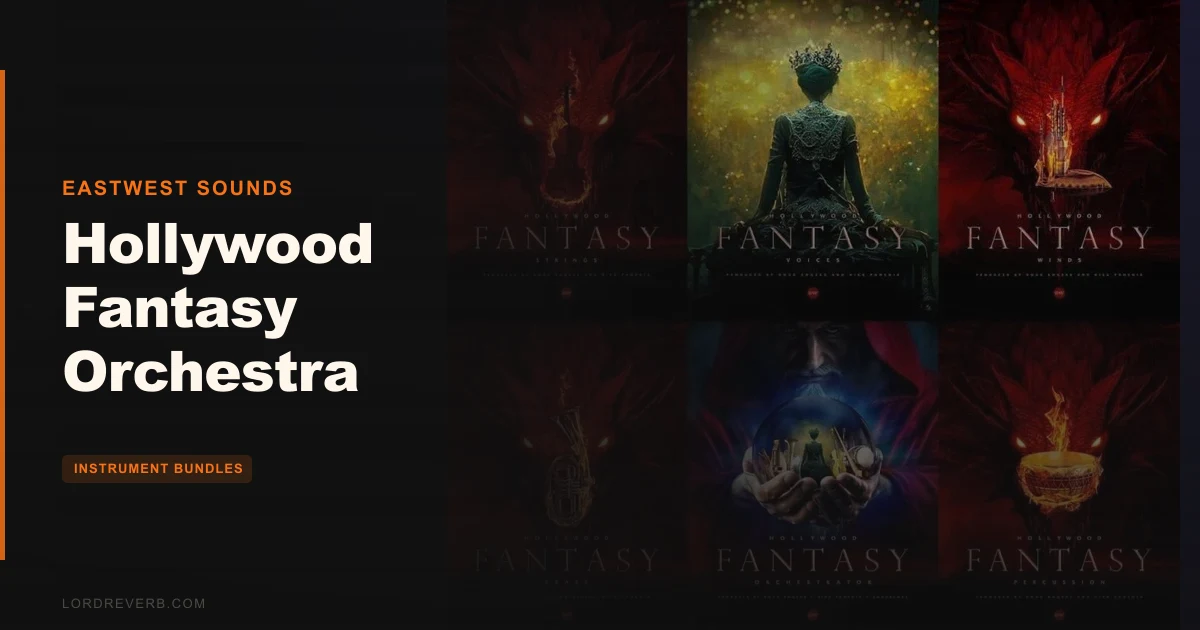
You’re scoring a fantasy battle scene, your deadline is Thursday, and your modern string section sounds completely wrong for the era. That’s the specific problem the Hollywood Fantasy Orchestra Bundle solves. Not “I need more instruments.” More like: “I need the right instruments, in the right acoustic space, laid out so my template doesn’t break.”
This is EastWest’s answer to the gap between a standard symphonic library and a score that needs to feel like it belongs in Middle-earth or a candlelit Baroque court. The bundle covers five dedicated libraries: Strings, Brass, Winds, Percussion, and Voices, plus the Hollywood Fantasy Orchestrator. It runs inside their OPUS engine. The full price is higher, though it has been discounted and even lower through promotional periods. Check the manufacturer’s site and Plugin Boutique for current pricing before you pay list.
This review is for working composers who have a real project on the line, not bedroom producers curious about the sound demos.
The Specific Gap This Was Built to Fill
Every composer who scores in a fantasy or historical genre hits the same wall. You’ve got a strong modern orchestral library. It sounds great for a Zimmer-style action cue. Then the director asks for something that sounds like it predates the 1700s, and suddenly your Spitfire Symphonic Strings sound deeply out of place.
The frustrating thing isn’t lack of options. It’s that most “fantasy” or “ethnic” sample libraries treat these sounds as colour: one-shot textures, FX beds, the occasional duduk loop. They’re supplements. You can’t build a full arrangement out of them.
Hollywood Fantasy Orchestra is built on a different idea. These instruments aren’t supplements. They’re replacements. Hardanger fiddles sit in the violin chair. Alphorns hold down the brass section. Dulcimers do the work of a piano. The whole ensemble logic is preserved; only the timbre has shifted by several centuries.
That’s a real solve for a real problem. And it works better than we expected.
How It Performs When You're Actually Scoring
We loaded the Strings library first. The 57.5GB footprint loaded into OPUS without drama. Key switching between articulations is where OPUS earns its keep over the old PLAY engine: patch changes are faster and we didn’t hit the hanging-note bug that used to be a PLAY specialty.
Here’s a specific moment worth sharing. We wrote a four-bar legato phrase for hardanger fiddles, sitting in the upper-mid register around E4 to B4. Against a simple low-drone brass pad, those strings produced something genuinely eerie. The sympathetic string resonance built into the samples does audible work. You don’t have to layer it with a separate drone patch. It’s already in there.
The Brass library gave us a similar experience. We layered alphorns against a conventional low brass pad from a separate library. The alphorn cut through without sitting in competition because the harmonic character is different enough to carve its own space. No EQ needed. That’s satisfying.
The Winds library (16.8GB) and Percussion are the weaker links. They’re not bad. They’re just not at the level of the Strings and Brass. A few articulations in the Winds feel thin in the lower dynamic layers, and we wish the velocity response was tighter. The Voices library is a genuine surprise on the upside: choral textures are full and the consonant samples blend well.
Download sizes to know: 16.8GB for Winds, 20.5GB for Brass, 57.5GB for Strings. The complete bundle pushes past 115GB. Plan your drive accordingly.
Strengths and Weaknesses, Honestly
The strength is the recording environment. Everything in this bundle was tracked on the same EastWest Studio One stage used for the flagship Hollywood Orchestra series, produced by Doug Rogers and Nick Phoenix. That acoustic consistency is worth more than most marketing copy ever conveys. When you stack a Hollywood Fantasy Strings layer against a Hollywood Orchestra Strings layer, the rooms match. The reverb tails don’t fight each other. That’s rare in a cross-library blend.
The OPUS engine is genuinely better than PLAY. Faster streaming, cleaner UI, lower idle CPU.
The weakness is consistency across the five libraries. Strings and Brass feel fully finished. Winds and Percussion feel like they got less attention, possibly fewer recording sessions or less time in post. The velocity layers in the Percussion don’t breathe the way good drum articulations should. That’s annoying when the other libraries set a higher bar.
Storage is also a real conversation. 115GB-plus for a specialty library is a hard sell if you’re on a 1TB drive that’s already half full. This is not a casual install.
Is the Price Actually Justified?
At $399 list, it’s a tough ask. You’re paying for five libraries plus the Orchestrator, which softens the per-unit math. But the Winds and Percussion dragging behind the Strings and Brass makes it feel like four-fifths of a bundle.
At the confirmed retailer price, the value picture improves. You’re getting a cohesive acoustic space, two excellent libraries, two decent ones, and one pleasant surprise (Voices). That’s a fair deal.
At $209 during a promotional window, it’s a clear buy if fantasy or historical scoring is any part of your work. Don’t hesitate at that price.
Who Should (and Shouldn't) Buy This
✅ Buy if you already own a modern orchestral library and need a historically-grounded second tier that sits in the same room acoustically.
✅ Buy if you score for games, film, or TV where medieval, Baroque, or Renaissance settings appear regularly enough to justify the 115GB footprint.
✅ Buy if you can catch a promotional price. At those numbers, the Strings and Brass libraries alone cover the cost.
❌ Skip if you don’t have at least 200GB of free drive space you’re comfortable dedicating to a specialty library.
❌ Skip if you are looking for your first orchestral library. This is a companion and a replacement layer, not a foundation. Start with best orchestral sample libraries first.
❌ Skip if you score exclusively in modern or contemporary idioms. This library has a very specific era it serves. It will feel like an expensive novelty outside of that context.
Score Breakdown
| Category | Score | Notes |
|---|---|---|
| Sound Quality | 4.5/5 | Studio One acoustics are consistent and excellent; Strings and Brass especially |
| Value for Money | 3.5/5 | Fair at a discounted price, borderline at full price given the uneven library quality. |
| Ease of Use | 4.0/5 | OPUS is clean; ensemble replacement logic is intuitive once you see it |
| Features | 4.0/5 | Five libraries plus Orchestrator is a complete toolkit for the use case |
| CPU Efficiency | 3.5/5 | Disk streaming is manageable on SSD; RAM use climbs fast with multiple instances open |
| Overall | 4.1/5 | A specific tool that does its specific job very well, with a couple of soft spots |
Alternatives Worth Looking At
Spitfire Audio Albion Tundra is the most direct competitor for historical and Nordic textures. It’s lighter on storage and leans more toward cinematic bed sounds than full ensemble replacement. Good for layering; less good as a standalone section swap. See our Spitfire Albion Tundra review.
8Dio Anthology Strings covers similar historical-flavoured territory with a stronger focus on strings specifically. If strings are your only need and you want to skip the full bundle cost, it’s worth pricing out. Check our best string sample libraries.
EastWest Hollywood Orchestra (the standard version) is worth mentioning as the logical companion purchase rather than an alternative. If you don’t own it yet, buying both on discount is a smarter long-term move than buying one at full price. See EastWest Hollywood Orchestra review.
For budget-conscious composers, the EastWest ComposerCloud subscription review gives you access to Hollywood Fantasy Orchestra alongside EastWest’s full catalogue for a monthly fee. If you’re not sure you’ll use it long-term, try it that way before committing to the bundle purchase.
The Hollywood Fantasy Orchestra Bundle doesn’t try to be everything. It tries to be the library that sounds like it belongs in the same room as your existing EastWest content, while moving several centuries backwards in time. On that narrow brief, it mostly delivers.
Buy it at a discount or below if medieval, Baroque, and Renaissance textures are a regular part of your work. Wait for the next promotional window if you’re at list price and the Winds or Percussion sections are the main draw. Skip it entirely if your hard drive is already a crisis.
The Strings and Brass alone are worth the discounted price. Everything else is a bonus you’ll appreciate when you need it.
Frequently Asked Questions
Does the Hollywood Fantasy Orchestra Bundle require a separate OPUS licence?
OPUS is EastWest's proprietary sampler engine and it's free to download. You need it to run the Hollywood Fantasy Orchestra libraries, but there's no separate cost for the engine itself. It replaced the older PLAY engine and offers faster patch loading and a cleaner interface. Make sure you're running the current OPUS version before installing to avoid compatibility headaches.
Can I use Hollywood Fantasy Orchestra without owning the standard Hollywood Orchestra?
Yes. Nothing in the bundle requires you to own other EastWest products. That said, the libraries were recorded in the same acoustic space as Hollywood Orchestra, so they blend best with that library. If you plan to use HFO as your only orchestral tool, the instrument roster is specialised enough that you'll likely hit gaps fast. It works standalone but it thrives as a companion.
Is the Hollywood Fantasy Orchestra Bundle available through EastWest ComposerCloud?
Yes. ComposerCloud subscribers get access to Hollywood Fantasy Orchestra as part of the subscription catalogue. If you're unsure whether fantasy orchestral scoring is a regular part of your workflow, trialling it via ComposerCloud before buying the bundle outright is the smarter move. Monthly subscription pricing is available directly from EastWest's site.
How does the 115GB download size break down across the five libraries?
Strings account for roughly 57.5GB, making it by far the largest individual library. Brass comes in at around 20.5GB. Winds sit at approximately 16.8GB. Percussion and Voices make up the remainder. If storage is tight, install Strings and Brass first since those are the strongest libraries, and add the others when space allows.