
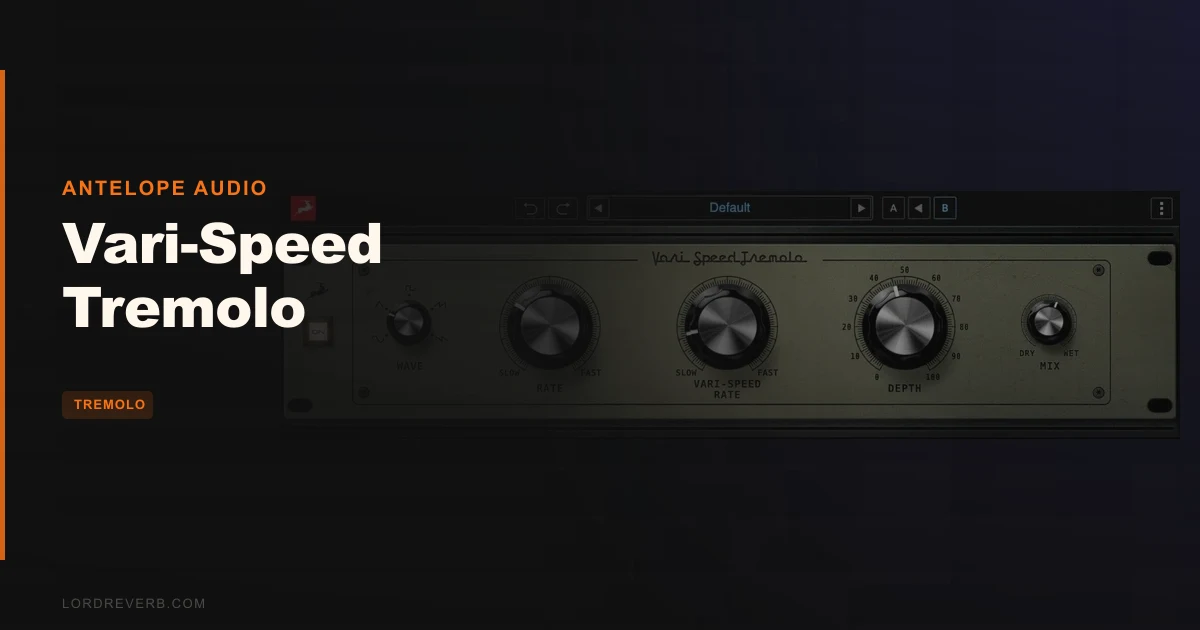
The Antelope Audio Vari-Speed Tremolo is a clever, narrow-purpose plugin that earns its $12.90 price tag if vintage organ or electric guitar tremolo realism is your actual goal, and wastes your CPU entirely if it isn't.
At $12.90 it sits in a price range where most producers expect a workhorse. This isn't that. It's a specialist tool that cares deeply about one thing: recreating the physical momentum of a spinning mechanical motor. Push it into an electric organ track and owners describe the result as swirling, authentic tension. The virtual speaker behavior is convincingly uneven in the way real rotary speakers are.
But there's a real catch: no grid sync, a steeper learning curve than a stompbox, and a CPU hit that'll make you wince on older machines.
What You're Actually Getting
Five modulation waveforms. A Rate knob for modulation speed. A Vari-Speed knob that shifts how fast the modulator wave frequency changes. A Depth knob for modulation intensity. And motor modeling baked into the core of the engine.
That Vari-Speed control is the whole personality of this plugin. It's not adjusting speed in a clean, stepped way. It's recreating the mechanical inertia of a motor that takes time to reach a new speed. Apply it gently and you get subtle pitch-drift feel. Push it and the tremolo becomes genuinely unpredictable in an organic way.
Harmonic saturation is part of the signal path too. Not an add-on. It's baked in, contributing what owners describe as a thick, warm quality in the midrange. That means what you're hearing isn't a clean LFO-shaped volume cut. It's a character effect.
Two versions exist: a native plugin that runs on Mac or PC without additional hardware, and a Synergy Core Real-Time version for compatible Antelope hardware. The hardware version runs with no perceptible latency, which matters for live performance.
Who This Plugin Actually Serves
The Vintage Organ Producer
Put this on an electric organ channel and don't touch the Rate for a minute. Just listen to what the motor modeling does to the tone. Owners consistently report it creates authentic, swirling tension in a way that simpler LFO tremolo plugins don't. The virtual speaker reacts more like a physical cabinet than a mathematical modulation curve.
If you're building soul tracks, gospel arrangements, or vintage psych records and you want that specific mechanical wobble on organ, this is worth the $12.90. The midrange saturation thickens the body of the organ in a satisfying way, the kind of warmth that takes the sterility out of a clean VST keyboard.
Buy it.
The Electric Guitar Producer or Recording Engineer
Dial in a slow, deep tremolo on a clean electric guitar part and you'll understand why Antelope describes this as giving new life to the oldest guitar effect. The Vari-Speed behavior adds the kind of drift that makes listeners assume there's a real amp in the room.
Your frustration will come at the DAW stage. If you need the tremolo to lock to a tempo grid for a pop or electronic record, you'll find that frustrating fast. No reliable grid sync means manual dialing by ear, which is satisfying if you have time and annoying if you're on a deadline.
Buy it if the music is about feel. Wait if tempo-locked precision matters more.
The DAW-Workflow Producer
You're running a dense session. You want to drop a tremolo on a rhythm guitar bus, hit TAP TEMPO or sync to your project BPM, and move on. That's not what this plugin is built for.
The absence of grid sync is a real design limit, not a subtle omission. If your mixing process relies on modulation effects locking to the beat, this plugin will cost you time and patience. The CPU load will cost you headroom on a busy session too.
Skip it. There are tremolo plugins built exactly for that workflow. This one isn't.
The Live Performer on Synergy Core
If you own compatible Antelope hardware, the Synergy Core Real-Time version is a genuine argument for this plugin in a live rig. Zero-latency motor modeling on stage is a different thing from using an LFO pedal. The unpredictability of Vari-Speed works in your favor in a live context because it breathes.
Worth it at $12.90 if the hardware is already in your signal chain.
The Not-So-Good
No grid sync. That's the loudest problem. For any producer building inside a tempo grid, this limit cuts the plugin out of a wide range of common use cases. Owners confirm it, and there's no workaround that makes it clean.
The CPU load is heavy. That's the developer's own assessment and owners back it up. On a system running a large session, adding this to even one or two channels will cost you. Light on processing power? Hard pass.
The learning curve is real too. Coming from a hardware pedal with one knob, the Vari-Speed behavior takes time to understand. The interaction between Rate, Vari-Speed, and the five waveform options isn't self-evident. Some producers love that depth. Others will find it ugly and overcomplicated on day one.
And honestly? The sharp gating effect some tremolo users love is not here. If you want that choppy, almost rhythmic gating sound, this plugin won't give it to you.
Who Should Buy This
- ✅ Buy if you produce vintage organ-driven music and need mechanical speaker modeling that sounds real
- ✅ Buy if you're a guitar producer who values organic feel and doesn't need tempo-locked precision
- ✅ Buy if you use Antelope Synergy Core hardware and perform live with tremolo in your chain
- ❌ Skip if you need grid sync for tempo-matched tremolo in a modern DAW session
- ❌ Skip if your system is already CPU-heavy and you can't spare the processing headroom
- ❌ Skip if you want sharp gating or percussive choppy tremolo sounds
Specs & Technical Details
| Spec | Detail |
|---|---|
| Developer | Antelope Audio |
| Price | $12.90 |
| Plugin Format | N/A |
| OS Support | Mac / Windows |
| Activation | N/A |
| CPU Usage | Heavy |
| Trial Available | N/A |
| Version Reviewed | N/A |
Score Breakdown
| Category | Score | Notes |
|---|---|---|
| Sound Quality | 4.5/5 | Motor modeling and harmonic saturation are genuinely convincing on organ and guitar |
| Value for Money | 4.0/5 | Fair price for the niche it serves; poor value if you need grid sync or general tremolo |
| Ease of Use | 3.0/5 | Steeper learning curve than expected; Vari-Speed interaction takes time to dial in |
| Features | 3.5/5 | Five waveforms and motor modeling are clever; no grid sync is a real gap |
| CPU Efficiency | 2.5/5 | High CPU footprint limits use on busy sessions and lower-spec systems |
| Overall | 4.0/5 | Brilliant at what it's built for; wrong tool for general DAW tremolo work |
The Verdict
This plugin has a clear identity and doesn't apologize for it. The motor modeling is clever engineering. The Vari-Speed behavior adds the kind of organic drift that separates vintage-sounding records from polished but sterile ones. Owners aren't wrong when they say the attention to dynamic behavior is staggering.
But the missing grid sync isn't a minor annoyance. It's a defining limit. For producers who live inside a tempo grid, that alone should redirect you elsewhere.
At $12.90 it's a satisfying buy for the vintage organ producer or the electric guitar specialist who cares more about feel than precision. For everyone else, the CPU cost and the workflow gaps add up to a plugin that'll sit unused after the first week. Know which camp you're in before you click buy.
Frequently Asked Questions
Does the Vari-Speed Tremolo require Antelope Audio hardware to run?
No. The native version runs on Mac or PC without any additional hardware. The Synergy Core Real-Time version requires compatible Antelope hardware and delivers real-time processing with no perceptible latency, which makes it the better choice for live performance use.
Why doesn't the Vari-Speed Tremolo have grid sync?
The plugin is built around mechanical motor behavior, where modulation speed isn't metronomic. That design philosophy is at odds with rigid tempo locking. It's a deliberate sonic direction, not an oversight, but it does make it a poor fit for tempo-matched DAW work.
What's the Vari-Speed knob actually doing to the sound?
It controls how quickly the modulator wave frequency changes speed. At low settings the effect feels like a motor gradually spinning up or winding down. Push it further and the tremolo becomes genuinely unpredictable, adding organic drift rather than a steady rhythmic pulse.
Is the Vari-Speed Tremolo good for electronic music production?
For most electronic music workflows, it's a difficult fit. The lack of grid sync is a real obstacle in tempo-driven genres, and the CPU load can strain a dense session. If you're after a choppy, rhythmic tremolo gate effect, this plugin isn't designed for that either. It's built for vintage and organic applications.