Your drums sound like a spreadsheet. Clean, accurate, perfectly in time, and about as exciting as a quarterly report.
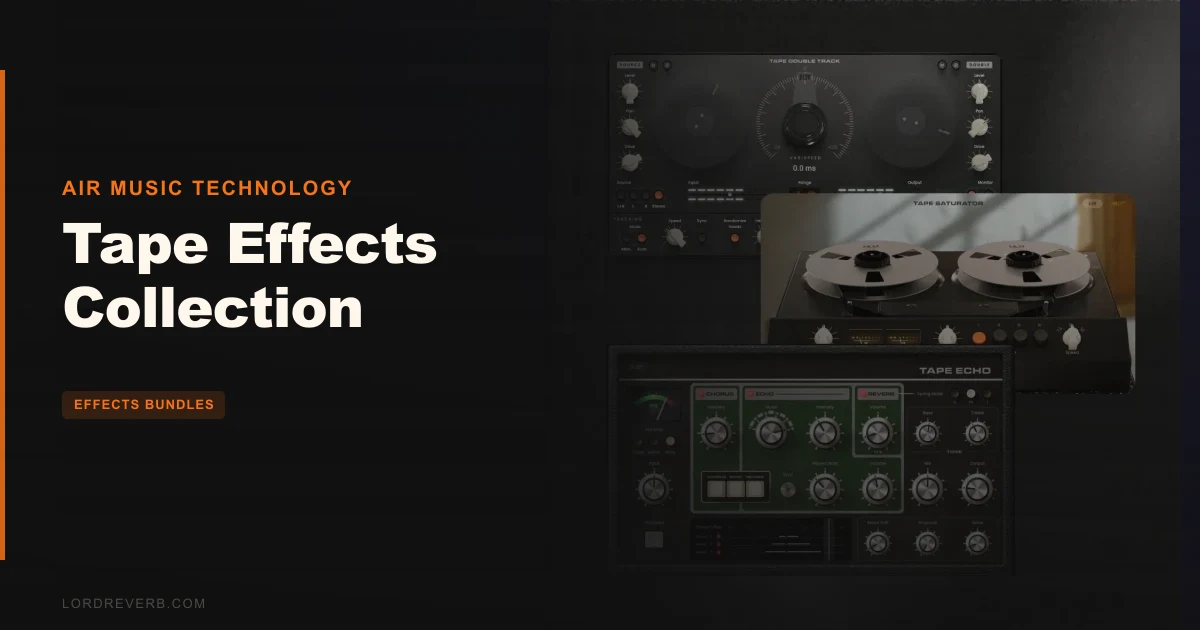
That’s the itch the Tape Effects Collection from AIR Music Technology scratches. It’s three tape-based plug-ins (saturation, echo and doubling) for $79. We think it’s for producers working in the box who miss the grit, drift and wobble that tape machines gave records without anyone asking.
If you want pristine, this isn’t your bundle. If you want your sounds to feel played rather than placed, keep reading.
What problem does a tape bundle actually solve?
Digital audio is too well behaved. Every repeat of a delay lands identically. Every transient hits the converter the same way. Nothing wobbles.
Records we love don’t sound like that. Tape slows down slightly, speeds up, drops out for a split second and adds hiss. Those flaws glue a mix together and give it a pulse.
You can fake some of it with a generic saturator and a chorus. It rarely convinces. The Tape Effects Collection goes after the flaws themselves: wow, flutter, dropout, motor drift and noise are all controls here.
That’s the pitch. Tape as a set of behaviours, not just a warm filter.
How does the collection perform as a whole?
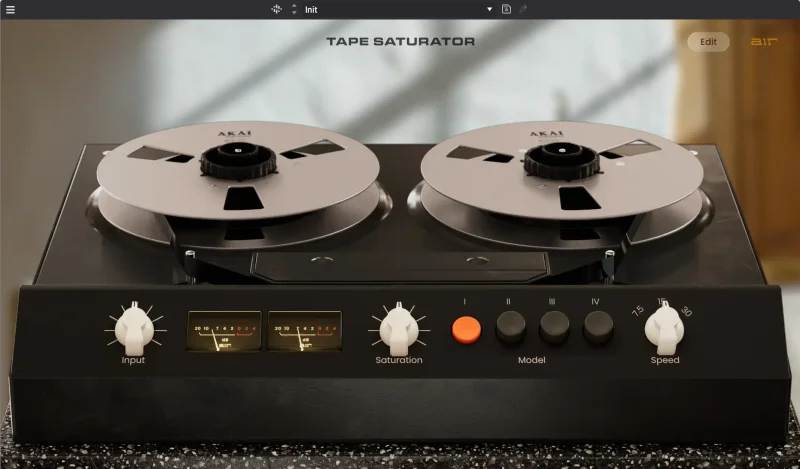
Three plug-ins ship in the box: Tape Saturator, Tape Echo and Tape Double Track. They run independently, or you can stack them as one tape-processing chain.
The chain idea is the smart bit. Saturate a vocal, double it, throw a send into the echo. Each stage shares the same commitment to subtle pitch instability and harmonic coloration, so they don’t fight each other.
Owners describe the result as confidence. They talk about replacing vintage outboard gear, and about getting a consistent gritty, aggressive vibe in MPC workflows.
One more thing worth knowing: the collection ships in VST, VST3, AU and AAX, on Windows 10 and up and macOS 14 and up. Check your OS before you get excited.
Tape Saturator: is it more than a warm filter?
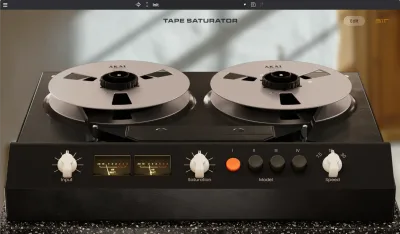
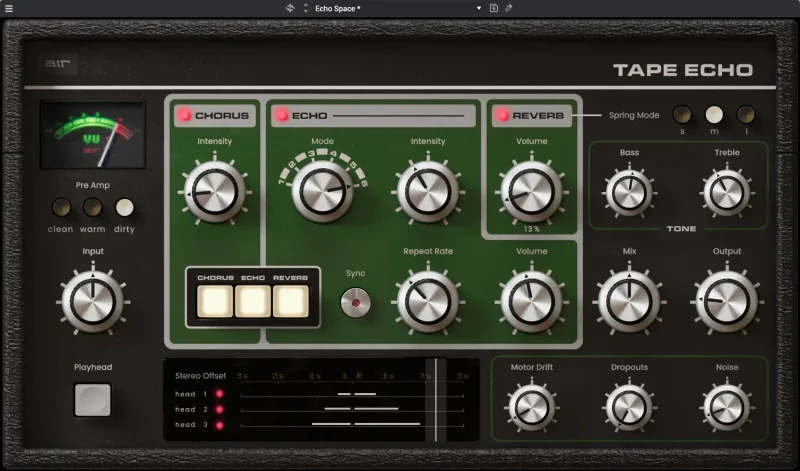
Tape Saturator is optimized for mixing and mastering, on desktop and in MPC workflows. It’s the one you’ll reach for most.
Four saturation models and the tape condition control
There are 4 saturation models. The standout control is tape condition, which sweeps from mint to heavily aged.
Mint tape adds density and harmonic richness. Aged tape adds the mess.
Put it on a drum bus and push the condition toward worn. That’s where a flat loop starts to sound dragged out of an old cassette deck. Back it off for the master bus and you get glue without the grime.
Wow, flutter, dropout and noise
Four controls handle the unreliable side of tape: wow, flutter, dropout and noise. Owners say having control over noise, tape condition and speed gives them freedom beyond what hardware allows. A real machine doesn’t let you dial the hiss to zero and keep the saturation.
That’s a clever trade. You keep the character and bin the annoying parts.
Tone shaping, auto gain and clipping
Tone shaping is built in, along with auto gain make-up and a clipping type selector.
Auto gain matters more than it sounds. Saturation lifts level, and louder always sounds better for about four seconds. Make-up gain keeps your A/B test honest, so you hear the colour and not the volume bump.
Users say Tape Saturator brings the mix forward genuinely. We’d hold that claim up against your own material, which is what the trial is for.
Tape Echo: does it earn the Roland name?
Tape Echo is a recreation of the Roland RE-501 Chorus Echo. Of the three, it has the most going on.
Multi-head modes and the joggable playhead
Multi-head modes come with BPM sync and natural variation. Sync keeps repeats in time with your session. The variation keeps them from sounding machine-gunned.
Then there’s the joggable playhead, which lets you move the head by hand. Grab it mid-repeat and the pitch bends like you’ve leaned on the tape reel. It’s ridiculous fun on a breakdown, and not something a plain digital delay does.
Preamp: Dirty, Clean and Warm
The preamp has three character modes: Dirty, Clean and Warm. Dirty crunches your repeats. Clean leaves them honest. Warm sits between the two.
We’d leave it on Warm for vocals and flip to Dirty when a pad needs some teeth. Three modes means you don’t need a separate saturator on the return.
Chorus, spring reverb and tone controls
There’s a built-in chorus section, spring reverb in three sizes, bass and treble tone controls, and stereo offset.
The spring reverb is a differentiator. It positions a center spring with room sounds off to the sides, which gives it a stereo image most spring emulations don’t bother with.
Owners praise Tape Echo for space and movement on pianos, vocals and melodic textures, with an atmospheric analog vibe. They also say the delay sounds natural and real. Add motor drift, dropout and tape noise simulation and the repeats wobble the way you’d expect from a worn machine.
Tape Double Track: when does ADT beat a copy-paste double?
Tape Double Track recreates the 1960s Automatic Double Tracking technique. That’s the trick studios used so a singer didn’t have to sing the same line twice.
Automatic tracking and varispeed
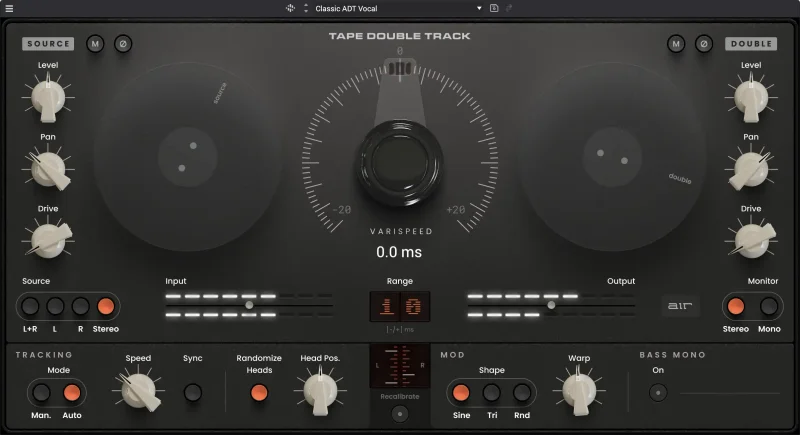
Automatic tracking uses randomized head positioning. The double never sits at a fixed offset, so it doesn’t sound like a pasted copy. Varispeed adds the widening effect.
That’s the whole appeal. Natural width and movement with no second take recorded.
Modulation shapes and the two channels
Modulation shape controls offer Sine, Triangle and Random. Sine is smooth and slow. Triangle is more obvious. Random is the one that sells the human illusion.
Source and double track each get their own channel, with pan, drive, mute, phase and level. Being able to mute the source and listen to the double alone is brilliant for dialling in the offset.
Put it on a lead vocal and hard-pan the double slightly. You get width that mono-folds without the phasey mess a stereo widener leaves behind.
Here’s the catch. It recreates one specific technique. If your doubling needs run to other approaches, this won’t cover them.
What are the real downsides?
The activation is the big one. License reactivation is required at least every 30 days.
One user reports the inconvenience was enough to stop them using the product. We get it. Nothing kills a session like a license dialog when you’re mid-idea. Plan around it, and don’t discover it on a laptop with no internet before a gig.
The second limit is focus. This is a tape collection, and that’s all it is. If your sound lives in clean, surgical territory, you’ll use it twice and forget it.
Third, the doubling. One 1960s technique, done well, is still one technique.
Is it worth $79?
Value is the whole question here, so let’s be blunt.
You’re paying $79 for three tools that each do one job. A tape saturator, an RE-501-style echo with spring reverb and chorus, and an ADT doubler. Bought separately, a good version of each would add up, and none of them would be designed to chain.
The 10-day free trial removes the risk. Spend it on your own drums, vocals and a melodic loop, not demo presets.
Cheaper or free saturators exist, and for light warmth they may be enough. Where the collection earns its price is the echo and the doubler, because those are harder to fake.
We’d pay for it if tape is your sound. If it’s a once-a-month garnish, we wouldn’t.
Try it yourself: three checks for the trial
- Run a dry drum loop through Tape Saturator, sweep tape condition from mint to worn, and decide where it stops helping.
- Send a vocal to Tape Echo, switch the preamp between Dirty, Clean and Warm, and listen to what each does to the repeats.
- Double a lead line with Tape Double Track on Random modulation, mute the source, and check whether the double sounds like a person.
Do the 30-day reactivation test too. Note how annoying it is for you.
Who should (and shouldn't) buy this?
- ✅ Buy if you work in the box and your mixes sound too clean and too perfect.
- ✅ Buy if you use an MPC and want a gritty, aggressive tape vibe without outboard gear.
- ✅ Buy if you want one coherent chain of saturation, echo and doubling rather than three unrelated plug-ins.
- ❌ Skip if you hate license check-ins, because the 30-day reactivation will wind you up.
- ❌ Skip if you want clean, non-tape processing, since every tool here has tape coloration baked in.
- ❌ Skip if you need several doubling styles, as Tape Double Track covers one 1960s method.
Specs & Technical Details
| Spec | Detail |
|---|---|
| Developer | AIR Music Technology |
| Price | $79 |
| Plugin Format | VST / VST3 / AU / AAX |
| OS Support | Windows 10+ / macOS 14+ |
| Activation | License reactivation required at least every 30 days |
| CPU Usage | N/A |
| Trial Available | Yes (10 days) |
| Version Reviewed | N/A |
Score Breakdown
| Category | Score | Notes |
|---|---|---|
| Sound Quality | 4.5/5 | Owners report natural, real-sounding repeats and genuine mix presence. |
| Value for Money | 4.0/5 | Three chainable tools, but only worth it if tape is your thing. |
| Ease of Use | 3.5/5 | Controls are clear, but the 30-day reactivation is a real irritation. |
| Features | 4.5/5 | Joggable playhead, three preamp modes, tape condition and spring reverb in three sizes. |
| CPU Efficiency | N/A | AIR publishes no CPU figures, so this row is not scored. |
| Overall | 4.0/5 | Strong tape character held back by reactivation and a narrow tape-only focus. |
Verdict: should you buy the Tape Effects Collection?
Buy it if your mixes are too polite and you want drift, dust and wobble on tap. At $79, the echo alone justifies the trial.
Skip it if clean is your religion, or if a license prompt every 30 days will drive you up the wall. Try the 10 days first, and judge it on your own drums.
Frequently Asked Questions
What's included in the Tape Effects Collection?
Three plug-ins: Tape Saturator, Tape Echo and Tape Double Track. They work independently, or you can combine them as one tape-processing chain.
Is there a free trial for the Tape Effects Collection?
Yes, a 10-day free trial is available. Use it on your own material to judge the saturation, echo and doubling before you pay $79.
What does Tape Echo emulate?
It's a recreation of the Roland RE-501 Chorus Echo. It adds multi-head modes with BPM sync, a joggable playhead, three preamp modes (Dirty, Clean, Warm), chorus and spring reverb in three sizes.
Which formats and operating systems are supported?
The collection comes in VST, VST3, AU and AAX formats. It runs on Windows 10 and up and macOS 14 and up.
What's the catch with the license?
License reactivation is required at least every 30 days. One user reports the inconvenience stopped them using it, so plan around that if you work offline.
What does Tape Double Track actually do?
It recreates the 1960s Automatic Double Tracking technique, using randomized head positioning and varispeed to widen a sound without a second recording. You get Sine, Triangle and Random modulation shapes, plus separate source and double channels.