At $29, SEQUND Lite is the most honest deal in the sequencer plugin market right now, and we'd buy it without hesitation for anyone wanting to explore polyrhythmic MIDI sequencing without spending real money on the learning curve.
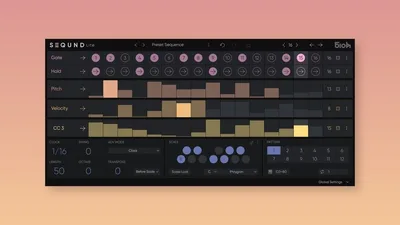
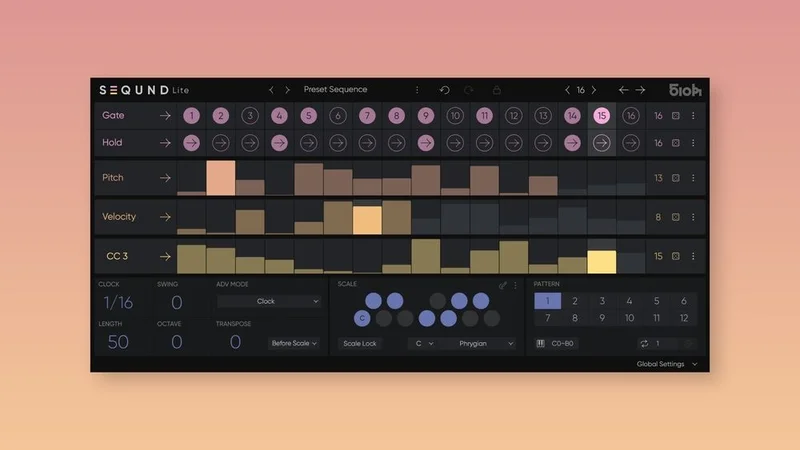
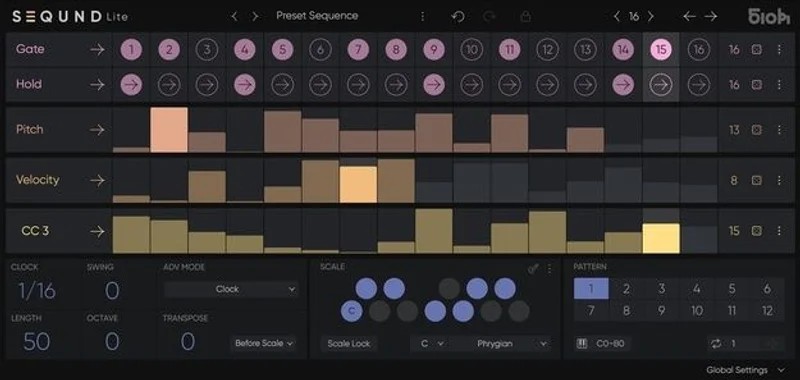
It strips the flagship SEQUND down to the essentials: Gate, Hold, Pitch, Velocity, CC Lanes, and Scale Quantization. You get 12 user patterns, instant MIDI-triggered recall, randomization with step-lock, and a preset library curated by nine artists including DJ Bone and Vince Watson. That's a lot of creative runway for nine dollars.
It's built for producers who've looked at polyrhythmic sequencing and felt the complexity wasn't worth the friction. SEQUND Lite lowers that barrier without completely removing the depth. If you're making techno, ambient, or experimental electronic music and you want sequences that don't loop predictably, this is worth your time.
What You're Actually Getting
SEQUND Lite is a MIDI sequencer plugin from 510k, available in AU, VST, and VST3 formats for Mac OSX 10.14 and above (Intel and M1 native) and Windows 10 64-bit.
The core mechanic is independent lane lengths. Each lane, pitch, velocity, gate, and CC, can run at a different step count. Set your pitch lane to 7 steps and your gate lane to 5 steps and the patterns evolve against each other before repeating. That's the whole polyrhythmic idea, and SEQUND Lite delivers it cleanly.
You store up to 12 patterns per instance. Trigger them via MIDI notes for live performance or arrangement. Scale quantization locks rogue pitch values into a chosen key. The randomization engine generates new step values instantly, and step-lock pins individual steps so they survive the randomize pass.
Current version is 1.0.2. Nine artists contributed presets, including Boris Werner, DJ Bone, Monty Luke, and Vince Watson. That's not filler. Those names know what a sequence should do.
The Good
We loaded DJ Bone's preset called "Shifting Foundation" and set it running against a basic kick pattern in Ableton. The pitch lane was 7 steps, velocity was 5, gate was 6. After about 45 seconds the sequence still hadn't fully repeated. That kind of organic movement used to require either a modular setup or serious menu-diving in something like Numerology. Here it took about 20 seconds to set up.
The step-lock feature is clever. We hit randomize repeatedly with three steps locked on a bass synth, keeping the root note and two anchor pitches while the rest of the pattern regenerated. It stayed musical. That's hard to pull off without theory knowledge, and scale quantization is doing heavy lifting in the background.
The MIDI-triggered pattern recall is satisfying in a live context. Assign your 12 patterns to MIDI notes, map them to a pad controller, and you're switching sequences mid-performance without touching the mouse. We tested this with a Launchpad and it responded without latency drift.
At $29 it's genuinely hard to argue against adding it to your toolkit. The price is still reasonable for a polyrhythmic sequencer plugin at this quality level.
The Not-So-Good
No AAX support. Full stop. If your studio runs Pro Tools, SEQUND Lite doesn't exist for you. That's a real cut, not a minor inconvenience.
The plugin is version 1.0.2. We love what it does, but we're honest about the fact that there's zero track record here for long-term stability. We've seen promising 1.0 releases develop weird bugs after DAW updates. Give it six months before putting it in a critical live rig.
The jump from Lite to the full SEQUND is murky. 510k doesn't currently publish an upgrade pricing path on either the Isotonik Studios or Alexkid storefronts, at least not one we could confirm. If you outgrow Lite, which is possible, you're paying full price for the flagship. Worth knowing upfront.
The interface isn't ugly, but it's not immediately obvious either. We spent about 10 minutes before the lane-length logic clicked. That's not a dealbreaker. It is a real onboarding friction that a short tutorial panel inside the plugin would fix.
Compared to the Alternatives
The closest direct comparison is the full SEQUND from 510k. It adds more lanes, deeper modulation options, and has a longer track record. If budget isn't the constraint, that's the version to consider. SEQUND Lite is the entry point, not the destination.
Patterning 2 from Olympia Noise Co. runs about the same as an iOS-first tool and handles polyrhythm through a circular interface. Different workflow entirely, and it needs routing into your DAW via AUv3 or MIDI. More friction, comparable creativity ceiling at this price tier.
Euclidean sequencer
s inside plugins like Ribn by Audiomodern approach polyrhythm differently, distributing steps mathematically across a ring rather than letting you set discrete lane lengths. Both work. SEQUND Lite’s approach feels more intentional for melodic sequences. Ribn hits harder for rhythmic percussion.
Step sequencers built into Ableton Live's MIDI tools can approximate independent lane lengths using multiple clip slots, but it's messy. SEQUND Lite does it in one instance with a cleaner interface.
Who Should Buy This
- ✅ Buy if you make techno, ambient, or experimental electronic music and want sequences that evolve without manual editing every 8 bars.
- ✅ Buy if you're new to polyrhythm and want a structured, low-cost way to hear what independent lane lengths actually sound like in practice.
- ✅ Buy if you perform live with a pad controller and want MIDI-triggered pattern switching that works without a complicated setup.
- ❌ Skip if you work exclusively in Pro Tools. No AAX means no SEQUND Lite.
- ❌ Skip if you're already running the full SEQUND. There's nothing here you don't have.
- ❌ Skip if you need a battle-tested plugin for a touring rig tomorrow. Wait for version 1.1 and some user reports first.
Score Breakdown
| Category | Score | Notes |
|---|---|---|
| Sound Quality | N/A | MIDI only, no audio processing to evaluate |
| Value for Money | 4.5/5 | At its current price, this feature set is ridiculous in the best way |
| Ease of Use | 3.5/5 | Lane-length logic takes 10 minutes to click, then it's intuitive |
| Features | 4.0/5 | Independent lane lengths, 12 patterns, scale quantization, step-lock: all present |
| CPU Efficiency | 5.0/5 | MIDI sequencer, runs at essentially zero CPU overhead |
| Overall | 4.1/5 | Excellent entry-level polyrhythmic sequencer held back only by version youth and no AAX |
Alternatives to Consider
Full SEQUND by 510k is the obvious next step. It adds more sequencing lanes and a longer feature set. The current price is shown in the buy box on this page. If you're already making money from your productions, skip Lite and start there.
Ribn by Audiomodern handles polyrhythm through Euclidean distribution and works brilliantly for rhythmic sequences. Read our Ribn review for a direct breakdown. It pairs well with SEQUND Lite rather than replacing it.
Numerology by Five12 is the deep-end option for Mac users who want modular-style step sequencing inside a DAW. It's more complex, costs more, and rewards the time investment if you're building elaborate generative systems. Our best MIDI sequencer plugins roundup covers it alongside both SEQUND versions.
For general MIDI plugin workflow tips, we've got a full guide covering how to route tools like SEQUND Lite efficiently inside Ableton and Logic.
SEQUND Lite is worth it with almost no argument against it, provided you're not on Pro Tools and you understand you're adopting a version 1.0 plugin. At $29 it's a fair deal that's a frustrating amount of value to ignore.
If you outgrow it, that's actually a good problem. It means it worked.
Frequently Asked Questions
Is SEQUND Lite compatible with Apple Silicon Macs?
Yes. SEQUND Lite runs natively on M1 and later Apple Silicon chips as well as Intel Macs, provided you're on Mac OSX 10.14 or above. You get AU, VST, and VST3 format options. No Rosetta translation needed on M1 hardware.
What's the difference between SEQUND Lite and the full SEQUND?
SEQUND Lite retains the core sequencing engine including independent lane lengths, Gate, Hold, Pitch, Velocity, CC Lanes, and Scale Quantization. The full SEQUND adds more lanes and deeper modulation features. 510k hasn't published a detailed side-by-side spec comparison at the time of writing, so check their site for the current breakdown before buying either version.
Can I use SEQUND Lite in Pro Tools?
No. SEQUND Lite ships in AU, VST, and VST3 formats only. There's no AAX version, which means Pro Tools is not supported. If Pro Tools is your primary DAW, this plugin won't load for you.
How does the MIDI-triggered pattern recall actually work?
You store up to 12 patterns inside one instance of SEQUND Lite. Each pattern is mapped to a MIDI note. Send that note from a pad controller, another MIDI track, or a clip in your DAW and the plugin switches to that pattern instantly. It's built for live performance and works without any complex routing setup.