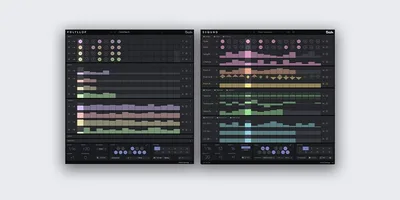
It was 1 AM on a techno track when we hit the wall every step-sequencer user knows. The groove was locked. The kick was right. But the melodic sequence on the bass synth was cycling every 16 steps exactly in sync with everything else, and it sounded like a loop, not a pattern. We needed offset. We needed the bass to drift against the grid without losing tempo. That’s when we loaded POLYLLOP, set Voice 1’s pitch lane to 7 steps and its velocity lane to 5, and watched the bass line stop sounding like it was on rails. That’s the specific problem this bundle solves, and it solves it well.
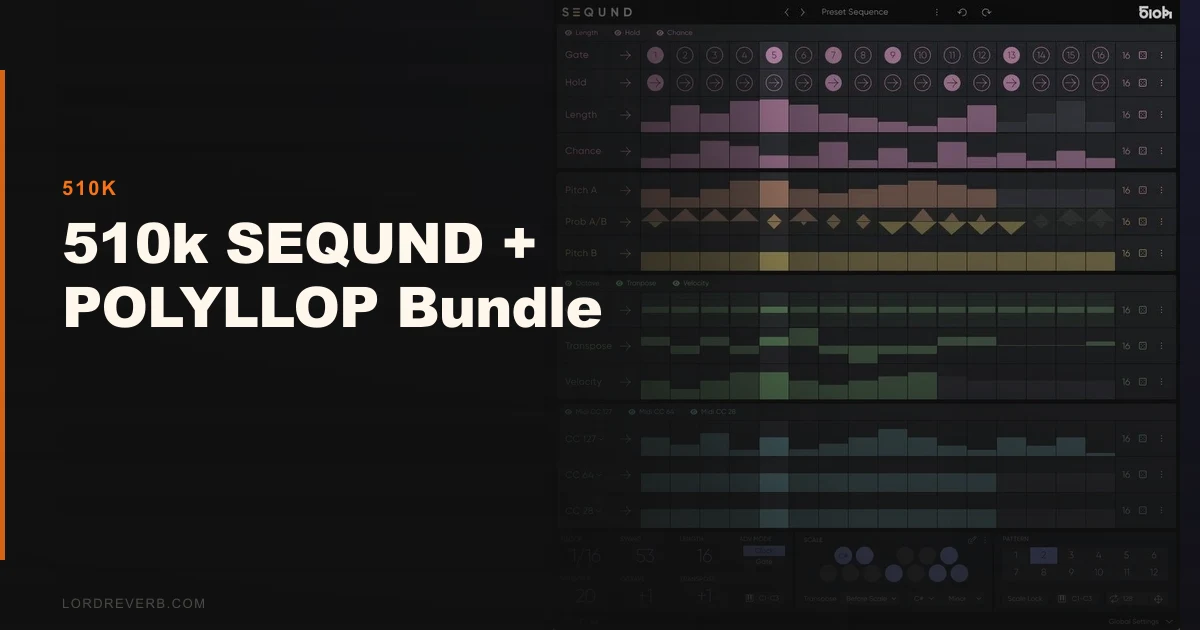
The 510k SEQUND + POLYLLOP Bundle costs $99. It’s built for producers who’ve outgrown their DAW’s native sequencer and want to work polyrhythmically and polymetrically without patching a modular.
First Impressions
Installation is clean. Both plugins arrive as AU, VST3, and AAX. Mac 10.14 and Windows 10 64-bit are the minimum specs, and Silicon compatibility is confirmed. Scan time in Logic and Ableton was under 10 seconds each.
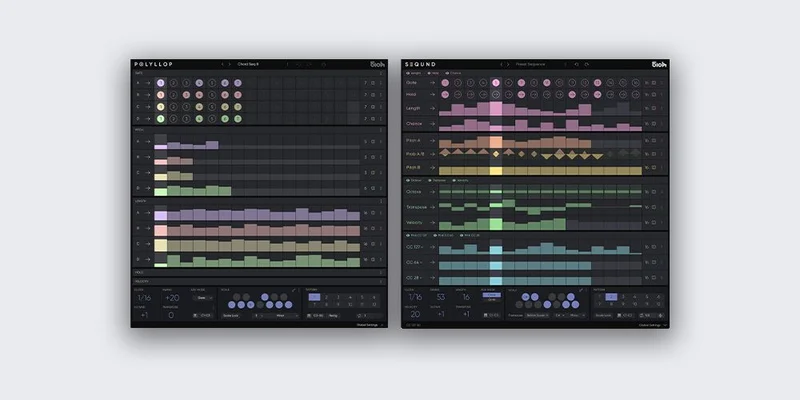
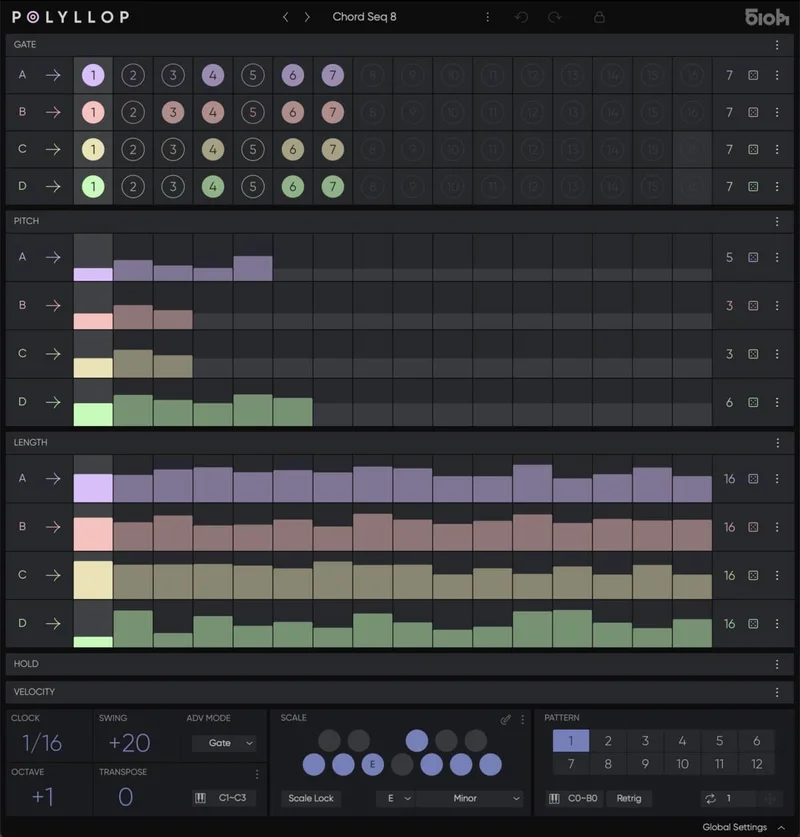
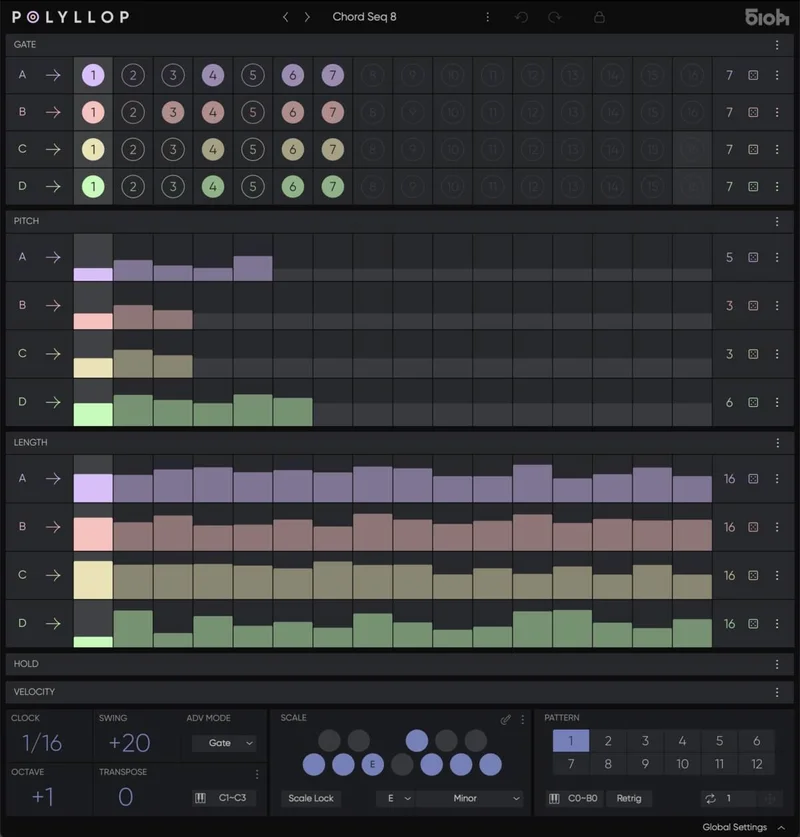
Opening POLYLLOP first is the right call. The interface is minimal to the point of feeling sparse. Four voices, each with independent lanes for gate, pitch, length, velocity, and hold. No presets on launch. That’s a deliberate design choice, not an oversight.
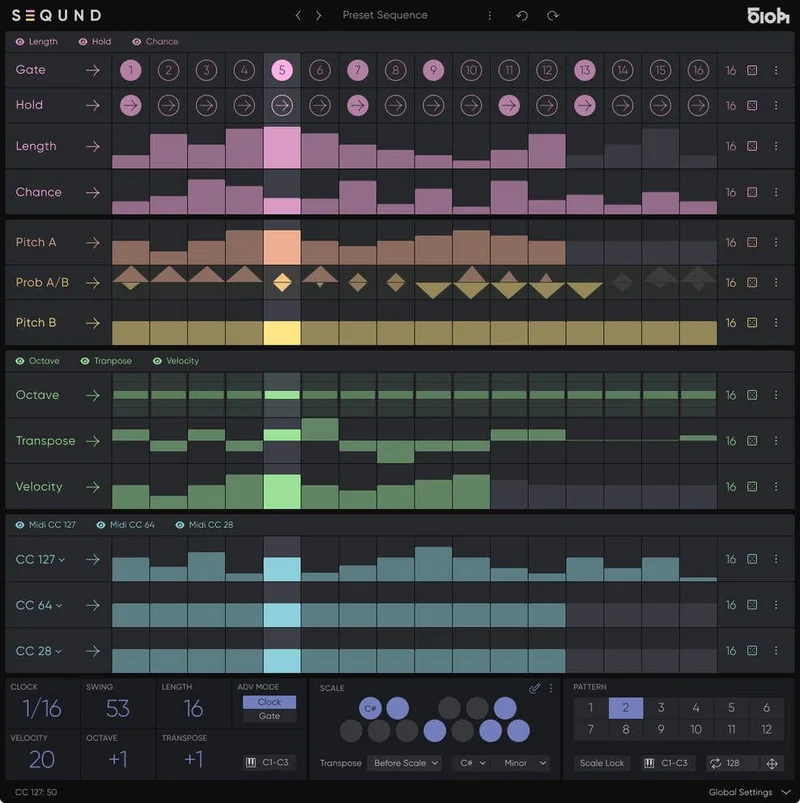
SEQUND is more feature-dense on first look: Gate, Length, Hold, Chance, Pitch A/B, Probability A/B, three assignable MIDI CC lanes, swing, two step advance modes, and 12-pattern recall via MIDI. It’s a lot to read before you’ve made a sound.
First impression overall: clever, slightly intimidating. Not ugly, but not welcoming either.
Getting It Into a Real Workflow
Both plugins are MIDI-only. No audio output. That’s the first friction point you’ll hit.
In Ableton Live, we placed SEQUND on a MIDI track, routed it to an instance of Massive X on a second track. Straightforward. In Logic, the routing requires an External Instrument track and some fiddling with MIDI channel assignments before it behaves correctly. Annoying, but solvable in about 10 minutes.
The workflow we found most satisfying was using SEQUND as the rhythmic engine and POLYLLOP for melodic content across the same session. SEQUND handled the percussion MIDI, driving a drum synth with Probability A/B varying the snare hits on each pattern recall. POLYLLOP ran the bass, with Voice 2 cycling a 9-step pitch lane against a 6-step velocity lane. By bar 8, the bass was doing something we hadn’t programmed intentionally.
That emergent quality is the whole pitch. If you want deliberate, predictable sequences, these aren’t your tools.
The learning curve is real. We spent roughly 90 minutes before patterns stopped sounding random and started sounding designed. Budget for that time.
What It's Genuinely Good At
POLYLLOP’s polymetric architecture is the standout feature. Each of the four voices runs independent step counts per parameter. Pitch, gate, length, velocity, and hold can each be a different length. Voice 1 can have 7 pitch steps, 5 velocity steps, and 12 length steps simultaneously. The patterns that fall out of that are structurally complex but tonally coherent if you set your pitch values intentionally.
We tested this against Ableton’s MIDI clip editor and Max for Live’s step sequencers. Getting equivalent polymetric behavior in Live natively required three separate MIDI clips, manual offset, and constant maintenance when the tempo changed. POLYLLOP handles all of that inside a single plugin instance.
SEQUND’s 12-pattern recall via MIDI is brilliant for live sets. Map 12 patterns to MIDI notes on a controller, switch mid-performance without stopping the clock, and the transition is sample-accurate. We tested this in Ableton with a Launchpad and it worked without dropout.
The three assignable MIDI CC lanes in SEQUND are underrated. We ran CC1 to filter cutoff and CC11 to resonance on a Moog emulation. Real-time modulation sequencing without an LFO or automation lane.
The Rough Edges
The MIDI-only design is both the concept and the limitation.
Every patch requires an external instrument. That’s one more plugin in the chain, one more point of latency risk, one more thing to save in your project. If you work fast and light, this friction adds up.
POLYLLOP has no chord voicing tools. Four voices are available, but building chord progressions means manually assigning root, third, fifth, and seventh pitch values across voices. That’s fine for producers who think in intervals. It’s frustrating for everyone else.
The 510k interface gives you almost no visual feedback about where you are in a pattern cycle during playback. There’s no position indicator you can read at a glance. We wished for a playhead more than once.
Pattern length maximums aren’t advertised clearly on the product page. We hit a ceiling when trying to build 32-step v
ariations in SEQUND and had to restructure the patch. That felt like discovering a room has a low ceiling after you’ve moved the furniture in.
Who This Is Really For
- ✅ Buy if you produce techno, IDM, or ambient and want sequences that evolve without manual automation
- ✅ Buy if you perform live and need 12-pattern MIDI recall on a controller without stopping the clock
- ✅ Buy if you already own a library of soft synths and want a smarter way to drive them
- ❌ Skip if you want internal sound generation. These are sequencers, not instruments.
- ❌ Skip if you're new to MIDI routing. The setup overhead will eat your first few sessions.
- ❌ Skip if you work primarily in pop, R&B, or hip-hop. The polymetric drift that makes this exciting works against groove-locked genres.
Score Breakdown
| Category | Score | Notes |
|---|---|---|
| Sound Quality | N/A | MIDI-only: sound is 100% your instrument choice |
| Value for Money | 4.0/5 | $99 for genuine polymetric capability not easily replicated natively |
| Ease of Use | 3.0/5 | Steep early curve; logical once it clicks but not intuitive on day one |
| Features | 4.5/5 | Per-voice independent step counts, MIDI CC lanes, pattern recall: the spec list earns it |
| CPU Efficiency | 4.5/5 | MIDI-only means near-zero DSP load on any modern system |
| Overall | 4.2/5 | Excellent tools for a specific producer type; wrong tool for everyone else |
Alternatives to Consider
If the MIDI-only limitation bothers you, Cthulhu by Xfer Records handles chord and arpeggio sequencing with a shallower learning curve. It’s less flexible polymetrically but gets you moving faster.
For producers already deep in the Ableton ecosystem, Max for Live sequencer tools cover similar ground and integrate without routing overhead. The tradeoff is portability: M4L devices don’t travel to other DAWs.
If you want a hardware alternative with the same polyrhythmic philosophy, Polyend Tracker mini review takes the concept off-screen entirely. Different workflow, same DNA.
Our Verdict
Here’s what we’d tell you at 1 AM over a session: if your sequences feel too locked, too predictable, too obviously programmed, the SEQUND + POLYLLOP bundle is one of the most direct solutions at $99 we’ve found. It’s not a workflow shortcut. It’s a workflow expansion, and you will pay for it in setup time and a 90-minute learning session before it starts paying dividends.
The bundle makes the price reasonable. Buying both plugins separately costs more. The bundle is $99. That saving is small but real.
It’s wrong for you if you want something that makes sound on its own, if DAW MIDI routing feels like a chore, or if your genres depend on locked, predictable groove. For everyone else producing music that’s supposed to feel like it’s alive: this is worth it.
Frequently Asked Questions
Do SEQUND and POLYLLOP work in any DAW?
Both plugins are available in AU, VST3, and AAX formats, covering Logic Pro, Ableton Live, Pro Tools, Cubase, and most other major DAWs. They're MIDI-only, so you'll need to route their output to an instrument track in your DAW. Routing setup takes about 10 minutes and varies slightly between hosts. Logic requires a few extra steps vs. Ableton.
What's the difference between SEQUND and POLYLLOP?
SEQUND is a single-voice polyrhythmic sequencer focused on rhythm, with Chance, Probability A/B, MIDI CC lanes, and 12-pattern recall. POLYLLOP is 4-voice polyphonic, with each voice running independent step counts per parameter (gate, pitch, length, velocity, hold). POLYLLOP evolved from a Max for Live device. SEQUND is the newer native build that POLYLLOP is built on top of.
Is the 510k bundle good for beginners?
Honestly, no. If you haven't worked with external MIDI routing or polyrhythmic concepts before, these plugins will frustrate you before they inspire you. We'd suggest getting comfortable with your DAW's native MIDI sequencer first. Once offset, phase relationships, and polymetric timing make intuitive sense to you, come back to this bundle.
How does POLYLLOP compare to Ableton's native arpeggiator?
Ableton's arpeggiator is monophonic and rhythmically fixed to the project grid. POLYLLOP runs four independent polyphonic voices, each with its own step counts per parameter, completely outside the grid if you want. Getting Ableton's native tools to produce equivalent polymetric behavior requires multiple MIDI clips, manual offset, and significant maintenance when tempo changes. POLYLLOP handles it inside a single plugin instance.