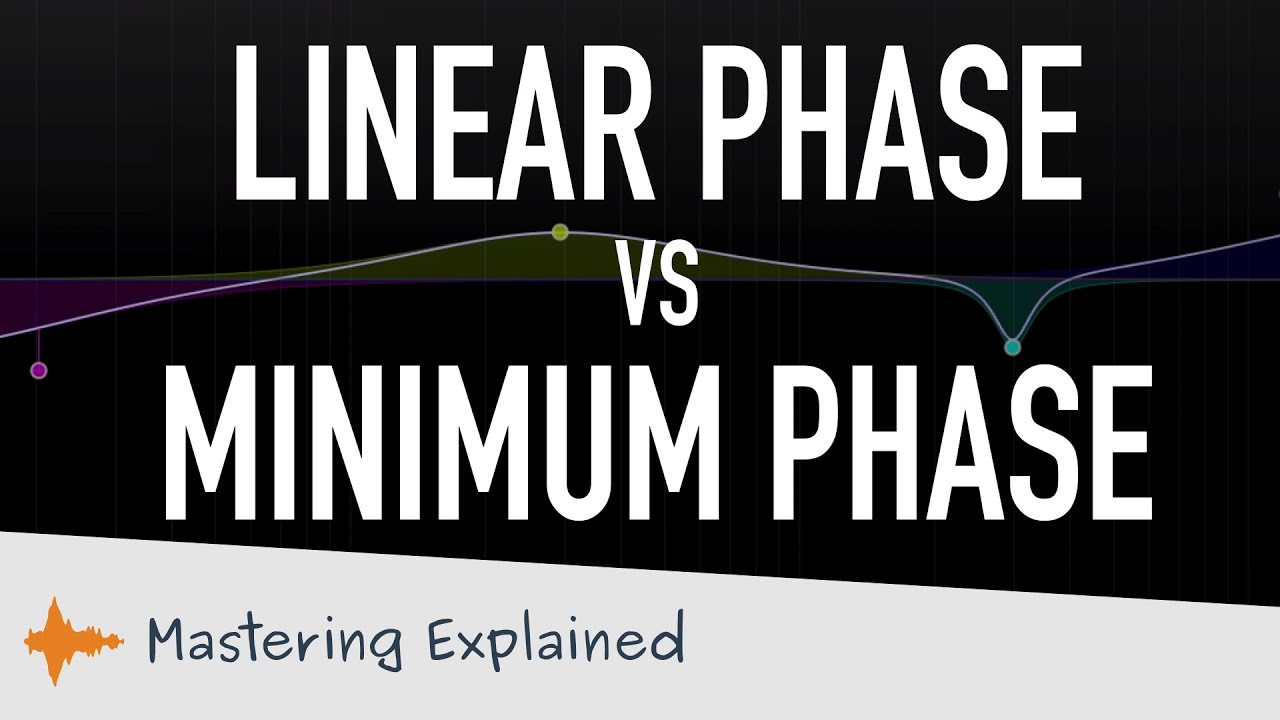
For mastering, minimum phase EQ is the better default. Linear phase EQ is worth reaching for only when you're working with multi-miked sources or making corrective cuts where phase coherence between tracks genuinely matters.
Minimum phase EQ wins most mastering sessions. Not because linear phase is bad, but because the scenarios where it actually outperforms minimum phase are narrower than the marketing suggests.
We've mixed this up ourselves. Early in our mastering work, we defaulted to linear phase on everything because we'd read it was "more transparent." Then we listened back on a second system and heard the pre-ringing on a boosted low shelf. That was the moment we stopped treating linear phase as a default and started treating it as a tool.
Here's the full picture: what each mode actually does to your signal, when the difference is audible, when it isn't, and which plugins handle each approach well. No hype. No oversimplification.
What Does Phase Actually Mean in an EQ?
Every EQ filter changes amplitude. What varies is whether it also changes the timing relationship between frequencies.
A minimum phase EQ delays only the frequencies it's actively processing. If you're boosting 8kHz, the signal around 8kHz arrives slightly later than the low end. That's phase shift. It's a byproduct of the filter math, and it's been part of recorded audio since the first console EQ was built.
A linear phase EQ applies the same delay to all frequencies. The result is that the frequency response change is identical to minimum phase, but no frequency arrives earlier or later relative to any other. The filter is, in technical terms, zero-phase. The trade-off is that it needs looser frequency resolution to achieve this, which introduces pre-ringing: artifacts that appear before a transient rather than after it.
Pre-ringing is the core problem. Post-ringing is what reverb does. We're wired to accept it. Pre-ringing sounds wrong because it violates causality. You hear a smear before the kick hits. It's subtle at small gain values. It becomes obvious fast when you push the filter hard.
The Math Behind the Latency
Linear phase EQs buffer incoming audio, process it, then output it. That buffer creates latency. In FabFilter Pro-Q 3, at 44.1kHz, the latency numbers are: Low mode adds roughly 70ms, Medium adds around 116ms, High around 209ms, and Very High reaches approximately 395ms.
At Very High, that's nearly half a second of added delay. In a mastering session bouncing a final file, that's fine. In a session where you're monitoring through the chain in real time, that's frustrating enough to make you want to throw the plugin away.
Minimum phase EQ adds effectively zero latency. For mixing and tracking, that alone makes it the clear choice.
When Does Minimum Phase EQ Sound Better?
Honestly? Most of the time in mastering.
When you're making broad, gentle moves on a stereo bus, the phase shift from a minimum phase EQ is negligible. A 1.5dB shelf at 10kHz with a typical slope introduces phase rotation that's inaudible on any monitoring system outside an anechoic chamber. The mastering engineers who've worked this way for decades aren't making a mistake.
We ran a session where we applied a +2dB low shelf at 80Hz to a finished pop mix using in minimum phase mode. Then we duplicated the move in linear phase at High quality. We blind-tested both against the unprocessed version.
We couldn't reliably tell them apart. Neither could the three producers we had listen. The boost was identical in frequency response. The phase difference was there in the analyzer, but it wasn't audible at that setting.
Minimum phase also colours slightly. That sounds like an insult. It's not. The phase shift interacts with harmonics and transients in a way that many engineers describe as "musical." That's not a vague word here. It means the attack of a transient can be subtly sharpened by the filter's phase response. Some engineers love that behaviour. We use it on purpose.
Coloration as a Feature
Hardware EQs are minimum phase, almost without exception. The Neve 1073 shelf, the API 550, the Pultec EQP-1A. All minimum phase. Nobody calls them broken.
That "warmth" in a Pultec low-end boost? Part of it is the simultaneous boost-and-cut interaction. Part of it is the phase behaviour of the inductors. Minimum phase isn't a compromise. It's part of the sound.
When Does Linear Phase EQ Actually Win?
Three scenarios where we'd reach for it without hesitation.
Multi-miked sources. Drums recorded with a close mic, overhead, and room mic. A piano with two positions. Any source where multiple mics are blended. If you EQ one track with minimum phase and it alters the timing relationship between it and the adjacent mics, you can get comb filtering. Linear phase keeps the arrival times intact. This is the legitimate use case.
Mid/side processing on already-aligned stems. If a client sends stems for mastering and you're doing MS work, linear phase keeps the mid and side signals time-aligned after processing. Minimum phase on a stereo signal applies slightly different phase responses to any asymmetry in the signal. It's usually inaudible. But if the client is picky and you want zero risk, linear phase is the safer call.
Steep corrective cuts. A 12dB notch at 60Hz to remove a hum. A surgical cut at 200Hz to remove room buildup. When the filter is narrow and the gain change is large, the phase shift from a minimum phase filter becomes more significant. We've heard the difference here on single-instrument sources. Linear phase keeps the sound more intact around the cut frequency.
The Pre-Ringing Threshold
Pre-ringing becomes audible in practical use around these settings: boosts above 6-8dB, Q values above 4-5, on material with sharp transients in the boosted frequency range. Below those thresholds, most engineers won't hear it on typical mastering material.
We pushed a Pro-Q 3 linear phase bell boost to 20dB at 3kHz with a Q of 15 on a snare hit. The pre-ringing was ugly and obvious. Nobody is doing that in mastering. But the point stands: pre-ringing scales with aggressiveness. Stay gentle, stay safe.
Which Plugins Handle This Best?
FabFilter Pro-Q 3 is the standard for flexible switching. You can set each band independently to linear phase, minimum phase, or zero latency mode. That's brilliant design. One plugin, full control, per band. It's what we use on most mastering sessions.
The Weiss EQ1-LP is the hardware reference. It's in mastering studios worldwide and it's built around linear phase processing specifically. The plugin version (by Softube) brings that sound into DAWs. Check the manufacturer's site for current pricing. It's not cheap, but if linear phase mastering EQ is your primary use case, it's the target.
DDMF LP10 is worth knowing. Despite the "LP" in the name, users and engineers often report preferring it in minimum phase mode for musical results. Clever that a plugin named for linear phase gets praised for its minimum phase behaviour. Check current pricing at ddmf.eu.
For those working in Ableton Live: Live has no native linear phase EQ. You'll need a third-party plugin. Pro-Q 3 or the Waves Linear Phase EQ are the standard solutions. Waves Linear Phase EQ is purpose-built for this, with less flexible band options but a clean workflow for dedicated linear phase use.
If you want to go deep on phase analysis in your sessions, iZotope Insight 2 gives you real-time phase correlation metering that makes the difference between mode choices visible. For purely academic understanding of filter math, the DSP Guide by Steven Smith is the free online text we'd point anyone to who wants to go past surface-level explanations.
Worth Bookmarking
- FabFilter Pro-Q 3, per-band linear/minimum phase switching, industry standard
- Softube Weiss EQ1-LP, plugin version of the mastering studio reference
- DDMF LP10, underrated, worth trying in both modes
- Waves Linear Phase EQ, solid Ableton workaround, purpose-built
- iZotope Ozone, EQ module offers linear/minimum phase switching in a full mastering chain
- The DSP Guide (free), deep filter theory, free online
- iZotope Insight 2, phase correlation metering to hear what the mode switch actually does
How to Actually A/B Test This in Your Session
Here's the methodology we use. It takes about ten minutes and it tells you everything.
Set up two parallel tracks. Send the same source to both. On track one, apply your EQ in minimum phase. On track two, apply an identical EQ curve in linear phase at High or Very High quality. Match the output levels with a gain plugin post-EQ. Keep them within 0.1dB of each other. Level differences will fool your ears every time.
Now blind-toggle between them. Don't look at which track is active. If you can't tell them apart in the first five seconds, you can't tell them apart. Use minimum phase. You're done.
If you can hear a difference, ask yourself which sounds better on the material in front of you. Not which sounds "more correct." Which serves the mix.
We ran this test on a mastering session for a sparse acoustic recording. Guitar, vocal, upright bass. No drums. The linear phase version on a gentle 2dB air boost at 12kHz sounded cleaner on the guitar attack. The minimum phase version had a slightly more present quality in the same region. We used minimum phase. It sat better in the context of the track.
That's what the test gives you: an actual answer, not a theory.
The CPU Reality
Linear phase processing costs more CPU than minimum phase. At Very High quality in Pro-Q 3, the difference is roughly 3x the CPU load compared to zero-latency mode, depending on band count. On a mastering session with a handful of plugins, this is rarely a problem. On a mixing session with 40 channels, it becomes annoying fast.
Use minimum phase during mixing. Switch to linear phase on the mastering bus only if your A/B test tells you it's worth it.
The Marketing Problem
Linear phase EQ got oversold. Heavily. The pitch was: minimum phase shifts the phase, therefore it's inferior for mastering. Buy our linear phase plugin instead.
That logic is flawed. Phase shift from gentle, broad EQ moves is not audible in a mastering context in most cases. The mastering engineers who built the records you love worked on hardware minimum phase EQs for decades. The results speak for themselves.
Linear phase isn't a lie. It's a real tool with real advantages in specific situations. The lie is the implication that you need it for every mastering session.
Our position: default to minimum phase. Use linear phase when you have a phase-critical reason, not a marketing reason.
Summary
Minimum phase EQ is the right default for mastering. It's what hardware units use. It's what most mastering engineers use. The phase shift from gentle, broad moves is inaudible in practice.
Linear phase EQ earns its place on multi-miked sources, steep corrective cuts, and MS processing where phase coherence is genuinely at risk. The latency cost and pre-ringing risk are real. Use it when you have a reason.
FabFilter Pro-Q 3 handles both modes with per-band control. Run the A/B test. Let your ears decide, not the plugin name.
Frequently Asked Questions
Does linear phase EQ actually sound better for mastering?
Not automatically. On gentle, broad moves, most engineers can't hear a difference in a blind test. Linear phase sounds cleaner on specific tasks like steep corrective cuts and multi-miked material. For typical mastering sweetening, minimum phase is just as good and avoids the pre-ringing risk.
What is pre-ringing and when does it become a problem?
Pre-ringing is an artifact that appears before a transient, caused by the buffering math in linear phase filters. It becomes audible when you push boosts above roughly 6-8dB with narrow Q values on material with sharp transients. At gentle mastering settings, it's not a practical concern for most sources.
Can I use linear phase EQ in Ableton Live?
Ableton Live has no native linear phase EQ. You'll need a third-party plugin. FabFilter Pro-Q 3 and Waves Linear Phase EQ both work well inside Live. Keep in mind the latency these add. Ableton will compensate for it automatically in bounced exports, but monitoring through the chain in real time will feel slow.
Is FabFilter Pro-Q 3 linear phase mode worth using?
Yes, when you need it. The per-band mode switching is the smartest implementation we've seen. You can keep drums in linear phase mode for phase coherence and use minimum phase on everything else in the same instance. At Low or Medium quality, the latency is manageable and the pre-ringing stays below audible thresholds for most mastering moves.
Do hardware mastering EQs use linear phase?
Almost none of the classic hardware mastering EQs are linear phase. The Neve, API, Pultec, and SSL units are all minimum phase by design. The Weiss EQ1-LP is the well-known exception built specifically for linear phase mastering. The fact that minimum phase hardware built most of the records in your collection should tell you something about the necessity argument.