
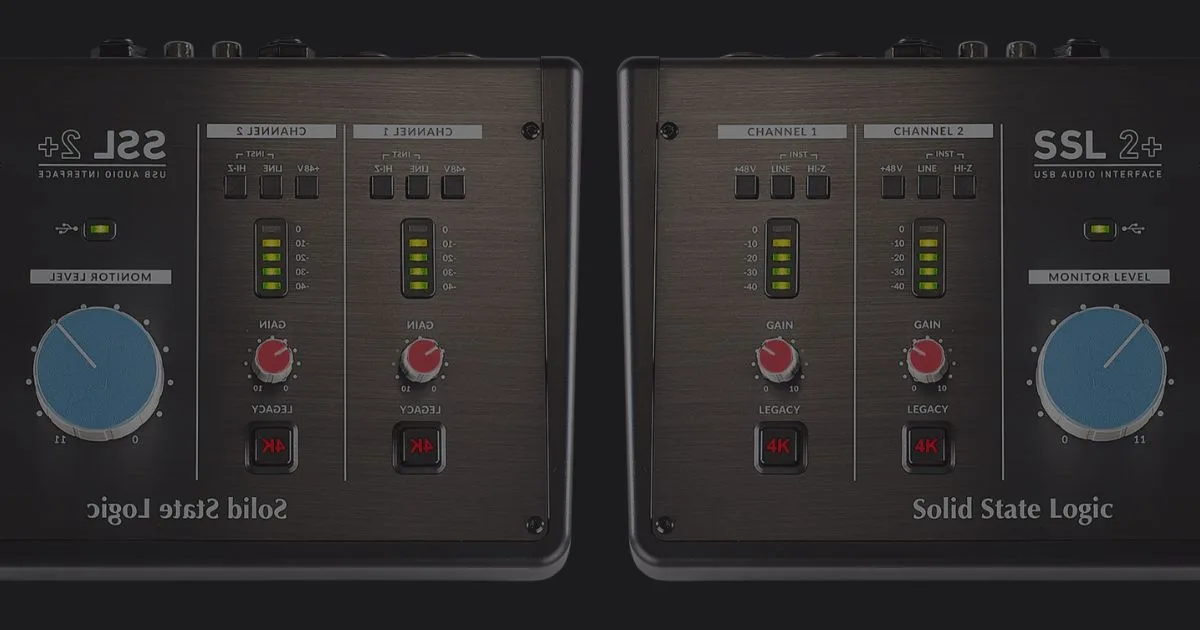
A preamp takes the weak electrical signal from a microphone or instrument and amplifies it to line level, the standard operating voltage for mixers, audio interfaces, and recording equipment. Without that gain stage, your signal is too quiet to record cleanly, and everything downstream in your signal chain works harder, adding noise.
Every recording starts with a preamp. Not a compressor. Not an EQ. Not a plugin. A preamp. It's the first thing your signal hits, and that first contact shapes everything that follows.
Most producers never think about preamps until something sounds wrong. A ribbon mic recording that comes back thin and noisy. A vocal that sits fine in the mix but never quite cuts. A drum room that sounds smaller than it felt in the session. The preamp is usually the culprit, or the fix.
We've spent time with everything from basic interface preamps to outboard units pushing $3,000 a channel. Here's what we've learned about what a preamp actually does, when yours is holding you back, and when it's fine to leave it alone.
What Does a Preamp Actually Do to Your Signal?
A microphone outputs a signal in the range of -60 dBu to -20 dBu depending on the source loudness and the mic type. Line level equipment expects signals around +4 dBu (professional standard) or -10 dBV (consumer standard).
That's a gap of anywhere from 24 dB to 60 dB of gain. Sometimes more.
The preamp closes that gap. It takes your mic-level signal and amplifies it cleanly, or not so cleanly if that's what you're after, up to a voltage that your interface, mixer, or recorder can work with properly.
Without that amplification, you'd crank your interface input until the signal is audible. But at that point you're amplifying the noise floor of the circuit itself. The result is a recording that sounds veiled and hissy, even before any processing.
The Gain Math That Actually Matters
Most built-in audio interface preamps top out at around 60 dB of gain. That's enough for a loud dynamic mic on a screaming guitar cab, but it's not enough for everything.
A passive ribbon mic can have a sensitivity as low as -52 dBu at high SPL, and much lower on quiet sources. Getting that to +4 dBu requires 56 dB minimum, with no headroom to spare. Push it to a quiet room recording and you're looking at 70 dB or more.
The Heritage Audio 1084 provides up to 80 dB gain. AEA's ribbon-optimised preamps like the R-Pre reach 81+ dB. Those numbers exist for a reason.
Your interface maxing out at 60 dB, plus its own noise floor kicking in above 50 dB, is why your ribbon recordings sound the way they do.
Why Does Impedance Matching Matter?
Impedance is the friction that electrical signals encounter moving through a circuit. Microphones have output impedances typically between 50 and 200 ohms. Your preamp's input impedance needs to be significantly higher than that, or you start losing signal and warping your frequency response.
The standard rule is a 10:1 ratio minimum. A 150-ohm mic wants to see at least 1,500 ohms at the preamp input. Most professional preamps sit between 1k and 10k ohms, which keeps the mic comfortable and the signal intact.
Passive ribbon mics are sensitive to this. We ran a Royer R-121 into a low-impedance preamp input once, a borrowed budget unit with an input impedance of around 600 ohms. The high end above 10 kHz lost around 3 dB of air, and the low-mids thickened up in a way that wasn't flattering. Swapping to an API 512c at 2k ohms brought the ribbon back to life. Same mic, same placement, same room. The preamp impedance was the only variable.
AEA designs some of their preamps with input impedances between 10k and 68k ohms specifically to interact with ribbon motors differently. Higher impedance changes the damping factor on the ribbon element itself, affecting transient response and the low-frequency character.
Active vs. Passive DIs and Instrument Impedance
The same impedance logic applies to direct input signals. A passive electric guitar pickup has an output impedance that can reach 10k–30k ohms. Plugging that directly into a standard mic preamp input (1k–2k ohms) loads the pickup, rolling off treble and killing dynamics.
A DI box converts the high-impedance instrument signal to a low-impedance balanced signal the preamp can accept. Active DIs do this with a powered buffer. Passive DIs use a transformer. Both solve the same problem: letting your preamp see the signal correctly.
Does Circuit Topology Change How Your Recordings Sound?
Yes. Significantly. This is where preamps stop being utility and start being instruments.
Preamp circuits fall into four broad categories: solid-state discrete, tube (valve), transformer-coupled, and op-amp based. Each behaves differently under gain, and that behaviour shapes your recordings before any plugin touches them.
Solid-State Discrete Preamps
Designs like the API 312, the Grace Design m101, and the Neve 1073 (transformer-coupled discrete) sit in this territory. Clean solid-state preamps can measure near-perfect THD figures below 0.01%, meaning they're adding almost nothing of their own character.
That transparency is useful on sources you want to capture accurately: acoustic guitar, orchestral recordings, dialogue, anything where the room and the mic should do the talking.
The Grace m101 is genuinely one of the most transparent preamps we've used under $1,000. It's almost annoyingly clean. You hear exactly what the mic hears, which is the point.
Tube Preamps
Tubes compress and saturate differently to transistors. When you push a tube circuit, it generates mostly second and third harmonic distortion. The second harmonic sits an octave above the fundamental. Your ear interprets this as added warmth and body rather than distortion.
That warmth is measurable: a pushed tube preamp adds harmonic content between 2 and 4 kHz that wasn't in the original signal, and often a soft saturation that compresses transient peaks by 1-3 dB at high gain settings without sounding like clipping.
The Universal Audio 610 and the Warm Audio WA-12 are good examples at different price points. On vocals with a U87-style condenser, the 610 adds a density in the 200–500 Hz region that can save you from reaching for a low-mid boost in the mix.
Transformer-Coupled Preamps
Transformers are physical components wound from wire and iron. They affect the signal in ways that simulate well: they saturate gently at high levels, they add a subtle emphasis around 100–200 Hz from their inductance, and they can soften very high frequencies above 15 kHz slightly.
The Neve 1073 is the industry example everyone cites, and for good reason. It's appeared on more professional recordings than any other single piece of outboard hardware. The transformer saturation at high gain settings has a character that plugins have spent decades trying to capture accurately.
We ran a kick drum through a 1073 clone at around 50 dB gain. The transient stayed intact but the impact in the 60–80 Hz range thickened up by what felt like 2 dB without touching the EQ section. That's the transformer doing its thing.
How Do You Know When Your Preamp's Noise Floor Is the Problem?
Every preamp adds noise. The question is how much.
The measurement used is Equivalent Input Noise, or EIN. A good benchmark is -127 dBu. Anything above -125 dBu is mediocre territory for studio use. The physical limit of a 150-ohm source at room temperature is around -129.5 dBu, so there's a narrow window between "excellent" and "the laws of physics".
Budget interface preamps often measure around -120 to -122 dBu EIN. That's a 5–7 dB noise penalty compared to a quality external preamp. On a loud electric guitar it doesn't matter. On a quiet acoustic guitar at 50 dB gain, it matters a lot.
The practical test: record 30 seconds of silence with your mic plugged in, gain at 50 dB, nothing moving. Zoom in on the waveform in your DAW. The noise floor you see is your preamp's floor at that gain setting. If it's above -80 dBFS, you're going to hear it behind quiet passages.
When to Upgrade vs. When to Leave It Alone
We'd say this plainly: if you're using a Focusrite Scarlett or Universal Audio Volt as your only interface, you don't need an external preamp for most work. Those preamps measure around -128 dBu EIN on recent generation hardware. That's competitive with outboard units at several times the price.
The reason to buy an external preamp is character, not necessarily quality. You want a specific colour. You need higher gain for ribbons. You're tracking multiple sources simultaneously and your interface runs out of inputs.
If you're recording ribbons or low-output condensers and need above 60 dB of clean gain, look at the Cloudlifter CL-1 first ($149). It adds 25 dB of inline gain using phantom power before the signal even reaches your interface preamp. Not ideal, but it solves the gain problem at a fraction of the cost of outboard hardware.
Worth Bookmarking
- Gearslutz (Gearspace) Geekslutz Forum, technical preamp discussions with measurement data and shootout threads that go deep on circuit topology
- Audio Science Review, independent measurements of preamp noise floors, THD, and frequency response; useful for cutting through marketing claims
- RecordingHacks, mic and preamp pairing database with community testing notes
- Sweetwater InSync, technical explainers on gain staging and signal chain concepts, regularly updated
- AEA Ribbon Mics Learning Hub, the best freely available resource on ribbon mic impedance loading and preamp pairing, written by engineers who've been doing this for decades
What's the Difference Between a Mic Preamp and a Phono Preamp?
Different job. Same name. Frustrating.
A phono preamp is built for turntables. It does two things: it amplifies the extremely low output of a phono cartridge (typically 0.2–5 mV, far weaker than a microphone), and it applies the RIAA equalisation curve in reverse to flatten out the intentional EQ built into vinyl records during cutting.
Vinyl is cut with bass reduced and treble boosted to fit more music per side and manage groove width. The phono preamp adds back the RIAA correction curve: a bass boost of around +20 dB below 50 Hz and a treble cut above 2 kHz. Without that correction, records sound thin and scratchy.
A studio mic preamp doesn't apply any EQ correction. It amplifies linearly across the frequency range. Running a turntable into a mic preamp gives you a loud, scratchy, bass-thin disaster. Running a microphone into a phono preamp is equally wrong.
If you're setting up a vinyl rig, check whether your audio interface or stereo receiver has a dedicated phono input before buying a standalone unit. Most modern interfaces don't include one.
Summary
A preamp amplifies your microphone or instrument signal to line level, which every piece of downstream equipment in your signal chain needs to work properly. It also handles impedance matching, keeping frequency response intact and preventing signal loss between your mic and your gear. Beyond pure gain, preamp circuit design shapes tonal character. Tube circuits add harmonic density and soft saturation. Transformer-coupled designs thicken the low-mids and have subtle high-frequency rounding. Clean solid-state and op-amp designs get out of the way. Your interface preamp is probably fine. Buy an external one when you need more gain, a specific sound, or more channels.
Frequently Asked Questions
Do I need a preamp if I already have an audio interface?
Your audio interface already has preamps built in. Whether you need an external one depends on two things: how much gain you need and what sound you want. Modern interfaces like the Focusrite Scarlett 4th gen measure around -128 dBu EIN, which is excellent for most work. Buy external preamps when you're recording low-output ribbon mics, want a specific tonal character like a transformer-coupled Neve sound, or need more simultaneous inputs than your interface provides.
How much gain do I actually need from a preamp?
Dynamic microphones on loud sources (kick drum, guitar cab) typically need 40–50 dB of gain. Condenser mics on vocals usually need 30–50 dB. Passive ribbon mics on quiet sources can need 65–75 dB. If your interface preamp tops out at 60 dB and your ribbons sound noisy and thin, that's the problem. Either get an external preamp with higher headroom or add an inline booster like the Cloudlifter CL-1.
What does "preamp colour" mean in practical terms?
Colour means the preamp adds its own character to the signal rather than passing it through unchanged. In measurable terms: a tube preamp pushed to 50 dB gain typically generates second and third harmonic distortion between 0.1–1% THD, adding warmth in the 200–500 Hz range. A transformer-coupled design like the Neve 1073 adds subtle saturation at high gain settings and a slight low-mid emphasis from the transformer's inductance. Transparent solid-state preamps like the Grace m101 measure below 0.005% THD at normal gain settings.
Can a bad preamp ruin a good microphone recording?
Yes. We've heard a Neumann U87 sound mediocre through a preamp with a noisy input stage and inadequate gain. The same mic through a quality preamp sounded like a completely different piece of equipment. The microphone is only as good as the first active gain stage it hits. A preamp with poor noise performance, incorrect impedance loading, or inadequate gain headroom will compromise even an excellent microphone's output.
What's the difference between a preamp and a channel strip?
A channel strip is a preamp plus additional processing in a single unit. That additional processing typically includes EQ, sometimes compression, sometimes a high-pass filter and a phase switch. The Neve 1073 is technically a channel strip because it includes EQ alongside the preamp. Channel strips are useful when you want to process the signal before it hits your interface, printing EQ and compression decisions to tape or to disk. A standalone preamp does gain and impedance matching only.
Why does my preamp sound different at high gain settings?
Every preamp changes character as gain increases, some more than others. Tube circuits saturate progressively, generating more harmonic content above 50 dB of gain. Transformer-coupled designs begin to saturate the transformer core, adding gentle compression and harmonic colouration. Even clean solid-state preamps show slightly higher noise floors and sometimes frequency response shifts at maximum gain settings. If your preamp sounds "veiled" or "compressed" above 60 dB, that's the circuit reaching its limits, not a fault. It's a design characteristic.