
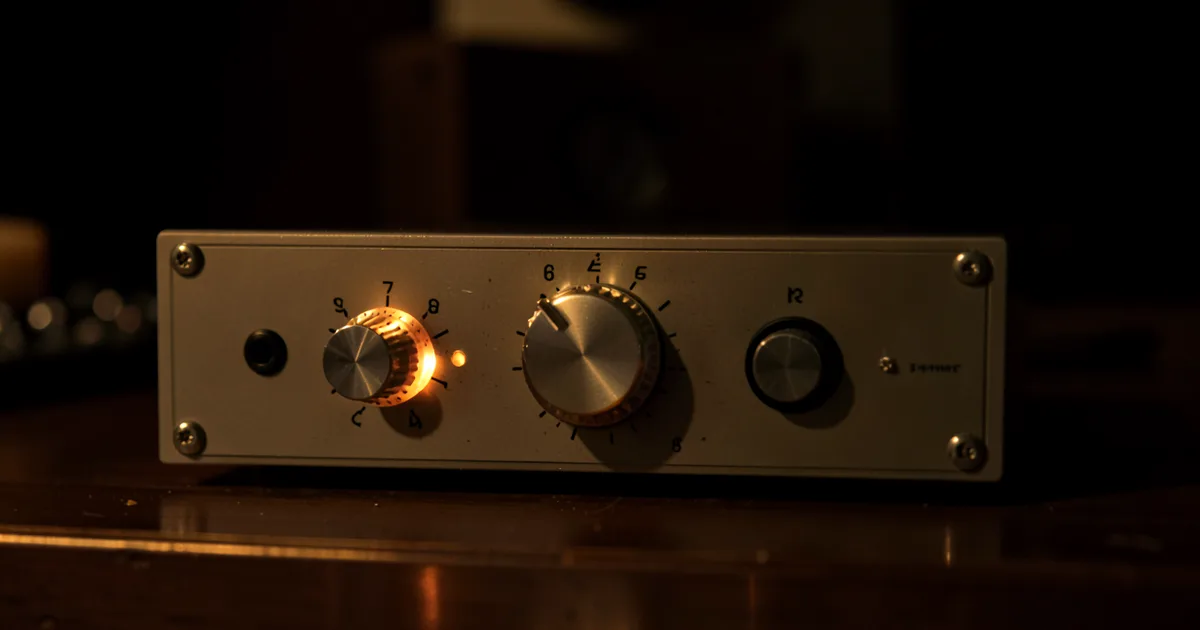
A preamp amplifies your microphone's weak signal (mic level, around -60dBu) up to a usable line level (around +4dBu) so your audio interface or recorder can capture it cleanly. The preamp you choose shapes the tone before anything else in your signal chain touches it, so getting this decision right matters more than most producers realise.
Every sound you record passes through a preamp first. Before the EQ, before the compressor, before the plugin chain, the preamp is where the signal either gets a clean lift or picks up character it'll carry forever into the mix.
Most producers treat preamps as an afterthought. They buy a mic, plug it into their interface's built-in preamp, and move on. That works fine at the start. But as your ears develop, you start hearing what you're missing: a certain weight on low-mids, a presence bump that makes vocals cut without touching EQ, or the opposite, a coloration that fights you every time you try to clean up a recording.
This guide covers how preamps work, what the technology differences mean in practice, how to match a preamp to a source, and where to spend your money at each budget level. We'll also be straight about what a preamp can't fix, and where your money goes further elsewhere.
What Does a Preamp Actually Do?
A microphone outputs a very low-voltage signal. Dynamic mics typically sit between -60dBu and -40dBu. Ribbon mics run even lower. That signal is too weak for a converter or recorder to capture with any useful signal-to-noise ratio.
The preamp applies gain, usually between 20dB and 70dB depending on the source and mic type, bringing that signal up to line level (+4dBu in professional environments, -10dBV in consumer gear). That's the job. Amplify without adding noise, and ideally without adding anything you don't want.
What varies between preamps is how they do that amplification, and what they add along the way.
Gain, Headroom, and Noise Floor
The noise floor is the baseline hiss every preamp produces. A good studio preamp sits below -90dBu equivalent input noise (EIN). A great one hits -130dBu EIN or lower. The difference matters when you're recording quiet sources: acoustic guitar, ribbon mics on brass, room ambience.
Headroom is the space between your nominal signal level and where the preamp clips. More headroom means more safety when a drummer hits harder than expected. Less headroom means character: some engineers push a preamp into light saturation deliberately to add harmonic content.
These two numbers, noise floor and headroom, are the honest technical spec sheet for any preamp. Everything else is tone.
Tube vs. Solid-State: What's the Real Difference?
This is the question every preamp conversation eventually lands on. Here's the straight answer.
Tube preamps distort in even-order harmonics. When a tube is pushed, it adds second and fourth harmonics predominantly. Those harmonics are musically related to the fundamental, which means the distortion sounds pleasing. The result is what most people call "warm", specifically, an emphasis in the 200-400Hz region combined with a subtle rounding of transients and a bloom on sustained notes.
Solid-state preamps distort in odd-order harmonics. Pushed hard, they add third and fifth harmonics, which are less musically related to the fundamental. Clean solid-state sounds transparent because it adds almost no harmonic content at normal operating levels. Pushed, it can sound harsh.
This is why "tubes sound warm" is a real statement, not audiophile mysticism. It's measurable. An even-order harmonic at -40dB below the fundamental changes the perceived tonality of a voice without you consciously hearing distortion.
Transformer vs. Transformerless Solid-State
Transformer-coupled solid-state preamps add their own character. Transformers saturate at low frequencies, adding a slight low-mid density. They also interact with the source impedance, which affects how a dynamic or ribbon mic responds. Classic Neve designs (the 1073 is the reference point here) use transformer coupling, which is a big part of why they sound different from modern transformerless designs.
Transformerless solid-state is the cleanest circuit path available. Preamps like the Grace Design m101 or the API 512c in transformer-coupled versus transformer-out modes illustrate this difference directly. Transformerless is what broadcast facilities and post-production houses often prefer: no colouration, maximum headroom, easy to drive into a clean converter.
Hybrid Preamps: The Underrated Middle Ground
Hybrid designs run a tube gain stage into a solid-state output section, or vice versa. The tube adds harmonic complexity at the input stage while the solid-state output stays clean and low-impedance, able to drive long cable runs without degradation.
The Manley CORE is a good example at the high end. At the budget end, the ART TubeMP (under $100) is a hybrid in theory, though the tube is running at such low voltage in that circuit that it contributes very little character. We've tested it. The tube is mostly decoration. That's fine at the price point, it still does the job, but don't buy it expecting tube saturation.
Which Preamp Colour Suits Which Source?
This is the gap most guides skip. "Choose based on your sound" is useless advice. Here's something you can actually use.
Vocals
Bright, airy voices with a lot of upper-mid presence often work better through a transformer-coupled solid-state or neutral preamp. Adding more harmonic content to a voice that's already forward can make it fatiguing over a full song.
Darker or thinner voices, especially baritones, certain female mid-range vocals, or any voice that disappears in a dense mix, often benefit from tube coloration. That even-order harmonic bloom at 200-400Hz gives the voice weight without EQ boost, which tends to sound more natural.
We put a baritone vocal through a UA 610 (tube-based, modelled on the Universal Audio 610 console) and compared it to the same vocal through an SSL-style solid-state preamp. The tube version needed 3dB less low-mid EQ boost to sit in the same mix position. That's not subjective. That's gain structure and harmonic content doing the work.
Drums
Overhead mics and room mics love transparency. A clean preamp, Focusrite ISA, Grace m101, API 512c, captures the real-room transient without smearing it. For kick and snare close mics, some engineers push for transformer saturation on the transient, which can add perceived punch to a kick drum without touching a transient shaper plugin.
For a full drum kit, you need multiple preamp channels simultaneously. The Focusrite Scarlett OctoPre at around $500 gives you 8 channels of clean, competent preamps. The Behringer ADA8200, under $200, gives you 8 channels that get the job done, we'd call it frustrating at high gain settings due to elevated noise floor, but for drums recorded at healthy levels it's serviceable. Don't expect magic. Expect adequate.
Guitars and Bass
Direct bass and guitar (DI into a preamp) responds well to transformer-coupled designs that add low-mid density. It makes a DI bass sound less sterile. For acoustic guitar with a mic, the same rules as vocals apply: match the source character.
Overdriven amp recordings are less sensitive to preamp character because the amp is already adding so much harmonic content. A clean preamp captures the amp honestly. A coloured preamp adds more to an already complex signal, which can work or can cloud things depending on the arrangement.
What Should You Spend? Budget Tiers Explained
Here's where we take a position: most producers spending under $500 on a dedicated preamp are making a mistake if they haven't already sorted their room and microphone. A $3,000 preamp in a reverberant bedroom with a $100 mic will sound worse than a $500 preamp in a treated room with a $500 mic. That's not an opinion. It's physics.
Under $200: Use Your Interface
The built-in preamps on a Focusrite Scarlett 4th Gen, Apollo Solo, or SSL 2 are clean enough that you won't be losing sessions to preamp quality at this budget. The Behringer ADA8200 sits here for multi-channel needs. It's ugly on the inside spec sheet, higher noise floor than anything above it, but it's not losing you a gig.
$200 to $500: First Worthwhile Upgrade
The Focusrite ISA One ($500 street, check manufacturer site for current pricing) is our first genuine recommendation. It uses transformer coupling inherited from the original Neve designs, sounds significantly more musical on vocals than the Scarlett preamps, and has an instrument DI input. At this level, you're buying real sonic character for the first time.
$500 to $1,500: Where It Gets Satisfying
This is the range we love. The API 512c, the Universal Audio 610, the Warm Audio WA73-EQ (a Neve 1073 clone at a fraction of the price). These preamps have real transformer-based designs, enough gain for ribbon mics, and enough character to change a vocal take from "recorded" to "produced."
The Warm Audio WA73-EQ in particular is underrated at its price. We've run ribbon mic vocals through it and compared directly to an original Neve 1073. The difference exists but it's subtle. For most home studio applications, the Warm Audio is brilliant value.
$1,500 to $3,500: Professional Tools
The Benchmark LA4 (check manufacturer site for current pricing) is a reference-class transparent preamp with specs that match or beat most of the market. The Audio-GD Vacuum HE1 XLR balanced runs around $3,999 and sits at the top of the tube preamp tier. These are tools you buy once and build around.
At this level, the differences are real but narrowing. You're paying for noise floor, for build quality that survives touring, and for resale value that holds. The Benchmark LA4 won't excite you the first time you hear it, there's nothing added, which is the point. Record through it for a year and compare to anything else. That's when transparent becomes satisfying.
Tube Maintenance: The Real Cost of Ownership
This is almost never covered. A tube preamp isn't a one-time purchase. Tubes cost $20-30 each and last 3-5 years under regular use. A full retube on a unit with multiple tube stages runs $100-200 in parts, plus $50-100 for professional biasing if you're not comfortable doing it yourself. Budget $50/year for tube ownership on an average unit. That's not a reason to avoid tube preamps, it's a reason to factor it in honestly.
Worth Bookmarking
- Gearspace (formerly Gearslutz), the best forum thread archive for real-world preamp comparisons and shootout recordings
- Sweetwater, spec sheets, user reviews, and tech support chat that actually knows signal chain
- Hairball Audio, DIY preamp kits based on classic designs, excellent for understanding what's inside the box
- Recording Revolution, practical tutorials on gain staging and preamp use in context
- Benchmark Media, white papers on preamp noise floor and EIN measurements, properly technical
- Warm Audio, transformer-coupled clones with published specs, good reference for comparing to vintage originals
What a Preamp Can't Fix
Bad room acoustics. A poor mic-to-source distance choice. A microphone that doesn't suit the source. These problems sit upstream of the preamp. No amount of harmonic coloration fixes a vocal recorded in a reflective kitchen with a large-diaphragm condenser 18 inches from the mouth.
The signal chain order matters: room, mic placement, mic choice, then preamp. Spend in that order too.
Summary
A preamp's job is amplification. Its personality is what you're buying. Tube preamps add even-order harmonics that add weight and warmth, measurable, not mystical. Solid-state preamps keep the signal clean or add odd-order character when pushed. Transformer coupling adds low-mid density. Transformerless stays out of the way.
Match the preamp character to the source. Spend under $200 on room treatment before spending on an external preamp. Budget for tube maintenance if you go that route. And remember: the best preamp for your vocal is the one that makes you reach for the bypass button less.
Part of our complete Studio Signal Chain Guide: Build a Clean Audio Path series.
Frequently Asked Questions
Do I need an external preamp if I have an audio interface?
Not at first. Modern interfaces from Focusrite, SSL, and Universal Audio have preamps that are clean and capable enough for professional results. An external preamp becomes worth considering when you want specific tonal character that your interface can't provide, or when you're tracking ribbon mics that need high-gain, low-noise amplification beyond what budget interface preamps offer.
What is phantom power and do all preamps have it?
Phantom power is a 48V DC supply sent through the mic cable to power condenser microphones. Most preamps and audio interfaces include it, but not all. Ribbon mics don't need it and some older designs can be damaged by it, so check your mic spec sheet before engaging phantom power. Passive dynamic mics are unaffected by it either way.
How much gain do I need from a preamp?
Dynamic mics typically need 50-60dB of gain. Ribbon mics often need 60-70dB, sometimes more. Condenser mics are more sensitive and usually need 40-55dB. A preamp with a maximum gain of 65-70dB covers almost every scenario. If you're buying specifically for ribbon mics, prioritise high gain and low noise floor.
What does impedance matching mean for preamps?
Impedance affects how a microphone's internal components interact with the preamp's input circuit. A ribbon mic with an output impedance of 150 ohms connected to a preamp input of 600 ohms versus 1500 ohms will produce a different frequency response and transient character. Some preamps have switchable input impedance specifically to exploit this. It's a tonal tool, not just a technical spec.
Is a tube preamp worth the maintenance cost?
For regular studio use, yes. Budget $20-30 per tube for replacement every 3-5 years, plus professional biasing costs of $50-100 if needed. The total cost of ownership over a decade is manageable compared to the tonal benefits. The annoying part is that tube quality varies between production batches, so finding a tube brand that works for your specific preamp sometimes takes experimentation.
Can I use a preamp with a USB microphone?
No, not directly. USB microphones have their own built-in preamp and converter inside the mic body. They connect directly to your computer and bypass any external preamp entirely. If you want to use an external preamp, you need an XLR microphone connected to an audio interface.
What's the difference between a preamp and a channel strip?
A channel strip adds EQ and compression to the preamp signal path in a single unit. Classic examples include the Neve 1073 (preamp plus EQ) and the SSL 4000 channel (preamp, EQ, and dynamics). A standalone preamp does amplification only. Channel strips are excellent for recording because you're shaping the sound before it hits the converter, which can reduce later processing needs.
How do I know if my preamp is clipping?
Most preamps have an LED clip indicator that lights when the signal exceeds headroom. Without metering, listen for harsh distortion that doesn't sound musical, different from the soft saturation of a tube being pushed gently. In your DAW, watch the input level meter and keep peaks below -6dBFS to leave headroom for dynamics you didn't expect. The goal is a healthy signal, not a maxed one.
Are hardware preamps better than preamp plugins and emulations?
For tracking, hardware is better because the gain staging happens before your converter, and the analog circuit's interaction with the microphone is part of the character. Plugins emulate the harmonic content but can't replicate the impedance interaction. For mixing, a plugin emulation of a preamp or console strip can add useful character to already-recorded signals. Both have a place, they're just doing different things.
What's the best preamp for home studio vocals on a tight budget?
Under $500, the Focusrite ISA One is our pick. It has real transformer coupling, enough gain for most dynamic mics, and an instrument DI input. If you need to stay under $200, your interface preamp paired with a good condenser mic and treated recording space will outperform a cheap external preamp in an untreated room every time. Sort the room first.