XLN Audio’s Hip Hop and Gospel Collection competes most directly with Native Instruments’ Expansions for Maschine and Battery, and it wins on drum character while losing on sheer MIDI content volume.
That’s the short version. Here’s the longer one.
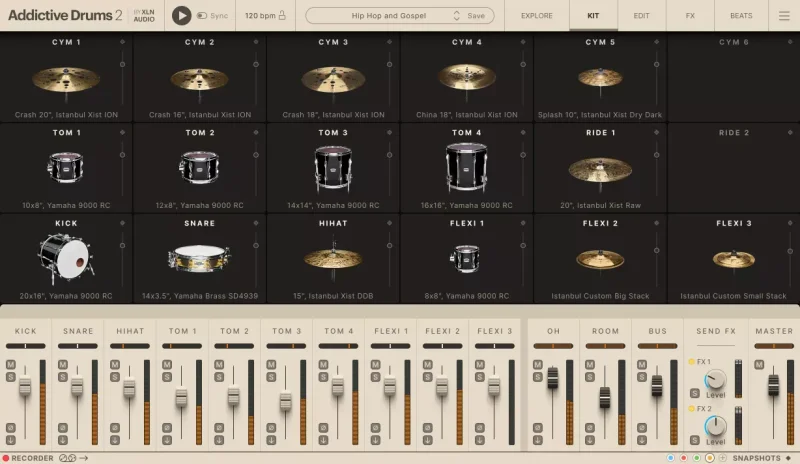
This is a drum library expansion review built around a single, well-chosen piece of hardware: a Yamaha 9000 Recording Custom kit. XLN recorded it specifically for pocket-heavy hip hop and the kind of explosive gospel drumming that Kirk Franklin and Tye Tribbett have made into a sonic signature. It’s for producers who want that crossover sitting in their session without spending three hours processing a generic rock kit into submission.
The price is $159. We’d say it’s worth it, with one important caveat we’ll get to.
How It Compares Out of the Box
Load a NI Expansion like “Ethereal Earth” or “Neon Drive” and you get a polished, immediately placeable sound. Load the Hip Hop and Gospel Collection into Addictive Drums 2 and you get something rawer. More room. More kit.
That’s not a knock. It’s the whole point.
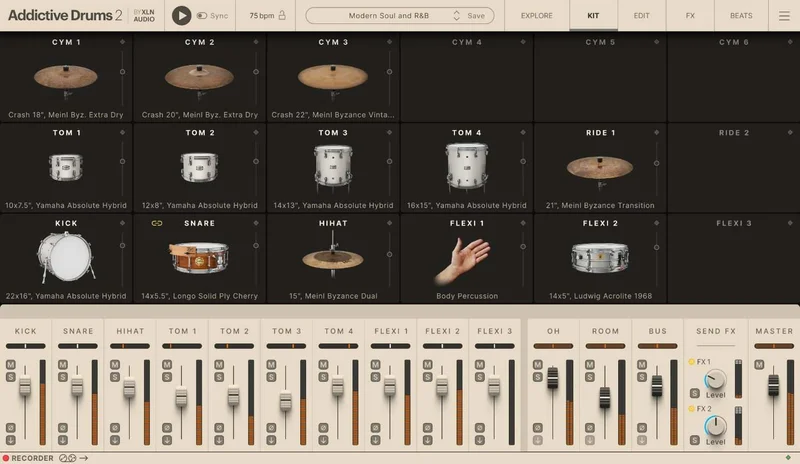
The Yamaha 9000 Recording Custom is captured in two bass drum configurations: a 20x16” tuned for tight definition and a 22x14” for maximum punch. The difference between them is audible immediately. The 20x16” sits under a sample-flipped Kendrick-era beat without fighting for space. The 22x14” wants to lead. In a gospel arrangement where the kick is the event, it delivers.
Competing libraries at this price usually give you one kick. XLN gives you a choice that actually matters.
Performance Deep Dive
We built a 90 BPM loop first. Straight boom-bap template. Four-on-the-floor kick on the 20x16”, snare on 2 and 4, closed hat running eighth notes.
The piccolo snare, a 14x3.5” Yamaha Brass SD4939, sits at around 3kHz naturally. No boosting needed. We ran it through a fast attack compressor at 4:1 and it didn’t break. The transient stayed present. That piccolo crack is satisfying in a way that a lot of sampled snares just aren’t.
We then pushed it to 128 BPM for a gospel-leaning arrangement and switched to the 14x6.5” RAS1465 Aluminum snare. That snare has weight in the 200-250Hz range without the mud that a wood snare brings at those frequencies. It punched through a dense choir arrangement without needing a high-pass filter on it.
The 14x5.5” S-Series Maple lands between the two. It’s the “just works” option. We’d reach for it on a track that couldn’t decide what it was.
Diamond Johnson’s MIDI performances are where this library earns points that specs don’t capture. His hi-hat ghosting and snare rolls have real velocity variation, roughly 15-20 distinct velocity stages audible across a single fill. Grid-programmed MIDI just doesn’t replicate that.
Plugin compatibility covers VST, VST3, AU, and AAX in 64-bit. CPU load is light to medium on our M2 test machine at session sizes up to 32 tracks.
Where It Wins
The genre pairing is underrated as a selling point.
Gospel and hip hop share rhythmic DNA. The pocket, the space around the kick, the snare that sits slightly behind the beat. Most libraries treat them as separate categories. XLN treats them as a continuum, and they’re right.
We haven’t found another library at this price that handles both Kendrick-era boom-bap and Tye Tribbett-inspired explosive gospel in the same kit. Native Instruments’ gospel content exists, but it’s scattered across multiple expansions. Here, it’s one purchase, one workflow.
The three-snare setup is brilliant. It sounds like an obvious decision in retrospect. It isn’t. Most expansions ship one snare and call it done. Having a piccolo, a mid-depth maple, and a deep aluminum option in the same collection means you’re not hunting for a separate library when the track changes character.
Diamond Johnson’s recorded performances are also the real thing. You can hear him thinking.
Where the Competition Wins
Native Instruments wins on MIDI content volume. Full stop.
Their Expansions ship with hundreds of patterns. The Hip Hop and Gospel Collection’s MIDI pack is solid but modest. If you’re a producer who leans on pre-built patterns and edits from there rather than building from scratch, NI’s ecosystem gives you more raw material to work with.
Splice and Loopmasters gospel packs win on genre depth too. If you specifically want gospel choir loops, organ samples, and complete gospel production templates, those platforms have dedicated vertical content that this collection doesn’t attempt to cover.
This collection is a drum library. It’s great at being a drum library. But if you need a complete gospel production toolkit, it doesn’t fill that role alone.
The price is also frustrating when some individual Addictive Drums 2 expansions cost less. The hardware pedigree justifies some of that premium. Not all of it.
Who Should Buy Which
✅ Buy if you produce hip hop and gospel simultaneously and want one kit that handles b
oth without genre-switching between libraries.
✅ Buy if live drum character matters to you and you’re tired of processing generic sample packs to get punch and pocket.
✅ Buy if you want Diamond Johnson’s performances as MIDI source material. His pocket is the kind you study, not just use.
❌ Skip if you primarily need MIDI pattern volume. NI Expansions give you more to start from.
❌ Skip if you’re building a full gospel production suite. This covers drums only. You’ll need additional sources for everything else.
❌ Skip if your budget is tight and you mostly work in trap tempos above 130 BPM. The kick character here suits slower, heavier grooves better.
Score Breakdown
| Category | Score | Notes |
|---|---|---|
| Sound Quality | 4.3/5 | Yamaha 9000 capture is detailed and genre-appropriate; kick variants are genuinely useful |
| Value for Money | 3.5/5 | The price is fair for the hardware pedigree but steep versus single-genre alternatives |
| Ease of Use | 4.3/5 | Loads clean inside AD2; three-snare selection is intuitive |
| Features | 3.8/5 | MIDI performances are strong; pattern quantity could be higher |
| CPU Efficiency | 4.0/5 | Light footprint on M2 Mac; no performance issues at 32-track sessions |
| Overall | 4.1/5 | Best dual-genre drum library at this price; held back by modest MIDI content |
Alternatives to Consider
If the MIDI volume gap is a dealbreaker, look at Native Instruments Battery Expansions review. You’ll get more patterns but less kit specificity. The drum character is more generic.
For producers working mostly in gospel production and wanting a complete template rather than a drum library, best gospel production VST plugins covers the wider toolkit including keys, organ, and choir sources.
If you’re budget-conscious and can compromise on live performance MIDI, best Addictive Drums 2 expansions under a certain price has options that cost less and still cover urban genres, though none with this specific hardware pedigree or gospel focus.
The Final Call
We loaded the 22x14” kick, the aluminum snare, and one of Diamond Johnson’s slower groove performances into a gospel arrangement at 72 BPM. The kick landed like something physical. The snare didn’t need touching. We added no processing for 20 minutes, which almost never happens.
That experience is what you are paying for. Not a feature list. Not a preset count.
If you produce in both hip hop and gospel, this is the one library that was actually built for that overlap. Gospel sampling in hip hop has been a creative thread from Kanye’s “The Life of Pablo” to Chance the Rapper’s “Coloring Book” (which pulled gospel references across more than half its tracks). Producers in that lane need drums that can cross. These do.
Skip it if you need a complete production toolkit or if your work lives above 130 BPM. Buy it if you want a drum library you’ll still be reaching for in three years.
Frequently Asked Questions
Does the Hip Hop and Gospel Collection work without owning Addictive Drums 2?
No. This is an expansion pack and requires Addictive Drums 2 to run. You'll need the base plugin first, which is a separate purchase. If you don't own AD2 yet, factor that into your total cost when comparing against standalone drum plugins.
How does Diamond Johnson's MIDI content differ from standard programmed MIDI patterns?
Johnson's performances were recorded as live takes, not grid-quantized. That means natural velocity variation across individual hits, subtle timing push and pull, and ghost note phrasing that reflects decades of professional session work. You can hear the difference most clearly in hi-hat sequences and snare rolls. Grid programming can't replicate that without significant manual editing.
Is the Hip Hop and Gospel Collection useful for trap production?
Partially. The kick drums have the low-end weight trap needs, but the collection wasn't built around the heavily compressed, ultra-sustain 808-adjacent sounds that define modern trap. For trap tempos above 130 BPM, you'll likely find the kit character leans too natural and open. It suits darker, slower hip hop and live-feeling gospel more than Atlanta-style trap.
How does the gospel sampling trend in hip hop affect whether this library is relevant for beatmakers?
Gospel-influenced hip hop has been a consistent commercial thread since at least 2016, covering artists from Chance the Rapper to Kendrick Lamar to Sunday Service-era Kanye. Producers working in that space need drums that carry both genres without sounding forced in either direction. This collection was built specifically for that crossover, which makes it more relevant for beatmakers in that lane than a generic urban drums expansion.