We were building a cue for a short film set in contemporary Shanghai, and the director wanted something that sat between a traditional ensemble and a modern production. We loaded up Wavesfactory’s Guzheng around 11pm, routed it through a short plate reverb at 0.8 seconds decay, and played the opening phrase. It landed. Not perfectly, not without tweaking, but enough to keep us working until 2am.
That session told us most of what we needed to know about this library.
Wavesfactory’s Guzheng is a Kontakt instrument built around sampled recordings of a 21-string guzheng. It’s aimed squarely at producers and composers who want a credible Chinese zither in their signal chain without learning to play the real thing or importing a physical instrument. If you already own other Wavesfactory instruments, you know what to expect from their sampling workflow. This is consistent with that output.
First Impressions: What You Actually Get When You Load It
Installation is standard Kontakt fare. Download, point the library manager at the folder, open the .nki, wait about four seconds for it to load. No iLok. No serial number drama. We had it running inside three minutes.
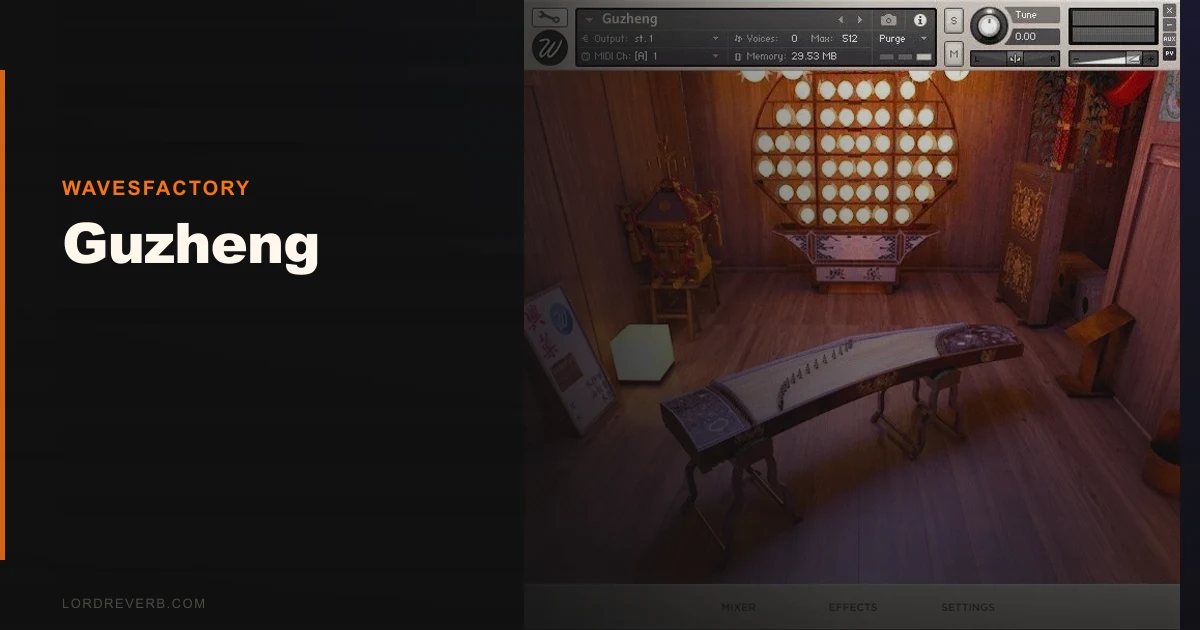
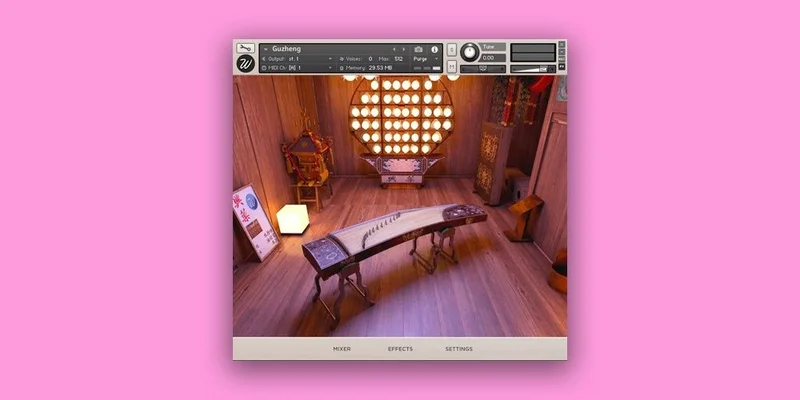
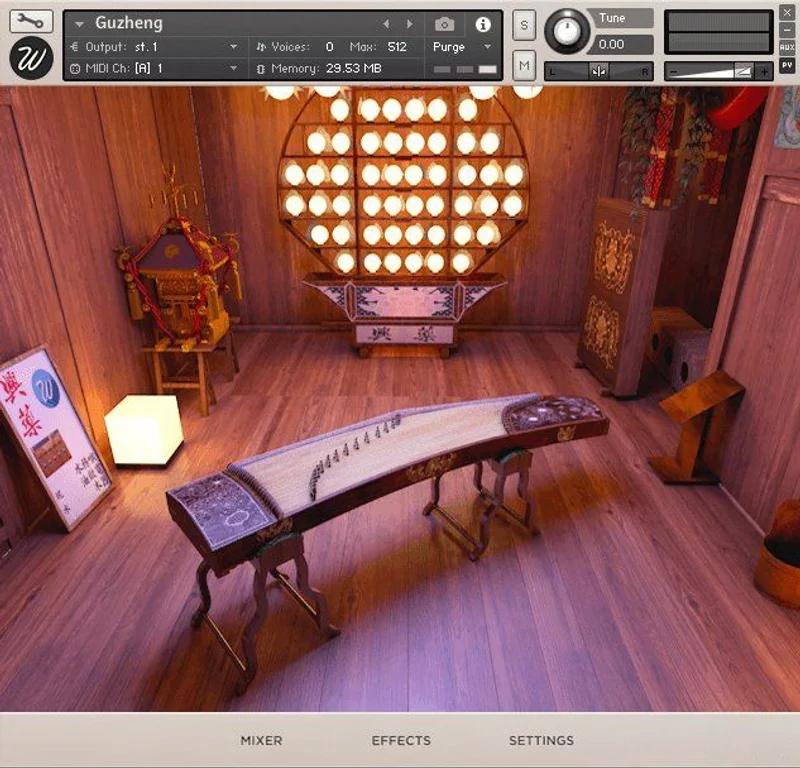
The GUI is minimal. One panel, a handful of knobs, articulation selectors along the top. It doesn’t look like much. That’s fine. We’re not here to stare at it.
What’s immediately clear is that the recorded samples are dry and close-miked. There’s no artificial reverb baked in, which is the right call. You get a realistic pluck with genuine string resonance, and the vibrato articulation is more convincing than we expected at this price point. First impression: solid foundation, limited depth.
Getting It Into a Real Workflow
Dropping this into a session is straightforward if you’re already comfortable with Kontakt’s keyswitching system. Articulations sit on the low keys. You tap C1 for sustain, D1 for vibrato, E1 for slide. In slow, melodic passages, that works cleanly.
The friction starts when you try to move fast. We ran a mid-tempo melodic line at around 100 BPM, with articulation changes every two or three notes. The keyswitch response introduced a small but audible stutter on two of the changes. Annoying. Not a dealbreaker, but you’ll want to pre-program your articulation lanes in your DAW rather than play them live.
MIDI velocity response is reasonably well-mapped. Soft playing gives you a thinner, more intimate tone. Hard playing pushes the sample into a brighter attack. The range between roughly velocity 40 and 90 is where the instrument lives most comfortably. Below 40 it gets a little thin. Above 100, the character doesn’t change much.
We also tested it alongside other ethnic instrument libraries we’ve reviewed to gauge how well the dry signal takes processing. It takes EQ and reverb well. A high-shelf boost at 8kHz adds presence without harshness. A notch at 400Hz tightened up any boxiness in the midrange.
What It's Genuinely Good At
The slide articulation is the star. We played a descending phrase across a sixth interval, triggering the slide keyswitch at the start, and the portamento tail was satisfying in a way that cheaper guzheng samples rarely are. It doesn’t sound synthesized. It sounds like a string under tension releasing across a bridge.
The vibrato samples hold up under scrutiny too. We looped a single note for eight bars in a quiet section of the cue, and the vibrato variation felt natural enough that nobody on the session flagged it as mechanical. That matters in sparse arrangements where a single sustained note is exposed.
CPU load is light. We ran 12 instances across a large orchestral template without issues. Disk streaming footprint is modest. This is not a CPU-hungry library. It behaves.
For film scoring, ambient production, and anything that wants a Chinese melodic element without going into full traditional ensemble territory, this library delivers real value at its price.
The Rough Edges
The tonal variation across dynamics is limited. We played the same phrase at velocity 30, 60, and 90. The difference in character was smaller than we’d like. A real guzheng changes texture significantly as you shift between soft fingertip touches and harder nail plucks. This library compresses that range. The samples are consistent, which is actually the problem.
The lack of round-robin samples on the basic sustain articulation becomes noticeable in repeated-note passages. You hear the machine-gun effect around the fourth or fifth repetition. It’s manageable with manual velocity variation in your MIDI editor, but you have to do that work.
Full Kontakt is required. No free Player support. If you’re running the free Kontakt Player, this library won’t open. That’s a real barrier. A full Kontakt 6 or 7 license costs a significant amount, which changes the value math for anyone who does not already own it.
Who This Is Really For
- ✅ Buy if you already own full Kontakt and regularly score for film, TV, or media that touches East Asian settings.
- ✅ Buy if yo
u want a playable guzheng that takes processing well and doesn’t cost you CPU headroom.
- ✅ Buy if you're producing ambient, new-age, or world-fusion tracks and need a credible melodic element you can dial in quickly.
- ❌ Skip if you only own the free Kontakt Player. This won't load.
- ❌ Skip if you need deep round-robin sampling and wide dynamic tonal variation. There are heavier libraries that go further.
- ❌ Skip if you're scoring a project that centers the guzheng prominently. For lead instrument work in a traditional context, a more comprehensive library will serve you better.
Score Breakdown
| Category | Score | Notes |
|---|---|---|
| Sound Quality | 3.5/5 | Slide and vibrato articulations are convincing; dynamic range is narrow |
| Value for Money | 4.0/5 | Strong at its price point, assuming you already own full Kontakt |
| Ease of Use | 3.5/5 | Keyswitch layout is intuitive but fast articulation changes are clunky |
| Features | 3.0/5 | Core articulations covered; no round-robin on sustain, limited tonal layers |
| CPU Efficiency | 4.5/5 | Light load, runs 12 instances without strain |
| Overall | 3.8/5 | Honest workhorse for media composers; not a substitute for a deep-sampled library |
Alternatives to Consider
If you want more dynamic depth and round-robin variation, Cinematique Instruments’ Guzheng is worth a look. It goes further into articulation detail, though it costs more and is similarly Kontakt-dependent.
For producers who want the flavour without the Kontakt requirement, Native Instruments’ Spotlight Series has touched on East Asian instruments in formats that load without a full Kontakt license. Check their current catalogue.
If your need is specifically ambient or textural rather than melodic, exploring drone-based or pad-layer libraries alongside a lighter guzheng sample set can get you further than either alone.
And if you’re already in the Wavesfactory ecosystem, their Ukulele Collection shows the same recording philosophy at work on a different string instrument. If you liked that, you’ll be comfortable here.
The Honest Verdict
Wavesfactory’s Guzheng is a useful, well-recorded library that does exactly what it says it will do, and not much more. The slide articulation alone earns it a place in a film composer’s toolkit. The limited dynamic variation and the full Kontakt requirement are real constraints, not minor footnotes.
If you own full Kontakt and you’re building cues that occasionally need a guzheng in the arrangement, buy it. At this price, the math works.
If the guzheng is your lead instrument, or you’re trying to score something where traditional authenticity is under scrutiny, spend more and go deeper.
Some tools are supporting players. This is one of them. Use it that way and it won’t let you down.
Frequently Asked Questions
Does Wavesfactory Guzheng work with the free Kontakt Player?
No. It requires a full Kontakt 6 or 7 license. The free Kontakt Player will open the library for a limited demo period before locking it out. If you only own the free version, this library won't function properly in your sessions. Factor in the full Kontakt cost if you don't already own it.
How many strings does a real guzheng have, and does this library reflect that?
The modern standard guzheng has 21 strings, tuned pentatonically across roughly four octaves. Wavesfactory's library is built around this 21-string configuration, which gives you a balanced melodic range that covers most production needs. Historical variants had fewer strings, but the 21-string is what you'll encounter in contemporary music.
Can I use this library for traditional Chinese music, or is it better for modern production?
It leans toward modern production use. The articulation set covers the core techniques, including slides and vibrato, but the limited round-robin sampling and compressed dynamic range mean it doesn't fully replicate the nuance of a recorded performance in a traditional context. For film scoring and ambient production it's strong. For a lead role in a traditional ensemble arrangement, a more comprehensive library will serve you better.
What's the difference between a guzheng plugin and buying a physical guzheng?
A physical guzheng at beginner level costs considerably more than this plugin, with professional models costing far more and master-craftsman instruments going well above that. The plugin costs $59 and requires no tuning, no humidity management (18% of lower-end physical instruments report soundboard cracking in dry winter conditions), and no local repair infrastructure. The trade-off is that a plugin can't replace the expressive range and physical feel of a real instrument, which matters if you're an actual guzheng player rather than a producer sampling the sound.