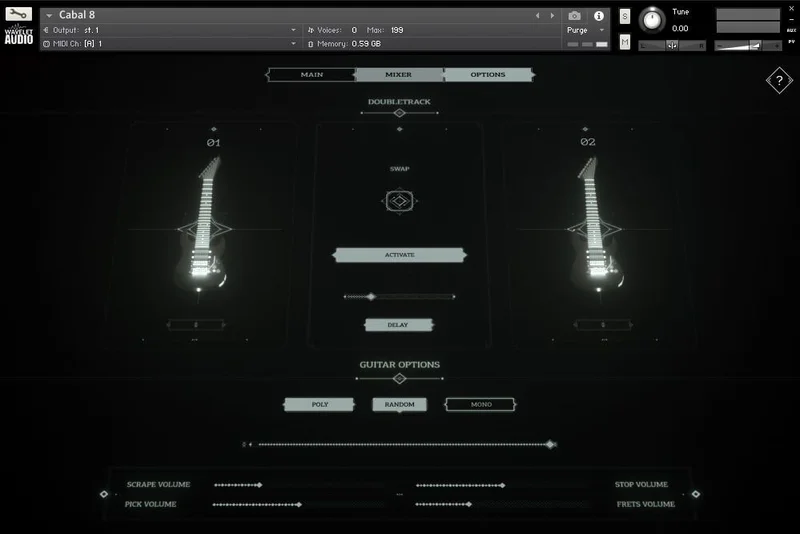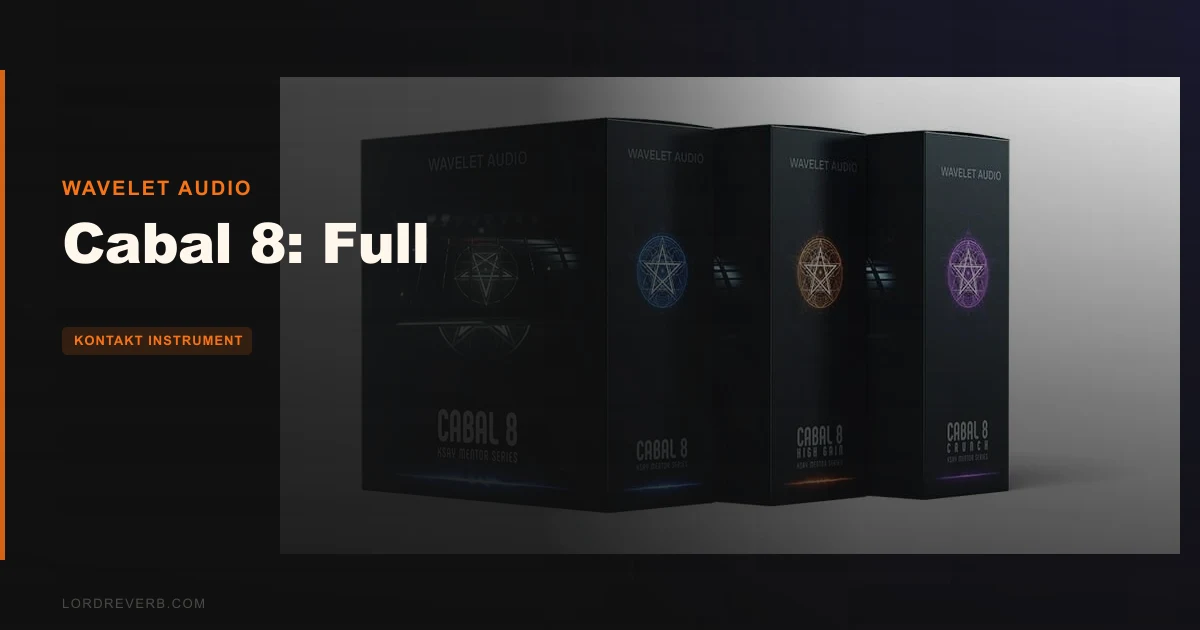
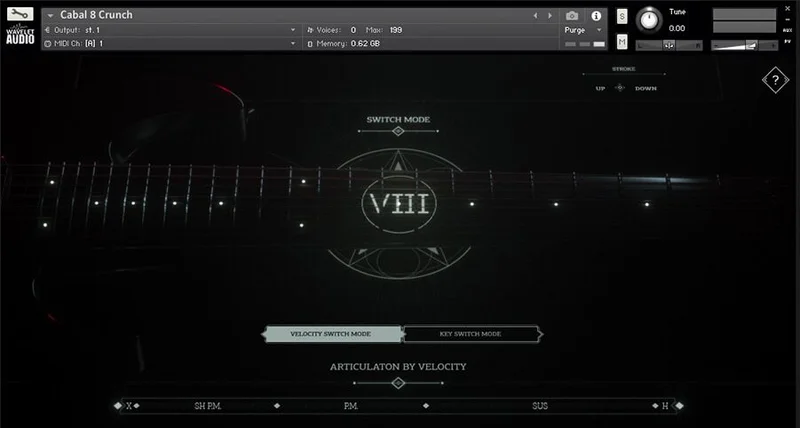
Cabal 8: Full is the right tool if you're programming djent riffs, modern progressive metal, or any 8-string guitar part that lives in drop tunings and low-string punishment. It's a Kontakt 5.7.3+ instrument from Wavelet Audio, priced at $159, and it's built for producers who want to write realistic 8-string rhythm parts in the box without hiring a session player or owning a seven-figure rig. Over 13,500 hand-edited samples, 8 round robins, six core articulations, and a portamento slide algorithm make it one of the most thorough 8-string libraries available right now. If you're writing pop, jazz, or anything that needs convincing solo lead lines, it's a harder sell. But for rhythm-first metal production, it earns its place in the signal chain.
Quick verdict: Cabal 8: Full is a focused, well-sampled 8-string guitar library that rewards producers willing to work its velocity curves and pair it with a solid amp simulator. At $159 for 8.52 GB of installed content, the value is real. The Clean DI option is where it lives best. The Elements presets are underwhelming and owners largely bypass them. Velocity tweaking is non-negotiable for power-chord passages. Score: 4.1/5.
Where It Belongs
You're building a djent track. The kick is dialled in, the bass is sitting right, and you need guitar chords that chug with real weight under a 400Hz shelf cut. That's exactly the scenario Cabal 8 was designed for.
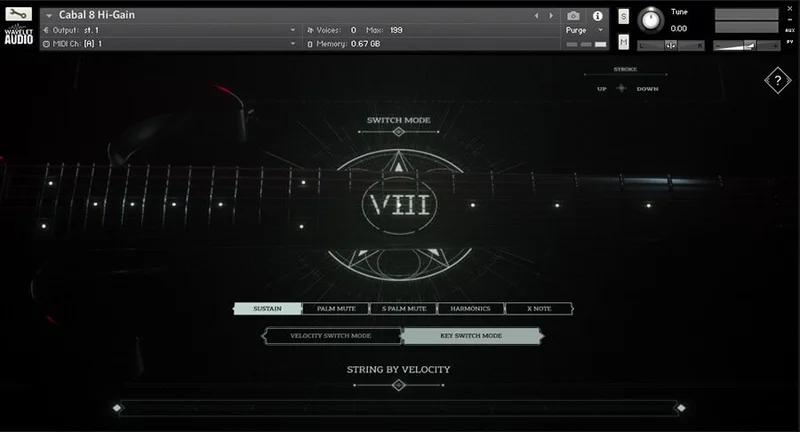
The six primary articulations cover what progressive and modern metal actually needs: Sustain, Palm Mute, Short Palm Mute, Harmonics, X-Note, and Tappings. These aren't catch-all articulations thrown in to pad a feature list. They represent the vocabulary of an 8-string player working through a Meshuggah-influenced passage, and the velocity-driven switching between them is what owners describe as simple and natural in practice.
The FX Sustain and FX Palm Mute articulations add texture for atmospheric passages, useful for layering under synth pads in the kind of hybrid metal production that's dominated playlists for the last five years.
Portamento glissandos land correctly here too. If you're sliding between frets on the low B or F# string, the portamento algorithm gives you control over speed, start position, end position, and the random slide noise built into that movement. Owners report the results are convincing. That's a satisfying feature for a library at this price point.
Chugging chords and heavy riffs work well with real-time control, according to owners. The 8 round robins keep those repeated palm mutes from piling up the machine-gun effect that kills a metal mix. The up and down picking directions add another layer of realism on sixteenth-note patterns. It's the kind of tool that makes 8-string rhythm work possible for a producer without a guitarist on call.
Where It Doesn't
Solo lead playing. Owners are already skeptical about sample-based guitars for realistic solo performance, and Cabal 8 does nothing to change that picture. The articulation set is tuned for rhythm. For expressive, legato lead lines over a mix, you're going to fight the library and probably lose.
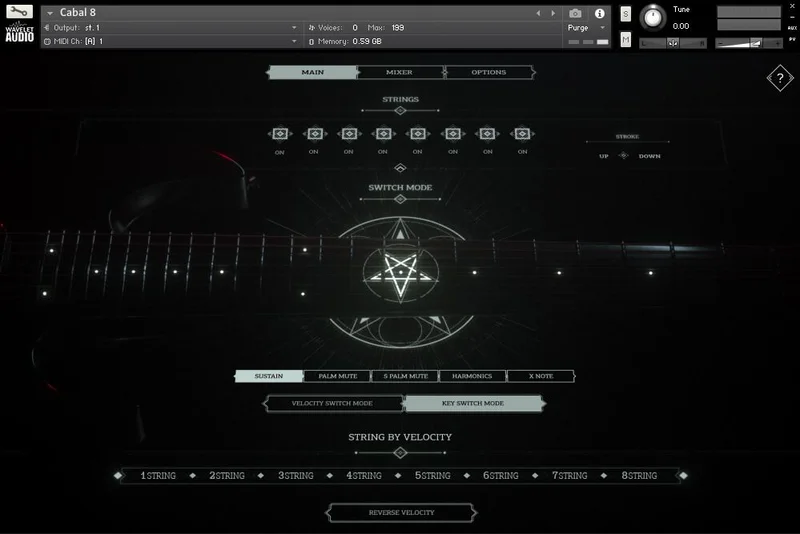
Repetitive power-chord riffs are frustrating too. The library needs manual velocity tweaking to keep those patterns sounding natural, and if you're writing in a style where a single power chord repeats over four bars of 4/4, the seams show without work. It's not unworkable, but it's not instant.
The Elements presets are a weak spot owners keep coming back to. If you land on Cabal 8 expecting the Hi-Gain Elements bundle to drop a finished guitar tone into your mix, you'll be disappointed. The Clean DI is where the library performs honestly. You'll need to run that signal into your own amp simulator and IR loader. best amp simulator plugins That's not a flaw in the samples, but it does shift the workflow burden onto your signal chain.
And one owner reported a baked-in flanger/phaser/chorus effect that could not be disabled. That's a hard problem if it affects your session. No workaround is documented.
The Sample Foundation: 13,500 Hand-Edited Samples
The number that defines Cabal 8's ambition is 13,500 hand-edited samples. Every string, every fret from open to the 24th, recorded and edited individually. That's not a number the developer invented to fill a bullet point. That scale of work is why the portamento algorithm has enough material to build convincing slides, and why the velocity-driven articulation switching doesn't feel like it's skipping across gaps.
The recording spec is 48kHz / 24-bit, which is the standard floor for serious sample library work. The original material runs to 15.9 GB. Installed, it compresses to 8.52 GB. That's a meaningful footprint reduction and makes drive management easier on a busy session machine.
Eight round robins per note is the key number for metal production specifically. Repeated palm mutes are where sample libraries get exposed fastest. A two-round-robin library playing sixteenth-note palm mutes sounds like a drum machine with a guitar sample. Eight robins don't guarantee perfection, but they give enough variation that the ear stops tracking the pattern. Owners working djent-style riffs confirm this holds.
Up and down picking directions sit on top of that. When you're programming a passage with alternating pick strokes, the subtle tonal difference between a downstroke and an upstroke is audible in a real performance. The fact that Cabal 8 captures that distinction matters if you're chasing realism.
One and a half years of continuous work for a single instrument is not a quick-flip project.
Articulations in Practice
The Six Core Articulations
Sustain is the foundation. Open it, play a chord, and you get a clean, full-length note decay that responds to velocity correctly. It's where you start building a part and where the tuning per string becomes most audible.
Palm Mute and Short Palm Mute are the articulations most producers come here for. The difference between them is decay length and the attack character. Short Palm Mutes cut faster, useful for tighter syncopated rhythms. Regular Palm Mutes have enough sustain to drive a low-end chug forward. Velocity switching between the two and the Sustain articulation is what owners describe as natural-feeling, which is high praise for a MIDI instrument.
Harmonics land convincingly for the pinch-harmonic squeals that punctuate metal rhythm guitar. These are the kind of accent you can't fake with pitch-shifting. The fact they're sampled separately keeps them from sounding processed.
X-Note covers the muted, percussive scratch that appears between chord hits in a lot of modern progressive metal. It's a small articulation in terms of pitch content but it does a lot of work for groove and realism.
Tappings are a welcome inclusion. They give you access to the tapped harmonic technique that players like Tosin Abasi built entire styles around. Whether the samples are deep enough for complex two-handed passages is a fair question, but their presence here is clever design for the target audience.
FX Articulations
FX Sustain and FX Palm Mute are the atmospheric layer. Push FX Sustain under a reverb send on a bus and it fills the space behind a chord hold in a way that standard sustain can't. They're not the headline feature, but in a hybrid metal production context, they earn their slot.
The Portamento Slide Algorithm
This is one of the features that separates Cabal 8 from a standard multisampled guitar library. The portamento slide algorithm gives you four control parameters: speed, starting position, ending position, and noise.
The noise control is what makes this interesting. A guitar slide doesn't just move in pitch. It generates pick noise, string friction, and positional scraping sounds as the finger moves across the fretboard. The ability to dial in how much of that noise appears in the slide is the difference between a glissando that reads as real and one that reads as pitch-bent audio. Owners confirm the results are convincing across cross-fret glissandos using pitch-bend.
Speed control means you can match the slide to the tempo and the rhythmic context of the passage. A slow sweep under a long chord hold is a different musical moment from a fast dive between two chord hits. Having that granular control without bouncing to audio or editing automation lanes is a workflow advantage.
Starting and ending position parameters tie the slide into the physical logic of the instrument. A guitar player doesn't slide from the same place every time. These parameters let you program that variation without making each MIDI note a separate automation event.
String Control and Tuning
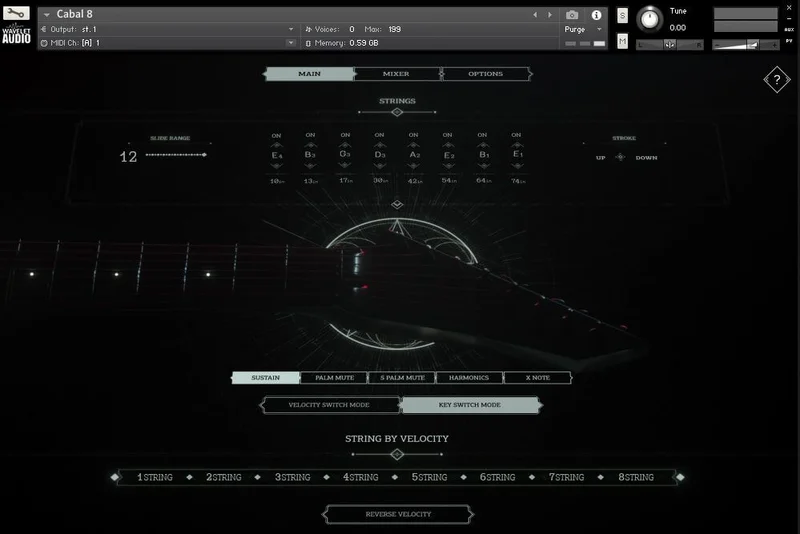
Individual string tuning for each of the eight strings is a straightforward but important feature. Drop tunings, open tunings, and the custom intervals that 8-string players work in aren't one-size-fits-all. Being able to set each string independently means the library can serve a wider range of actual playing setups without forcing you to transpose at the bus level and introduce artifacts.
The ability to disable specific strings and have Cabal 8 automatically reallocate CPU load to the remaining active strings is a clever piece of engineering. If you're only using the bottom five strings for a particular passage, you're not paying the RAM and processing cost for the top three. That kind of efficiency thinking matters when the library is already running 8.52 GB of content.
Keyswitch Mode takes that per-string logic further. Velocity-based string selection means you can build performance scripts that feel more like playing a real instrument, where the string choice follows from note range and context rather than a fixed mapping. That's the kind of detail that separates a library built for programmers from one built for players who program.
Level control per string and per articulation is another layer of fine-tuning. If the low F# string sits too loud against the B string in a particular riff, you adjust at the string level rather than drawing automation on an instrument track and hoping your clip doesn't clip something downstream in the chain.
EQ, Noise, and Tone Shaping
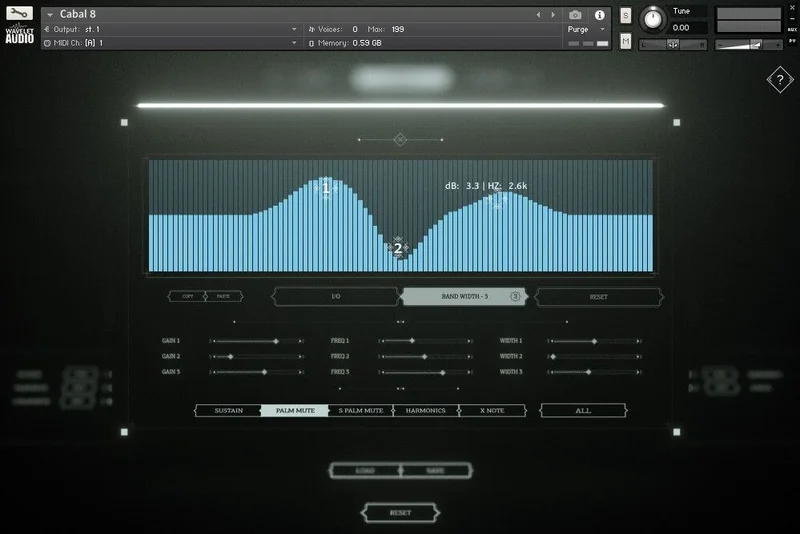
Detailed equalization available for the whole instrument or for specific articulations on individual strings is a serious workflow tool. You can high-pass the palm mute articulation on the top two strings without affecting the sustain on the lower four. That's the kind of per-articulation surgical control that usually requires routing to individual outputs and building a parallel chain in your DAW.
Pick, fret, scratch, and release noises are individually adjustable. This is where a lot of sample libraries either over-deliver or disappear. Too much pick noise and the guitar sounds like it's being played by someone who learned yesterday. Too little and it sounds lifeless. Having the control in your hands means you dial this to match the amp sim you're running downstream and the density of the arrangement.
Owners make a consistent recommendation: run the Clean DI signal, skip the Elements presets, and process externally. The Hi-Gain Elements and Crunch Elements bundles are described as poor value compared to running a DI through a good amp simulator and IR loader. That's honest feedback. The samples underneath the Elements presets are the same 13,500 that power the DI. The tone-shaping just works better when you're in control of it.
The vibrato algorithm complements the EQ and tone work. Realistic vibrato on held notes is one of the hardest things to fake in a guitar library. The fact that Cabal 8 addresses it algorithmically rather than just leaving a static sample to ring is relevant for any passage where a note holds for more than a beat.
Routing, Modes, and MIDI Integration
Operating Modes
Two operating modes support real-time playing and detailed MIDI part editing. This is a meaningful distinction. Real-time mode is where you perform ideas, jam through a progression, and capture a rough part. MIDI edit mode is where you go back in and make that part actually sound like a guitar player recorded it.
That two-mode workflow acknowledges something a lot of single-mode instruments ignore: the way you want to interact with a library during composition is different from how you want to interact with it during production. Worth building your template around.
Bus Routing and the Routing Map
Articulations can be routed to specific buses via a configurable routing map. If you want Palm Mute articulations on their own bus for separate compression treatment, and you want Harmonics feeding a different reverb send, the routing map makes that possible without multiple instances of the library.
This is the kind of feature that pays off in a dense metal mix where the tonal signature of each articulation needs to sit in a different pocket in the frequency spectrum.
MIDI Files and True Doubling
MIDI files are included with the product. For producers who want a reference starting point for programming, these give you a playable baseline to modify rather than building from scratch. It's a small thing. It saves time.
The true doubling feature is worth flagging for anyone building wall-of-guitar productions. Doubling a guitar part in the box usually means copying a MIDI part, shifting it to a second instance, and adding micro-timing variation manually. True doubling handling this inside the instrument is a satisfying time saver, especially at the stage where you're running multiple rhythm layers across a dense arrangement.
The GUI: Stylish but Straining
The interface is described as stylish and intuitive by the developer. Owners agree on stylish. The legibility critique is consistent: small white type on a black background is hard to read, especially on a smaller monitor or at 1080p with the Kontakt window not maximized.
This isn't a dealbreaker for day-to-day use once you've learned the layout. But the first few sessions while you're locating controls will be annoying. If you're working in low-light studio conditions, that contrast issue gets worse. It's the one area where the design serves the aesthetic over the user.
Beyond the legibility issue, the control layout earns the "intuitive" description. The per-string controls and articulation routing don't require navigating buried submenus. The EQ, level, and noise controls are accessible at the instrument level without menu-diving. That matters when you're mid-session and need to adjust quickly.
The Kontakt Requirement: Know Before You Buy
Cabal 8 requires the full version of Kontakt 5.7.3 or higher. Not the free Kontakt Player. Not Kontakt 5.6. The full version, at the right revision. If you don't own full Kontakt, add that cost to your $159 calculation before you decide.
This is the most important limit to know upfront. A producer running only Kontakt Player will hit a 15-minute demo timeout and then nothing. The library won't run. There's no workaround and no alternative activation method listed in the available information.
If you already own full Kontakt, the requirement is painless. If you're buying Kontakt specifically to run Cabal 8, you're making a different investment decision than the headline price suggests. Plan accordingly.
Against the Field
Shreddage 3 Engine is the most common comparison point, and the verdict from owners is consistent: Cabal 8 is faster to get results with. Shreddage 3 Engine's workflow is described as more cumbersome for quick programming. If you want a library you can get a convincing riff out of in a single session without deep workflow investment, Cabal 8 has the edge.
Shreddage 2 is the other comparison, and this one goes the other way. For instant-gratification palm-mute riff performance, owners cite Shreddage 2 as superior. If the majority of your work is drop-D power-chord chugging and you don't want to tweak velocity curves, Shreddage 2 may be the more direct answer.
Shreddage 3 Hydra is upcoming and the comparison is speculative for now. There are concerns from owners about its palm-muting velocity layer handling compared to Cabal 8. Whether those concerns are validated by the release is something to check when it's available.
None of these alternatives give you an 8-string with per-string tuning, portamento slide control, and 8 round robins in the same package at this price. That specific combination is where Cabal 8 holds its position.
The Verdict
Cabal 8: Full is a serious 8-string library with a clear creative identity. It doesn't pretend to be a universal guitar instrument. It's built for producers working in progressive metal and djent who need realistic rhythm guitar, detailed articulation control, and flexible per-string editing without setting up a recording session.
The clean DI path is where it performs best. Bypass the Elements presets and run the DI through your own amp sim and IR loader. The samples underneath are strong enough to carry that chain convincingly. The portamento algorithm is brilliant for slide passages. The 8 round robins hold up under repeated pattern scrutiny. The per-string tuning and disabling features add a layer of workflow precision you won't find in thinner libraries.
The legibility issue is real and annoying. The power-chord velocity work is a real time cost. And the Elements presets are overrated. None of those issues are dealbreakers for a producer who knows what they're getting into.
At $159, with full Kontakt already in your setup, this is a clear buy for modern metal and progressive rhythm work. Without full Kontakt, price the bundle together before you commit.
Specs & Technical Details
| Developer | Wavelet Audio |
| Price | $159 |
| Plugin Format | Kontakt Instrument (.nki) |
| OS Support | N/A |
| Activation | N/A |
| CPU Usage | N/A |
| Trial Available | N/A |
| Version Reviewed | N/A |
| Sample Resolution | 48 kHz / 24-bit |
| Installed Size | 8.52 GB |
| Original Sample Data | 15.9 GB |
| Total Samples | 13,500+ |
| Round Robins | 8 per note |
| Kontakt Requirement | Full Kontakt 5.7.3 or higher (Kontakt Player not supported) |
Score Breakdown
| Category | Score | Notes |
|---|---|---|
| Sound Quality | 4.5/5 | 13,500 hand-edited samples at 48kHz/24-bit deliver real depth; Clean DI path is convincing with a good amp sim |
| Value for Money | 4.0/5 | Strong content-to-price ratio if you own full Kontakt; the Elements presets underdeliver but the DI samples earn the cost |
| Ease of Use | 3.5/5 | GUI legibility issues and the velocity tweaking required for power chords add friction in early sessions |
| Features | 4.5/5 | Portamento algorithm, per-string tuning and disabling, 8 round robins, and configurable routing map are strong for the genre |
| CPU Efficiency | N/A | No data available from source material |
| Overall | 4.1/5 | A focused, well-built 8-string library that rewards producers willing to use the Clean DI path and dial in their own tone |
Alternatives to Consider
Shreddage 2 (Impact Soundworks), If instant palm-mute riff performance matters more than per-string surgical control, owners say Shreddage 2 delivers faster results with less velocity work. A strong option for straight-ahead drop-tuned metal without the deep editing overhead.
Shreddage 3 Engine (Impact Soundworks), The workflow is described as more cumbersome than Cabal 8 for quick programming, but the Shreddage 3 ecosystem is wide and well-supported. Worth considering if you're building a broader library collection around a single platform.
Shreddage 3 Hydra (Impact Soundworks), An upcoming 8-string library with uncertainty around its palm-muting velocity layer handling at the time of this review. Keep it on your watchlist, but Cabal 8 is the known quantity right now for 8-string dedicated work.
Cabal 8 wins when per-string tuning, portamento slide detail, and articulation routing control are your priorities. The alternatives above win on instant playability and ecosystem breadth.
If you're deep in progressive and djent production and you already own full Kontakt, Cabal 8: Full is worth every dollar of $159. Load the Clean DI, build your amp chain, and dial in the velocity curves on those palm mutes. The library will do the rest. If you need instant out-of-the-box tones with no signal chain work, look at Shreddage 2 before you buy. Cabal 8 is an instrument for producers who want control. It asks for effort and pays it back.
Related reviews: Sonespheres 3 Current Review 2026 · High School Drum Corps
Frequently Asked Questions
Does Cabal 8: Full work with the free Kontakt Player?
No. Cabal 8 requires the full version of Kontakt 5.7.3 or higher. If you don't own full Kontakt, factor that into your total cost before buying.
Do I need an amp simulator to use Cabal 8: Full?
Technically no, but practically yes. The Hi-Gain Elements and Crunch Elements presets provide processed tones inside the library, but owners consistently find these underwhelming. The Clean DI path gives you the raw, unprocessed guitar signal, and that's where the samples shine. Running that DI through a quality amp simulator and IR loader is the approach owners recommend for realistic results.
How many articulations does Cabal 8: Full include?
Cabal 8 includes eight articulations total: six primary (Sustain, Palm Mute, Short Palm Mute, Harmonics, X-Note, and Tappings) plus two FX articulations (FX Sustain and FX Palm Mute). Velocity-driven articulation switching between sustains, palm mutes, and harmonics is simple and realistic.
Is Cabal 8: Full suitable for guitar solo programming?
Owners express skepticism about sample-based guitars for realistic solo playing, though they rate the overall product as solid for rhythm work. The library is built for rhythm work: chugging chords, palm mutes, harmonics, and slides. Expressive solo lead lines are a weaker use case for sample-based guitar libraries in general, and Cabal 8 doesn't break that pattern. Use it for rhythm parts and look elsewhere if lead playing is your primary goal.