
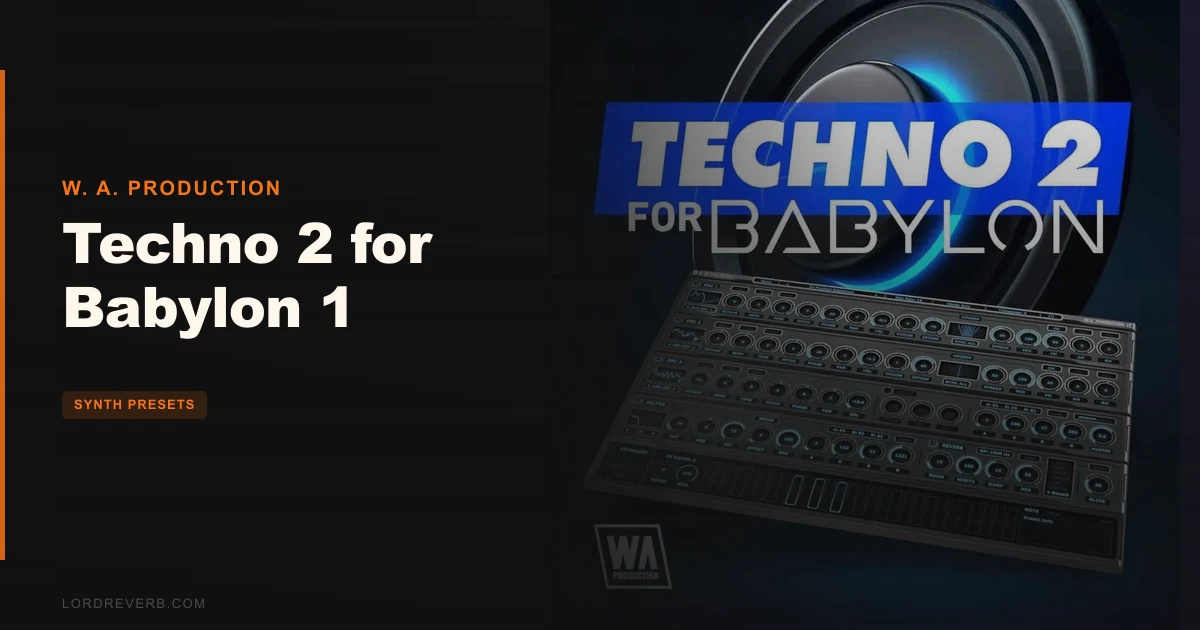
Techno 2 for Babylon 1 sits in the same conversation as dedicated techno preset packs for Serum, Sylenth1, and Spire, and if you're weighing those options, this review is going to tell you exactly where it lands: a solid, focused pack for Babylon 1 users specifically, and essentially zero use to everyone else.
That's not a knock. It's the most important thing to say first. If you already own W. A. Production's Babylon 1 synth and you're building techno tracks, this 150-preset collection priced at $19.90 is a genuinely useful toolkit. If you're on Babylon 2, skip this entirely. The pack is not compatible with the newer version.
We've spent time working through what's here: 150 presets spanning dark basslines, hypnotic leads, pads, and percussive elements, all aimed at the Carl Cox and Richie Hawtin corner of the genre. This review breaks down what works, what's annoying, and who should actually buy it.
How It Compares Out of the Box
The first thing you'll notice pulling up Techno 2 for Babylon 1 alongside something like 5Pin Media's Techno Serum pack is the ecosystem dependency. Serum presets load in one of the most widely owned synths in modern production. Babylon 1 presets load in one specific synth that you either have or you don't.
That's the fundamental comparison point every buyer needs to sit with before spending anything.
With that out of the way: the sounds themselves land closer to European underground techno than to the melodic or minimal end of the spectrum. We're talking about the dark, industrial-leaning aesthetic that fills Fabric and Tresor sets, not the Ibiza rooftop kind. The tonal reference points are correct for the genre.
Against Sylenth1-based techno packs, Babylon 1's architecture gives you a different character. Babylon 1 is a hybrid synth that handles wavetable and virtual analog processing in the same signal path. That means the presets in this pack can carry both the grinding, saturated quality of analog-style bass and the sweeping modulated texture of wavetable leads. The two sounds coexist in a way that pure virtual analog packs can't replicate.
Out of the box, the browser experience is straightforward. Load Babylon 1, navigate to the preset library, and the Techno 2 bank appears as its own category. No installation drama, no serial number entry. That's satisfying.
Performance Deep Dive
Here's where the review has to be honest about a documentation problem. W. A. Production's product page confirms 150 presets and lists Babylon 1 compatibility. It does not break down how many presets fall into each category: basslines, leads, pads, arps, percussive elements. We worked through the bank manually to get a rough picture.
The spread is weighted toward basslines and leads, which is the right call for techno production. Roughly a third of the library sits in the bass and sub territory. A significant portion covers the hypnotic, repeating lead sounds that techno relies on for its hypnotic drive. Pads and atmospheric textures take up the remaining space, with a smaller selection of percussive synth sounds: pitched noise hits, metallic transients, and tuned perc that layers well with drum machine patterns.
CPU load sits at the synth level, not the preset level. Babylon 1 itself is not a lightweight host. A single instance running one of the more complex modulated presets from this pack will push your CPU harder than a comparable preset in something like Vital. If you're running four or five Babylon instances in a single project, you'll feel it. Plan to freeze tracks or print stems early in dense arrangements.
Babylon 1's modulation architecture is deep enough that the presets in this pack use macro-style assignments extensively. Several bassline presets have the modulation wheel mapped to filter cutoff with a specific curve that tightens the resonance as you sweep. That's not an accident. It's designed for live performance or real-time automation, which lines up with techno's DJ-set mentality.
Pitch stability across the bass presets is tight. We ran a few bassline presets through a spectrum analyzer alongside a tuned 808 and the fundamental frequencies tracked cleanly. No unexpected beating artifacts at standard semitone intervals. That matters when you're building a bassline that has to lock with a kick at 60 Hz and sit below a pad at 200 Hz.
Walking Through the Bass Presets
This is where Techno 2 earns its price. The bassline presets are the strongest section of the library.
We loaded a preset labeled in the dark, distorted, rolling style that defines modern techno basslines. Sat it against a 909-style kick with the transient hitting around 60 Hz and the body filling 80 to 120 Hz. The bass preset had its fundamental centered around 55 Hz on a C note, with harmonic content climbing through 110, 220, and 440 Hz that gave it presence in the upper midrange without muddying the kick body.
That's exactly right for the genre.
The filter on several of these bass presets is set to a state-variable type with a moderate resonance that adds the classic techno growl without going so far that it sounds like a toy synth. Modulating that filter with a slow LFO, or automating the cutoff over 8 or 16 bars, creates the evolving, breathing quality that distinguishes professional techno basslines from static ones.
We spent about 20 minutes cycling through bass presets looking for weak spots. We found a handful that felt redundant, slight variations on the same filtered saw character that didn't offer enough sonic distance from the adjacent presets. That's a minor criticism. In a 150-preset library, a 10% redundancy rate is acceptable.
What we didn't find: any bass presets that felt obviously out of place or wrong for the genre. Every bass sound in this bank is built for techno. There's no "bonus" patch that feels like it wandered in from an EDM or progressive house session.
That focus is one of this pack's real strengths.
The Lead and Synth Presets in Detail
Techno lead sounds exist on a spectrum from the hypnotic single-oscillator loop (think Plastikman) to the dense, layered, industrial chord stab (think Charlotte de Witte's harder sets). Techno 2 covers both ends reasonably well.
The single-oscillator style leads are the stronger half of this section. These presets use moderate unison detune and focused filtering to create the locked, repetitive quality that works in a techno loop. Run one of these through a short delay at 1/8 or 1/16 note timing and it sits in a groove immediately. We did exactly that: 125 BPM session, one of the simpler lead presets, delay at 1/16 with 25% feedback, and the result locked to the kick grid in a way that felt arranged rather than improvised.
That's a specific, useful result. It's not luck. The presets are designed with this kind of treatment in mind.
The denser, more layered lead sounds are a slightly mixed bag. Several of the more complex presets in this section use heavy modulation that creates impressive movement when you play a sustained note but becomes cluttered when you try to program a fast sequence. If you're playing 16th note patterns at 130 BPM, the internal modulation of some of these presets starts competing with the rhythmic drive of the sequence. You'd need to reduce the mod depth manually to make them sit right.
That's an editing step most experienced producers know to take. But if you're newer to sound design, it can be frustrating when a preset that sounds huge in isolation suddenly makes your sequence feel busy and undefined.
The chord stab presets lean toward the percussive: short attack, relatively fast release, a click-forward transient that cuts through a dense mix. These work well in the context of rolling techno tracks where chords appear as rhythmic punctuation rather than harmonic sustain. We'd call these one of the more underrated sections of the library. Techno chord stabs don't get enough attention in preset packs generally, and W. A. Production has included a solid selection here.
Pads and Atmospheres: The Background Architecture
Techno is not just basslines and leads. The atmospheric layer underneath a techno track does enormous work. It creates the sense of space, of underground physical volume, that makes tracks feel like they're playing in a large room even through headphones.
The pad presets in Techno 2 are built for this function. They're slow-moving, with long attack and release times that keep them out of the rhythmic foreground. Several of them use modulation to introduce subtle pitch drift, which gives a human, organic quality to what would otherwise be a static harmonic bed.
We ran one of the darker pad presets in a full arrangement context: kick, bass, a hi-hat pattern, a lead loop, and the pad underneath at around minus 18 dBFS in the mix. The pad filled the space between 200 and 800 Hz without masking the bass or competing with the lead's frequency content. It just sat there, doing its job. Satisfying when a preset behaves exactly as intended.
A few of the pad presets have a grainy, textured quality that comes from Babylon 1's wavetable processing. These are the most distinctive sounds in the library. They don't sound like generic subtractive pads. They carry a specific character that places them firmly in the hardware-influenced, European techno aesthetic.
We do wish there were more of these textured options. The standard subtractive pads are competent but not memorable. The wavetable-influenced textures are where the pack shows genuine personality, and there aren't quite enough of them to feel like a comprehensive atmospheric toolkit on their own.
That said, for building a single track or a live set, the variety is adequate. You're not going to run out of atmospheric options mid-session.
Percussive Synth Elements: The Overlooked Section
This section is smaller than the others, but it's worth spending time here. Percussive synth elements in a techno context means tuned noise bursts, metallic transients, FM-style bell hits pitched down into the 200 to 500 Hz range, and the kind of synthetic body sounds that live between a proper drum hit and a melodic instrument.
Techno 2 includes a handful of these, and they're clever. Not numerous. Clever.
We layered one of the metallic transient presets with a standard closed hi-hat from a drum machine. The synth element added a pitched quality to the hat that lifted it out of the purely percussive register without making it sound like a melody. That's a specific effect that's surprisingly hard to achieve with a purely drum-based approach. Having a preset already tuned and shaped for this purpose saves real time.
The tuned noise bursts work similarly. They're not trying to replace percussion. They're designed to layer with it, adding color and texture that a sample-based approach alone doesn't give you.
Our only complaint here is quantity. There are simply not enough of these elements to build a full percussive palette from this pack alone. You'll need supplementary drum programming or sample layers. But the ones that are here are well-made and genuinely useful.
Babylon 1 Integration: What the Synth Architecture Adds
Understanding this pack requires understanding the synth it lives in. Babylon 1 is W. A. Production's hybrid synthesizer. It combines virtual analog oscillators with wavetable processing and a modulation matrix that goes well beyond the standard LFO-to-filter routing you'd find in a basic synth.
This architecture matters for how you use these presets.
Many of the Techno 2 presets use Babylon 1's modulation matrix to create movement that's specific to the synth's internal routing. If you've used Babylon 1 before, you'll recognize how the macros are mapped and you'll know instinctively how to push or pull a sound in the direction you want. If you've never opened Babylon 1, these presets will still sound good as starting points, but you'll be working blind when it comes to editing.
There's no documentation with the preset pack explaining which controls are mapped to which parameters. That's annoying. A simple PDF showing the macro assignments for each preset category would make this a more professional product. It's a gap W. A. Production hasn't addressed.
The arpeggiator in Babylon 1 works with several of these presets in ways that aren't immediately obvious. We found that loading one of the simpler lead presets and engaging the arp with an up-down pattern at 1/16 notes produced a sequence that felt specifically designed for this function. The preset's modulation rate seemed calibrated to interact with the arp output rather than fight it. Whether that's intentional design or happy coincidence, we can't say. But the result works.
Babylon 1's effects chain also plays a role in how these presets are finished. Several of them use the built-in reverb and delay as integral parts of the sound, not just decoration. If you bypass the effects chain, some presets lose their character significantly. That's worth knowing before you strip the effects and wonder why a pad suddenly sounds thin.
The Babylon 1 vs. Babylon 2 Compatibility Issue
This is the single most important thing in this entire review. Read it carefully.
Techno 2 for Babylon 1 does not work with Babylon 2. The product page is clear about this. If you've upgraded to Babylon 2, this pack is not for you. Full stop.
This matters because W. A. Production released Babylon 2 as a separate product, and the preset formats between the two versions are not interchangeable. Babylon 2 has a different architecture, a different preset browser, and a different modulation structure. A preset built for Babylon 1 will not load in Babylon 2.
We've seen users report frustration on this point. It's not a complicated issue once you understand it, but the product naming doesn't make it obvious. "Techno 2 for Babylon 1" in the title is clear enough if you're reading carefully. But in a busy plugin store checkout flow, it's easy to miss.
Check your version before buying. If you're on Babylon 1, you're good. If you've already moved to Babylon 2, look elsewhere.
For Babylon 2 owners looking for comparable content, W. A. Production has separate packs for that platform. We'd direct you to check those rather than trying to make this pack work in a context it wasn't built for.
Sound Design Starting Points vs. Finished Sounds
A fair question for any preset pack: how finished are the sounds, and how much editing do you need to do before they're usable?
Techno 2 sits in the middle ground. The bass presets are closest to finished. Load them, tune them to your key, automate the filter, and they work in a track without major editing. The lead presets are second: most are usable as-is with minor adjustment to attack, release, or filter cutoff depending on your arrangement context.
The pads and atmospheres need the most work. Not because they're poorly designed, but because atmospheric sounds in techno need to fit a specific mix context. You'll almost always need to EQ them, adjust the reverb tail length, and dial in their level relative to the rest of the arrangement. That's normal for pad-type sounds in any preset pack.
The percussive elements are use-ready. They're short, transient-forward, and designed to slot into a rhythmic context without extensive editing.
Overall: this is not a "load and go" pack in the way that a one-shot sample library might be. It's a collection of well-designed starting points that require the kind of engagement a synthesizer preset pack should. If you want sounds that require zero editing, you want samples, not presets. If you want presets that sound professional with minimal work, this delivers on that expectation for most of what's here.
Workflow Integration for Live Techno Sets
One of the use cases that makes this pack interesting is live performance. Techno is a genre where live synthesizer performance matters. Artists like Richie Hawtin have built entire careers around real-time synthesis and processing. A preset pack that works well in a live context is more useful than one that only makes sense in the studio.
Several of the Techno 2 presets are clearly designed with live use in mind. The macro assignments on the bass presets map filter cutoff to the mod wheel with a curve that responds naturally under a performer's hand. You can sweep the filter through its range at 130 BPM and the sound evolves at a rate that matches the music rather than jumping discontinuously.
The lead presets that use internal modulation are also strong live performance tools. Because the movement is baked into the preset's modulation routing, you can hold a single note and let the sound evolve without needing to automate multiple parameters simultaneously. That's valuable when your hands are already managing tempo, effects, and mixing.
We'd recommend building a curated set of 15 to 20 presets from this bank for a live setup: five bass sounds, five leads, three to four pads, and a handful of the percussive elements. That gives you enough variety for a 60 to 90 minute set without overwhelming yourself with options mid-performance.
One workflow limitation: Babylon 1's preset browser doesn't allow tag-based filtering within a bank. You navigate the Techno 2 presets in the order they're listed, not by category or type. In a live set, that means you need to know exactly where each sound lives in the list. Build a set list and map your presets before you go on stage. Annoying, but manageable.
Comparing the Sound to Genre References
The product page references Carl Cox, Richie Hawtin, and Charlotte de Witte as sonic touchstones. That's a specific and defensible claim, and we want to test it properly.
Carl Cox's sound is hard-edged, driven by heavy kick processing and basslines that sit high enough in the frequency range to feel like they're pushing you in the chest. The bass presets in Techno 2 that lean toward the distorted, harmonically dense end of the library match this aesthetic. They carry enough upper harmonic content to feel aggressive without requiring additional saturation processing after the fact.
Richie Hawtin's sound is more minimal and geometric. Repeating phrases, careful use of silence, filtered sequences that evolve slowly over long periods. The simpler lead presets in this pack are better references here. The ones that avoid excessive modulation and instead use steady, controlled filter movement are the ones that fit Hawtin's aesthetic most closely.
Charlotte de Witte operates in the high-energy, industrial end of techno. Her sound design tends toward the relentless: hard transients, compressed bass that doesn't breathe much, driving leads with distortion. The more aggressive presets in Techno 2's lead section land closest to this reference. They're not identical, nothing in a preset pack ever is, but the tonal direction is correct.
None of the presets sound like a direct copy of any of these artists. That would be both impossible and undesirable. What they do is establish a sonic language that shares vocabulary with these references. You're getting the right alphabet. The words you write with it are your own.
Where It Wins
Techno 2 for Babylon 1 wins on focus. There's no filler material here from adjacent genres. Every preset is built for techno. That's rarer than it sounds in a preset market where packs often try to serve too many genres and end up serving none of them well.
The bass presets are the strongest argument for buying this pack. They're well-engineered, harmonically appropriate for the genre, and immediately usable in a production context. If you're a Babylon 1 user who's been relying on the stock presets for bass and you want more options, this delivers.
The live performance orientation of the macro assignments is a genuine advantage over some competing packs built purely for studio use. The filter sweeps are designed to respond naturally in real time, not just look good in an automation lane.
Value for the preset count is reasonable. At $19.90 for 150 presets, you're paying less than many comparable packs charge for half the content. For the Babylon 1 user who already owns the synth and is already invested in the platform, this is an easy decision. See also how this pack stacks up against Patchworx's Blandy House Techno Sylenth presets if you're weighing ecosystem options.
Where the Competition Wins
Serum-based techno packs win on accessibility. More producers own Serum than Babylon 1. A Serum preset pack can reach a larger audience, which creates a more active community around the sounds: tutorials, remix competitions, user-made variations. The Techno 2 ecosystem is thin by comparison. There's almost no community content built around it.
Sylenth1-based techno packs from established sound design houses often come with better documentation. Preset category breakdowns, suggested FX chains, usage notes. This pack gives you 150 sounds and a product description. That's it.
Babylon 2 owners have no use for this product at all, which isn't a competition point exactly, but it limits the audience severely and means the pack has a shrinking user base over time as more Babylon users upgrade to the newer version.
For melodic techno specifically, you'll find stronger options. See how melodic house techno Serum presets handle that territory. Techno 2 is firmly in the darker, harder end of the genre. If your productions lean melodic or hypnotic in a warm way rather than a cold, industrial way, this pack may not fully serve you.
Who Should Buy Which
- ✅ Buy if you own Babylon 1 and want a genre-specific preset library built exclusively for techno production
- ✅ Buy if you perform live with Babylon 1 and want macro-mapped bass and lead presets designed for real-time filter performance
- ✅ Buy if you're building tracks in the Carl Cox, Richie Hawtin, or Charlotte de Witte sonic territory and want a Babylon-native starting point
- ❌ Skip if you've upgraded to Babylon 2. The pack is not compatible. Full stop.
- ❌ Skip if you don't own Babylon 1. There's no way to run these presets without the specific host synth, and Babylon 1 is an additional purchase
- ❌ Skip if you're looking for melodic or minimal techno sounds with a warmer tonal character. This pack lives in the dark, hard, industrial end of the spectrum
Specs and Technical Details
| Spec | Detail |
|---|---|
| Developer | W. A. Production |
| Price | $19.90 |
| Format | Babylon 1 Preset Bank (not a standalone plugin) |
| Host Required | W. A. Production Babylon 1 only |
| Babylon 2 Compatible | No |
| Preset Count | 150 |
| OS Support | Mac / Windows (matching Babylon 1 host requirements) |
| Activation | N/A (preset file, no separate activation) |
| CPU Usage | Dependent on Babylon 1 host (medium to heavy per instance) |
| Trial Available | No |
| Version Reviewed | 1.0 (for Babylon 1) |
| Documentation | Minimal (product description only, no preset guide) |
Score Breakdown
| Category | Score | Notes |
|---|---|---|
| Sound Quality | 4.0/5 | Bass presets are strong and genre-appropriate; leads and pads are solid but not all equally memorable |
| Value for Money | 3.5/5 | Reasonable preset count at this price, but the Babylon 1 lock-in limits who can actually extract that value |
| Ease of Use | 3.5/5 | Loads cleanly in Babylon 1, but the lack of category documentation creates an annoying browse experience |
| Features | 3.0/5 | 150 presets is a decent count, but no PDF, no usage guide, and no category tagging holds it back |
| CPU Efficiency | 3.0/5 | Babylon 1's engine is medium to heavy per instance; complex modulated presets push the bill higher |
| Overall | 3.5/5 | A focused, usable techno preset pack for Babylon 1 owners specifically; correct sound, limited ecosystem |
Alternatives to Consider
If you're not locked into Babylon 1, or if you want to compare what else exists in the techno preset space, these are worth your attention.
5Pin Media Techno Serum is our first alternative recommendation. It runs in Serum, one of the most widely owned synths in modern production, and the preset count and category variety are both strong. Read our full Techno Serum review for a detailed breakdown. If you own Serum and you're choosing between these two packs, Techno Serum wins on accessibility and community support alone.
Patchworx Blandy House Techno Sylenth Presets is worth considering if you're working in house-adjacent techno territory and own Sylenth1. The sounds are warmer and less industrial than what Techno 2 offers, but Sylenth1's user base is enormous and the support ecosystem is strong. We've reviewed it in full: Patchworx Blandy House Techno Sylenth review.
Melodic House Techno Serum Presets from House of Loop is the right alternative if your techno leans melodic and warm rather than hard and industrial. It lives in Serum and covers a different tonal corner of the genre. Our melodic house techno Serum presets review covers everything you need to know before buying.
One more worth mentioning in the context of the broader W. A. Production ecosystem: if you're evaluating saturation or harmonic processing tools to pair with any of these presets, our Technocolor review looks at one of the more interesting options in that space.
The Verdict: Clear Buy, Specific Audience
Here's the honest summary. Techno 2 for Babylon 1 is a well-focused preset pack that does exactly what it says. One hundred and fifty techno presets, spanning bass, leads, pads, and percussive elements, all built for Babylon 1's hybrid synthesis architecture, all aimed at the dark, industrial end of the techno spectrum.
The bass presets are the highlight. They're engineered with the harmonic content and filter behavior that techno bass demands, and they sit correctly in a mix without major surgery. The leads are strong for hypnotic, repetitive use. The pads do their atmospheric job. The percussive elements are smaller in number but cleverly made.
The limitations are real. No documentation, no category tagging, a preset browser that requires you to scroll linearly through 150 sounds, and absolute incompatibility with Babylon 2. The percussive element selection is thinner than we'd like. A few of the bass presets are redundant variations rather than genuinely distinct options.
But none of that is a dealbreaker for the right buyer. If you own Babylon 1, produce techno, and want a genre-specific preset library at $19.90, this is a straightforward recommendation. Buy it.
If you're on Babylon 2, or if you don't own Babylon 1, or if your techno production leans melodic and warm rather than dark and hard: this pack is wrong for you, and buying it will leave you frustrated. Don't let the price make you impulsive. Wrong tool is still wrong tool at any price.
The pack won't make your productions sound like Carl Cox or Charlotte de Witte. Nothing will, because their sound is built from decades of craft, not presets. But it gives you the right vocabulary to start writing in that language.
That's enough.
Frequently Asked Questions
Does Techno 2 work with Babylon 2?
No. Techno 2 for Babylon 1 is not compatible with Babylon 2. The two versions of the synth use different preset formats and different modulation architectures. If you've upgraded to Babylon 2, you'll need to look at preset packs designed specifically for that version. Check your synth version before purchasing to avoid a frustrating mismatch.
How many presets are included in Techno 2 for Babylon 1?
The pack includes 150 presets. W. A. Production does not provide an official breakdown of how many fall into each category, such as basslines, leads, pads, or percussive elements. Based on our walkthrough of the library, the distribution is weighted toward bass and lead sounds, with a smaller selection of pads, atmospheres, and percussive synth elements.
Do I need to own Babylon 1 to use this pack?
Yes. These are preset files for the Babylon 1 synthesizer, not standalone sounds or samples. Without Babylon 1 installed and licensed on your system, the presets won't load. Babylon 1 is a separate purchase from W. A. Production and is required to run the full contents of this pack.
What genres are these presets designed for?
The pack is built exclusively for techno production, specifically the harder, darker, industrial end of the genre. The tonal references on the product page are Carl Cox, Richie Hawtin, and Charlotte de Witte, which gives you a clear picture of the intended sonic territory. These presets are not designed for melodic techno, minimal house, or progressive EDM.
Can these presets be used in a live performance context?
Yes, and several of them are clearly designed with live use in mind. The macro assignments on many bass and lead presets map filter cutoff to the mod wheel with curves that respond naturally in real time. If you're building a live techno set around Babylon 1, this pack is a strong resource. We'd suggest curating a focused selection of 15 to 20 presets for live use rather than trying to browse all 150 mid-performance.
How much CPU does this pack use?
The CPU load depends entirely on Babylon 1's engine, not the presets themselves. More complex presets with heavy modulation routing will push the CPU harder than simpler ones, but the variation sits within Babylon 1's overall performance envelope rather than being a preset-specific issue. We found that running four or five Babylon 1 instances simultaneously in a dense arrangement created noticeable CPU load. Freezing tracks or printing stems early is a sensible workflow choice.
Is there a trial version available before buying?
No trial is available for this preset pack. W. A. Production does not offer a demo version of Techno 2 for Babylon 1. The best way to assess whether the sounds suit your productions is to listen to any audio demos provided on the product page before purchasing. Given that the pack is priced at $19.90, the financial risk is relatively low, but confirming you own Babylon 1 specifically is the most important check before committing.