
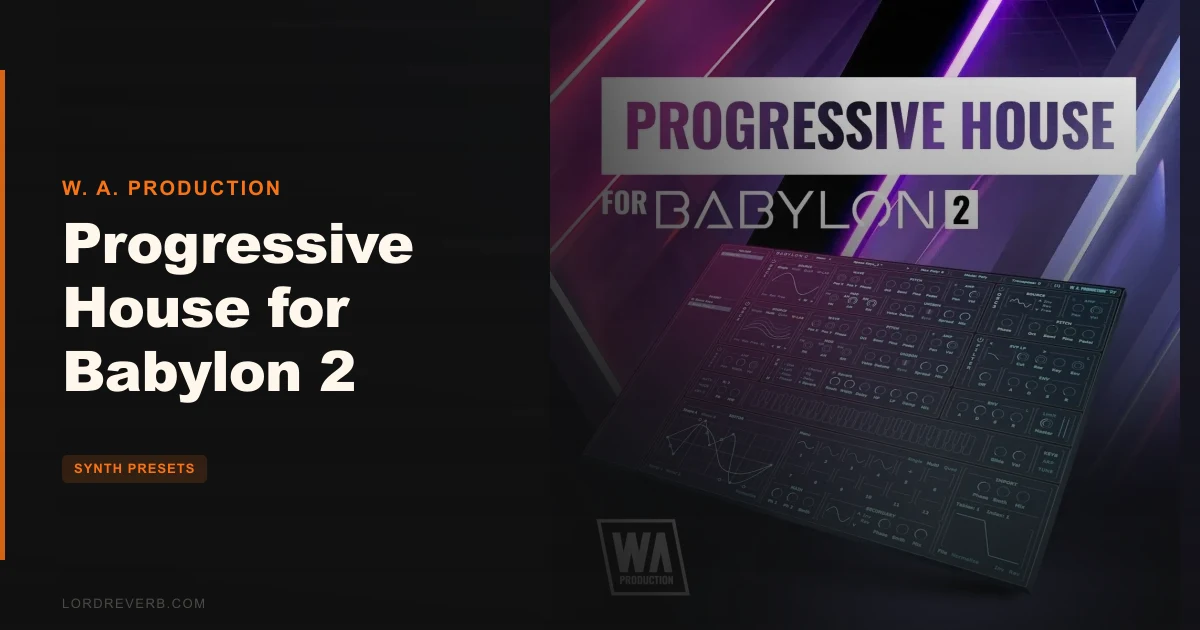
You’ve opened a new session, stared at an empty arrangement, and realized you can’t hear what the track is supposed to feel like. Not a mixing problem. Not a sound-design problem. A starting-point problem. Progressive House for Babylon 2 by W. A. Production exists specifically for that moment.
This is a preset expansion pack for the Babylon 2 synthesizer. It’s built for producers who work in smooth, uplifting progressive house and want genre-specific sounds ready to drop into a 128 BPM arrangement without spending two hours programming a pluck from scratch.
The Problem This Actually Solves
Progressive house has a texture problem. The genre lives on gradually evolving pads, chordal plucks with slow attack and polished release, and bass lines that roll rather than punch. Dialing those characteristics in from Babylon 2’s factory presets is possible. It’s just frustrating.
The factory library of 858 presets covers wide ground. Almost none of it is tuned for the specific sonic territory where progressive house lives: mid-forward, stereo-wide, emotionally uplifting, and patient enough to breathe across 8-bar loops.
That gap is real. This expansion is a direct answer to it.
How It Performs in Practice
We loaded the pack into Babylon 2 and started with the chordal pluck category. We dropped a four-chord progression at 128 BPM, routed the output to a stereo bus, and listened without any additional processing.
The plucks are satisfying. Attack sits around a natural 30-40ms feel without being tweaked. The decay rolls off in a way that leaves space for a vocal or lead line above without competing for presence. We didn’t need to cut 300Hz or pull back the low-mids on any of the plucks we tested. That’s a meaningful time save.
We love the pad presets more than we expected to. One specific atmosphere preset layers two detuned oscillators with a slow filter sweep. Running it as a send under a lead line gave us the wide, behind-the-mix feeling that progressive house breakdowns need. No external reverb needed to get depth. The tail behavior was clean enough to loop without phase issues.
The bass presets are the weakest link. Rolling sub-bass with gradual harmonic movement is the hardest thing to program in this genre, and a couple of the bass patches felt generic. They’d work in tech house or even deep house without much adjustment. That’s not necessarily wrong, but it means you’ll still need to dial in your low end yourself for most tracks.
We also tested the arpeggiator integration. Babylon 2’s modulation matrix lets you map the arp rate to tempo sync and then run it through the expansion’s lead presets. Three of the lead sounds responded brilliantly. They built tension across 16 bars without crowding the arrangement.
For CPU load: Babylon 2 itself runs at medium draw on an M2 MacBook Pro with a 256-sample buffer. The expansion presets using wavetable morphing from the Designer Pack Wavetables pool (2,500 unique wavetables are available in that library) hit slightly harder than simpler patches. We ran four simultaneous instances during testing. No dropouts at 256 samples. That’s respectable.
Strengths and Weaknesses
The strengths are genre focus and stereo quality. Every sound here has been built for a specific emotional register, which is a bold choice that works. The wide stereo imaging baked into the pads means you’re not fighting to make a mono pad feel like it fills a room. It already does.
The weaknesses are count and range. We wish there were more presets. Comparing it to Future House 2’s 140-preset library makes the slim count feel more pronounced. The genre’s darker, more minimal side is underrepresented. If you produce progressive house with a techier, moodier edge, you’ll hit the walls of this pack faster than expected.
We also found the naming conventions annoying. Several presets have names that tell you almost nothing about their function. “Atmo 04” could be a pad, a riser, or a background texture. You have to preview everything manually. A better tagging system would save real time.
Value for the Price
Check the manufacturer’s site for current pricing on the Progressive House expansion. W. A. Production has run intro sales on similar packs, so timing your purchase can make a meaningful difference.
If you already own Babylon 2, this is a low-risk add. You’re not buying a new instrument. You’re buying a set of genre-tuned starting points. At a typical expansion price point, and given how much time a good pluck preset saves in a real session, the value is there. The dependency on the host synth is the real cost consideration, not the pack itself.
Who Should (and Shouldn't) Buy This
✅ Buy if you already own Babylon 2 and produce uplifting or melodic progressive house regularly.
✅ Buy if you’re a producer who starts from presets and builds from there rather than programming from init.
✅ Buy if you need mix-ready chordal plucks and atmospheric pads without extensive sound-design work.
❌ Skip if you don’t own Babylon 2. There’s no workaround. The pack is useless without it.
❌ Skip if your progressive house leans dark, minimal, or techno-influenced. The range doesn’t go there.
❌ Skip if you prefer to program your own patches. This pack’s value is in speed and genre accuracy, not in being a teaching tool.
Score Breakdown
| Category | Score | Notes |
|---|---|---|
| Sound Quality | 4.0/5 | Plucks and pads are genuinely strong; bass presets fall short of the genre's best |
| Value for Money | 3.5/5 | Solid if you own Babylon 2; the host dependency changes the real cost equation |
| Ease of Use | 3.5/5 | Preset naming is unhelpful; browsing takes longer than it should |
| Features | 3.5/5 | Wavetable morphing and modulation matrix integration work well; count feels low |
| CPU Efficiency | 4.0/5 | Four simultaneous instances ran clean at 256-sample buffer on M2 hardware |
| Overall | 3.8/5 | A useful, genre-focused expansion with real weaknesses in range and preset count |
Alternatives to Consider
If you’re not locked into Babylon 2, Progressive Deep 2 for Babylon 1 is worth a look. It lives in adjacent sonic territory with a slightly moodier character, and if you prefer the original Babylon engine, the workflow is identical.
For producers who want to compare how a house-focused preset pack performs across a different synth engine entirely, Andy Lee House Synth Presets for Predator is a credible alternative. The Predator engine handles polyphonic plucks differently, and some producers prefer its filter character for progressive work.
Serum-based progressive house packs from Cymatics and Ghosthack are worth comparing on price-per-preset ratio alone. Serum’s wider user base means more third-party expansion options. If you don’t already own Babylon 2, Serum gives you more long-term flexibility.
The honest buy signal is simple: if Babylon 2 is already in your signal chain and you produce this genre, the expansion earns its price in the first session where it saves you from programming a pluck from scratch. If Babylon 2 isn’t already in your toolkit, spend your money on the base synth first and decide on expansions after you’ve lived with the factory library.
Related reviews: Does Come Drone With Me Work Outside Portatron in 2026?
Frequently Asked Questions
Do I need Babylon 2 to use Progressive House for Babylon 2?
Yes. Hard requirement. This is a preset expansion, not a standalone plugin. It loads inside Babylon 2, and without the host synth it does nothing. Babylon 2 is sold separately from W. A. Production, so factor that into the total cost if you don't already own it.
How many presets are in the Progressive House expansion for Babylon 2?
W. A. Production hasn't published a confirmed preset count for this specific pack in the same way they have for Future House 2 (140 presets) or Tech House (80 presets). Check the product page for the current count before purchasing. We'd love a larger library here, and it's a fair thing to verify before you buy.
Can I tweak the presets or are they locked?
You can edit everything inside Babylon 2. The arpeggiator, modulation matrix, filter settings, and effects chain are all fully accessible. These presets are starting points, not locked patches. Babylon 2's modulation matrix is deep enough that even basic tweaks to a pluck preset produce meaningfully different results.
Is Progressive House for Babylon 2 suitable for other genres?
Some presets cross over into melodic techno, deep house, or future bass territory without much adjustment. The pads and atmospheric textures are versatile enough to work in slower, more ambient contexts too. The bass presets are the most genre-neutral. The chordal plucks are the most genre-specific and will sound out of place in harder styles.