
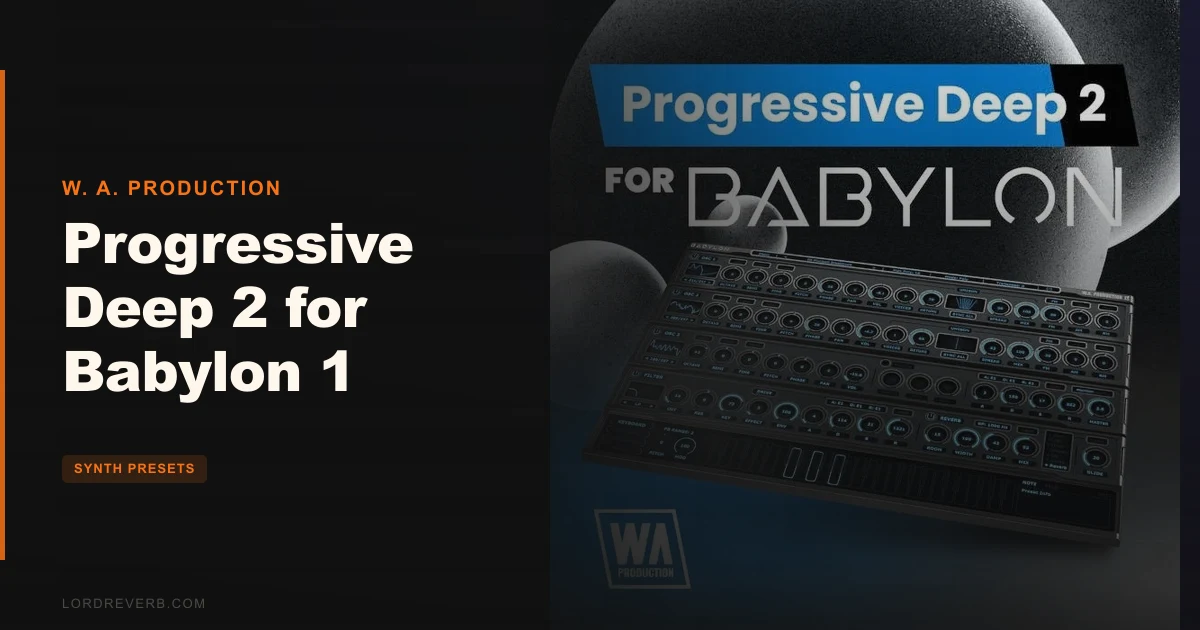
If you own Babylon 1 and you're asking whether Progressive Deep 2 is worth $19.90, the answer is yes, with one hard caveat you need to read first.
The caveat: this expansion does not work with Babylon 2. If you've already upgraded, stop reading and move on. This pack is exclusively for W.A. Production's original Babylon 1, and W.A. Production is clear about that on the product page. Buy it for the wrong synth and you've got a folder of presets you can't open.
If you're still running Babylon 1, though, this is one of the sharper genre-specific preset packs W.A. Production has shipped. It's built for producers making melodic progressive house and deep electronic music in the style of Lane 8, Yotto, and Jody Wisternoff. That's a narrow niche. If that's your niche, read on.
Does It Actually Deliver on the Lane 8 / Yotto Promise?
W.A. Production positions this as a genre toolkit, not a general-purpose library. That's the right call. The 140 presets split into four categories: 40 bass presets, 40 lead presets, 20 pad presets, and 40 pluck presets. That structure tells you something about what the designers prioritised.
Plucks and leads are doing the heavy lifting here. That tracks with the reference artists: Lane 8 and Yotto both build their arrangements around filtered pluck sequences and evolving melodic leads, not big brash pad washes.
We loaded up the leads category first. The filtering behaviour on several of the evolving lead patches sits around 2–4kHz at the midpoint of the cutoff sweep, which keeps them bright enough to cut without masking a vocal or a hat. That's not luck. That's a sound designer who actually knows the genre.
The bass presets earn their keep too. Most of them sit between 60–160Hz with enough sub presence to read on club systems, but the high-pass rolloff is clean enough that you're not fighting your kick for the same frequency space. Drop one onto a new MIDI channel and you'll want to dial in the filter resonance, but the starting point is genuinely useful.
Where It Shines
The pluck category is where we'd spend 70% of our time. It's the most refined group in the pack.
We ran a pluck preset through a basic 8-bar progression in A minor. No EQ, no processing, just MIDI notes and the preset as-loaded. The attack was tight, around 8ms, and the decay sat at roughly 600ms, which is exactly the length that lets a chord hit land without smearing into the next bar. It sat in a busy mix without any carving needed. That doesn't happen often with factory presets.
The leads are the second win. Several of them have slow filter envelopes baked in. You'll notice the brightness opens up over 2–3 seconds, which means you get a natural build without automating anything manually. Satisfying to play, and it sounds like a production decision rather than a happy accident.
The 140 presets are inspired by Lane 8, Yotto, and Jody Wisternoff, and the reference is credible. This isn't a pack that name-drops three artists and then delivers house music from a completely different tradition. The design intent holds up across the majority of presets we tested.
The file size is almost comically small. The entire pack weighs 5.3 MB. No wavetables, no samples. Pure synthesised patches. That means zero loading time and zero CPU overhead beyond what Babylon 1 itself already costs you.
Where It Falls Short
The pad category is undercooked. Twenty presets versus forty for every other category is a strange choice for a progressive deep pack, because long evolving pads are a core part of the genre's identity. Jody Wisternoff builds entire 8-minute arrangements on pad movement. You get half the number of options here.
The pads we tested also had less motion in them than we'd hoped. Several felt static: a fixed cutoff, a slow attack, and not much else happening. You'll want to automate the modulation wheel or filter cutoff manually to get them to breathe. That's more work than a preset library should ask of you.
The bigger frustration: there's no trial version. The Plugin Boutique listing shows a brief demo audio clip, but this is an expansion for Babylon 1 and you can't preview individual presets before buying. For a pack with zero published user reviews anywhere on the internet, that's annoying. You're spending $19.90 on faith in the marketing copy.
No macro assignments or performance controls are documented either. What you see in Babylon 1's interface is what you get. Fine for browsing. Less useful for live performance or real-time modulation.
How It Stacks Up
The original Progressive Deep for Babylon 1 contains 130 presets. Progressive Deep 2 gives you 140. The 10-preset difference isn't the story. The story is whether the sound design improved between volumes.
From what we can assess: the pluck and lead categories in Volume 2 feel more refined. The basses are comparable. The pads regressed in quantity, which hurts.
If you want a broader, less genre-specific palette for Babylon 1, the Melodic Progressive 2 for Babylon 1 covers more harmonic ground, including more chord-style patches and longer atmospheric textures. That's the better buy if you're not fully committed to the underground progressive deep aesthetic specifically.
Outside the Babylon ecosystem entirely: Arturia's Pigments preset banks and Output's ANALOG STRINGS are obvious comparisons, but they require different hosts and cost significantly more. They're not direct competitors in this price range.
Is the Price Fair?
$19.90 at Plugin Boutique. For 140 presets that are genuinely calibrated to a specific sound, that's fair. You're paying about 14 cents per preset.
If even 40 of the 140 become go-to sounds in your sessions, that's a good return. And given how strong the pluck and lead categories are, we think 40+ usable presets is realistic.
The caveat: you have to own Babylon 1. If you'd need to buy the synth first, factor that into your maths.
Score Breakdown
| Category | Score | Notes |
|---|---|---|
| Sound Quality | 4.0/5 | Lead and pluck patches are excellent; pads are thin in character and quantity |
| Value for Money | 4.0/5 | $19.90 for 140 usable presets is a reasonable deal, no-trial policy drops the score |
| Ease of Use | 4.0/5 | Browse and load in Babylon 1 with no friction; no macro mapping docs is a miss |
| Features | 3.5/5 | Good category breakdown but the pad count imbalance hurts for a deep/progressive genre pack |
| CPU Efficiency | 5.0/5 | 5.3 MB, no samples, zero additional CPU beyond the host synth |
| Overall | 3.8/5 | A strong genre-specific pack with one glaring compatibility trap and a thin pad library |
Alternatives to Consider
Progressive Deep for Babylon 1 (Volume 1): The original. 130 presets, same price range. Worth comparing if you haven't bought either volume. Volume 1 has more pad content proportionally.
Melodic Progressive 2 for Babylon 1: If you want more harmonic range and less genre-specific focus, this is the better choice. More chord voicings, longer atmospheric patches, broader utility.
Best Preset Packs for Progressive House Producers: If you're not locked to the Babylon ecosystem and want to audit the wider market, our roundup covers options across Serum, Vital, and Pigments at comparable prices.
Progressive Deep 2 for Babylon 1 is a love letter to a very specific corner of electronic music. If that corner is where you live, it's worth the $19.90. If you've already moved to Babylon 2, don't even look at the checkout button.
Frequently Asked Questions
Is Progressive Deep 2 compatible with Babylon 2?
No. This is one of the most important things to check before buying. Progressive Deep 2 is built exclusively for W.A. Production Babylon 1 and will not load in Babylon 2. If you've upgraded your synth, this pack is unusable for you.
How many presets are in Progressive Deep 2 for Babylon 1, and how are they organised?
There are 140 presets total, split into four categories: 40 bass presets, 40 lead presets, 20 pad presets, and 40 pluck presets. The pluck and lead categories are the strongest. The pad category is lighter than you'd expect for a progressive deep-focused pack.
Who is this preset pack aimed at?
It's built for producers working in melodic progressive house and underground progressive deep, with reference artists including Lane 8, Yotto, and Jody Wisternoff. If you're making big-room EDM or tech house, the sound design language here won't serve your sessions well. This is specifically for the slower, more melodic, emotionally driven end of the spectrum.
Is there a free trial or demo before buying?
No trial version is available. Plugin Boutique hosts a short audio demo clip on the product page, but you can't preview individual presets before purchase. There are currently no published user reviews publicly available anywhere, which makes the no-trial policy more frustrating. Buy it confident in the genre fit, or wait until user feedback starts appearing.