
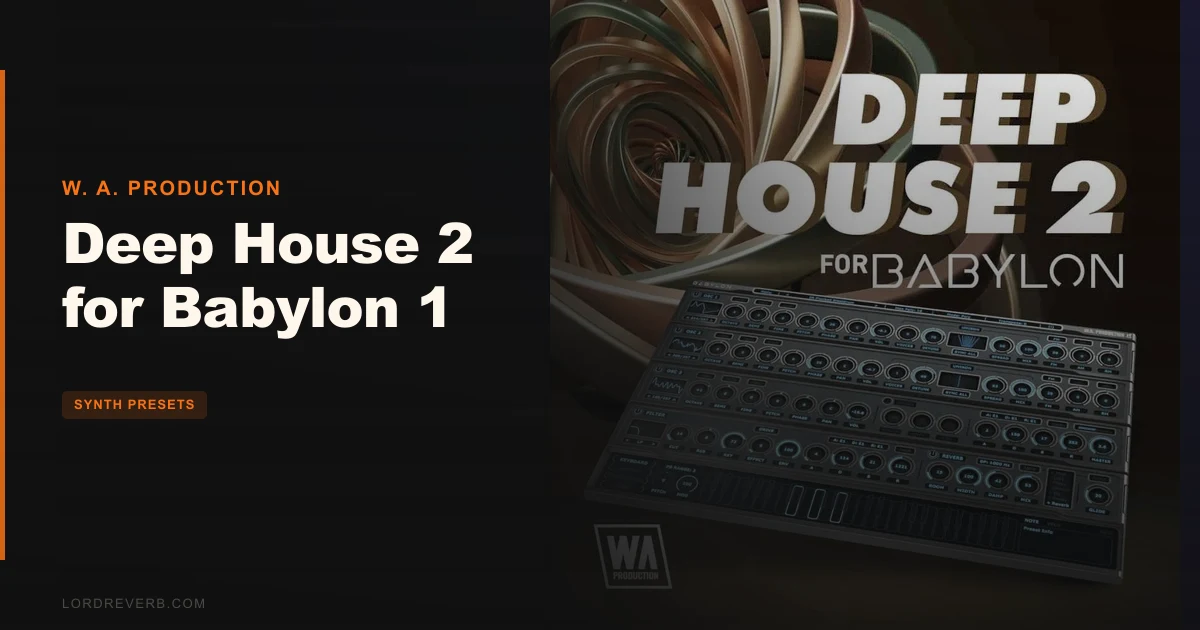
Deep House 2 for Babylon 1 is a 140-preset expansion pack for W. A. Production's Babylon synthesizer, aimed at producers working in the deep house, organic house, and melodic tech space.
We loaded it on a Thursday afternoon with a half-finished track sitting in Ableton. The session needed a pad that breathed, something with slow attack and a subtle pitch shimmer, not a Serum supersaw dressed in vintage clothing. We found three candidates in the first ten minutes of browsing. Two of them were genuinely usable with zero editing. The third needed the cutoff pulled down by about 15% to stop it from masking the lead. That's a good hit rate for a preset pack.
But there's a catch. A real one. And we'll get to it.
What These Presets Actually Are (And What They're Not)
This is a sound design toolkit, not a sample library. Every preset is built inside Babylon's synthesis engine, which means you're getting fully editable patches, not static WAV files dressed up in a plugin wrapper.
The 140 presets split across basslines, keys, leads, pads, and plucks. The categories mirror the original Deep House for Babylon pack almost exactly, which is either efficient or lazy depending on how generous you're feeling toward the naming convention.
What it's not: a shortcut to originality. These presets will sound like deep house because they were designed to sound like deep house. That's the point. If you're building something more experimental or genre-blending, you'll hit the ceiling fast. And if you don't own Babylon, this pack is completely worthless to you. There's no cross-compatibility, no standalone player, nothing. It's Babylon or nothing.
Living With It: Setup, Browsing, and What We Found After a Full Week
Installation is straightforward. Drop the presets into Babylon's preset folder, restart the plugin, and they appear in the browser. No iLok, no activation headaches. That's satisfying.
Browsing the pack without an in-plugin search function is annoying. Babylon's preset browser works by category, so you're scrolling through lists rather than typing "pad" and filtering. On a pack this size it's manageable. On a larger library it would be frustrating. Worth knowing before you buy.
We spent most of our time in the pads and basslines. The pads lean warm, meaning they sit between 200Hz and 2kHz with gentle high-frequency rolloff above 8kHz. They don't fight for space in the top end, which makes layering straightforward. The basslines have usable low-mid presence around 150-250Hz without being muddy. We ran one through a high-pass filter at 40Hz and it sat clean in a mix with a kick that had significant sub content.
The plucks are the weakest category. Several of them share similar attack transient characteristics and the same approximate decay shape. After a few days of using the pack, they started feeling interchangeable. That's a legitimate criticism.
We also compared a handful of presets against the original Deep House for Babylon pack. Read our thoughts on the Progressive Deep 2 expansion Honestly? The sonic gap between V1 and V2 is not obvious. If you already own the first pack, we'd want a clearer reason to buy this one. W. A. Production hasn't published a proper changelog or A/B comparison, and that's a real gap in their communication.
The Trade-Offs Worth Thinking About
The strongest argument for buying this pack is speed. Deep house production has a specific harmonic language: minor keys, suspended chords, offbeat basslines, filtered plucks on the upbeats. These presets speak that language without translation. You don't have to teach Babylon what the genre sounds like.
The trade-off is depth. Because the presets are built for genre authenticity, they share a sonic DNA that becomes obvious after you've used the pack for a few weeks. The pads start to sound like each other. The leads sit in similar frequency ranges. That's not a design flaw, it's a design choice, but it does mean your ceiling for variety within the pack is lower than the 140-preset count implies.
There's also the Babylon dependency issue. Babylon 2 costs a fair amount new. The upgrade from Babylon 1 is priced separately. Check our Babylon synthesizer coverage for full context If you're on Babylon 1 and haven't upgraded, the preset pack itself runs inside Babylon 1 fine, but you're not getting Babylon 2's 858 factory presets or updated synthesis architecture alongside it. That context matters when you're budgeting.
Against the Field
The obvious comparison is deep house preset packs for Serum and Sylenth1. A Serum-based deep house pack at a similar price point typically offers broader genre stretch because Serum's wavetable engine gives you more harmonic options to pull away from the genre center. If you want to drift from deep house toward melodic techno or afro house, a Serum pack gives you more runway.
Sylenth1 deep house packs are often cheaper and the browsing experience inside Sylenth1 is faster. But the sound design ceiling is lower. Babylon sits between these two options: more complex than Sylenth1, more genre-focused than Serum.
For producers committed to Babylon, the closest internal comparison is the Progressive Deep 2 for Babylon 1 pack, which targets a slightly more progressive sound. If your tracks lean harder toward the melodic side, that pack may serve you better than this one.
Against Loopmasters' synth-specific preset offerings, like the Andy Lee House Synth presets for Predator, Deep House 2 holds up on preset count but lacks the single-artist curatorial voice that makes packs like that feel cohesive. These presets feel like a genre catalogue, not a producer's personal palette.
The Real Verdict
If you own Babylon and you produce deep house, this pack earns its price. It's not brilliant. It's not a must-buy. But it does the job: 140 presets that work in the genre, installed in ten minutes, ready to drop into a session without significant editing.
Skip it if you already own Deep House V1 for Babylon and you're hoping V2 sounds noticeably different. The gap isn't wide enough to justify the spend. Also skip it if you're buying Babylon specifically to run this pack. Start with Babylon's 858 factory presets and decide if you need more before adding expansion costs.
Score Breakdown
| Category | Score | Notes |
|---|---|---|
| Sound Quality | 3.5/5 | Genre-accurate with warm pads and usable basslines, but plucks feel repetitive |
| Value for Money | 3.5/5 | Reasonable if you're in the Babylon ecosystem; zero value if you're not |
| Ease of Use | 3.5/5 | Fast install, but Babylon's browser lacks search, which slows navigation |
| Features | 3.0/5 | 140 presets across five categories covers the genre but V2 improvements aren't clear |
| CPU Efficiency | 4.0/5 | CPU load is Babylon's overhead, not this pack's fault; Babylon runs reasonably light |
| Overall | 3.5/5 | A solid, honest genre toolkit for committed Babylon users, nothing more |
Alternatives to Consider
W. A. Production Progressive Deep 2 for Babylon 1, If your productions sit closer to the melodic techno or progressive house side of the deep house spectrum, this pack may be a better fit. See our full review
Loopmasters Andy Lee House Synth Presets for Predator, Built for a different synth but offers a stronger single-artist curation that gives it a more coherent voice across patches. Works best if you're on Predator and want house presets with real personality. Full comparison here
W. A. Production Deep House for InstaComposer 2, If your workflow is more loop and pattern-based than synthesis-driven, the InstaComposer route gives you a different kind of deep house starting point. Read the breakdown
Deep House 2 for Babylon 1 is a competent, genre-faithful preset pack. It's not the pack that will make your music sound different from everyone else's. It's the pack that gets you to a working, genre-correct sound in ten minutes so you can spend the remaining hour writing something worth releasing. Check the manufacturer's site for current pricing, confirm you're on Babylon 1 or 2, and buy it if deep house is genuinely your lane. If you're not sure, don't. The plucks alone won't convince you.
Frequently Asked Questions
Do you need Babylon 2 to run Deep House 2, or does Babylon 1 work?
The pack is built for Babylon 1 compatibility, so you don't need to upgrade to Babylon 2 to access the presets. That said, Babylon 2 is available as a paid upgrade for existing users, which is worth considering if you want the expanded factory library of 858 presets alongside this pack.
How does Deep House 2 compare to the original Deep House for Babylon?
Both packs contain 140 presets across matching categories: bass, keys, lead, pad, and pluck. W. A. Production hasn't published a clear changelog, and in our testing the sonic difference between V1 and V2 was not obvious. If you already own V1, we'd wait for a sale or a more detailed breakdown from the developer before upgrading.
Can these presets work in genres outside deep house?
Some of the pads and leads can stretch into melodic techno or organic house without much editing. The basslines and plucks are more genre-locked. Don't buy this expecting a versatile multi-genre toolkit: it's designed for deep house and that's where it works best.
How do the presets handle further editing inside Babylon?
Because every preset is a fully native Babylon patch, all of Babylon's synthesis parameters are open for editing. You can adjust filter cutoff, envelope shapes, modulation routing, and effects without any restrictions. That's the core advantage of synth-specific presets over sample-based packs: the architecture is yours to work with once you've found a sound you like.