Vibraphone libraries mostly fall into two camps: clean and expensive, or cheap and unconvincing. THEPHONOLOOP's Cassette Vibraphone for Kontakt breaks that pattern by recording a real vibraphone through four different cassette decks and building something that sounds like a memory, not a sample. If you've been layering vinyl crackle over a pristine vibraphone patch and still not getting there, this is what you were actually looking for.
It's a Kontakt instrument priced at $26 (with sale pricing occasionally dropping much lower). It targets producers working in lo-fi, ambient, downtempo, chillout, jazz, and cinematic music. Full Kontakt 5.6.6 or later required. No Player support.
The Specific Problem This Library Exists to Solve
Clean vibraphone samples sound wrong in lo-fi contexts. The high-frequency shimmer of a well-recorded vibes patch sits too clearly, too perfectly, in a mix that's supposed to feel worn-in. You spend time trying to dirty it up with tape saturation, bitcrushers, EQ cuts around 8kHz. It's annoying work. The result is usually a clean sample that sounds like a clean sample wearing a costume.
Recording through cassette decks isn't a filter applied after the fact. The tape compression, the gentle high-frequency rolloff, the subtle harmonic smear: that's baked into the source material here. What you load into Kontakt already sounds like it belongs in that context. You're not fighting the sample. You're building around it.
That's the gap this fills. At that price, it fills the gap without making you justify the purchase to anyone.
How It Actually Performs in a Session
The library ships with 2,372 samples total. Those are split across four cassette decks, with 592 samples per deck, each covering a 3-octave range across 4 dynamic layers with 4x round-robin per layer. The math matters: you're not hearing the same sample repeat when you run a fast melodic line. The repetition fatigue that kills cheaper percussion libraries isn't present here.
We loaded the default patch on a mid-range session machine and played through a chord progression in the 400-700Hz range where vibraphone resonance tends to cluster and bloom. The sustain tail is warm in a measurable sense: high frequencies above roughly 6kHz roll off noticeably compared to a dry recording, and the mid-range body carries more even-order harmonic content. It doesn't sound broken. It sounds considered.
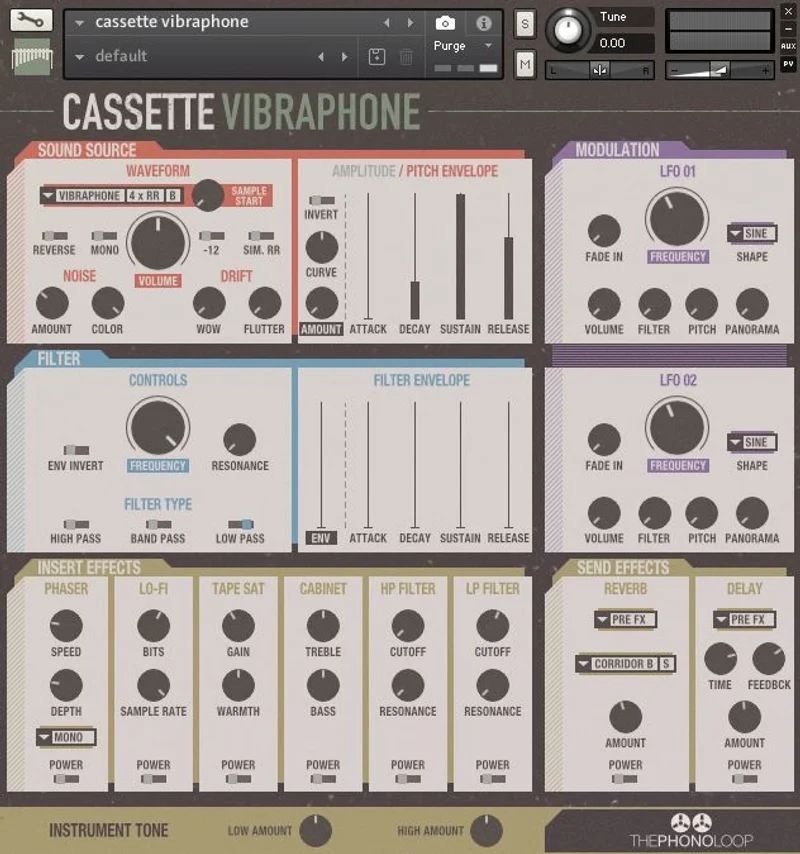
The 11 custom convolution reverb impulses split into 4 spring, 4 hall, and 3 corridor responses. We ran the "corridor 2" impulse on a slow, spaced-out melody and it opened the sound beautifully without washing out the attack. The pre/post insert placement option for effects is a smart inclusion. Put reverb post-drive and the tail blooms. Pre-drive and the reverb diffusion gets gently saturated along with the dry signal. That's a different texture entirely and it's worth experimenting with both positions before settling.
The 42 presets range from usable-right-now vibraphone tones to heavily processed pads and textures that don't obviously read as vibraphone at all. Some of the experimental presets are genuinely clever. A few are borderline ugly, which is exactly right for sound design work.
Multi-format support covers Kontakt 5, Ableton Live 9, Logic Pro X, and SFZ players. Version 1.1 fixed amplitude envelope bugs in reverse mode, which is worth knowing if you were using an earlier build and noticed inconsistent tail behaviour.
What Works, What Doesn't
The round-robin implementation is the standout technical strength. Four velocity layers with four round-robins each means fast passages and repeated notes both hold up. We ran a vibraphone melody at 120bpm with 16th-note runs and didn't hear a single machine-gun artifact. That's satisfying. Most libraries at this price don't manage it.
The cassette deck variation is also underrated as a feature. Switching between decks gives you four distinct characters within the same instrument. One deck skews warmer and darker. Another retains slightly more top-end presence. They're not dramatically different, but they're different enough that you'll have a favourite within ten minutes of playing.
The frustrating part is the Kontakt Player lock-out. If someone owns Kontakt Player but not the full version of Kontakt, they cannot load this library at all. That's a real barrier for newer producers who haven't committed to the full Kontakt ecosystem. THEPHONOLOOP doesn't hide this requirement, but it's worth stating clearly: full Kontakt 5.6.6 or later, no exceptions.
We also wish the developer published polyphony limits and CPU load figures. We didn't hit any obvious performance issues in testing, but running multiple instances in a dense session without any published ceiling is a guessing game. That data should be in the product specs.
Value for the Price
The price is hard to argue with. We'd pay full price for a single usable reverb impulse. Here you're getting 6.76GB of 24-bit WAV files, 2,372 samples, 11 reverb impulses, 42 presets, and a n instrument that sounds like it was recorded with intention rather than assembled to hit a checkbox.
The sale pricing is almost absurd. At that price you're essentially getting the library for free in any practical budgeting sense.
If you need a clean, orchestral vibraphone that sits in a traditional arrangement, this is the wrong place to spend your money. But for the lo-fi and ambient use case it's built for, the value-to-quality ratio is better than most libraries at five times the price. see our best Kontakt instruments for lo-fi production
Who Should (and Shouldn't) Buy This
- ✅ Buy if you produce lo-fi, downtempo, or ambient music and want a vibraphone that already sounds like it belongs in the mix
- ✅ Buy if you score for film or media and need a characterful, vintage-textured mallet instrument for underscore or transitional cues
- ✅ Buy if you own full Kontakt 5.6.6+ and want sound design raw material beyond a standard vibraphone patch
- ❌ Skip if you only have Kontakt Player. It won't load.
- ❌ Skip if you need a clean, orchestral vibraphone for traditional arrangements. Look at Soniccouture Vibraphone or Cinematic Instruments Fine Mallets instead.
- ❌ Skip if you're expecting a full-production-ready instrument with detailed documentation and developer support. This is a boutique library, not an enterprise product.
Score Breakdown
| Category | Score | Notes |
|---|---|---|
| Sound Quality | 4.3/5 | Cassette-sourced character is genuine and consistent across all four decks |
| Value for Money | 4.8/5 | 2,372 samples, 11 reverb impulses, and 42 presets at this price is difficult to beat. |
| Ease of Use | 3.8/5 | Straightforward UI but no published documentation on polyphony or CPU limits |
| Features | 4.0/5 | Pre/post reverb placement and four deck variations add real depth |
| CPU Efficiency | 3.5/5 | No published benchmarks; no obvious issues in testing but can't confirm at scale |
| Overall | 4.2/5 | Best lo-fi vibraphone library at this price; niche but excellent within that niche |
Alternatives Worth Knowing
Soniccouture Vibraphone is the clean-recording alternative. It's a different instrument for a different job: pristine 24-bit sampling, full dynamic range, built for orchestral and jazz contexts where you want the vibraphone to sound like a vibraphone in a real room. The current price is shown in the buy box on this page. Soniccouture Vibraphone review
Cinematic Instruments Fine Mallets covers the broader mallet family with marimba, xylophone, and vibraphone all in one library. More expensive, more flexible, but zero vintage character. If you need a multi-mallet toolkit for scoring, this is the one. best mallet Kontakt libraries for film scoring
8Dio Vibraphone sits between the two in terms of aesthetic. It has more processed preset options than Soniccouture but stays cleaner than Cassette Vibraphone. 8Dio Vibraphone review If you're scoring for picture and occasionally need a lo-fi option, 8Dio gives you more range. If lo-fi is your primary territory, Cassette Vibraphone is the more direct answer.
Buy Cassette Vibraphone for Kontakt if you make lo-fi, ambient, or cinematic music and own full Kontakt. Skip it if you need a clean orchestral vibraphone or if Kontakt Player is your only option. That's the whole decision.
Frequently Asked Questions
Does Cassette Vibraphone work with Kontakt Player?
No. This library requires the full version of Kontakt 5.6.6 or later. Kontakt Player will not load it. This is one of the library's real limitations, and it's worth checking your Kontakt version before purchasing.
What makes this different from a standard vibraphone library?
The source recordings were captured through four different cassette decks before sampling. That process introduces gentle tape compression, high-frequency rolloff above roughly 6kHz, and subtle harmonic content that you don't get from a clean studio recording. It's not a filter applied after the fact. It's in the samples themselves.
How many presets does Cassette Vibraphone include, and are they usable?
42 presets are included. They range from straight vibraphone tones to heavily processed ambient pads and experimental textures. Some are immediately usable in a session. A few are deliberately strange, which makes them useful for sound design work rather than melodic performance. The quality is consistent across both categories.
Can I use Cassette Vibraphone in Ableton or Logic without Kontakt?
Yes, partially. The library ships with multi-format support including Ableton Live 9 and Logic Pro X compatibility, as well as SFZ player support. You won't have access to the full Kontakt scripting, convolution reverbs, or preset system without loading it in Kontakt, but the core samples are accessible in those environments.