
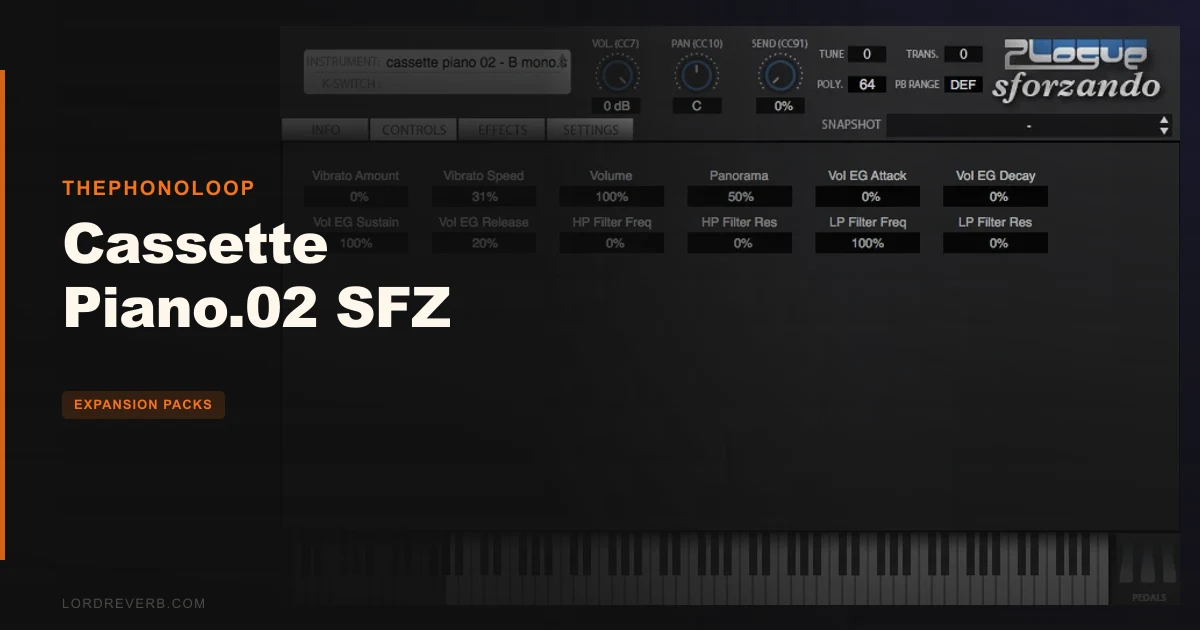
Cassette Piano.02 SFZ is a strong buy if you want genuine cassette-degraded upright piano samples that load in any free SFZ player, but it's not the right pick if you want hands-on tape wobble control or deep modulation routing. That's the short answer. Here's the longer one.
THEPHONOLOOP built this around an intentionally flawed old upright piano recorded in a ballet training room, both stereo and mono, then ran those recordings through four physically distinct cassette decks to introduce different grades of pitch instability and noise. The recordings captured an organic and tasty sound with all kinds of little imperfections. The result is a sample library that sits in the lo-fi, jazz-hop, and bedroom pop space, and it's aimed squarely at producers who want tape coloration baked into the source, not added as a post-processing plugin.
This is for producers working in Plogue Sforzando, Plugin Boutique's Zampler, or any SFZ-compatible host on Mac, Windows, or Linux. If you're on Kontakt and want the full modulation suite, THEPHONOLOOP sells that version separately.
Does the Cassette Degradation Hold Up, or Is It Just Noise?
The honest skeptic's question about Cassette Piano.02 SFZ is this: is the cassette "character" a real sonic asset, or just slapped-on hiss you could fake with a free lo-fi plugin? We tested it. The answer is: it depends which deck you load.
Deck A Stereo is the highest quality version with very low pitch instability, recorded in stereo. Deck A Mono is the same quality but mono. Deck B Mono uses a slightly loose drive belt that introduces a lot of pitch instability, which sounds great when transposed down. Deck C Mono is the noisiest deck of all, with medium pitch instability. Deck D Mono is similar to Deck A but with more instability in pitch and overall sound.
We loaded Deck B Mono and dropped the instrument down one octave using the built-in octave switch. The pitch wobble became slow, irregular, and satisfying in a way that a static pitch modulation LFO doesn't replicate. That's the genuine article: the instability isn't periodic or perfectly shaped, it drifts in and out the way a real worn belt does.
The Simulated Round Robin makes faster note passages sound more realistic and adds to the overall nonlinearity of the instrument. That's a clever move for a sampler instrument at this price. Repeated notes don't machine-gun.
Where It Shines
The denoising approach is genuinely clever. Most lo-fi sample libraries just leave raw tape hiss baked into every note, which means playing a five-note chord stacks five layers of hiss on top of each other.
Every note has been carefully denoised with a high quality algorithm to avoid noise stacking when playing more than one note, with some noise left in the samples to avoid denoising artifacts. Noise can still be added with the noise knob, which allows you to adjust the volume of the noise independently while also applying filtering. When playing a five-voice chord, only one sample of noise instead of five stacked on top of each other will be heard. That's a real engineering decision that separates this from lazy lo-fi libraries.
The library ships with 5 GB of samples, 1,325 samples in total, recorded on 4 different decks with mono and stereo versions, 5 noise samples (each around 2 minutes long), 3 velocity layers, and 5 basic presets. For $29, that sample count and the multi-deck approach represent solid value per note. The 3 velocity layers keep the instrument playable rather than a one-dynamic-tone sound effect.
We ran a slow left-hand bass line on Deck C Mono at 74 BPM. The low register sat between 150–250Hz with a naturally rolling-off high end above 5kHz that comes from the cassette medium itself. No EQ touch needed to keep it from poking out of a beat. It just sat.
Compatibility with any SFZ player including the free Plugin Boutique Zampler is a real advantage. No Kontakt licence required. No iLok. No activation server. Load and play on Mac, Windows, or Linux without friction.
Where It Falls Short
The pitch wobble on Deck B is baked in. You can't reduce it, shape the rate, or sync it to your BPM. You're stuck with what the physical belt gives you. That's charming in one context and frustrating in three others.
The SFZ version skips the modulation suite that the Kontakt version gets. There are features like the sample start knob (controllable via Mod Wheel) which allows you to control initial transients while designing your sound. That's present in SFZ. But the Kontakt edition layers on 2 independent LFOs with 5 shapes and 4 destinations each, that's entirely absent here. If modulation routing matters to your workflow, the SFZ version will feel stripped.
Five presets is not a starting point. It's barely a suggestion. Producers who want to audition sounds quickly will be annoyed. You're loading individual SFZ files per deck, not cycling through ready-to-use patches. That's a workflow snag that THEPHONOLOOP hasn't resolved across versions.
We also don't love the lack of any flutter rate control. Real tape flutter sits in the 0.5–20Hz range depending on the mechanism. The baked wobble on Deck B reads closer to 1–3Hz, which sounds great for slow passages and ugly on anything above 120 BPM with rapid 16th-note lines. You can't dial it back. Skip Deck B for uptempo work.
How It Stacks Up Against the Real Competition
The most direct comparison is Native Instruments Vintage Pianos (part of Komplete). That library covers five classic upright and grand piano models with full Kontakt modulation, multiple mic positions, and NKS integration. It's also significantly more expensive and requires a full Kontakt licence.
Cassette Piano.02 SFZ wins on format accessibility and lo-fi authenticity. NI Vintage Pianos wins on clean fidelity, mic blending, and control depth. If you want studio-quality piano that you occasionally dirty up with a plugin chain, go Vintage Pianos. If you want the dirt to be intrinsic to the source signal and you're working SFZ, choose Cassette Piano.02.
For a closer THEPHONOLOOP comparison, check Cassette Mallets .02 review. Mallets uses the same cassette deck architecture and sits at a similar price. If mallet textures suit your project better than piano, Mallets edges it for tonal variety. Piano wins on playability and low-register weight.
Also worth looking at Cassette Vibraphone for Kontakt review if you're already in the Kontakt ecosystem and want that extended LFO routing back.
Is $29 Fair for What You Get?
Yes, with one clear caveat. 5 GB of samples and 1,325 total recordings across 4 deck variants for $29 is a good deal on raw material. The per-note denoising engineering alone justifies the premium over similarly priced lo-fi piano samples that ship as flat WAVs.
The caveat: if you want the full version with LFO modulation and deeper sound design, the multi-format bundle costs more. The SFZ-only purchase at $29 is best understood as the "load and play" tier. Know which tier you need before buying.
Score Breakdown
| Category | Score | Notes |
|---|---|---|
| Sound Quality | 4.0/5 | Genuine cassette coloration from physical decks; 3-velocity-layer playability holds up |
| Value for Money | 4.0/5 | 5 GB of per-note denoised samples for $29 is honest pricing |
| Ease of Use | 3.0/5 | Loading individual SFZ files per deck is clunky; only 5 presets to start from |
| Features | 3.5/5 | Noise slider + sample start knob are clever; missing LFOs and adjustable flutter rate |
| CPU Efficiency | 4.5/5 | SFZ streaming is light; no proprietary engine overhead |
| Overall | 3.8/5 | A well-engineered lo-fi piano at a fair price, held back by thin preset count and no wobble control |
Alternatives to Consider
THEPHONOLOOP Cassette Mallets .02 (Multi-Format Bundle): Same cassette deck architecture, same denoising logic, but mallet timbres instead of piano. Works best for producers who want melodic top-lines rather than chordal bed. Read our full Cassette Mallets .02 review
THEPHONOLOOP Cassette Vibraphone for Kontakt: If you're already licensed for Kontakt and want the extended modulation routing that the SFZ version skips, the vibraphone is worth considering as a companion. Read our Cassette Vibraphone for Kontakt review
Native Instruments Vintage Pianos (Komplete): Cleaner, deeper, more controllable piano library with multiple mic perspectives. Right for film scoring and pop production. Wrong for lo-fi beats where clean is the enemy. Requires full Kontakt licence.
Cassette Piano.02 SFZ is a buy if you produce lo-fi hip-hop, bedroom pop, or jazz-influenced beats and you want an upright piano that already sounds like it came off a worn cassette. It's a skip if you need adjustable wobble rate, serious modulation routing, or a preset-heavy instrument you can explore without building patches yourself. Thirty dollars for 5 GB of genuinely degraded, carefully engineered piano samples is fair. Just don't expect a sound designer's toolkit. Expect a working instrument with one very specific, very good personality.
Frequently Asked Questions
Do I need Kontakt to use Cassette Piano.02 SFZ?
Cassette Piano.02 SFZ is compatible with any SFZ player, for example Plugin Boutique Zampler, which is free. You don't need a Kontakt licence at all. Plogue Sforzando also works and is free. Load the .sfz files directly into your SFZ player of choice and you're ready to go. No activation server, no dongle.
What's the difference between the SFZ version and the Kontakt version?
Both share the same core sample pool, 5 GB, 1,325 samples, 4 deck variants, 3 velocity layers. The Kontakt version adds 2 independent LFOs with 5 shapes and 4 destinations each, extending modulation routing significantly. The SFZ version keeps it simpler: noise slider, sample start knob, octave switch, and a 2-band EQ. If you want sound design depth, the Kontakt version or the full multi-format bundle is worth the upgrade.
Can I control how much tape wobble is applied?
Not directly in the SFZ version. The pitch instability on each deck is baked into the recorded samples rather than applied as a real-time modulation parameter. Deck A Stereo and Deck A Mono have very low pitch instability, while Deck B Mono's slightly loose drive belt introduces a lot of pitch instability, and Deck C Mono sits at medium pitch instability. You choose your wobble amount by choosing your deck, not by dialing a knob.
Is Cassette Piano.02 SFZ usable on Linux?
It's available in the SFZ format, which is compatible with any SFZ player. SFZ players like Plogue Sforzando and LinuxSampler run on Linux, so the library functions on Linux systems, which is genuinely rare for commercial piano instruments at this price. Mac and Windows are fully supported too. No format-specific limitations apply to the sample files themselves.