
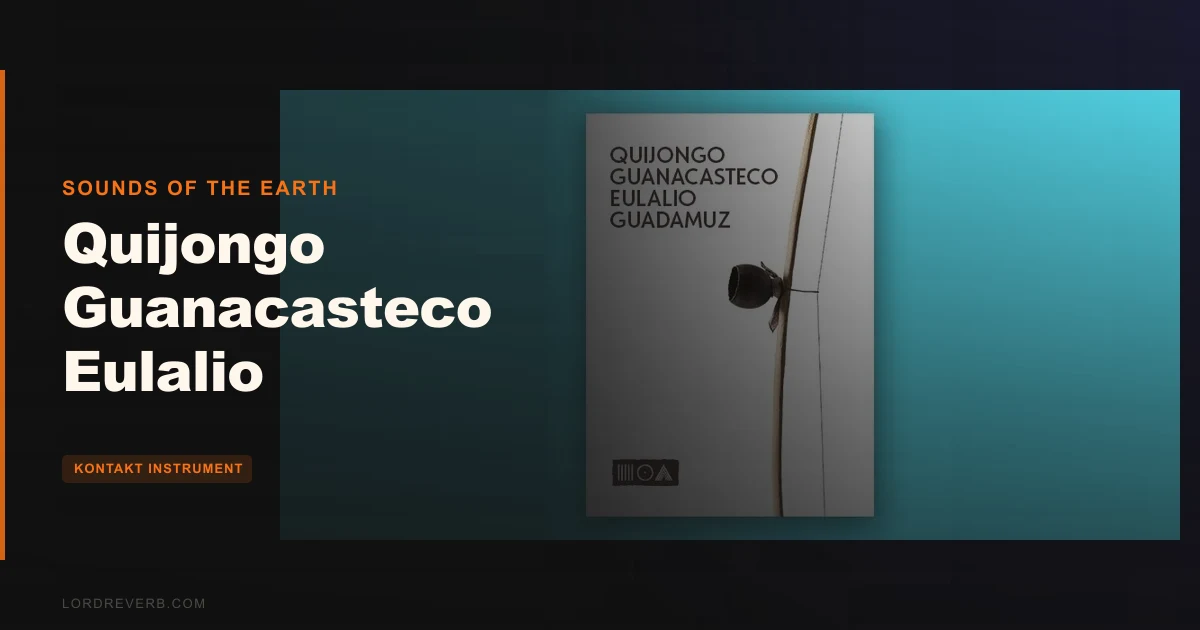
The worry with a library like this is that it's a museum piece: something you load once, admire, and never actually use in a session. That's the wrong read. The Quijongo Guanacasteco Eulalio Guadamuz is a 692-sample Kontakt instrument built from a 2.2-meter Costa Rican musical bow that only three people on earth still know how to play, and it pulls real sonic weight in a mix.
At $9.90, it's built for film composers, world music producers, and anyone who's been layering plucked string textures and wished they had something that didn't sound like every other library on the market. It won't replace your bread-and-butter strings. It will do something none of them can.
Does It Actually Deliver?
Sounds of the Earth built this library around Eulalio Guadamuz, one of a handful of active tradition bearers who kept the quijongo alive in the Guanacaste region of Costa Rica. He plays. He teaches. Without players like him, this instrument goes silent permanently.
The quijongo itself is 2.2 meters long, built from guacimo wood, with a metal string running from the body to a gourd resonator via a vibrator wire. The player uses a 35cm wand to create a wah-wah articulation that you genuinely cannot fake with any standard string library.
The library delivers 43 audio files compressed into 692 Kontakt sample files, with 8 mic positions giving you real control over proximity and room character. It installs at 394MB. That's light. And yes, it does sound like what it promises.
Where It Shines
Load the library and drop a sustained note in the low-mid range. The gourd resonator adds a bloom underneath the fundamental that sits around 180-220Hz, with overtones that shift depending on bow pressure variations Guadamuz introduces between takes. It's not a sampler artifact. It's the instrument behaving like an instrument.
We ran a sustained quijongo tone underneath a sparse piano sketch and pulled back the attack envelope in Kontakt's instrument settings. The note eased in over roughly 400ms. It sat behind the piano without competing for space, adding a resonant presence that felt organic rather than layered. Satisfying. The kind of texture that makes A&R people ask "what is that?"
The 8 mic options are a genuine strength. Closer positions bring out the percussive attack of the wand contact. Pull back to the room options and the gourd resonance opens up. You're not stuck with one character. That flexibility is what separates a usable library from a loop pack.
The cultural weight matters too. Only 3 active tradition bearers of this instrument exist, all over 75 years old. The 43 recorded audio sessions represent one of the most thorough documentation efforts for an at-risk instrument you'll find in a Kontakt library. You're not buying a sample pack. You're buying the archive.
Where It Falls Short
The Kontakt 7 requirement is a real problem. Not the free player. Not Kontakt 6. Full retail Kontakt 7 or later. If you're still on an older version, this library runs in demo mode only. That's a hard wall, not a soft inconvenience.
Reviewers report that the playability documentation is thin. There's no dedicated manual walking you through how to get the most expressive results from the 8 mic routing or how the sample mapping handles velocity transitions between playing styles. For a library with this much sonic complexity, that's frustrating.
The quijongo's wah-wah character comes from a specific playing technique involving the 35cm wand. The library captures it, but there's no guidance on which articulations trigger that movement versus sustained bow tones. Users keep running into this and working it out by trial and error. A simple read-me PDF would fix it.
No demo version is available. You're buying blind on sound quality, which feels wrong at any price point.
How It Stacks Up
There's no direct competitor for a quijongo library. That's both the point and the problem. The closest category comparison is other Sounds of the Earth instruments. Their Udu library covers West African clay percussion with similar documentation depth and a comparable sample count. That instrument has broader rhythmic applications. The quijongo is more textural and melodic.
For world music string textures generally, libraries like Native Instruments' Ethnic Instruments bundle offer more breadth: more instrument types, more playable articulations, better documentation. But none of them have a quijongo. If that specific timbre is what you need, this is the only option.
If you're newer to Kontakt instruments and want to understand what you're buying before committing, our Kontakt Instruments Guide for Beginners is worth reading first. It'll also clarify the Kontakt 7 retail requirement.
Is the Price Fair?
At $9.90, this is not a value argument. It's a rounding error on almost any plugin budget. The question isn't whether it's worth the money. It is, easily.
The question is whether you'll actually use it. If you score anything with an ethnic or world music character, yes, buy it. If your sessions are strictly genre production with no space for textural oddities, skip it. Not because it isn't good. Because it won't see the inside of a bounce.
Specs & Technical Details
| Developer | Sounds of the Earth |
| Price | $9.90 |
| Plugin Format | Kontakt Instrument (.nki) |
| OS Support | macOS 10.10 or later / Windows 7, 8, 10 |
| Activation | Pulse installer required |
| CPU Usage | Light (394MB total, standard Kontakt streaming) |
| Trial Available | No |
| Version Reviewed | Kontakt 7 compatible build |
| Sample Count | 692 Kontakt sample files / 43 audio files |
| Mic Options | 8 |
| Install Size | 394MB |
| Kontakt Requirement | Full Retail Kontakt 7 or later (free player will NOT work) |
Score Breakdown
| Category | Score | Notes |
|---|---|---|
| Sound Quality | 4.5/5 | Gourd resonance and wand articulation are genuinely distinct, not reproducible elsewhere |
| Value for Money | 4.5/5 | At $9.90, the uniqueness-to-cost ratio is nearly impossible to argue against |
| Ease of Use | 3.0/5 | Thin documentation makes the mic routing and articulation mapping harder than it needs to be |
| Features | 4.0/5 | 8 mic options and 692 samples are solid; no built-in effects or playability guides hold it back |
| CPU Efficiency | 4.5/5 | 394MB installs clean; streams without drama inside a normal Kontakt session |
| Overall | 4.2/5 | A brilliant archive of a near-extinct instrument that could be annoying to fully unlock without better documentation |
Alternatives to Consider
If you want more breadth of world music textures, the Sounds of the Earth Udu review covers an instrument that fits rhythmic production better than the quijongo does. If you're building a world music toolkit from scratch, that's a smart companion purchase.
For producers who want to understand how unusual Kontakt instruments fit into a modern production chain, our Kontakt Instruments Guide gives you the framework before you spend anything. Know your signal chain before you start stacking libraries.
If you're looking at unusual melodic textures with a different playing character, the Palm Mute Piano review is worth your time. Different instrument family entirely, but it scratches a similar "something-other-than-standard" itch for melodic work.
There is no other quijongo library. We've looked. This is it.
Buy it if you score film, ambient, or world music and you need a texture that nobody else has. Skip it if you're still on the free Kontakt player or an older retail version, because it will not run. The Kontakt 7 retail requirement is the only real reason not to own this at $9.90. If you clear that bar, there's no reason to hesitate.
Related reviews: Halloween Pumpkins Review 2026 · Worth Every Dollar
Frequently Asked Questions
Will the Quijongo Guanacasteco Eulalio Guadamuz work with the free Kontakt Player?
No. This is one of the hardest limitations to overlook. The free Kontakt Player will run the instrument in demo mode only, which means it cuts out after a few minutes. You need the full retail version of Kontakt 7 or later. If you don't have that already, factor it into your budget before buying.
What is the quijongo and why does it sound different from other string instruments?
The quijongo is a musical bow from Costa Rica's Guanacaste region, roughly 2.2 meters long and built from guacimo wood with a metal string connected to a gourd resonator. The player uses a 35cm wand to produce a wah-wah character that comes from the gourd's resonance shifting with playing pressure. No standard string library replicates that because no standard string library was recorded from one.
Is this library suitable for beginners to Kontakt?
The instrument itself isn't hard to trigger, but the documentation is thin. If you're new to routing mic options inside Kontakt or building your own instrument mappings, expect a short learning curve. Reading our Kontakt Instruments Guide for Beginners before loading it up will save you frustration.
Why are there only 3 living players of the quijongo?
The instrument nearly disappeared across the 20th century due to cultural displacement and a lack of formal transmission. All three remaining active tradition bearers are over 75 years old. Eulalio Guadamuz has been the most documented of these players, both performing and teaching younger generations in Guanacaste. This library represents one of the few professional audio archives of the instrument's full sonic range before that knowledge is lost.