The TAPED: Echolette Choir by KLANG is worth six dollars, and if you already own Kontakt Full, you should probably just buy it right now and finish reading later. That's the honest verdict. It's a lo-fi tape emulation instrument with real character, real limitations, and a price so low that most objections dissolve before you can finish typing them.
It's not a mixing tool. It's not a workhorse reverb. It's a mood machine built around the sonic DNA of the Echolette, a vintage German tape echo unit from the 1960s that found its way onto stages and into studios for decades.
If you're chasing that degraded, flutter-worn texture that sits under synth pads, lo-fi beats, or ambient guitar loops, this nails it faster than you'd expect. If you're hoping to replace a dedicated tape plugin in a professional mix chain, it won't get you there.
What You're Actually Getting
KLANG built this as a Kontakt instrument and an Ableton Live device, both priced at $6. We tested the Kontakt version, which needs Kontakt Full 5.6.8 or higher.
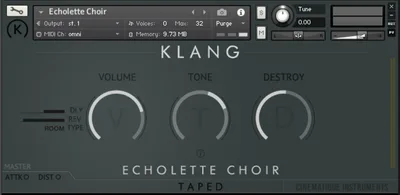
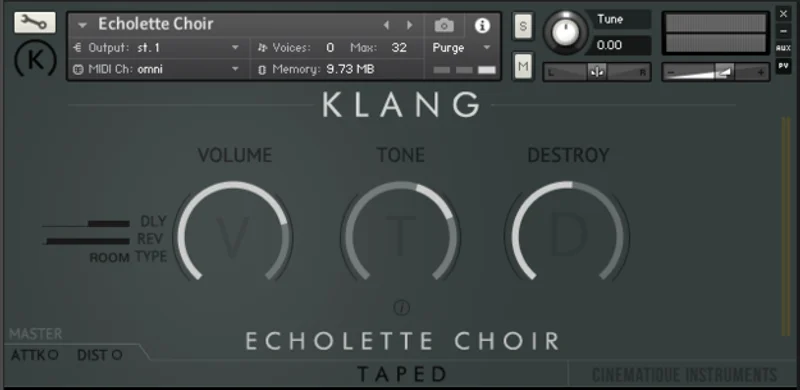
The interface has eight controls: Rage, Tone, Destroy, Volume, Attack, Distort, Delay, and Reverb. There's no deep modulation matrix. No preset library. No visual feedback like a spectrum analyser or gain meter. What you get is a single-screen instrument you load, play, and twist.
The source sounds are choral and textural. The Echolette Choir name isn't metaphorical: the instrument feeds choir-type tones through tape-modeled processing including wow, flutter, saturation, and self-oscillation effects. It sounds old. That's the point.
Ratings across both platforms back up the concept. The Kontakt version sits at 4.7 out of 5 across 55 reviews. The Ableton version holds 5.0 out of 5 from 8 reviews. Small sample on the Ableton side, but the Kontakt number carries real weight.
The Good
The Rage control is where this instrument stops being boring. We pushed Rage to about 70% with Distort engaged, running a held major chord. The result broke apart in a way that felt satisfying rather than digital. The saturation added odd-order harmonics that pushed the sound forward in the mix without boosting the volume.
Self-oscillation kicked in around 85% on the Delay control when we pushed the feedback up. Most software self-oscillation sounds clipped and ugly. Here it built slowly, climbing into controlled chaos before feeding back on itself. We loved that moment. Ran it three times deliberately.
The Destroy control genuinely destroys things. At 40% it introduced warm, slightly warped degradation, the kind you'd hear from a tape running at the wrong speed. At 80%, it chewed through the signal in a way that sat brilliantly under a clean piano layer, adding grit without killing the original note.
For six dollars, the depth of character here is embarrassing to competing plugins that cost forty times more and do the same job worse.
The Not-So-Good
You need Kontakt Full. Not the free Player, not a trial. Full. If you don't own it, this instrument actually costs you several hundred dollars to access. That's the number one thing to know before buying.
The no-preset situation is annoying. We started four different sessions with this instrument and spent the first few minutes re-dialling the same approximate settings each time. A handful of factory starting points would fix this completely. It's a frustrating oversight on an otherwise clean product.
CPU load isn't documented anywhere, and KLANG doesn't publish specs. We ran it on an M2 Mac in Kontakt 7 alongside a moderately busy project and noticed no significant hit. But we can't give you a number, and that's a problem for producers who manage CPU budgets carefully.
The Ableton Live version requires Live 10 Suite or above. That rules out Intro and Standard users, which cuts out a meaningful slice of Live's user base.
Compared to the Alternatives
Soundtoys Decapitator gives you five analog saturation models, full wet/dry control, and a punish mode that tears signals apart. It costs around full price. It's a professional tool for mixing. The Echolette Choir is not trying to be that, and the comparison feels unfair in both directions.
Valhalla Vintage Verb delivers deep reverb algorithms with controls that go far beyond what Echolette Choir offers. Again, different category. Vintage Verb is a reverb plugin. Echolette Choir is a textural instrument with reverb as one of eight knobs.
The closer comparison is TAPED: Blooming Vibes, another KLANG instrument at the same $6 price point. If you're debating between them, buy both. At six dollars each, that's still cheaper than most single plugins in this genre.
For tape saturation specifically, iZotope's Vinyl free plugin covers some similar ground. It's free and solid, but lacks the Echolette Choir's musical self-oscillat ion behaviour and the expressive Rage-to-Destroy signal chain.
Who Should Buy This
- ✅ Buy if you already own Kontakt Full and produce lo-fi, ambient, or experimental music.
- ✅ Buy if you want a fast, cheap layer of tape texture without building a saturation chain from scratch.
- ✅ Buy if six dollars is genuinely a low-stakes spend and you like discovering odd tools.
- ❌ Skip if you only own Kontakt Player. It won't load.
- ❌ Skip if you need a transparent, mix-ready tape plugin for professional sessions. This isn't that.
- ❌ Skip if you use Ableton Intro or Standard. The Live version needs Suite.
Score Breakdown
| Category | Score | Notes |
|---|---|---|
| Sound Quality | 4.0/5 | Genuinely characterful tape textures; self-oscillation and Destroy behave musically |
| Value for Money | 5.0/5 | Six dollars. Argument over. |
| Ease of Use | 3.0/5 | Eight knobs, no presets: fast to start, frustrating to recall |
| Features | 3.0/5 | Rage, Tone, Destroy, Distort, Delay, Reverb, Attack, Volume, no modulation, no preset management |
| CPU Efficiency | 3.5/5 | Appeared light in our M2 testing but undocumented; can't confirm under heavy load |
| Overall | 3.9/5 | Brilliant concept and price; held back by platform gatekeeping and missing basics like preset saving |
Alternatives to Consider
TAPED: Blooming Vibes by KLANG sits at $6 and comes from the same design philosophy. If Echolette Choir speaks to you, read our Blooming Vibes review before deciding which to grab first. Honestly, buy both.
iZotope Vinyl is free and covers vinyl degradation and tape-style noise convincingly. It's a free plugin worth having in your chain even if it's less expressive on the oscillation side.
Soundtoys Decapitator is the serious option if your budget stretches further. It's a professional saturation tool with real mixing credentials. Compare it to Echolette Choir only if you need mix-ready results rather than textural mood.
Valhalla Vintage Verb covers the reverb side more thoroughly at a higher price. If it's the reverb control in Echolette Choir you're most drawn to, Vintage Verb gives you more of that with far deeper algorithm control.
Should You Buy the TAPED: Echolette Choir?
Buy it. Six dollars doesn't require a convincing argument, just a working Kontakt Full licence.
We'd skip it only if you expected it to function as a proper mix tool. It isn't one. It's an instrument designed to make clean sounds feel worn, old, and slightly haunted. On that brief, it delivers every time.
The no-preset situation is the one genuinely annoying gap. A tool this expressive deserves to be recallable. Right now, every session starts from zero, which wastes the speed that the simple interface promises.
At $6, KLANG has basically dared you not to own it. Don't be the person who declined on principle and spent the next year layering EQ and tape plugins trying to recreate what this does in forty seconds.
Frequently Asked Questions
Does TAPED: Echolette Choir work with the free Kontakt Player?
No. It requires Kontakt Full, version 5.6.8 or higher. Kontakt Player won't load it. If you're running the free Player, you'll need to upgrade to the full version of Kontakt before this instrument becomes usable.
What does the Destroy control actually do?
Destroy degrades the signal in a tape-style way. At low settings around 20-40%, it adds warmth and subtle flutter. Past 60%, it starts breaking the signal apart noticeably, adding noise and instability that works well under cleaner layers. It's destructive by design, not a mistake.
Is the Ableton version different from the Kontakt version?
Both are priced at $6 and built around the same Echolette concept, but they are separate products built for their respective platforms. The Kontakt version requires Kontakt Full 5.6.8 or above. The Ableton version needs Ableton Live 10 Suite or above. Buy the one that matches your setup, or pick up both if you use both DAWs.
How does TAPED: Echolette Choir sit in a mix against live instruments?
We used it as a pad layer under clean acoustic guitar and it sat cleanly without masking the attack of the guitar strings. The Tone control let us pull the high-end back enough to keep it from competing with the top end. For that kind of textural background role, it earns its place without much fuss.