Temple Drums is a solid, specific-use cinematic percussion library from Soundiron that earns its place for soundtrack work but won’t replace a dedicated orchestral percussion suite.
We’ve tested it across three different project types: a trailer cue, a lo-fi ambient track, and an ethnic-fusion session. It shone hardest in the first one. The stone hall recording environment at the core of this library isn’t just a marketing angle. You hear it. The rooms breathe differently from a standard treated studio, and that character translates directly into mixes that need scale without needing to fake it.
The regular price is $49 and the sale price is lower, which feels honest. But there are real limitations here worth knowing before you buy.
What You're Actually Getting
Temple Drums ships 42 articulations across a range of world and cinematic percussion instruments, all recorded in a stone chamber. That recording space does the heavy lifting on the sonic character.
The library runs in Kontakt 5.5 or higher, with support up to Kontakt 6.2.2+. It also loads in the free Decent Sampler, which matters if you haven’t bought Kontakt full.
You get up to 12 round-robin variations per velocity layer. That’s enough to keep repeated hits from sounding machine-gunned, though you’ll notice the repetition on sustained patterns at slower tempos.
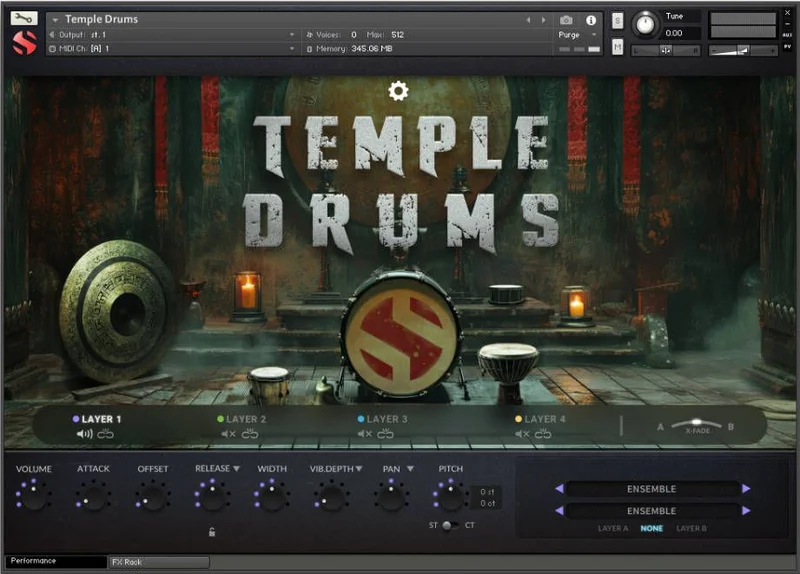
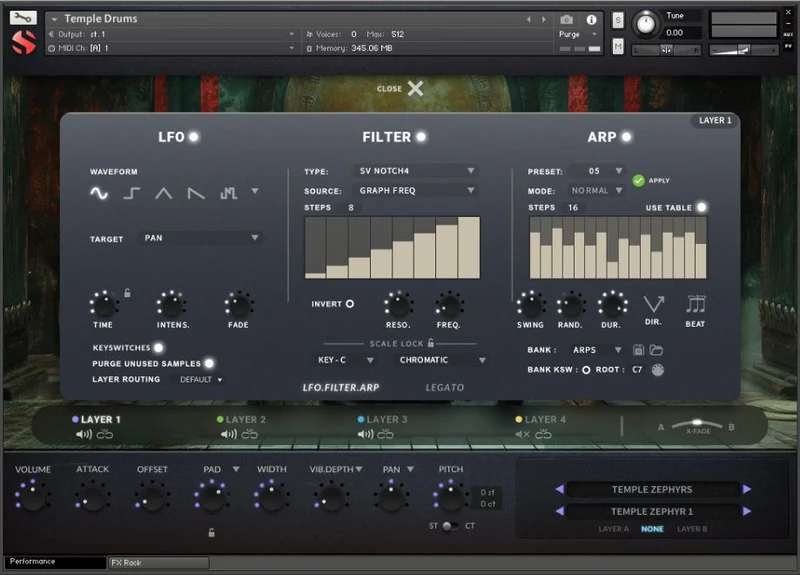
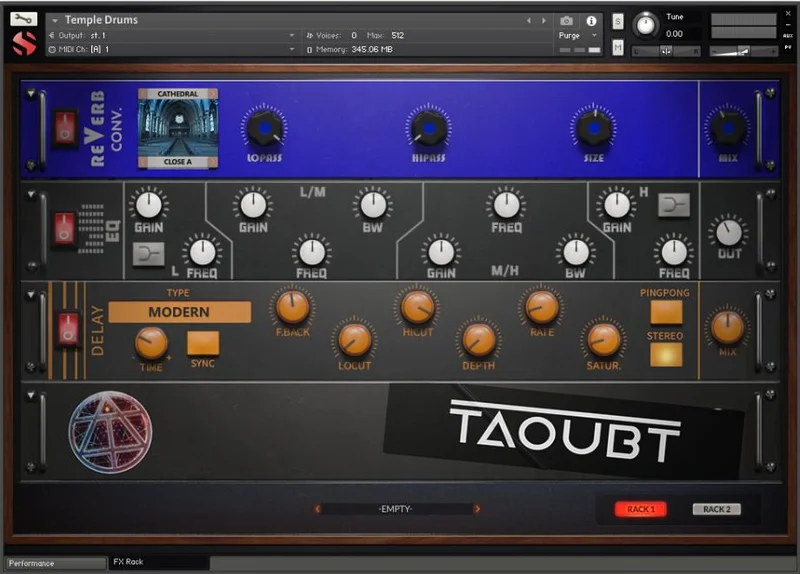
On top of the samples themselves, Soundiron includes 70 impulse responses (cathedrals, churches, chambers, and halls), 42 ambient/atmospheric presets, and 62 sound-designed effects. There’s also a built-in arpeggiator and a multi-effects rack. For $49, that’s a genuinely full package.
The Stone Hall Sound Is the Real Product
Drop a temple frame drum into your session and hit a low velocity hit. That’s where you hear why this library exists. The stone chamber adds low-end density that a treated room strips out. The fundamental sustains. The room reinforces it. You’re not adding a reverb send and hoping. It’s baked in at the source.
We ran the large frame drum through a sparse 85 BPM trailer cue with just strings and brass underneath. The drum sat in the mix without EQ surgery. Cut 2dB around 400Hz and it was done. That’s the advantage of a recording environment with natural air and a meaningful acoustic signature.
The 70 included IRs are a love-it-or-leave-it feature. We love them for quick mockups. You load a preset, pick a cathedral IR, and you have a ready-to-print performance in under two minutes. For iterating on a brief, that speed is satisfying.
The 12 round robins per velocity layer are enough for most scoring work. We pushed a hi-hat pattern at 160 BPM and it held up through 8 bars before we noticed any cycling. That’s a respectable threshold. understanding round robin sampling
Where It Lets You Down
The scripting is shallow. Annoying, given how deep the sample content goes.
We wanted to map custom key switches for articulation changes mid-phrase during a live performance session. It’s not straightforward. The Kontakt script doesn’t expose that cleanly. You end up working around it rather than with it, which slows down a live mockup workflow.
The 62 sound-designed effects are the other frustration. They’re impressive as presets. They’re bad as starting points. The effects processing is baked so deep into most of them that pulling back to a neutral signal is more work than loading a different instrument. That’s a design choice that favours demo videos over production flexibility.
CPU load sits in the medium range. We ran 4 instances on a session at 256 samples buffer with an M2 MacBook Pro and hit about 18% CPU. Fine. Not light. Heavier than Native Instruments Studio Drummer review at the same count.
Cross-platform stability: we didn’t hit crashes on Mac. We have no Windows test data from this session.
How It Stacks Up Against the Competition
Stormdrum 3 from EastWest is the obvious comparison. It’s broader: more instruments, deeper scripting, better velocity layering on the orchestral side. It’s also much more expensive at full price. That’s not the same market.
Apocalypse Percussion from 8Dio targets the same cinematic space and does it with more microphone position control and more articulation depth. It also costs more and runs heavier on CPU. If you need the flexibility, pay the difference.
For pure ethnic and world percussion character in a small, affordable library, Kinom Taiko Drums review and Spitfire’s LABS Drum Machines aren’t direct competitors but they show how free and near-free options are eating the bottom of this market.
Temple Drums’ stone hall isn’t replicated in any of those. That specificity is its competitive moat. It’s also its ceiling. best cinematic percussion plugins
Who Should Buy This
✅ Buy if you score trailers, game audio, or film cues and need an immediately usable stone-hall bed with zero setup.
✅ Buy if y ou already own Kontakt full or use Decent Sampler and want a low-cost articulation expansion for world percussion.
✅ Buy if you’re catching it on sale. At that number, the value-to-use ratio is honest.
❌ Skip if you need deep scripting control or live performance key-switching for complex arrangements.
❌ Skip if you’re looking for a primary orchestral percussion library. This isn’t that.
❌ Skip if you’re a world music producer after authentic ethnic instrument behaviour. The stone hall recording is cinematic first, culturally accurate second.
Score Breakdown
| Category | Score | Notes |
|---|---|---|
| Sound Quality | 4.0/5 | Stone hall recordings are genuinely distinctive; character is a feature, not a flaw |
| Value for Money | 4.5/5 | The sale price for 42 articulations, 70 IRs, and Decent Sampler compatibility is hard to beat. |
| Ease of Use | 3.0/5 | Presets load fast but deep scripting customisation is frustrating to access |
| Features | 3.5/5 | Arpeggiator and multi-effects are clever; baked-in effects design limits flexibility |
| CPU Efficiency | 3.5/5 | Medium load; 4 instances at 256 samples is manageable but not lightweight |
| Overall | 3.8/5 | Strong for its specific cinematic niche; too shallow for power users |
Alternatives to Consider
EastWest Stormdrum 3 remains the fuller orchestral percussion library if budget allows. Deeper scripting, more microphone options, broader instrument range. Expect to pay considerably more. Worth it if percussion sits at the centre of your work rather than the background.
8Dio Apocalypse Percussion targets the same cinematic intent with more mic position control and articulation depth. CPU load is heavier. Price is higher. If you’re scoring at a professional level and need flexibility, it’s the upgrade path.
Spitfire LABS (free percussion volumes) won’t give you the stone hall, but they cost nothing and hold up in a mix. If the sale price still feels like a question mark, load a LABS kit first and see whether you’re missing what Temple Drums specifically offers. best free Kontakt libraries
Soundiron library reviews roundup
Final Word
We’d buy Temple Drums on sale for a trailer or game audio session without much hesitation. The stone hall character is real, it translates immediately, and the included IRs make it a useful quick-deploy tool.
We wouldn’t buy it as our only percussion library, and we’d be frustrated buying it at $49 expecting deep live performance scripting. Those are two separate disappointments you can avoid by knowing going in.
The library does one thing with genuine conviction. Decide whether that one thing is something you need, then act accordingly.
Some instruments earn a permanent slot in your template session. Temple Drums earns a folder.
Frequently Asked Questions
Do I need the full version of Kontakt to use Temple Drums?
No. Temple Drums works with Kontakt 5.5 or higher, and Soundiron has added Decent Sampler compatibility, which is completely free. If you don't own Kontakt full, download Decent Sampler and you can load Temple Drums without the 15-minute demo timeout that limits third-party libraries in the free Kontakt Player.
How does the stone chamber recording affect the mix?
The stone recording environment adds natural low-end density and sustain that treated studio recordings don't carry. You'll notice it most on larger drums at lower velocities. In practice, it means the samples sit in a cinematic mix with less reverb processing required. That's a genuine advantage for quick scoring work, but it also means the drums will always carry that character regardless of your preferred aesthetic.
Is Temple Drums good for live performance or just studio work?
Primarily studio work. The scripting doesn't support clean live key-switching between articulations in the way dedicated performance libraries do. For static scoring sessions and mockup building, it's comfortable. For live hybrid performance rigs where you need to switch articulations mid-phrase cleanly, look at something with deeper Kontakt scripting.
What's the difference between the 42 articulations and the 62 sound-designed effects?
The 42 articulations are playable percussion instrument patches: different strikes, rolls, hits, and tonal variations across the instrument set. The 62 sound-designed effects are processed, textural presets built from those same samples but heavily treated with the built-in effects rack. The effects are better suited to atmospheric beds and transitions than to rhythmic performance. Think of them as two separate tools inside the same library.