We loaded Iron Pack 6 into Kontakt on a Tuesday afternoon, chasing a specific sound: a breathy, slightly unsteady wooden flute line for an underscore cue that needed to feel handmade. The first sustain note we played was genuinely lovely. Airy. Real mic bleed at the edges. We held the note, let it decay, and felt something close to optimism.
Then we tried to play a phrase. A simple pentatonic run, nothing complicated. That’s where the cracks appeared.
Iron Pack 6 - Wooden Flutes is a $5 micro-library from Soundiron. It covers Indian Venu and Native American wooden flutes. It’s built for composers who need something textural fast, not something expressive and deep. That distinction matters a lot.
What This Library Actually Is (And What It Refuses to Be)
Iron Pack 6 is a compressed, affordable snapshot of two wooden flute characters. You get chromatic sustains, short pre-recorded melodic phrases, ambient pads, and tonal drones. The whole thing installs at 350 MB. There are 36 presets and 66 samples across the full build.
It’s not a performance instrument. Full stop.
If you want to play living, breathing flute lines that respond to velocity and articulation like a real player, this isn’t it. The sample count is too low. There are no round-robins, no dynamic layers, no legato transitions. It’s a texture tool. A sketch pad. It works beautifully in exactly that role.
Who it’s wrong for: film composers doing solo flute features, producers needing instrument-level realism, anyone whose budget just cleared a hundred dollars and is shopping here anyway.
Living With Iron Pack 6 Across Real Sessions
Setup is frictionless. Load the .nki in Kontakt 5.5 or later, or drop the SFZ into any compatible sampler. The SFZ option is genuinely clever here. It means Kontakt owners aren’t the only audience.
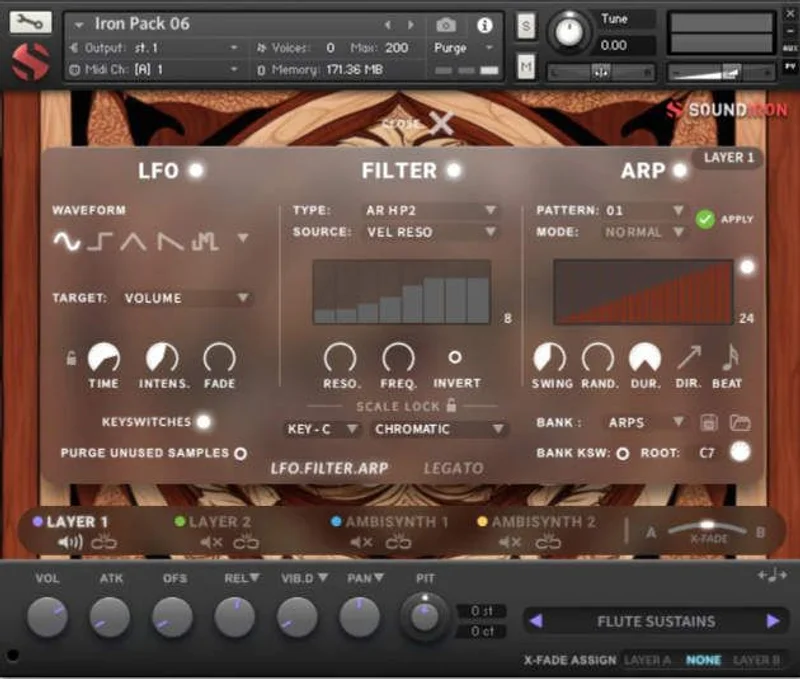
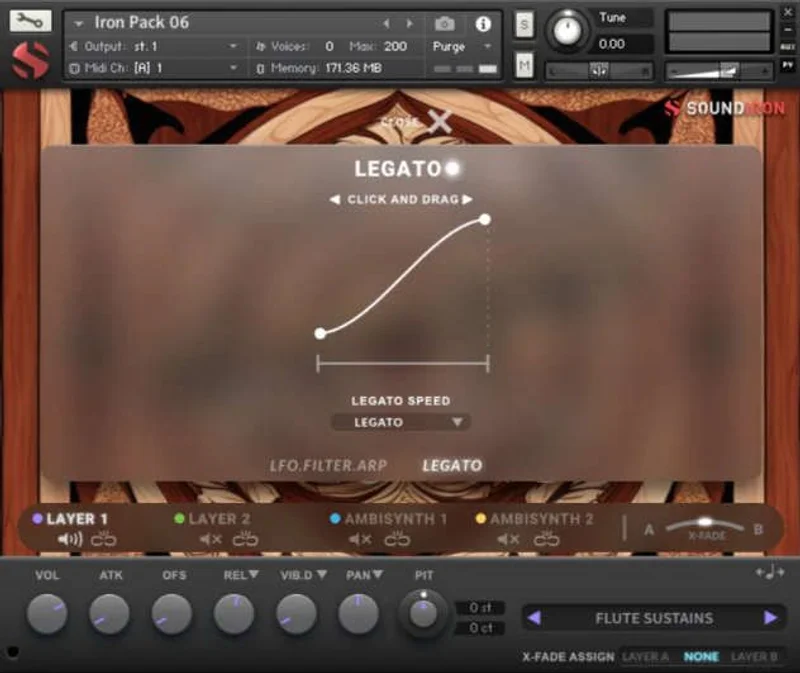
The UI gives you LFO controls, a filter, glide, and a full arpeggiator. We used the glide setting on a drone patch and got a satisfying slow-sweep effect that sat nicely under a string pad without fighting for frequency space. That was a win.
The convolution reverb is where Soundiron over-delivered. Ninety-nine rooms, halls, and chambers, plus 40 custom FX impulses. For a budget library, that’s a ridiculous amount of spatial processing. We spent more time exploring the reverb options than we did playing notes.
The 10 ambience patches are underrated. They’re not realistic flute sounds. They’re morphed, stretched, atmospherically processed textures that work well under dialogue or as a bed for more defined melodic elements. We used one in a trailer cue and it sat in the mix without effort.
The frustrating part: the short phrases. They’re musically useful only if your cue happens to match their rhythm and contour. Otherwise you’re fighting them. We tried to splice two phrases together across a bar line and gave up after twenty minutes.
The Trade-Offs You Should Know Before Buying
At this price, the conversation about trade-offs feels almost absurd. But they exist and they’re real, and you should understand them going in.
The low sample count means you’ll hear repetition. Play the same sustain note in two adjacent bars and most listeners won’t notice, but you will. There’s no humanization system to help mask it. You’re relying on your own creativity to vary velocity and layering.
The pre-recorded phrases are a double-edged thing. When they work, they work well. The Venu phrases have a genuine field-recording quality to them. Breathy, slightly imperfect, human. But they’re fixed melodic events, not flexible tools. If the phrase doesn’t fit your tempo or key feel after pitch-shifting, it becomes mud.
The FX rack and convolution reverb genuinely offset some of these weaknesses. They let you transform limited source material into something more compositionally useful. We’d call that smart design for a micro-library.
Against the Field
Soundiron’s other instrument libraries show the same design philosophy: compact, specific, affordable, and honest about scope.
For direct competition, Spitfire Audio’s LABS series offers a free Pipa and occasional world instrument releases that match or beat Iron Pack 6 on realism. LABS wins on sound quality. Iron Pack 6 wins on breadth of timbre within one download, specifically the Venu plus Native American pairing.
Native Instruments’ World Series libraries go much deeper on articulation and playability. They cost dramatically more. If your budget allows for a premium option, look there.
For pure texture and pad work at zero cost, Pianobook has community-created world flute samples wo rth checking. But the Iron Pack 6 reverb suite and arpeggiator pull it ahead for producers who want everything in one place.
best affordable Kontakt libraries for film composers
The Real Verdict
We’d buy Iron Pack 6. We already did. It’s not a library we’d build a flute performance around, but it’s brilliant for texture, for beds, for moments where you need something organic and non-Western fast.
The score reflects real limitations. Fifty-two source samples can only take you so far before the seams show. If you need a solo flute instrument that tracks your melody naturally, skip this and save up for something deeper.
At this price, the frustration-to-value ratio is acceptable. Just go in with clear expectations.
Score Breakdown
| Category | Score | Notes |
|---|---|---|
| Sound Quality | 3.3/5 | Sustains are genuinely lovely; phrases are limited and fixed |
| Value for Money | 4.5/5 | Hard to argue with $5 for two flute characters plus a full FX suite |
| Ease of Use | 4.0/5 | SFZ and Kontakt formats, clean UI, near-zero learning curve |
| Features | 3.0/5 | FX rack and 99 reverb IRs impress; articulation depth doesn't |
| CPU Efficiency | 4.5/5 | Light footprint, no issues across older sessions |
| Overall | 3.6/5 | Honest micro-library with real limitations, best used as a texture tool |
Alternatives to Consider
If you need something deeper, these are worth your time.
Spitfire Audio LABS (Free World Instruments): Check the LABS catalogue before spending anything. Some releases cover similar timbres with better playability. Free beats a paid option.
best free Kontakt instruments for world music
Native Instruments Komplete World Series: Genuine performance depth, multiple articulations, real legato. Costs significantly more. Worth it if world instruments are central to your work, not just occasional colour.
Pianobook Community Libraries: Dozens of user-contributed world flute instruments, free, with varying quality. Some are stunning. You’ll need to sift, but the ceiling is higher than Iron Pack 6 on the best ones.
affordable sample libraries for soundtrack composers
Iron Pack 6 - Wooden Flutes costs about the same as a coffee. It delivers about that much satisfaction: quick, pleasant, and not something you’d build a meal around.
If you’re a film composer who needs Venu or Native American flute texture in thirty seconds without spending real money, buy it. If you need a playable instrument that tracks your melody across a two-minute cue, save your session file and shop elsewhere.
Frequently Asked Questions
Does Iron Pack 6 require a full Kontakt license to use?
The .nki files require Kontakt 5.5 or later with a full license. Kontakt Player won't load unlicensed third-party libraries past the 15-minute demo limit. The SFZ format files don't need Kontakt at all. Load them in any SFZ-compatible sampler like ARIA Player or sforzando and you're running immediately.
What's the difference between the Indian Venu and Native American flute in this library?
The Venu is an Indian bamboo flute with a brighter, more penetrating tone and a slightly thinner harmonic profile. The Native American wooden flute has a warmer, more muted character with more breath noise at the attack. Both are recorded with real mic bleed and room sound, which gives them a natural, imperfect quality. Neither has deep articulation layers, but the timbral contrast between the two is genuinely useful for variety.
Can you use Iron Pack 6 for real-time live performance?
The sustains and drone patches play back reliably in real time with low latency. The pre-recorded phrase patches are less practical for live use because they're fixed melodic events, not velocity-responsive performance tools. We'd call it a studio-only library. The arpeggiator adds some real-time interest, but this isn't built for the stage.
Is Iron Pack 6 still available to purchase in 2026?
Check Soundiron's official site directly for current availability and pricing. The launch price was a promotional rate through July 1, 2014. Current pricing may differ. Soundiron occasionally bundles older Iron Pack titles in collections, so it's worth checking whether a bundle offers better value than a single title purchase.