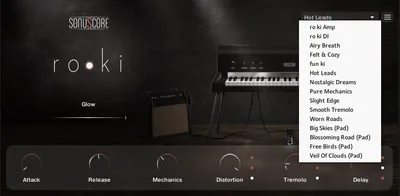
The honest doubt about ro•ki is this: do we really need another Kontakt electric piano in 2026, when every DAW ships with one and the internet is drowning in Rhodes samples? We tested it, and the answer is yes, but only if you're already living in the full Kontakt ecosystem and you want a vintage instrument that rewards digging past the presets.
Sonuscore built ro•ki around a restored '70s electric piano, recorded with the kind of care that shows up in the playback. This isn't a library for everyone. The Kontakt Player wall alone will eliminate a chunk of potential buyers before they hear a note. But for the producer who clears that hurdle, there's a genuinely satisfying instrument waiting.
This review is for soul and R&B producers, lo-fi beatmakers, and film composers who want something with real vintage bones and some creative flexibility on top.
Does It Actually Deliver on the Vintage Promise?
Sonuscore recorded a restored '70s electric piano with 20 velocity layers per note. That number matters in practice. Feathering a chord softly and then digging in hard produces two genuinely different responses, not just the same sample pitched louder.
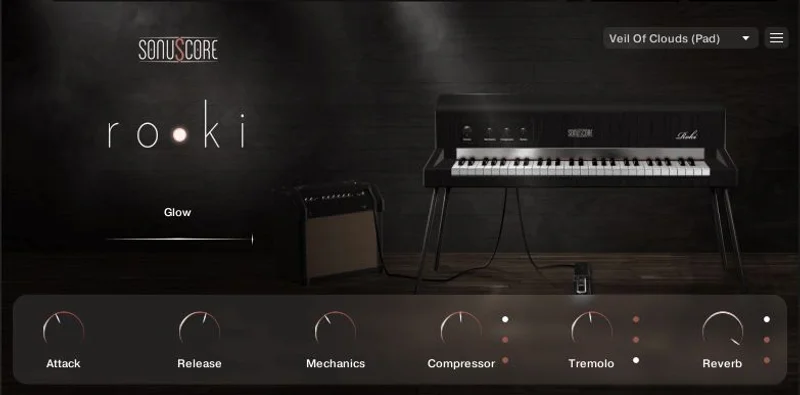
The instrument captures mechanical noise, tine buzz, and damper clunk as separate controllable elements. You can dial those in or pull them back depending on how lived-in you want the result.
Two signal paths are on offer: a clean DI capture and a vintage-style reamped path run through amp simulation. Switching between them isn't cosmetic. The DI sits cleaner and sits further back in a dense arrangement. The reamped version has a midrange push around 1.5kHz to 2kHz that places it more aggressively in front of a mix.
Sonuscore delivers what they advertised. It sounds like a real instrument was miked in a real room, because it was.
Where ro•ki Actually Shines
The velocity layering is the strongest argument for this library over cheaper alternatives. We ran a Rhodes-style chord progression through ro•ki with automation on velocity, dropping from 110 down to 45 across eight bars. The transition from full attack to ghost-touch softness was smooth and convincing. No jarring crossfade artifacts.
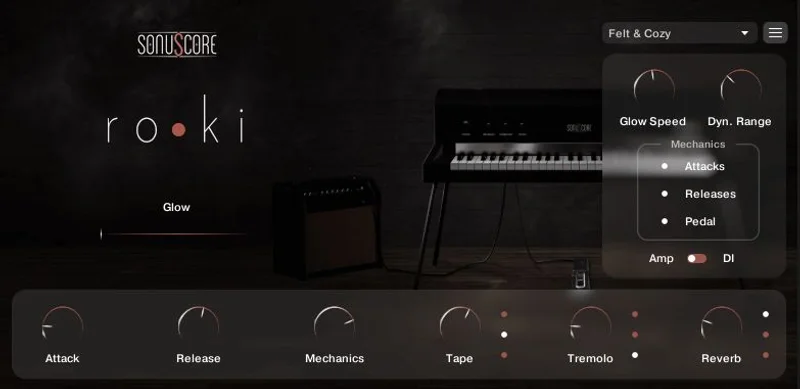
The Glow slider is genuinely clever. It's not reverb, not a filter. Sonuscore designed it as a continuous morph that transforms the instrument's character from dry vintage soul into something ambient and textural. Pushed to 70% or above, the piano starts to bloom and sustain in ways that sit beautifully under a pad layer without competing with it. We loved pulling Glow to around 55% on a slow R&B track and letting it breathe without any additional reverb on the channel.
The nine onboard effect modules cover chorus, reverb, delay, EQ, and compression, among others. They're not deep enough to replace your go-to plugins, but they're good enough to shape a sound before committing.
Attack and release controls on the mechanical noise give you direct access to how the piano's physical character comes through. Shortening the release on the mechanical layer is satisfying in a way that trimming a sample never quite replicates.
Where It Falls Short
The Kontakt Player exclusion is frustrating and it's the loudest criticism we have. If you spent a significant amount on Komplete Standard but the full Kontakt is in a higher tier, ro•ki is inaccessible. Sonuscore made this call, and it limits the audience considerably.
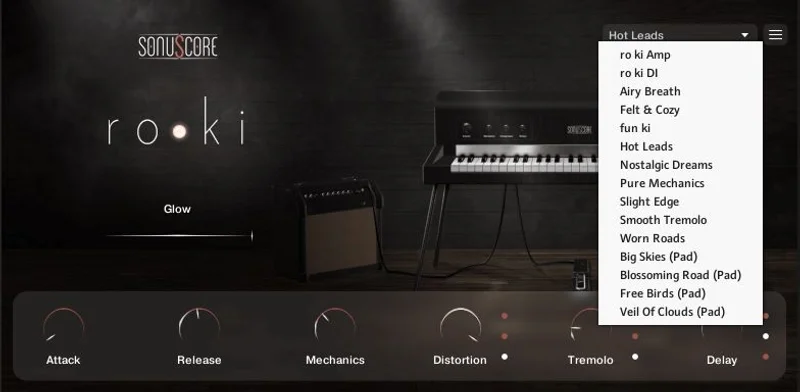
Fifteen color presets is thin. Compared to something like Spitfire LABS or even free Kontakt instruments with 40 or 50 starting points, 15 presets feels like Sonuscore expects you to build your own sounds from the start. That's fine if you enjoy sound design. It's annoying if you wanted a palette of ready-to-go tones.
We found no published CPU or RAM benchmarks from Sonuscore. In our session, ro•ki ran at moderate load, roughly comparable to other mid-size Kontakt libraries. But the absence of any file size or CPU specification in the documentation is an oversight that makes it harder to plan around for resource-constrained systems.
No trial. No demo period. At $69, you're buying blind unless you track down audio demos online.
How It Stacks Up Against Real Competition
The most direct comparison is Scarbee Mark I from Native Instruments, which ships at a similar price point. Scarbee Mark I is deeper in raw sampled detail and is Player-compatible. If you want the most realistic Fender Rhodes emulation for session work, Scarbee wins on fidelity and accessibility.
Where ro•ki wins is the Glow system and the creative signal chain. Scarbee doesn't give you a built-in morph toward ambient territory. It's a workbench instrument. ro•ki is a workbench that also has a painting mode.
Keyscape from Spectrasonics is the other obvious name. It covers more instruments for a much higher price, and the sound quality is hard to argue with. But Keyscape is overkill if you specifically want one vintage electric piano with a strong character rather than a collection. ro•ki is the focused buy.
For Kontakt instrument reviews, we'd place ro•ki squarely in the mid-tier, above commodity free libraries, below the top-shelf session tools.
Is $69 a Fair Price?
At $69, ro•ki is reasonably positioned. You're paying for genuine multisampled depth and a signature creative feature in the
Glow slider that isn’t just bolted on.
We'd rate it as fair value, not exceptional. The Kontakt Player exclusion and the thin preset count mean you're not getting maximum return for the price. If Sonuscore runs a sale, that is where the value to cost ratio becomes easy to recommend without hesitation.
At $69, it's worth it if the Glow slider fits your workflow. The current price is shown in the buy box on this page.
Score Breakdown
| Category | Score | Notes |
|---|---|---|
| Sound Quality | 4.3/5 | 20 velocity layers and dual signal paths deliver convincing vintage character |
| Value for Money | 3.8/5 | Fair at $69, better on sale; Kontakt Player exclusion hurts the case |
| Ease of Use | 4.0/5 | Streamlined UI, but 15 presets means more setup time for new users |
| Features | 3.8/5 | Glow slider is a genuine differentiator; effect modules are functional but shallow |
| CPU Efficiency | 3.5/5 | Runs medium-load; no official spec published, which is an oversight |
| Overall | 4.1/5 | Strong instrument held back by access limitations and thin preset count |
Alternatives to Consider
Scarbee Mark I (Native Instruments): The most sampled Fender Rhodes library at a comparable price, and it works with Kontakt Player. If you need compatibility and raw realism over sound-design flexibility, this is our pick. Scarbee Mark I review
Keyscape (Spectrasonics): Covers multiple electric piano types with exceptional depth. It's significantly more expensive, but if you want a library that handles every vintage keyboard scenario, it's hard to beat. Keyscape review
Spitfire LABS Electric Pianos: Free, Player-compatible, and surprisingly usable for lo-fi and soul work. Doesn't have ro•ki's velocity depth or Glow system, but costs nothing. Worth having in your free Kontakt instruments guide regardless of whether you buy ro•ki.
Sonuscore Glow Bundle: If ro•ki interests you, the bundle with LO•KI felt piano and HA•PI concert harp is worth pricing out. Three instruments with the same Glow architecture for producers who want a unified textural palette. Check the manufacturer's site for current bundle pricing. Sonuscore instruments overview
Buy or Skip?
We'd buy ro•ki with one eye open. The instrument sounds real, the Glow slider is a genuinely satisfying creative tool, and the velocity layering holds up under close inspection. We ran a chord stab through the reamped signal with Glow at 60%, added a light tape delay from the onboard effects, and it sat in the mix without touching another plugin. That kind of immediate usefulness is rare.
But the Kontakt Player exclusion is a hard wall. If you don't own the full version of Kontakt 6.6.1 or above, this library is invisible to you. Sonuscore should fix that. Until they do, a meaningful portion of producers who'd love this instrument can't have it.
Skip it if you want a wide preset library, need Player support, or are buying a first electric piano plugin cold. Buy it at $69 if you're a soul or R&B producer with full Kontakt who wants one well-recorded vintage instrument with genuine sound-design range. At a sale price, the decision gets easier.
It's not the best electric piano library ever made. It is the best one with a Glow slider.
Frequently Asked Questions
Does ro•ki work with the free Kontakt Player?
No. ro•ki requires the full version of Kontakt 6.6.1 or above. It will not load in the free Kontakt Player. This is a hard compatibility wall and one of the main reasons we'd tell some producers to skip it entirely. Check whether you own full Kontakt before purchasing.
What is the Glow slider and why does it matter?
The Glow slider is Sonuscore's signature feature across their Glow Series instruments. It morphs the electric piano's character from dry, close, vintage realism toward something more ambient and harmonically open. It's not reverb and it's not a simple filter. At higher Glow values, the instrument becomes a textural sound-design tool rather than a straight sample playback library. That range is what makes ro•ki interesting beyond the sampling quality alone.
How does the DI signal differ from the reamped signal in practice?
The DI signal is cleaner and sits further back in a mix without adding midrange weight. The reamped signal has more presence in the 1.5kHz to 2kHz range and pushes forward in a dense arrangement. For solo piano or lo-fi work, DI keeps things clear. For R&B tracks where the piano needs to cut through drums and bass, the reamped path does that work without needing additional EQ.
Is ro•ki part of a bundle with other Sonuscore instruments?
Yes. Sonuscore offers ro•ki as part of the Glow Bundle alongside LO•KI (a felt piano) and HA•PI (a concert harp). All three instruments share the Glow architecture, which makes them well-suited to textural production work where you want multiple instruments with a consistent ambient character. Check the manufacturer's site for current bundle pricing, as it varies.