Origins Vol.5 competes most directly with Spitfire Audio's LABS series and the lo-fi preset packs inside Omnisphere, and here is where we land: it beats LABS on rhythmic design tools, loses to Omnisphere on raw playability and depth, and sits at $69 in a space where free alternatives exist. That context matters before you buy.
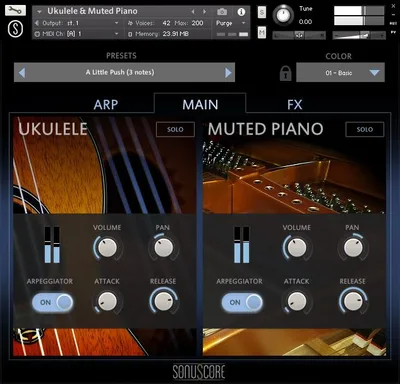
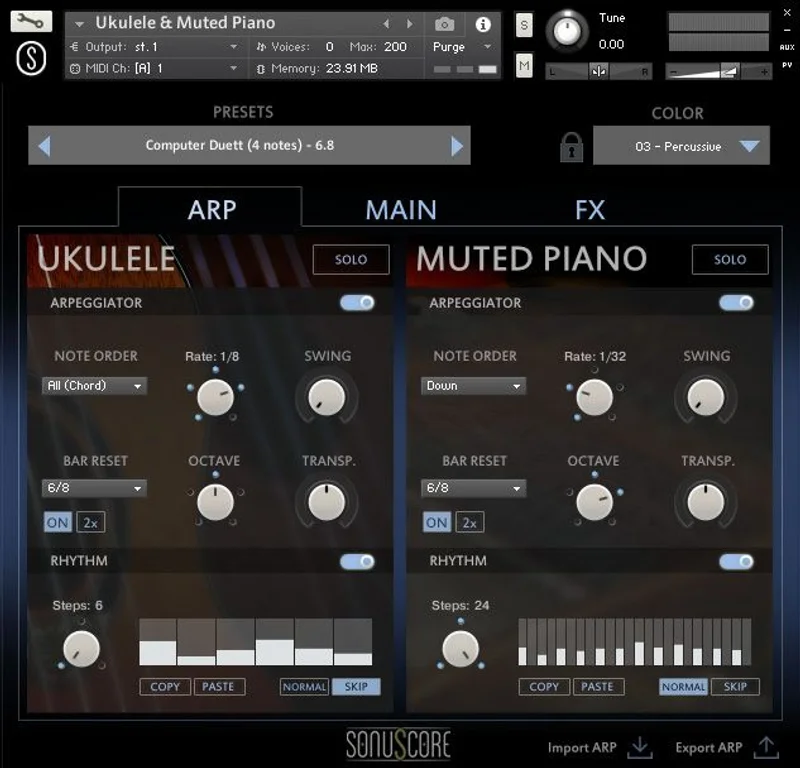
This is a Kontakt 5.8.1 instrument built around two sources: a light, plucky ukulele sitting in the upper frequencies, and a muted piano with a dull, damped attack built for atmospheric low-mid groundwork. Neither instrument is meant to be played note-by-note like a traditional Kontakt library. The engine driving this is the Multi-Arpeggio-Designer, or MAD, and that's the actual product you're buying.
It's built for producers making indie, ambient, or lo-fi content who want a fire-and-forget texture layer. If you're a live performer or need expressive solo ukulele runs, this isn't for you.
How It Compares Out of the Box
Load up LABS Soft Piano and you get a playable, deeply sampled instrument with velocity layers you can actually feel under your fingers. Load up Origins Vol.5 and you get a preset browser first, an arpeggiator second, and an instrument third. That ordering is intentional, and it's either a feature or a dealbreaker depending on who you are.
The first thing we did was ignore the presets and try to play a chord manually. The ukulele sounds thin and exposed without the MAD engine running. The muted piano has a satisfying clunk at medium velocities, but without arpeggiation it sits there like a damp cloth. Point being: you need to work with this library the way Sonuscore designed it.
Compared to other Origins Series titles, the workflow is identical. If you own Origins Vol.1 through Vol.4, you already know how to use this. The arpeggio presets you build here load directly into those other instruments too. That cross-compatibility is smarter than it sounds.
Performance Deep Dive
The MAD engine ships with 80 rhythm presets and 12 color presets. Multiply those together and you get 960 combinations before you touch a single parameter. Sonuscore quotes over 1,200 predefined combinations, which accounts for additional layering states the interface allows.
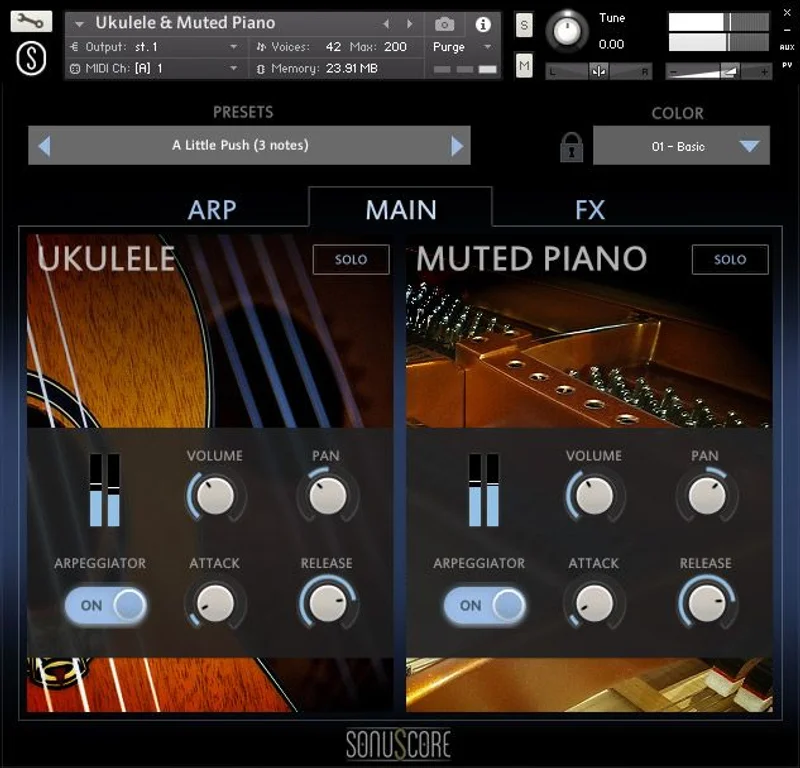
We spent 40 minutes running through rhythm presets on a single held C major chord. Sixteen of those presets produced something we'd actually use in a track. That's a 20% hit rate, which is honest for any preset library in this price range.
The library installs at 158 MB. That is genuinely light. We ran it inside Kontakt 7 on an M2 MacBook Pro and saw CPU usage between 4-7% per instance during playback with arpeggiation active. Sonuscore publishes no official CPU figures, so treat ours as a single data point, not a guarantee.
We loaded three simultaneous instances on separate tracks: one ukulele rhythm, one muted piano pad, one with both blended. CPU stayed under 18% combined. For context, a single Omnisphere patch running a complex arp will often hit that figure alone.
Latency at 256 samples buffer was imperceptible during preset-driven playback. Real-time performance isn't the use case here, so this matters less than it would for a lead instrument, but it's clean.
Where It Wins
The MAD engine is genuinely clever. We dropped a four-bar loop into a sparse folk-pop track that needed something in the 2-4kHz range without adding another plucked element manually. We loaded a rhythm preset called something close to "offbeat skip," held a chord, and it locked to our DAW's tempo in under three seconds. Satisfying.
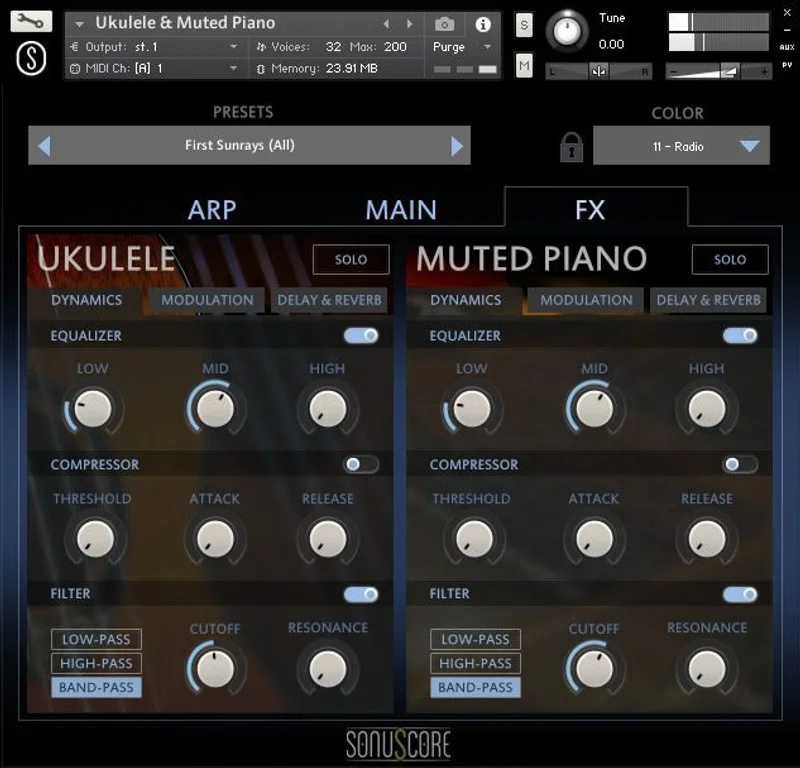
The color presets do something useful: they shift the timbral character from percussive and dry to ambient and padded without you touching EQ or reverb. One color preset pushed the muted piano into a washed-out, slightly detuned texture that cost us nothing in CPU and would have taken five minutes to build with separate processors.
The bundle angle is underrated. If you buy Vol.1-5 together, the arpeggio architecture is shared. One rhythm preset you tweak in Vol.5 becomes available to Vol.2's duduk. That kind of portability across a suite of instruments is something neither LABS nor Omnisphere offers in this direct way.
158 MB. We love a library that respects drive space.
Where the Competition Wins
LABS Ukulele doesn't exist, but LABS Peel Guitar and LABS Frozen Strings are free and more playable as solo instruments. Free is hard to argue with.
Omnisphere has ukulele-adjacent timbres inside its acoustic guitar and plucked string patches. You can build every rhythmic pattern Origins Vol.5 produces, and then fifty more, with Omnisphere's arpeggiator. The gap is cost: Omnisphere costs far more. Not a fair comparison at the unit level, but it's real.
The bigger honest gap is playability. There's no velocity-mapped solo ukulele run available here. No hammer-ons, no slides, no articulation switching. If you want to write a melodic uk
ulele line for a children’s song or a folk track, this library is frustrating. It won’t do that job. You’ll be fighting the MAD engine instead of playing music.
Also annoying: Sonuscore publishes no CPU specs, no polyphony limits, and no documented latency figures. For a product at this price, that is lazy documentation.
Who Should Buy Which
- ✅ Buy if you produce lo-fi, ambient, or indie folk and want rhythmic ukulele/muted piano textures on demand without manual programming.
- ✅ Buy if you already own other Origins Series titles and want to expand your MAD arpeggio palette with new timbres.
- Buy at the intro price. At regular price, the value calculation gets tighter.
- ❌ Skip if you need an expressive, playable solo ukulele instrument with articulation control.
- ❌ Skip if your genre is outside ambient, folk, or lo-fi. The sounds don't adapt well to hip-hop, rock, or EDM.
- ❌ Skip if you don't own Kontakt. The full version of Kontakt 5.8.1 minimum is required. Kontakt Player is not supported.
Score Breakdown
| Category | Score | Notes |
|---|---|---|
| Sound Quality | 3.5/5 | Clean and usable within its narrow timbral range; thin when played outside the MAD engine |
| Value for Money | 3.5/5 | Fair at intro price; questionable at regular price given free LABS competition |
| Ease of Use | 4.0/5 | Preset-first workflow is fast once you accept the library's logic |
| Features | 3.5/5 | MAD engine is the standout; 1,200+ combinations from 92 presets is good mileage |
| CPU Efficiency | 4.5/5 | 158 MB install, 4-7% CPU per instance: one of the lightest Kontakt instruments we've tested |
| Overall | 3.8/5 | Specialist tool with a real use case; wrong pick if you need a playable solo instrument |
Alternatives to Consider
If you want a more playable plucked string instrument with similar lo-fi character, look at Spitfire Audio LABS review. It's free, it's well-sampled, and several LABS instruments cover adjacent timbral territory without locking you into an arpeggiator workflow.
If the rhythmic design capability of MAD is what drew you here, and you want more source material variety, the Sonuscore Origins Bundle Vol.1-5 review bundles all five volumes together. The per-volume cost drops, and the arpeggio portability across instruments becomes the main argument for buying the whole set.
For producers who want muted piano textures with more expressive control, Native Instruments Una Corda review is worth the price comparison. It's a deeper instrument, more expensive, and built for pianists rather than loop-makers, but the muted and prepared piano sounds are in another tier.
If you're weighing this against Omnisphere for general arpeggiator needs, that's not a fair fight at this price point. Check our best Kontakt instruments for ambient production roundup for a full breakdown of where Origins Vol.5 sits in the broader field.
Origins Vol.5 is a production tool that does one specific job well: instant rhythmic ukulele and muted piano textures inside a tidy 158 MB install. We would buy it at the intro price for an ambient or folk project where we needed that texture fast. We would skip it at regular price if our DAW already had a capable arpeggiator and a decent acoustic sample library. It's not wrong for the right producer. It's just very wrong for anyone else.
Frequently Asked Questions
Does Origins Vol.5 work with Kontakt Player?
No. Origins Vol.5 requires the full version of Kontakt 5.8.1 or higher. Kontakt Player is not supported. If you only have the free Kontakt Player, this library won't load. Make sure you have a full Kontakt license before buying.
Can you play Origins Vol.5 as a normal solo instrument without the arpeggiator?
Technically yes, but it's not what the library is built for. The ukulele samples sound thin when played as single notes without the Multi-Arpeggio-Designer running. The muted piano holds up better for simple chord stabs. For expressive solo performance, look at a different library.
Are the arpeggio presets compatible with other Origins Series instruments?
Yes. This is one of the better features of the series. Rhythm and color presets you build or modify in Origins Vol.5 can be loaded into other Origins instruments. If you own Vol.1 through Vol.4, your MAD work in Vol.5 carries across all of them.
Is Origins Vol.5 part of a bundle, and is the bundle better value?
Yes. Sonuscore offers an Origins Bundle covering Vol.1-5. If you're interested in more than one or two volumes, the bundle brings the per-instrument cost down meaningfully. The cross-instrument arpeggio compatibility also makes the full bundle more useful than any single volume in isolation.