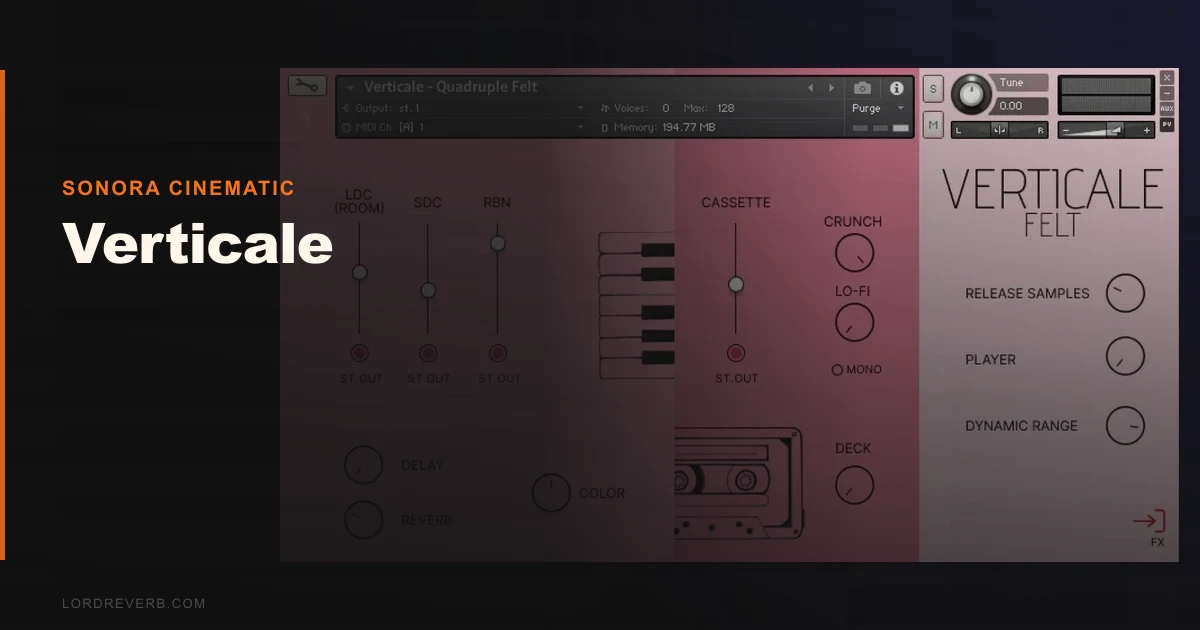
Sonora Cinematic's Verticale is a sampled Italian upright piano for free Kontakt Player 7, built around a quad-layer felt recording system that no other library currently offers. We loaded it mid-session on a sparse, melancholic cue, needing something less formal than a grand and more characterful than a toy piano. Verticale answered that call faster than we expected.
It's built specifically for cinematic and lo-fi work. If you're chasing a pristine Steinway sound for a classical piece, this isn't your instrument. But if you want that slightly boxy, intimate upright tone with felt variations baked in at the sample level, this is one of the more considered options we've tested in that lane.
The library sits at 7.44GB compressed. It runs on Kontakt Player 7.1 or higher, which is free. No paid full Kontakt required. That's a meaningful detail for producers who haven't committed to Native Instruments' ecosystem.
First Impressions: Smaller Than Expected, in a Good Way
Installation through Native Access is painless. Download, locate, done. The Kontakt interface opens and Verticale's UI is clean but minimal. There's no flashy splash screen trying to convince you the instrument costs more than it does.
The default patch loads fast. Within thirty seconds we had notes playing. The natural patch sits in a register that feels immediately honest. Not flattering. Not processed within an inch of its life. Just an upright piano in a room.
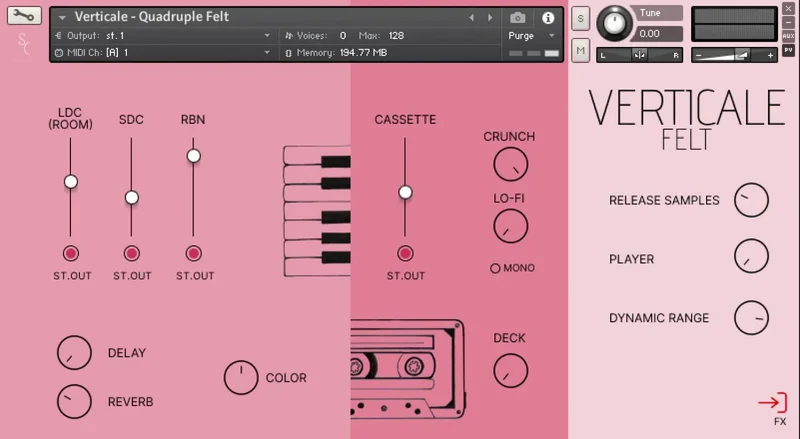
First thing we reached for was the Color knob, which functions as a tilt EQ. Clockwise brightens the high end while pulling lows. Counter-clockwise does the opposite. It's a satisfying single-knob approach that works without needing to open a separate EQ in your signal chain. We pulled it slightly counter-clockwise on the first pass and the low mids opened up in a way that felt right for the session.
Getting It Into a Real Workflow
We tested Verticale across three different session types: a lo-fi beat project, a short film cue, and a singer-songwriter demo that needed simple piano support without competing with vocals.
The lo-fi session is where the cassette section earns its place. The bit reduction and sample rate controls aren't just aesthetic switches. Pulling the sample rate down creates a genuine lo-fi degradation rather than a fake plugin shimmer. We ran the cassette section at roughly 60% degradation on a C3-C4 melody line and it sat under a drum loop without needing any additional processing. That was satisfying in a way that saved real time.
The three mic positions are close, room, and a blended option. Switching between them doesn't require reloading. That matters. In a session with a client watching, hunting through menus kills momentum. We kept the close mic for the film cue and layered in roughly 25% room underneath to add dimension without losing definition.
The one friction point: the felt layer selection isn't visually intuitive. You can tell from the sound that you've engaged more felt, but the UI doesn't give you a clear indicator of how deep into the quad-layer stack you are. Annoying when you're trying to recall a specific tone the next day.
What Verticale Is Genuinely Good At
The quad-layer felt system is the headline feature, and it delivers. Most felt piano libraries offer one felt layer. Some offer two. Sonora recorded four separate felt configurations on this upright, which means the transition from a barely damped tone to a fully muffled, muted sound is smooth and musical rather than binary.
We played a descending run from C5 down across the felt spectrum and there was no jarring switch point. The texture evolved continuously. That's rare and it shows recording discipline.
The reverb and delay sends are well-chosen. The reverb modes include room, hall, and plate variants. The plate option on piano works well. We set a short 0.8-second plate on a staccato melody and the decay cleared between notes without smearing. The delay modes offer tempo-sync options, and dotted-eighth worked immediately on a 90bpm cue without any phase fighting.
For cinematic underscore work, the natural patch requires almost no mixing. It has a slightly recessed upper midrange that keeps it from clashing with strings or vocals sitting around 2kHz-4kHz. We love that. It means less corrective EQ work in the mix.
The Rough Edges
We wish the pricing was posted anywhere obvious. Check the manufacturer's site for current pricing because we will not invent a number. That opacity is frustrating when you're recommending a tool to someone with a specific budget.
CPU usage is manageable in simple arrangements. We ran it on a 2022 M2 MacBook Pro and saw approximately 4-6% CPU on a simple four-voice piano part. In a denser arrangement with reverb sends active and the cassette section engaged, that climbed to around 14-18%. Not catastrophic, but worth knowing if you're on an older machine.
The felt layer UI needs work. It's the library's strongest feature and it's the least visible element of the interface. A simple visual meter showing felt depth would take this from "sounds interesting" to "instantly recallable and repeatable." Right now, it's a bit of a guess-and-listen workflow.
No demo version available that we could locate. That's a miss for a library where the felt character is the whole selling point. You need to hear it before you commit.
Who This Is Really For
Score Breakdown
| Category | Score | Notes |
|---|---|---|
| Sound Quality | 4.5/5 | Quad-felt system delivers genuine tonal range no competing library matches |
| Value for Money | 3.5/5 | Hard to score without transparent pricing, but feature set justifies a fair ask |
| Ease of Use | 3.5/5 | Color knob and mic switching are clever; felt layer visibility is a real gap |
| Features | 4.0/5 | Cassette section, three mic positions, and tilt EQ cover most use cases |
| CPU Efficiency | 3.5/5 | Fine for simple sessions; effects chain adds load that older machines will feel |
| Overall | 4.1/5 | A genuinely clever upright piano library held back by UI gaps and pricing opacity |
Alternatives to Consider
Spitfire Audio's LABS Felt Piano is free and worth having in your arsenal alongside Verticale. The LABS version is a single-layer felt recording with less tonal range but a faster load time and zero cost. We'd use LABS for quick sketches and Verticale when the felt character needs to be front and centre. Spitfire LABS review
Native Instruments' Una Corda is the closest serious competitor. Recorded by Daniel Lanois, it offers three felt configurations on a unique one-string-per-note piano. The sound is more atmospheric and less traditional upright. Una Corda costs significantly more than Verticale at most pricing tiers we've seen, and it requires full Kontakt or the dedicated player. If budget isn't a concern and you want that specific breathy Una Corda character, it's the stronger tool. best piano Kontakt instruments
Keyscape from Spectrasonics covers an enormous range of piano types including upright and felt variations. It's the heavy investment option at a price point well above most competition. If you need one library to cover everything from Wurlitzer to upright to grand, Keyscape is worth the cost. If you specifically need an upright cinematic character, Verticale is a more focused and likely cheaper choice. Keyscape review
For producers building out a full lo-fi toolkit, our best lo-fi plugins guide covers how Verticale fits into a broader production setup.
Our Verdict
Verticale earns its place because it solves a specific problem well. That problem is: how do you get intimate, characterful upright piano tones with felt variation baked in at the sample level, running on a free player, without fighting your mix?
We'd buy it for film and lo-fi work without hesitation, if the price lands in a reasonable range when you check the Sonora Cinematic site. We'd skip it if you need grand piano realism, or if you're the kind of producer who wants to see exactly what the instrument is doing at a glance. The UI will frustrate you.
The quad-felt recording is genuinely clever. It's the thing that separates Verticale from everything else in this category. If that feature matters to your workflow, there's nothing else that does it the same way.
Frequently Asked Questions
Do I need to buy full Kontakt to run Verticale?
No. Verticale runs on the free Kontakt Player 7.1 or higher. You download Kontakt Player through Native Access at no cost. No paid Native Instruments subscription or full Kontakt licence is required.
What does the quad-layer felt system actually mean?
Most felt piano libraries record the instrument with felt dampers in one position. Sonora Cinematic recorded this upright with four distinct felt configurations, capturing progressively more muted tonal characters at the sample level. The result is a smooth continuum from open tone to fully muffled, rather than a binary felt on/off switch. No synthesis or modelling fills the gaps.
Is Verticale suitable for live performance use?
Technically yes, since Kontakt Player supports live performance setups. The load time is reasonable and latency depends on your audio interface buffer settings, not the library itself. That said, the UI isn't optimised for quick patch switching on stage. It's designed as a studio composition tool.
How does the cassette lo-fi section compare to dedicated lo-fi plugins?
It's functional but not a full replacement for a dedicated lo-fi processor. The bit and sample rate reduction controls create convincing degradation on piano specifically, because they're baked into the library's signal path and tuned for this instrument. For general lo-fi processing across a full mix, you'd still want a dedicated plugin like RC-20 or Vinyl Distortion in your chain.