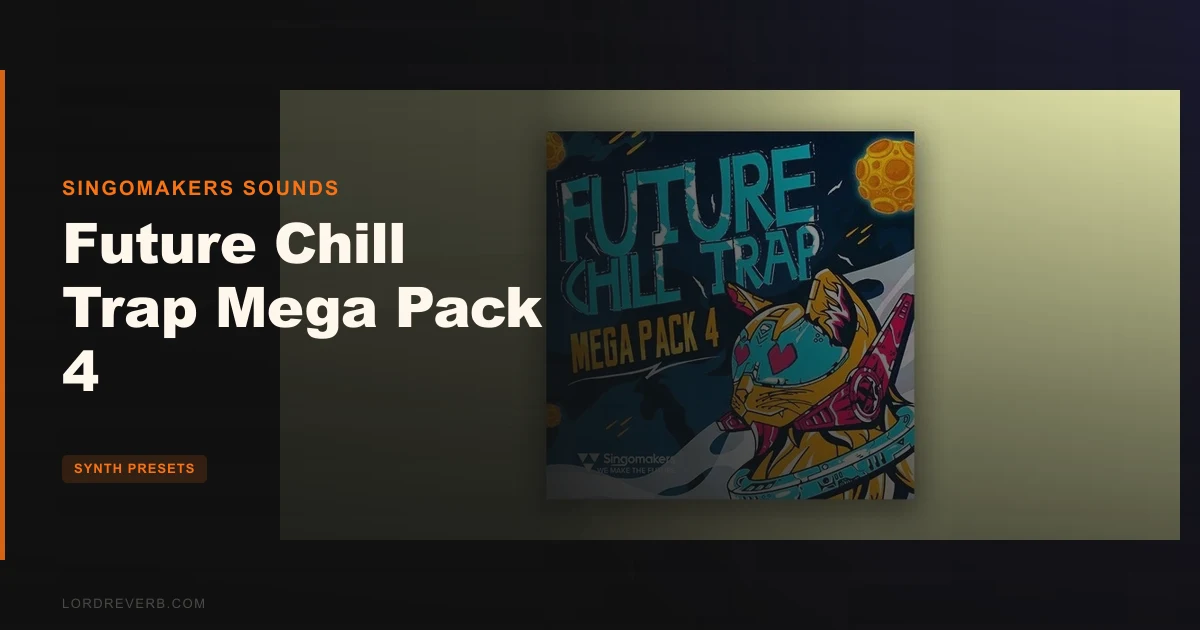
Future Chill Trap Mega Pack 4 by Singomakers is a 2.1 GB royalty-free sample and patch library covering the full chill trap production toolkit, and at $36 it's one of the more honest value propositions in this genre. We pulled it into a session on a Wednesday afternoon with a half-built track going nowhere. One MIDI melody loop, dragged straight in and repitched down a minor third, cracked the whole arrangement open. That's the pack's best quality: it moves fast.
This review is for producers who need to ship music, not just collect sounds. If you're building chill trap, lo-fi trap, or ambient hip-hop and you want a deep library that covers samples, MIDI, and synth patches in one download, read on. If you only need a handful of sounds, this is overkill. We'll tell you why below.
First Impressions: 2,287 Files and a Real Folder Problem
Opening the download, you get nine formats in one package: WAV, REX2, EXS24, MIDI, Battery, NN-XT, Kontakt, Massive, and Spire. That's not bloat. That's Singomakers covering every major DAW workflow in one shot.
The folder structure is clean enough. Bass Loops, Drum Loops, Lo-Fi Drum Loops, Melody Loops, Pad Loops, Keyboard Loops, Drum FX, One-Shots, Snare Rolls, Vox Loops, MIDI, FX. Each category is labelled with BPM and key where relevant. That's satisfying. You're not hunting blind.
The sheer file count is the first friction point. 2,287 files sounds brilliant until you're scrolling through 145 melody loops looking for the one that fits your current key. Audition time adds up fast. We'd love a key-tagged subfolder system here. It's not there.
Getting It Into a Real Workflow
We dropped the pack into Ableton 12 and started a session at 130 BPM. The WAV files loaded without issues. The 24-bit quality held up under pitch-shifting. We nudged a melody loop up four semitones and it stayed clean, no obvious artifacts in the upper harmonics.

The MIDI loops are where this pack earns serious points. All 271 MIDI files correspond to the WAV loops, so you can pull the MIDI version, drop it on your own synth, and completely revoice the melody. We tried this with a pad loop MIDI on a Vital patch we already had open. The groove and phrasing were there instantly. Our own timbre. Their arrangement. That's a satisfying workflow.
The 74 sampler patches load cleanly in Kontakt and NN-XT. The 11 drum kits in particular are production-ready. We ran one through a bus with an SSL-style console emulator and a touch of parallel compression, and it sat in the mix without fighting the other elements.
One honest friction point: the REX2 files require a REX-compatible host. If you're fully on a modern DAW that's moved past REX2 support, that format is dead weight in this download. Annoying, but it doesn't cost you anything except folder space.
What It's Genuinely Good At
The melody loop selection is the strongest part of this pack. 145 loops is a lot, and the quality density is high. We found usable ideas in roughly 60% of them without any processing, which is a better hit rate than we expected.
The lo-fi drum category deserves a specific mention. 70 lo-fi drum loops, including crunch, vinyl saturation, and deliberate tape flutter. We layered one lo-fi loop under a clean 80 drum loop at about 8dB lower in the mix, cutting everything above 8kHz on the lo-fi layer. The result was instant texture without losing punch. That layering trick works because Singomakers recorded the two categories to complement each other.
The one-shot breakdown is thorough. 80 kicks across different decay lengths and sub weights. 40 snares. 50 synth percussions. 20 hi-hats. 40 tape drums, which are underrated in this genre and genuinely useful. The breadth here lets you build custom kits rather than relying on the premade ones.
100 VST patches split across 60 Massive and 40 Spire cover leads, pads, basses, and arps. Reviewers report strong usability on the Spire patches in particular, noting the modulation routing feels intentional rather than generic. We agree that the sound design direction is coherent and on-genre.
The Rough Edges
The VST patches require Massive or Spire. No exceptions. If your studio runs Serum, Vital, or Pigments as its primary soft synth, those 100 patches are inaccessible without buying additional software. That's a real limitation in 2026, where Serum and Vital dominate most producers' signal chains.
The lo-fi drum loops and standard drum loops overlap more than they should. We found several patterns that were near-identical aside from a vinyl filter applied to the lo-fi version. Singomakers could have differentiated these categories more aggressively with groove variation rather than just tonal processing.
No BPM-organised subfolders in the melody section is a genuine workflow snag when you're working outside the 130 BPM sweet spot. The pack covers 110-150 BPM, but finding loops that actually sit at your session tempo requires ear-testing or checking filenames individually. Frustrating when you're mid-session.
Who This Is Really For
- ✅ Buy if you produce chill trap, lo-fi trap, or atmospheric hip-hop regularly and need a large, royalty-free library that covers every production layer.
- ✅ Buy if you use MIDI loops as a primary composition tool. The 271 MIDI files paired with your own synths is the strongest use case here.
- ✅ Buy if you own Massive or Spire. Those 100 patches add serious extra value on top of an already deep sample set.
- ❌ Skip if your synth of choice is Serum, Vital, or anything outside Massive and Spire. You'll lose access to a meaningful portion of the pack's value.
- ❌ Skip if you're producing outside the chill trap or lo-fi trap sphere. The genre specificity is deep. It doesn't translate well to harder trap or future bass without heavy processing.
- ❌ Skip if you want a curated small pack. 2,287 files demands time to organise and explore. If you need five sounds by tomorrow, look elsewhere.
Specs & Technical Details
| Developer | Singomakers Sounds |
| Price | $36 |
| Plugin Format | Sample Pack (WAV, REX2, EXS24, MIDI, Battery, NN-XT, Kontakt, Massive, Spire) |
| OS Support | Mac / Windows (DAW-agnostic samples; Massive and Spire required for VST patches) |
| Activation | Download only, no activation required for samples |
| CPU Usage | N/A (sample pack; CPU depends on host sampler) |
| Trial Available | No |
| Version Reviewed | Vol. 4 (released September 2019) |
Score Breakdown
| Category | Score | Notes |
|---|---|---|
| Sound Quality | 4.0/5 | 24-bit WAV holds up well under pitch-shifting; melody and pad loops are the standouts |
| Value for Money | 4.5/5 | 2,287 files at $36 is hard to argue with, even accounting for the Massive/Spire dependency |
| Ease of Use | 3.5/5 | No key-tagging in melody folders and no BPM subfolders slow down real sessions |
| Features | 4.5/5 | Nine formats, MIDI parity with WAV loops, and 11 drum kits cover almost every workflow |
| CPU Efficiency | 4.0/5 | Sample-based, so CPU is determined by your sampler. REX2 and Kontakt patches run light |
| Overall | 4.1/5 | Deep, genre-specific, and good value. The MIDI loops alone justify the price for most producers |
Alternatives to Consider
If you need chill trap sounds but want something built around a specific synth, check our review of KHORDS Future Bass. It's a different approach, but the melodic sensibility overlaps and the Kontakt integration is tighter.
For producers working in the future bass space rather than strict chill trap, Galactic Future Bass for Phase Plant covers a lot of adjacent melodic territory. Phase Plant's modulation depth gives you more sound-design control than Massive in this context.
If your priority is VST patches rather than samples, Ultimate Future Bass for Serum Vol. 1 is the one to check. 64 patches built for Serum with macro assignments that Future Chill Trap Mega Pack 4's Massive and Spire patches don't match for Serum users. Also worth a look: Future Sounds Bundle Review for a broader library comparison across four different sound sets.
The Verdict
Future Chill Trap Mega Pack 4 is a serious working library, not a mood board. At $36 for 2,287 files across nine formats, it's genuinely hard to undercut on volume and genre coverage alone.
The MIDI loops are the reason to buy it. Having a WAV loop and its corresponding MIDI in the same pack means you never have to commit to someone else's synth choice. That flexibility is brilliant, and most competing packs at this price don't bother.
The Massive and Spire patch dependency is the reason to hesitate. If you're not already running one of those two synths, you're paying $36 for 2,187 files instead of 2,287. Still good value, but know what you're buying.
Skip it if your sessions need ten sounds fast. Buy it if you're building a genre library you'll dig into over months. This pack rewards producers who explore, not producers who need answers in five minutes.
Related reviews: Serum House Foundations Review · Progressive House for Babylon 2 Review 2026
Frequently Asked Questions
Is Future Chill Trap Mega Pack 4 royalty-free?
Yes, all samples in the pack are 100% royalty-free. You can use them in commercial releases, sync placements, YouTube content, radio broadcasts, and label releases without paying additional licensing fees. The royalty-free licence covers all 2,287 files across every included format.
Do I need Native Instruments Massive or Reveal Sound Spire to use this pack?
You need Massive or Spire only to access the 100 VST synth patches. The 2,187 remaining files, including all WAV samples, MIDI loops, REX2 files, Kontakt patches, and sampler formats, work without either synth. If you don't own Massive or Spire, you still get a deep and usable library. You're just locked out of that specific patch set.
What DAWs are compatible with Future Chill Trap Mega Pack 4?
The WAV and MIDI files work in any DAW, including Ableton Live, Logic Pro, FL Studio, Cubase, Studio One, and Reaper. The REX2 files require a REX-compatible host. The EXS24 patches are built for Logic Pro's sampler, NN-XT is for Reason, Battery is for Native Instruments Battery, and Kontakt patches need a full version of Kontakt rather than the free Kontakt Player.
How does Vol. 4 compare to the earlier volumes in the Future Chill Trap series?
We haven't tested Vols. 1 through 3 side by side with Vol. 4 in a controlled session, so we won't guess at direct comparisons. What we can say is that Vol. 4 stands alone as a complete library. You don't need the earlier volumes to get value from this one. If you find Vol. 4's sound direction fits your style, the earlier volumes are built on the same production philosophy and are worth exploring as supplements.