Sinevibes Stator is a $19 tape wobble plugin for Korg’s NTS-1 mkII and NTS-3 Kaoss Pad, and it does exactly one thing: makes your synth sound like it’s being played off a slightly warped cassette.
We loaded it onto an NTS-1 mkII mid-session, trying to fatten up a pad that kept sitting too clean in a lo-fi beat. The install was under a minute. We hit play. The pitch immediately started breathing, just this slow, lazy flutter that felt organic in a way software LFOs rarely do. It sat in the mix before we’d touched a single parameter.
That first listen was satisfying. Then we started reaching for controls that weren’t there.
This review covers whether that two-knob simplicity is a feature or a limitation, who should spend the $19, and who should keep scrolling.
What It Actually Does (and Where It Stops)
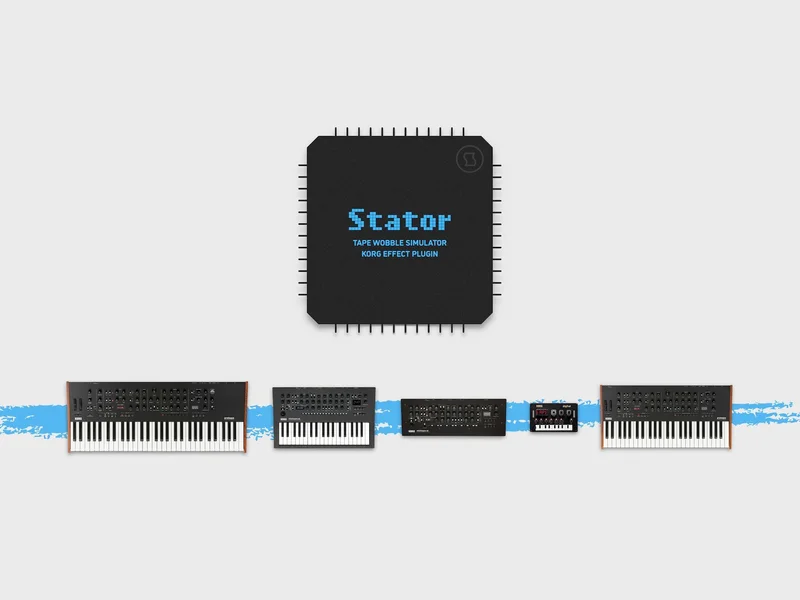
Stator is a multi-engine plugin, which means it lives inside your Korg hardware rather than your DAW. No VST. No AU. No AAX. It runs on the NTS-1 mkII and the NTS-3 Kaoss Pad. That’s the complete compatibility list in 2026.
It simulates wow and flutter: the pitch and timing instabilities you get from an aging tape machine. Version 2 added stereo width, a dry/wet mix control, and crosstalk between channels, which is the effect of signal bleeding between adjacent tape tracks.
What it’s not: a full tape emulation. There’s no tape saturation, no high-frequency roll-off, no hiss, no EQ shaping. If you want a complete vintage tape character, Stator handles the motion side only. You’ll need something else for the dirt.
It’s also not for original Minilogue XD or Prologue owners. Those older logue-compatible devices are not supported in v2.
Living With It Day to Day
Setup is genuinely painless. You download the .ntkdigunit file from Sinevibes, open the Korg NTS-1 mkII librarian app, drag it in, and it’s on the hardware. No account. No iLok. No activation server. We had it running in about 45 seconds.
The two main controls are Speed and Depth. Speed sets the modulation rate, which adjusts both the wow frequency and the flutter frequency simultaneously. Depth controls how far the pitch swings. Slow Speed and low Depth gives you the gentle seasick wobble of a well-maintained but aging cassette deck. Crank both and it sounds like the tape is actively melting.
Here’s where we found the frustrating part. Speed moves wow and flutter together. Real tape machines have different rates for each. A Revox with a worn pinch roller has slow wow and fast flutter at the same time. You can’t get that with Stator because the parameter couples them. The result is convincing but slightly one-dimensional once you notice it.
The v2 crosstalk parameter surprised us. We ran a simple stereo pad, pushed crosstalk up to about 70%, and suddenly the left and right channels were slightly bleeding into each other. It’s a subtle thing. But it made the sound feel less digital in a way that was hard to pinpoint until we bypassed it.
We wish the dry/wet control had been there from v1. Without it, Stator was all-or-nothing on the effect, which made it hard to use on anything where you needed the original pitch to stay precise.
The Trade-Offs Worth Knowing
The simplicity is the product. Two knobs means you can dial it in live, on stage, without looking down. That’s genuinely clever design for a hardware plugin.
But that same simplicity becomes a wall in the studio. When we wanted the flutter rate slower than the wow rate, we couldn’t do it. When we wanted saturation alongside the wobble, Stator didn’t have it. We ended up running the NTS-1 mkII output into a separate tape saturation plugin in the DAW to fill the gap. That works, but it means Stator is a partial solution requiring a second tool.
The $19 price makes this easier to accept. At $19, you’re not buying a complete tape emulation suite. You’re buying a specific modulation character for a specific piece of hardware. Judged on those terms, it delivers.
The no-trial policy stings a little. Sinevibes doesn’t offer a demo version of Stator. You’re committing $19 without hearing it on your specific hardware first. Given the compatibility is already narrow, a 14-day trial would remove all friction for potential buyers.
Against the Field
For Korg hardware users specifically, Stator has almost no direct competition. Other multi-engine plugins tackle oscillators, granular synthesis, or sequencing. Very few go after tape motion effects. In that niche, Stator wins by default and by quality.
If you’re comparing purely by effect type and DAW plugins are on the table, the field gets crowded. Waves Wow & Flutter runs in any DAW and gives you independent wow and flutter rate controls. That’s the feature Stator is missing. IK Multimedia’s Ta pe Machine plugins add the full package: saturation, EQ, noise, and modulation together.
Neither of those run on your NTS-1 mkII. That’s the whole point. If you’re building a hardware-centric, no-laptop setup, Stator is the only option we’d recommend for this effect. For purely ITB work, the best tape emulation plugins in 2026 gives you more for your money.
For broader Sinevibes context, our Sinevibes Integer review covers how their other logue plugins perform if you’re building out a full multi-engine library.
The Real Verdict
If you own an NTS-1 mkII or NTS-3, $19 for Stator is an easy yes. The wobble sounds right, the install is painless, and v2’s dry/wet control means you can blend it sensibly without losing your pitch center.
If you’re on older Korg logue hardware or working entirely in the box, skip it. There’s nothing here for you that a DAW plugin can’t do better and with more control.
The one honest caveat: if you’re a sound designer who needs surgical tape modeling, this will frustrate you inside of a week.
Score Breakdown
| Category | Score | Notes |
|---|---|---|
| Sound Quality | 3.8/5 | Wobble character is convincing; no saturation or noise means it's incomplete as a tape effect |
| Value for Money | 4.3/5 | $19 for a hardware plugin with free v2 upgrade is hard to argue with |
| Ease of Use | 4.5/5 | Two knobs and a 45-second install; the simplest possible workflow |
| Features | 3.0/5 | Coupled Speed parameter is a real limitation; v2 additions help but the gaps remain |
| CPU Efficiency | N/A | Runs on hardware DSP, your laptop doesn't care |
| Overall | 3.8/5 | Niche but effective for its exact use case; frustrating outside it |
Alternatives to Consider
Waves Wow & Flutter gives you independent wow and flutter rate controls that Stator can’t match. It’s a DAW plugin, so it won’t help your NTS-1 mkII setup, but for ITB lo-fi work it’s the smarter buy. Check current pricing on the Waves site as it’s frequently on sale.
Sinevibes Integer is a different multi-engine plugin from the same developer, focused on waveform shaping rather than tape motion. If you’re already buying Stator, read our Integer breakdown before you commit to building your multi-engine library around Sinevibes.
Korg’s own built-in modulation effects on the NTS-3 Kaoss Pad cover basic vibrato. They’re free. They’re also thinner and less characterful than Stator. If you’ve already exhausted the stock options and want more tape personality, that’s when Stator earns its $19.
For a broader look at the best Korg multi-engine plugins available in 2026, we’ve tested the full field and ranked them by use case.
Stator is a $19 answer to a very specific question: how do I get organic tape wobble on my Korg hardware without opening a laptop? If that’s your question, buy it. If that’s not your question, this plugin has nothing to say to you.
Frequently Asked Questions
Does Sinevibes Stator work with the original Korg Minilogue XD or Prologue?
No. Version 2 of Stator is compatible with the Korg NTS-1 mkII and NTS-3 Kaoss Pad only. The original logue-SDK devices including Minilogue XD and Prologue are not supported in the current version. If you're on those older units, check Sinevibes' site for their legacy-compatible plugin list.
Is there a free trial for Stator before buying?
There isn't. Sinevibes doesn't offer a demo version of Stator, which is annoying given the narrow hardware compatibility. We'd recommend watching demo videos on the NTS-1 mkII specifically before committing, since the effect varies noticeably depending on what you're running through it.
What's the difference between wow and flutter in Stator's Speed parameter?
Wow is slow pitch drift, typically below 4Hz, caused by speed irregularities in the tape transport. Flutter is faster modulation, typically between 4Hz and 100Hz, from the capstan or rollers. Stator's Speed knob adjusts both simultaneously, which keeps the interface simple but removes the ability to set them independently. Real tape machines have different rates for each.
Do I need a computer running to use Stator once it's installed on the NTS-1 mkII?
No. Once you've loaded the plugin onto the hardware via the Korg librarian app, it runs entirely on the NTS-1 mkII's DSP. No laptop, no DAW, no internet connection needed. That's one of the strongest arguments for hardware-resident plugins like this in a live or hardware-only setup.