
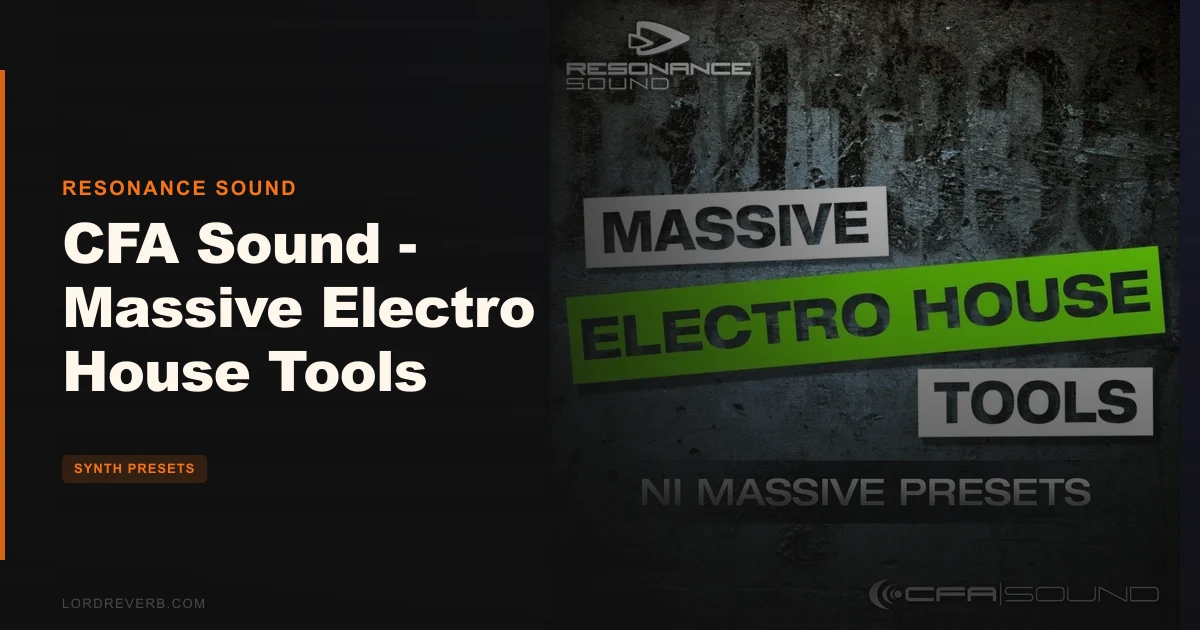
You’ve dragged a construction kit MIDI file into your DAW, loaded Massive on a few tracks, and the sections are already laid out before you’ve touched a knob. That’s the pitch of CFA Sound - Massive Electro House Tools, and it’s the part we like best.
At $25.95, it’s a solid buy for anyone who still runs Native Instruments Massive and writes electro house or big room. It’s a harder sell if you’ve moved to Massive X.
This is a source-based review, not a hands-on one. It’s built from the product page, the developer’s published feature list and the review scores quoted in the research. No audio demos or CPU figures were available, so those are flagged as unverified below.
First Impressions: What You Get in the Box
Resonance Sound distributes this pack, which comes from CFA-Sound. It’s the second chapter of a Massive soundset series. The first was Massive Complextro Tools.
The developer’s headline number is 65 presets in Massive’s native .nmsv format. All of them have full macro control allocation. That’s the detail that matters most.
Macros mean you don’t need to dive into Massive’s deep routing page to change a sound. You grab a handful of knobs and the patch changes shape. For fast arrangement work, that’s the right design.
The pack also ships 8 construction kits with 82 MIDI files in total. We’ll come to those, because they’re the real hook.
What the 65 Presets Actually Cover
The developer publishes a clean breakdown. It’s worth reading slowly, because it tells you what the pack is for.
- 20 Basses
- 17 FXs
- 11 Leads
- 2 Pads
- 3 Sequences
- 12 Synth sounds
Add those up and you get 65. Good. The numbers match the headline.
Basses and FX make up 37 of the 65 patches. That’s 57% of the pack. This is a bass-and-impact toolkit first, and a melodic library second.
Two pads. That’s the number that jumps out. If you want lush chord beds, look elsewhere.
The 20 Basses
Basses are the largest group, and electro house lives or dies on them. The developer describes them as “heavy bad-ass basses”. That’s marketing language, so treat it as a claim, not a measurement.
What we can say is that 20 is a decent spread. You’d expect a few growling mid-range patches, some sub-weighted ones and a couple of stabbier variants. We can’t confirm the exact split without hearing them.
The honest caveat: no frequency analysis is available for any of these patches. We can’t tell you how much sub energy sits below 60Hz or how hot the 1 to 3kHz region runs. You’ll want to audition them against your own kick before committing.
The 17 FX and 3 Sequences
The developer calls out “wicked tonal fx modulations”. In practice, that means risers, sweeps and pitched hits you can drop into builds and transitions.
Three sequences round out the rhythmic side. They’re the smallest group after pads, so don’t expect a deep arp library.
FX patches are underrated in packs like this. A good riser saves you twenty minutes of automation. We’d happily take 17 of them.
The 11 Leads and 12 Synth Sounds
Leads cover the “huge big room” territory the developer mentions. Eleven is enough for a track or two, not enough for a whole catalogue.
The 12 synth sounds are the catch-all category. The product page also mentions “spicy plucks”, so expect some of those here.
The Construction Kits: The Real Reason to Buy
This is where the pack separates itself from a plain preset dump.
Eight construction kits. Eighty-two MIDI files. Each kit is a pre-named track layout, so the MIDI files line up with specific presets.
The developer’s workflow is simple. Drag the MIDI files into your DAW. Add several Massive instances. Pick the presets named after each track. Done.
That’s a clever way to teach sound design. You don’t just get a bass. You see how the bass, lead and FX parts talk to each other in a finished arrangement.
Why MIDI Kits Beat Preset-Only Packs
A preset on its own tells you nothing about how it sits in a track. A MIDI part does.
You see the note lengths. You see the rhythm. You see how the bass avoids the kick and where the lead leaves room.
An artist review in the research makes the same point. Reviewers highlight the value of the kits for understanding sound design potential. We agree with that reading.
A Quickstart in Five Steps
- Open a new project and set your tempo to a typical electro house range.
- Drag one construction kit's MIDI files onto separate tracks.
- Load a Massive instance on each track.
- Match each preset to its pre-named MIDI track.
- Reach for the macros to reshape each sound.
The developer says that’s all it takes. We can’t verify the setup time, but the logic is sound.
Macro Controls: Fast Edits, Not Deep Edits
Full macro allocation is a real selling point. Reviewers describe the patches as making effective use of Massive’s macros for quick editing.
That’s the right trade for this genre. You want to push a filter, add some movement and drive a patch harder without opening four menus.
Massive’s macro system gives each patch a set of knobs that control multiple parameters at once. A good preset designer maps the useful ones for you. That’s what “full macro control allocation” promises here.
The downside is obvious. Macros hide depth. If you want to rebuild an oscillator routing from scratch, you’re back in Massive’s main interface. That’s normal, and it’s no knock on the pack.
What Critics Said
The research brief gives us four published scores. Here’s how they line up.
- Computer Music Magazine UK: 8/10
- Bang the DJ magazine: 9/10
- Producer Kris O'Neil: 8/10
- Jason Nevins, a producer known for work on Run-DMC's remix: 9/10
The average is 8.5 out of 10. That’s a strong, consistent result. No outlier dragged it down.
Reviewers used words like “tough”, “characterful” and “on-trend”. We’d treat those as taste signals, not measurements. Still, four positive scores from four different outlets count for something.
We should be fair about the limits here. These are the developer-facing press quotes, not independent forum threads. We found no user feedback from KVR or other producer forums in the material, so we can’t report on long-term satisfaction.
The Massive X Problem
Here’s the biggest warning, and the developer states it up front.
This pack is not compatible with Massive X. It needs the original Native Instruments Massive, version 1.3 or higher.
That’s a hard filter. If you’ve moved fully to Massive X, this pack is dead weight. If you’re still on the original Massive, it’s fine.
We think that’s the single most important line in this review. Check which version you own before you spend anything.
Original Massive is a legacy synth now. That means the pack serves a shrinking audience. It also means the audience that remains is loyal, and probably owns hundreds of presets already.
Where CFA Sound - Massive Electro House Tools Wins
First, focus. It’s an electro house toolkit, not a general library. Nothing in it is trying to be a film pad or a vintage keyboard.
Second, the kits. Eighty-two MIDI files you can drag straight into a session is a genuine time-saver. Most preset packs stop at the sounds.
Third, the macro allocation. Every patch is set up for quick tweaks. That’s the part that keeps the pack usable after the first week.
Fourth, the critical reception. An 8.5 out of 10 average across four sources is hard to ignore.
Where It Falls Short
Start with the compatibility wall. Massive X owners are locked out. That’s a real limit, and it’s not the developer’s fault.
Next, the pad count. Two pads in 65 patches is thin. If your tracks need atmosphere, you’ll fill that gap elsewhere.
Then there’s the verification gap. We have no audio demos in the material, no spectral data and no CPU figures. Massive can be CPU-hungry when you stack instances, and eight MIDI tracks each running their own Massive could add up. We can’t put a number on it. Don’t assume it’s light.
Finally, the trendiness risk. “On-trend” is a double-edged word. Electro house sounds date quickly. Patches built for today’s dancefloor can feel stale in two years.
What We Can't Verify Yet
We can’t tell you how the basses measure against your own sub chain. We can’t tell you the true latency or CPU draw. We can’t confirm whether a free trial exists, because none is mentioned in the material reviewed.
Those are the unknowns. Listen to any available demos before you buy.
How It Compares
The closest sibling is the earlier Massive Complextro Tools pack from the same series. It targets a related but different sound.
Beyond that, the Massive preset market is crowded. Several developers sell electro and big room banks for the same synth. We can’t claim this pack is the first of its kind, and it isn’t.
What sets it apart is the construction kit angle. Plenty of rivals sell preset banks. Fewer bundle 82 MIDI files laid out as complete track structures. That’s the real difference in scope.
If you want presets for a different synth, our review of Andy Lee House Synth Presets for Predator covers a house-leaning bank for a different engine. It’s a useful contrast.
For a modern take on a sound library workflow, see CFA CableForce for U-He ACE, which comes from the same developer family but targets a different synth.
best Massive preset packs
Pricing and Value
The pack costs $25.95. For that you get 65 presets, 8 kits and 82 MIDI files.
Do the sums on the per-patch cost and it’s modest. The kits add real value on top, because they work as a teaching tool.
The value case depends entirely on whether you still use Massive. If you do, it’s an easy yes. If you don’t, no price is low enough.
We can’t confirm a trial or demo. Check the product page for any current offer before you buy.
Who Should Buy This
- ✅ Buy if you still run Massive 1.3 or higher and write electro house or big room.
- ✅ Buy if you learn by dissecting finished arrangements, since the MIDI kits make that easy.
- ✅ Buy if you want bass, lead and FX parts that already fit together.
- ❌ Skip if you only own Massive X, because the presets won't load.
- ❌ Skip if you need lush pads or ambient textures, since there are only two.
- ❌ Skip if you want timeless sounds rather than current club trends.
Specs and Technical Details
| Spec | Detail |
|---|---|
| Developer | Resonance Sound (CFA-Sound) |
| Price | $25.95 |
| Plugin Format | Massive preset bank (.nmsv), requires Native Instruments Massive |
| OS Support | Depends on Massive 1.3 or higher (Mac / Windows) |
| Activation | N/A (preset pack, no separate activation stated) |
| CPU Usage | N/A (not stated; depends on Massive instance count) |
| Trial Available | Not mentioned in the material reviewed |
| Version Reviewed | Current listing, based on product page |
Score Breakdown
These scores rest on the documented feature set and the published critic scores. We’ll revisit them after longer use and once audio demos are available.
| Category | Score | Notes |
|---|---|---|
| Sound Quality | 4.3/5 | Critics rate it 8.5/10 on average, but no audio was available to us |
| Value for Money | 4.3/5 | 65 presets plus 82 MIDI files at a modest price |
| Ease of Use | 4.5/5 | Full macro allocation and drag-and-drop kits |
| Features | 4.0/5 | Strong kits, but only two pads and three sequences |
| CPU Efficiency | 3.5/5 | Unverified, and Massive can stack up across many tracks |
| Overall | 4.1/5 | A focused, well-built electro house pack held back by Massive X incompatibility and missing data |
Alternatives to Consider
If you’ve moved to Massive X, the obvious route is a preset pack built for that synth instead. Native Instruments sells expansions for it, and you’ll avoid the compatibility wall entirely.
If you want a different engine for house-style sounds, Andy Lee House Synth Presets for Predator is worth a look. It’s a house-leaning bank for Predator, not Massive.
If you prefer U-He synths, CFA CableDance for U-He ACE and CFA CableSphere for U-He ACE cover that ground. For a broader sample-and-synth bundle from the same family, our piece on the CFA Sound Super-7 is the next stop.
how to layer synth bass for electro house Massive vs Massive X explained
The Verdict on CFA Sound - Massive Electro House Tools
Buy it if you still use Massive and write club-focused electro house. At $25.95, the combination of 65 macro-ready presets and 82 MIDI files is good value.
It’s wrong for Massive X owners, and it’s wrong for anyone chasing pads or timeless textures. Check your Massive version first.
We’d still like to hear the audio and see real CPU numbers before we’d call it a must-have. Until then, it’s a confident recommendation with honest gaps.
Load a kit, drag the MIDI in, and see if the drop lands before you’ve opened a single menu.
Frequently Asked Questions
Does CFA Sound - Massive Electro House Tools work with Massive X?
No. The developer states these presets are not compatible with Massive X. You need the original Native Instruments Massive, version 1.3 or higher.
How many presets are in CFA Sound - Massive Electro House Tools?
There are 65 presets in .nmsv format. The breakdown is 20 basses, 17 FXs, 11 leads, 2 pads, 3 sequences and 12 synth sounds. All patches have full macro control allocation.
What are the construction kits in this pack?
The pack includes 8 construction kits with 82 MIDI files in total. You drag the MIDI files into your DAW, load Massive instances, and pick the matching pre-named presets. It's a fast way to build a track structure.
Is CFA Sound - Massive Electro House Tools good for beginners?
It suits beginners who already own Massive. The macro controls make edits simple, and the construction kits show how a finished track is layered. You still need to know how to load presets and route MIDI in your DAW.
How was this pack rated by critics?
Computer Music Magazine UK gave it 8/10 and Bang the DJ gave it 9/10. Producer Kris O'Neil scored it 8/10 and Jason Nevins scored it 9/10. That averages out to 8.5 out of 10.
Does it have a free trial or demo?
No trial or demo is mentioned in the material we reviewed. Check the product page for any current offer, and listen to any available audio demos before you buy.