South Indian percussion sounds incredible in film scores and electronic productions. Getting it into your session without it sounding fake is the hard part. Most world percussion libraries give you either a dry, unrealistic single-hit collection or a bag of loops you can't reshape. Neither works when you need to drop a thavil pattern into a cue that changes tempo, or when your director asks for "more traditional" and you've got one round robin and no fills.
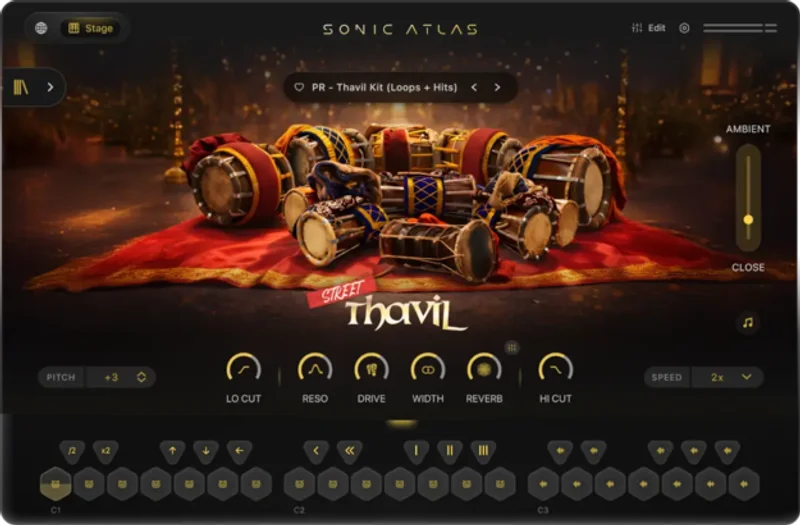
The Sonic Atlas Expansion: Thavil Kit by Pitch Innovations is built specifically to fix that. It's a sampled ensemble of 10 traditional thavil percussionists, recorded with 1,623 samples across velocity layers and round robins, packaged with loops, fills, and triplet grooves. Award-winning composer Harris Jayaraj has called out its sonic depth and recording quality, which carries weight when we're talking about an instrument this culturally specific.
This review is for film composers, hybrid producers, and world music enthusiasts who want a playable, mix-ready South Indian percussion section without hiring a full ensemble.
The Frustration This Product Exists to Solve
Here's the situation most of us have been in. You're building a South Asian-influenced cue. You pull up your existing world percussion library. You get a loop at 130 BPM in the wrong tuning, or a single-hit thavil sample with no round robins that machine-guns embarrassingly the moment you play anything above quarter notes.
The thavil isn't a tambourine. It's a double-headed barrel drum played by both hands, central to temple rituals, Carnatic music, and processional contexts. Its sound comes partly from the instrument and partly from the ensemble context: multiple players, interlocking patterns, the room they're in.
A single-player dry sample can't capture that. Pitch Innovations' answer was to record 10 musicians simultaneously. That's where the ensemble density comes from, and it's what separates this from the single-hit workarounds most of us have been stitching together from generic percussion packs.
How It Performs in a Real Session
We loaded the Thavil Kit into a cue built around a 96 BPM underscore with strings and oud. The first thing you notice is the low-end body. These aren't studio-processed samples with artificial weight dialed in post. The fundamental sits somewhere around 80-120Hz depending on the hit, with a sharp transient attack that cuts through without needing EQ surgery.
We played a straight eighth-note pattern at a moderate velocity. The round robins kicked in immediately. No machine-gunning. Hit the same note 16 times in a row and you hear natural variation in attack weight, which is exactly what you want when you're building a loop-free performance.
We then pushed the velocity to near-maximum on a triplet groove pattern. The samples opened up: more crack, more stick definition, the kind of top-end presence you'd expect from a harder strike on a tensioned drum head. The velocity layers are doing real work here, not just getting louder.
The included loops and fills are recorded material, not MIDI. That's a constraint worth naming upfront. If your tempo is far from the source BPM, you're stretching audio. We'd use the playable instrument for tempo-flexible work and lean on the loops for mood and atmosphere where timing is less rigid.
Pitch Innovations lists compatibility with Ableton Live, Pro Tools, Logic Pro, FL Studio, Cubase, Nuendo, Reaper, and Reason. We tested in Logic Pro and Ableton without issues. Load times were reasonable. The player interface is clean. Nothing annoying to report on the technical side.
What we don't have: manufacturer-published CPU benchmarks or exact latency figures. That's a gap. If you're running a dense orchestral template, you'll want to test the demo before committing.
Strengths and Weaknesses
The recording quality is the headline strength. Ten simultaneous musicians means you're hearing a real ensemble acoustic, not a single player artificially widened. The stereo field has natural spread. The room sits behind the instrument without swamping it.
The 1,623-sample count is serious for a percussion instrument. Velocity layers give you dynamic expression. Round robins kill the machine-gun effect. Together they make the instrument playable rather than decorative.
The triplet grooves are a smart inclusion. Thavil music is heavily rhythmic and triplet-based patterns appear constantly in Carnatic contexts. Having those pre-built saves arrangement time.
Now the weaknesses. The library lives inside Pitch Innovations' own player. You don't get a Kontakt library you can tear apart, repitch, and rewire. That limits deep sound design. If you want to layer these samples into a custom instrument or route individual hits through separate channels, you may hit a wall depending on the player's routing options.
The lack of published technical specs is annoying. We'd love to know the sample rate, bit depth, and mic position options. Right now, you're trusting the marketing copy until you've loaded it yourself.
Is the Price Justified?
At the introductory price, this is a low-risk buy. You're getting 1,623 samples, real ensemble recording, and a playable instrument that works across every major DAW. That's a fair deal.
The bundle price for the full Streets of South India collection is where it gets genuinely interesting. If South Indian percussion and melodic elements appear in your work more than occasionally, the bundle is the smarter purchase.
The regular individual price of $79 is still reasonable for this level of recording. We wouldn't hesitate at that price either.
Miss the intro period and it's still worth it. Don't miss the intro period.
Who Should Buy This (and Who Should Skip It)
- ✅ Buy if you score to picture and need culturally specific South Indian percussion that reads as authentic, not decorative.
- ✅ Buy if you produce hybrid or world fusion music and want playable ensemble percussion with real dynamic response.
- ✅ Buy if you're building a world percussion library and you've got the budget for a focused, high-quality addition.
- ❌ Skip if you need full sample-level access for deep sound design. The proprietary player will frustrate you.
- ❌ Skip if your template is already CPU-maxed. No benchmark data means you can't plan around it.
- ❌ Skip if you only need one or two thavil hits as accents. A cheaper single-sample pack will do the job.
Score Breakdown
| Category | Score | Notes |
|---|---|---|
| Sound Quality | 4.5/5 | 10-musician ensemble recording delivers real acoustic density and convincing velocity response |
| Value for Money | 4.0/5 | $79 is still fair for this sample count and recording quality |
| Ease of Use | 3.5/5 | Clean player interface, broad DAW support; proprietary format limits advanced routing |
| Features | 4.0/5 | Loops, fills, triplet grooves, velocity layers, and round robins cover real production needs |
| CPU Efficiency | 3.0/5 | No published benchmarks; can't score higher without data |
| Overall | 4.1/5 | Strong recording quality and smart content design; held back by thin technical documentation and proprietary player limits |
Alternatives Worth Knowing
If the Thavil Kit isn't quite right for your workflow, here are three options worth comparing.
Spitfire Audio LABS (World Percussion series): Free entry point for world percussion textures. Less focused than Thavil Kit, no South Indian specificity, but zero cost. Good for testing whether this sonic territory works in your project before spending. Spitfire Audio LABS review
Native Instruments Komplete World Series libraries: Broader cultural coverage, Kontakt-based so you get deep editing access. Pricier individually, but the Kontakt format is a love it or hate it consideration depending on how much you want to shape the raw samples. Native Instruments Komplete review
Output ARCADE (world percussion loops): Loop-focused, subscription model, less playable instrument design. Works brilliantly if you want fast inspiration. Frustrating if you need tempo flexibility or custom performances. best world percussion sample libraries 2026
None of these offer a recorded 10-musician thavil ensemble. That's the gap Thavil Kit fills. If that specific instrument is in your cue, there's no direct substitute at this price.
Our Verdict
The thavil is one of the most sonically distinctive percussion instruments in South Asian music. Getting it wrong is obvious to anyone who's heard the real thing. Pitch Innovations didn't get it wrong.
At the intro price, the Sonic Atlas Expansion: Thavil Kit is a genuinely satisfying addition to a world percussion toolkit. The ensemble recording is the real thing. The velocity layers and round robins make it playable, not just decorative. Harris Jayaraj's validation isn't just a blurb: it signals that this was built for production use, not cultural tokenism.
We wish the technical documentation was stronger. The proprietary player will frustrate anyone who wants Kontakt-level control. But for a composer who needs an authentic, mix-ready South Indian rhythm section and doesn't want to fly in session musicians, this is the honest answer.
At the intro price, buy it before March 2, 2026. At $79, still buy it. If you don't score to picture and you don't make world-influenced music: this one's not for you, and that's fine.
Frequently Asked Questions
What is the Sonic Atlas Expansion: Thavil Kit?
It's a sampled percussion instrument built around the thavil, a traditional South Indian barrel drum central to temple rituals and Carnatic music. Pitch Innovations recorded 10 traditional thavil percussionists simultaneously to capture real ensemble density. The library includes 1,623 samples with velocity layers, round robins, loops, fills, and triplet grooves, playable inside their Sonic Atlas player across all major DAWs.
What DAWs does it work with?
Pitch Innovations lists compatibility with Ableton Live, Pro Tools, Logic Pro, FL Studio, Cubase, Nuendo, Reaper, and Reason, plus additional DAWs. It runs inside their Sonic Atlas player, so compatibility depends on that player's plugin format support. Check the manufacturer's site for the most current format and OS details before purchasing.
How does the Thavil Kit compare to generic world percussion libraries?
Most world percussion libraries offer either single-player dry hits or fixed loops. Thavil Kit is a 10-musician recorded ensemble with real round robins and velocity layers, which gives you playable dynamic response instead of one-dimensional samples. The specificity of the instrument matters too: this is built for thavil, not a generic "ethnic drums" collection padded with everything from a tabla to a djembe. best world percussion sample libraries 2026
Is the introductory price worth acting on quickly?
Yes. The individual kit is on sale at a lower price until March 2, 2026, rising to $79 after that. The full Streets of South India bundle is discounted during the promotion. If South Indian music appears in your work at all, the bundle price is the cleverer buy. Miss the window and the regular pricing is still fair, but there is no reason to leave savings on the table. Check the manufacturer's site to confirm current pricing before you buy.