
Retropolis is a solid, focused Kontakt instrument that earns its place at $40 if you already own full Kontakt and want immediate access to five classic analogue synth sounds without the synthesis homework.
The library pulls samples from the Red Sound Dark Star, Alpha Juno2, Kawai SX240, Arp Odyssey, and Moog MG-1. That's a genuinely interesting selection. Not the usual suspects. And at $40, the price of entry is low enough that the maths works out quickly if you produce anything that needs retrofuturist textures, analogue bass weight, or pad beds that breathe without feeling sterile.
But here's the caveat you need before spending anything: if you're running the free NI Kontakt Player, Retropolis won't load. Full stop. You need the paid, full version of Kontakt 5.8.1 or higher. That changes the value equation for a chunk of producers who assumed otherwise.
This review is for producers who want the honest picture on whether that friction is worth pushing through.
What You're Actually Getting
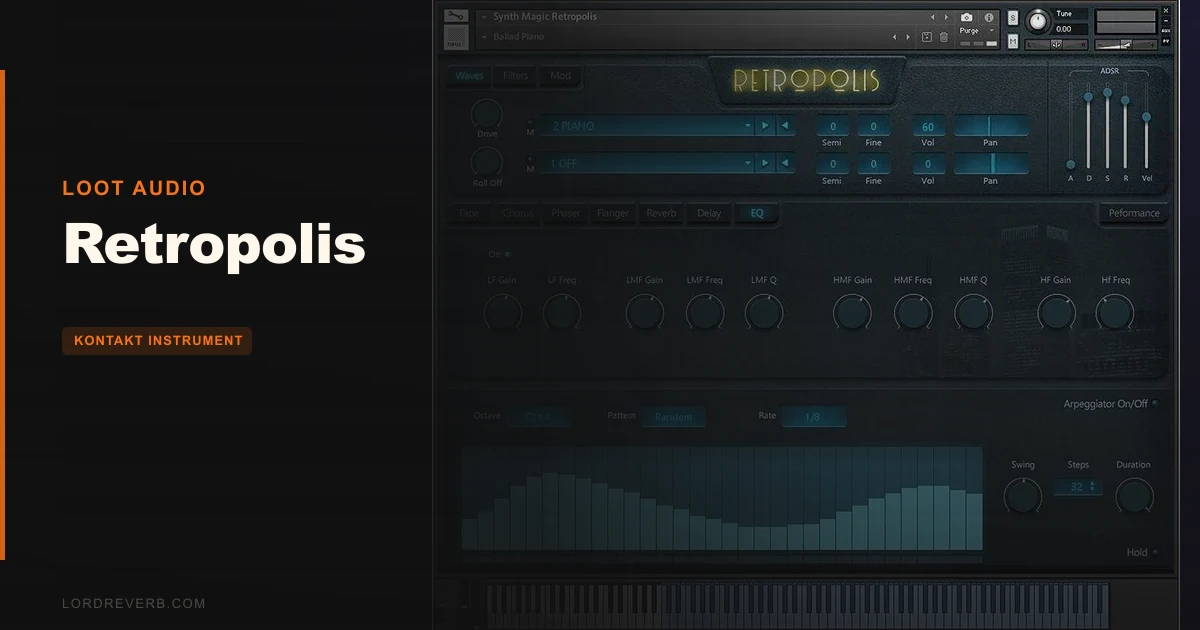
Retropolis gives you sampled versions of five vintage synthesizers, all navigable through a menu-driven interface inside Kontakt.
The snapshot library sits at over 200 presets, organised into folders: Bass, Strings/Pads, and Synths. That three-folder structure sounds simple, and it is. You're not hunting through categories inside categories. You open the folder you need, pick a snapshot, and you're playing.
On top of the sample engine, there's a full effects section baked in. The arpeggiator is the genuinely clever part. It's not just a rhythmic pattern tool. It can modulate filter cutoff, which means you can get movement and sweep happening automatically without reaching for a separate modulation source. For pads and evolving synth lines, that's satisfying to have in one place.
What Retropolis is not: a deep synthesis environment. It's a sample player with smart organisation and a workflow built around speed, not tweaking.
The Good
Five synths. One library. That ratio is the whole argument for buying this.
The Red Sound Dark Star, Arp Odyssey, and Moog MG-1 are not instruments most producers have sampled themselves. Getting workable, organised snapshots from all five sources at $40 is genuinely good value in a market where single-synth Kontakt libraries routinely cost more.
The snapshot organisation is underrated. Over 200 presets split cleanly across Bass, Strings/Pads, and Synths means you can drop Retropolis into a session, navigate to "Bass", and have something sitting in the mix fast. That's the actual workflow win here.
The arpeggiator's filter cutoff modulation is cleverly implemented. Load a pad snapshot, set the arp to a slow rate, and let the filter cutoff sweep through the pattern. You get textural motion that sounds like the synth is alive. That kind of movement would normally need an LFO routed to a filter somewhere else in your signal chain. Having it locked to the arp internally keeps the session tidy.
The effects section rounds it out. You're not bouncing the instrument dry and hunting for a reverb plugin to finish it. It's self-contained enough to work fast.
The Not-So-Good
The Kontakt Player restriction is the biggest problem here, and it's annoying because it's not obvious at first glance.
If you bought Kontakt as a standalone purchase or as part of Komplete, you're fine. But if you downloaded the free Kontakt Player because you just wanted to run libraries without committing to the full software, Retropolis will not work for you. The library requires full Kontakt 5.8.1 or higher. That's a hard wall, not a workaround.
Beyond the compatibility issue, the interface depth is limited. The menu-driven design is fast and accessible, which is a genuine strength for speed. But if you want to dig into how a sound was constructed, reshape the source sample playback, or build something that isn't in the snapshot library, you'll hit the edges quickly. This is a preset-forward instrument. Love the presets? Great. Wish you could rebuild them from the ground up? You'll be frustrated.
There's also no standalone mode. Retropolis lives inside Kontakt, which lives inside your DAW. It's two dependencies deep. That's standard for the format, but worth naming plainly for anyone new to Kontakt instruments.
Who Should Buy This
- ✅ Buy if you own full Kontakt 5.8.1 or higher and want immediate analogue vintage tones without building patches.
- ✅ Buy if you produce lo-fi, synthwave, retrowave, or cinematic music and need pad beds and bass sounds from real vintage hardware sources.
- ✅ Buy if you work fast and want a snapshot-driven library where the organisation does the thinking for you.
- ❌ Skip if you only have the free NI Kontakt Player. It simply won't run.
- ❌ Skip if you want deep sound design control. Retropolis is built for speed and browsing, not synthesis architecture.
- ❌ Skip if you already have a deep vintage synth Kontakt collection. At that point, the overlap probably isn't worth $40.
Specs & Technical Details
| Developer | Loot Audio |
| Price | $40 |
| Plugin Format | Kontakt Instrument (requires host DAW) |
| OS Support | Mac / Windows (via Kontakt) |
| Activation | N/A |
| CPU Usage | N/A |
| Trial Available | N/A |
| Version Reviewed | N/A |
Score Breakdown
| Category | Score | Notes |
|---|---|---|
| Sound Quality | 4.0/5 | Five real vintage synths sampled; the hardware sources are the strong argument here |
| Value for Money | 4.5/5 | Five synth sources at this price point is a strong deal if you own full Kontakt |
| Ease of Use | 4.0/5 | Snapshot-driven workflow is genuinely fast; menu navigation is clean |
| Features | 3.5/5 | Arpeggiator with filter modulation and effects section are solid; synthesis depth is shallow |
| CPU Efficiency | N/A | No data available |
| Overall | 4.0/5 | Focused, well-priced vintage synth library let down only by the Kontakt Player restriction |
The Bottom Line
Retropolis is a smart, narrow tool. It knows exactly what it is.
You load it when you need a bassline with Moog weight, a pad with Alpha Juno shimmer, or an arp sequence with filter movement baked in. You don't load it when you want to spend an hour building a patch from scratch. That's not what it was built for, and pretending otherwise would be a waste of your time.
If you're working in synthwave production or scoring something that needs analogue vintage colour without a wall of synthesis menus, this is the library you keep open in a template session.
The Kontakt Player restriction is a real problem. Check your version before buying. If you're running full Kontakt 5.8.1 or above, this is an easy recommendation at this price. If you're not, it's a hard pass, and no amount of clever arp filter modulation changes that.
For producers who build Kontakt libraries into their workflow, Retropolis earns its slot. For everyone else, the compatibility wall is the whole conversation.
Brilliant source material, limited ceiling. Know which one matters more to you before you buy.
Related reviews: Elektronik 25
Frequently Asked Questions
Does Retropolis work with the free NI Kontakt Player?
No. Retropolis requires the full version of Kontakt 5.8.1 or higher. The free NI Kontakt Player will not load this library. If you're unsure which version you have, check inside the NI software before purchasing. This is the single most important thing to verify before spending anything.
What synths are sampled in Retropolis?
Retropolis samples the Red Sound Dark Star, Alpha Juno2, Kawai SX240, Arp Odyssey, and Moog MG-1. These are the five sources the entire library is built from. All five are accessible through the menu-driven interface inside Kontakt, with over 200 snapshots organised across Bass, Strings/Pads, and Synths folders. Check our guide to vintage synth Kontakt libraries if you want to see how these sources compare to other sampled hardware collections.
Can the arpeggiator in Retropolis do more than standard rhythmic patterns?
Yes. The built-in arpeggiator can modulate filter cutoff, which adds timbral movement to patterns rather than just rhythmic repetition. That makes it more useful for evolving pad sounds and textural synth lines. It's one of the more interesting design choices in the library. If you're building cinematic synth beds, that filter modulation capability will see regular use.