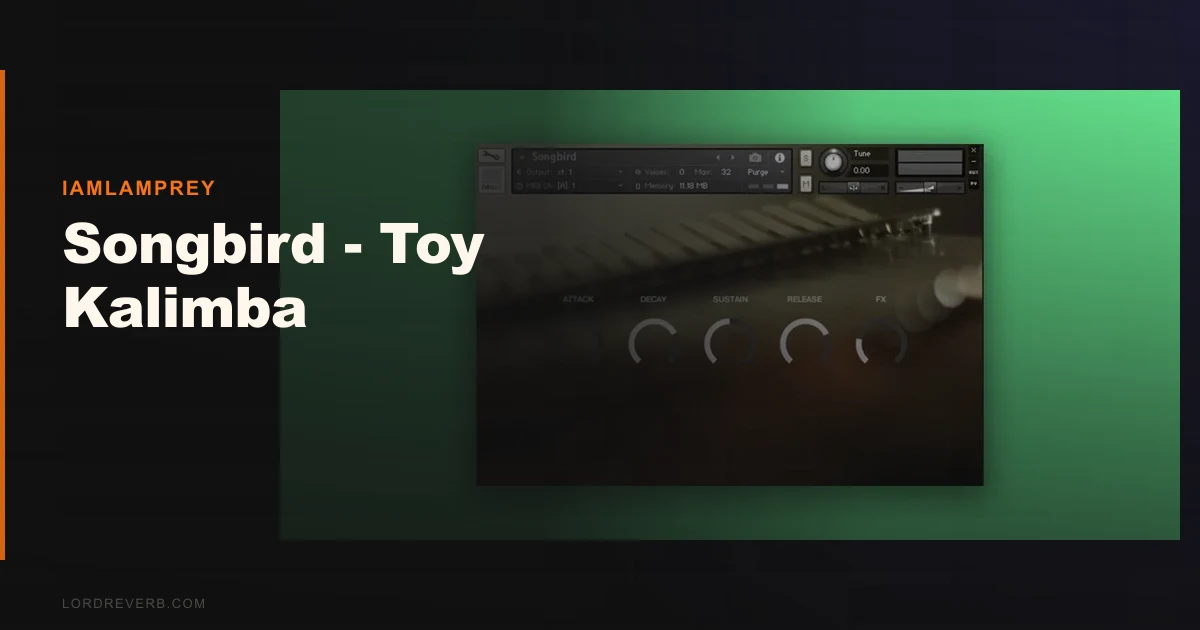
Songbird by IamLamprey is the best free kalimba Kontakt library we've tested, and it's not particularly close.
If you produce lo-fi, ambient, or anything adjacent to Nala Sinephro territory, download Songbird right now. It's free, it's 84 MB, and it plays better than most paid ethnic percussion libraries we've opened in the last two years. The caveat: you need either the NEAT Player (free) or a full Kontakt 5.8+ license to run it. Kontakt Player won't work. That one detail trips up more people than it should, so bookmark it before you get excited.
This is for producers who want genuine toy kalimba texture without the higher price tag that comparable libraries charge. It's also for anyone who's sampled their own kalimba and knows how hard it is to get round-robin cycling to feel natural.
What You're Actually Getting
Songbird is a sampled toy kalimba. Not a concert kalimba. Not a 17-tine Hugh Tracey. A toy. That distinction matters sonically: you get higher-pitched, slightly thinner tines with more overtone brightness and a shorter sustain tail compared to professional kalimbas.
The key range runs G2 to E5. IamLamprey recorded it with 3 velocity layers and 4 round-robin variations per note, which means repeated notes cycle through slightly different takes rather than machine-gunning the same sample.
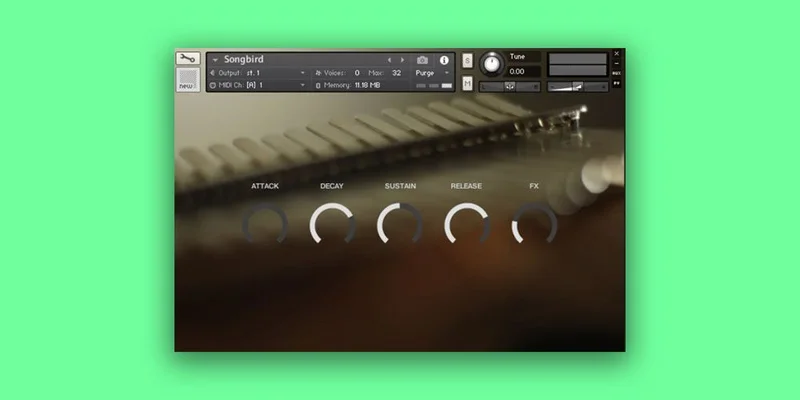
The built-in GUI gives you ADSR controls plus three effects: reverb, delay, and chorus. That's your full signal chain inside the instrument. You can go from dry and intimate to washed-out ambience without leaving the plugin window.
File size is 84 MB. It loaded in under four seconds on our test rig. Version 1.0, released June 2023.
The Good
The round-robin implementation is where Songbird earns genuine respect. We ran a repeated eighth-note pattern at 90 BPM in a lo-fi hip-hop session and listened for the "machine-gun" effect that kills sampled instruments. It didn't appear. The four round-robins cycle naturally enough that repeated notes feel like a player, not a loop.
That's satisfying in a way that surprises you at zero dollars.
The velocity layering holds up too. We played a soft melody at around 30% velocity and a harder stab at 90%. The crossover between layers is clean. No obvious jump where you suddenly hear a different microphone position or a different tine ring-out character.
The built-in reverb is clever. It's not a convolution monster, but dialed to around 30% wet with a medium decay it places the kalimba in a small room convincingly. Pair that with the delay at a dotted-eighth and you've got a playable ambient texture in under two minutes of setup.
We love that IamLamprey didn't cut corners on the sampling process just because the instrument is free. The pitch stability across the G2-E5 range is consistent. No notes that feel out of tune relative to their neighbors.
The Not-So-Good
The Kontakt full version requirement is frustrating if you're expecting this to work like most free Kontakt libraries. Kontakt Player, which most producers already own, won't run it. You need a paid Kontakt 5.8+ license or the NEAT Player workaround.
That's an annoying barrier for beginners who downloaded Kontakt Player for free and assumed all .nki files would load.
The key range stopping at E5 is a genuine limitation. If you're writing a melody that wants to climb above that, you're stuck. There's no way to pitch-shift convincingly beyond the sampled range without the tines starting to sound wrong.
No legato. No sustained notes. Every hit is plucked and done. That's accurate to a real toy kalimba, but it means you can't create the slow, swelling kalimba lines you hear in certain ambient tracks. Those sounds require a different instrument entirely.
The chorus effect is the weakest of the three built-ins. At anything above 20% it introduces a wobble that we'd call ugly rather than characterful. We'd skip it and use your DAW's own chorus if you need that width.
Compared to the Alternatives
The closest paid competition is the Cinematique Instruments Kalimba library, which costs more and offers more articulations, a wider key range, and a concert kalimba option alongside the toy version. If you need that range or those articulations, spend the money. But for toy kalimba specifically, Songbird's round-robins are comparable.
8Dio's Intimate Grand Kalimba costs significantly more and targets cinematic composers who need sustained, layered textures. Wrong tool for lo-fi production. Overkill for bedroom beats.
The Native Instruments Noire has a kalimba-style preset buried in its expansion content, but it's a keyboard instrument dressed up rather than a dedicated sample library. It doesn't capture the overtone character that makes a real toy kalimba identifiable in a mix.
For free alternatives: nothing we've found at zero cost performs
as cleanly across velocity layers. Songbird wins the free tier.
Who Should Buy This
- ✅ Buy if you produce lo-fi hip-hop or bedroom ambient and want a playable toy kalimba texture without spending anything.
- ✅ Buy if you already own Kontakt full version or want to try the NEAT Player workflow.
- ✅ Buy if you're building out a free instrument collection and want something that doesn't sound like a free instrument.
- ❌ Skip if you only have Kontakt Player and can't install NEAT Player. It won't load.
- ❌ Skip if you need legato articulations, sustained tones, or a range above E5 for melodic writing.
- ❌ Skip if you need a concert kalimba sound. The toy character is baked in and you can't EQ it out entirely.
Score Breakdown
| Category | Score | Notes |
|---|---|---|
| Sound Quality | 4.0/5 | Clean velocity transitions, accurate toy kalimba character, honest overtone representation |
| Value for Money | 5.0/5 | It's free. The score writes itself. |
| Ease of Use | 3.5/5 | Simple GUI but the Kontakt full-version requirement catches people off guard |
| Features | 3.5/5 | ADSR plus three effects covers basics; no legato or extended range limits advanced use |
| CPU Efficiency | 4.5/5 | 84 MB, loads fast, sits light on CPU during playback |
| Overall | 4.2/5 | Overdelivers for a free instrument; falls short only against paid libraries with deeper articulation sets |
Alternatives to Consider
If you want more articulation depth and a wider pitch range, the Cinematique Instruments Kalimba is worth paying more for. It has a concert option alongside the toy, and the additional round-robin count gives you more variation in dense arrangements.
For producers who want kalimba textures inside a broader ethnic percussion context, check out Spitfire Audio LABS Charango as a free adjacent option. Different instrument, similar textural role in lo-fi production.
If your budget opens up and you want a cinematic-grade treatment, Native Instruments Session Strings Pro won't scratch the kalimba itch, but it signals the level of library investment that produces noticeably different results in professional mixes.
For producers building a completely free toolkit, Songbird pairs well with free Kontakt instruments for lo-fi production and covers the melodic percussion slot without requiring any budget at all.
Songbird is the right download for anyone who produces lo-fi, ambient, or bedroom pop and does not want to spend more on a kalimba library they will use twice a month. The round-robins are good enough to use on a released track without feeling like you compromised. The free price isn't a warning. It's just what it costs, which happens to be nothing.
The one producer who should skip it: anyone running only Kontakt Player who doesn't want to install NEAT Player. That friction is real and IamLamprey can't do much about Kontakt's licensing structure. Everyone else: it's free, it's 84 MB, and it plays like it cost more than it did.
Frequently Asked Questions
Does Songbird work with Kontakt Player?
No. Kontakt Player doesn't support third-party .nki libraries without a Native Access license. You need either Kontakt full version 5.8 or higher, or the free NEAT Player (version 0.17 or later). NEAT Player is the easiest workaround if you don't own a full Kontakt license.
What's the difference between a toy kalimba and a concert kalimba in terms of sound?
A toy kalimba has shorter, thinner tines that produce a higher-pitched, brighter tone with more overtone shimmer and a faster decay. A concert kalimba, like the 17-tine Hugh Tracey Alto, has longer tines, a fuller fundamental, and a longer sustain tail. Songbird captures the toy character accurately: it's bright, slightly tinny, and sits high in a mix without much low-end weight.
How many notes can Songbird play at once? Is there a polyphony limit?
IamLamprey hasn't published a specific polyphony cap for Songbird. In our testing, full chord clusters across the G2-E5 range loaded without audible dropouts or voice stealing on a mid-range system. CPU load stayed light throughout. You're unlikely to hit a polyphony wall in standard lo-fi or ambient production contexts.
Can I use Songbird in a commercial release for free?
IamLamprey distributes Songbird as a free download, but you should check the license documentation on the official download page before releasing commercially. Most free Kontakt libraries from independent developers allow commercial use, but the terms are set by the developer and can change. Don't assume. Read the license.