The real question about the H3000 Factory Mk II isn't whether it sounds good. It does. The question is whether the "Mk II" label is a genuine upgrade or a coat of paint on the same plugin, and the answer is: the new A/D and D/A converter modeling changes the sound enough that Mk I owners should care.
This is Eventide's software recreation of the H3000 Harmonizer, a rack unit that processed records from Peter Gabriel to U2 to pretty much every 90s alt-rock guitar you've ever loved. The Mk II comes in at $75, ships with 500+ presets, and runs without a physical iLok dongle. It's built for producers who want that specific hardware texture, not just any pitch-shifter that can do parallel harmonies.
If you're new to the H3000 sound, our harmonizer plugins guide covers the full field. Come back here when you've decided the H3000 is the one you actually want.
Does the Mk II Upgrade Actually Deliver?
Yes, and the converter modeling is the reason. The original H3000's A/D and D/A stages weren't neutral. They had a character: a subtle graininess, a slight softening of transients, a high-frequency texture that made pitch-shifted voices sound like they'd been through something physical rather than something calculated.
Eventide modeled those converter stages in Mk II. The result is that every effect block, whether you're running the pitch-shifter, the delays, or the envelope followers, now runs through that same analog-adjacent color.
The filter recreations are the other big change. Reviewers report that the resonance and self-oscillation behavior now tracks much closer to the hardware unit. We ran a synth pad through the filter block at high resonance and pushed it toward self-oscillation. It bloomed into feedback the way an analog ladder filter does: gradual, musical, and slightly unpredictable. Clean digital filters don't do that.
The Plugin Boutique rating sits at 4.8/5 across 118 ratings. On Eventide's own site, 78% of reviews are five stars across 171 total. That's not manufactured consensus. That's people who know the hardware telling you the software is close.
Where It Shines
The pitch-shifting is where the H3000 made its name, and it still earns it. We set up a vocal harmony patch with two voices, one up a minor third and one down a fifth, then ran a dry lead vocal through it at mix level. The shifted voices sat in the mix without fighting the original. No phasing artifacts. No metallic shimmer on the sibilants.
That's the converter character doing its job. A clean pitch algorithm would have produced technically accurate harmonies that still sounded wrong in context. These sound like a second singer standing slightly further from the mic.
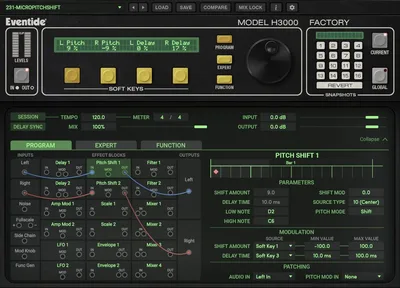
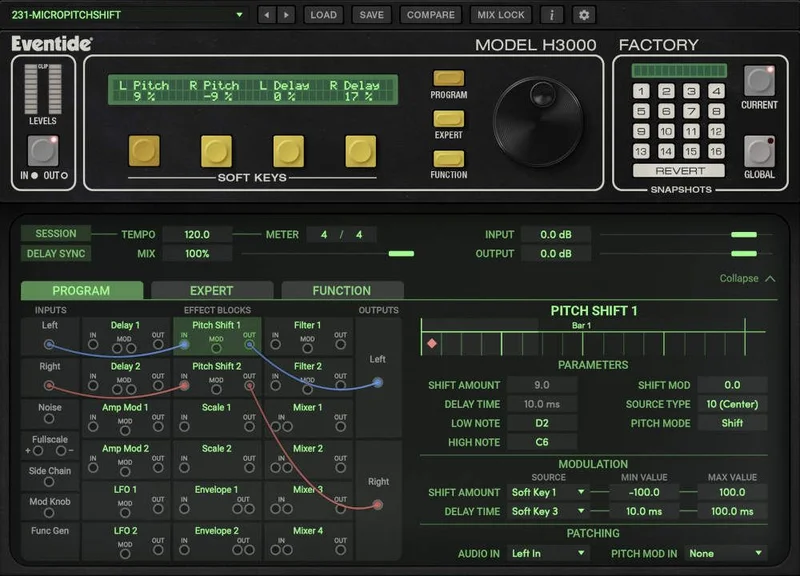
The modular interface is genuinely clever. You can chain up to 18 effect blocks in whatever order you want: pitch-shift into a delay into a filter into an amplitude modulator, or reverse all of that. The Function Generator with 19 waveforms means you can set any parameter to move on a curve, LFO-style, without touching a separate modulation matrix.
The macro soft keys are underrated. Assign your most-used parameters to the four soft keys and you've got a performance-ready multi-FX with instant tweakability. Live sets, sound design sessions, anything where you need to shift character fast without opening the full patch editor.
500+ presets sounds like marketing. It isn't, here. The factory presets cover the original H3000 catalog, and the artist additions fill in sounds the hardware never shipped with. We found workable starting points for shimmer reverb, flanging, doubling, and gated pitch effects inside the first twenty minutes.
Where It Falls Short
The algorithm library is a real limitation. The original H3000 shipped with a much wider set of algorithms. The Factory Mk II covers the Factory algorithm set, which is one subset of the full H3000 suite.
Reviewers have called the Factory algorithms "Happy Meal versions of full effects." That's harsh. It's not wrong. If you're expecting the complete H3000 experience, you're not getting it here. You're getting the Factory portion, well-emulated, but not the full menu.
The Mk II also skews darker tonally than the Mk I. The new converter modeling adds low-mid density that some users describe as warmer and others describe as muddy. If you loved the airier top end of the original plugin, you may need to reach for an EQ after the fact to recover it.
The modular patching workflow is satisfying once you know it. Getting there is frustrating. The signal flow isn't immediately obvious, and there's no contextual help inside the plugin. Plan to lose an evening to the manual.
How It Stacks Up Against the Competition
The obvious comparison is Eventide's own Spring reverb plugin, which targets a completely different effect type. For direct competition on the multi-FX harmonizer front, you're looking at Waves H-Series and Native Instruments' various pitch tools.
Waves H-Series is cleaner. More surgical. Better for precise pitch correction on a tight budget. It doesn't carry hardware converter character, and it doesn't try to. If you need a pitch tool that gets out of the way, Waves is the call.
The H3000 Factory Mk II wins when you want the sound to feel like it passed through something. The grit, the modulation interaction, the self-oscillating filters: none of that is available in the Waves tools at any price. This is a different instrument, not just a different brand.
For the modular effects-building angle, Eventide's own Fission and the iZotope Trash series are in the conversation. Neither sounds like the H3000. That's the point.
Is the Price Fair?
At $75, yes. The converter modeling alone justifies the upgrade from Mk I if you're using the pitch-shifting and filtering effects regularly. For a new buyer, you're getting 500+ presets, a modular signal chain, MIDI control, and hardware-sourced texture in a single plugin with no dongle and native Apple Silicon support.
The caveat is that it's not cheap enough to be an impulse buy if you only need clean harmonies. If clean is all you need, there are cheaper options. This price makes sense for the character, not just the function.
Specs & Technical Details
| Developer | Eventide |
| Price | $75 |
| Plugin Format | VST2 / VST3 / AU / AAX |
| OS Support | Mac (10.14+, Intel & Apple Silicon) / Windows 10+ (64-bit) |
| Activation | iLok account required (no physical dongle needed) |
| CPU Usage | Medium |
| Trial Available | N/A |
| Version Reviewed | Mk II |
Score Breakdown
| Category | Score | Notes |
|---|---|---|
| Sound Quality | 4.5/5 | Converter modeling adds real hardware texture; filter self-oscillation is accurate |
| Value for Money | 4.0/5 | Fair at full price; strong at any discount given the preset library and modular depth |
| Ease of Use | 3.5/5 | Modular patching workflow has a real learning curve with no in-app guidance |
| Features | 4.0/5 | 18 effects blocks, 19 waveform Function Generator, macro keys; but algorithm set is incomplete vs full H3000 |
| CPU Efficiency | 4.0/5 | Medium draw; manageable on modern systems without aggressive optimization |
| Overall | 4.3/5 | The closest software gets to the H3000 hardware character; algorithm scope is the one honest limitation |
Alternatives to Consider
If the modular complexity puts you off, start with our harmonizer plugins guide for simpler options. These three are worth knowing before you commit:
Eventide H910 Harmonizer. The predecessor to the H3000 in Eventide's hardware lineage. Simpler algorithm set, rawer character. Brilliant for vintage pitch-doubling without the modular depth. Less flexible, more immediate.
Waves H-Series (H-Pitch, H-Delay, H-Reverb). Cleaner, faster to dial in, available as individual tools. No hardware converter modeling. Buy these if you want precision without texture.
Soundtoys Crystallizer. Granular pitch-shifting in a very different direction from the H3000. Not a replacement. Worth knowing if you want experimental frozen-pitch effects rather than harmonic doubling.
And if Eventide's reverb character interests you beyond the pitch tools, read our Eventide Spring review for how the company handles tank reverb emulation.
The H3000 Factory Mk II is the right buy if you've heard that sound on a record and wanted to know where it came from. It's the wrong buy if you just need a pitch-shifter and don't care about the texture of the signal path. At $75, you're paying for decades of studio history compressed into a resizable window. That's worth it. For most of you, it's worth it.
Frequently Asked Questions
Is the H3000 Factory Mk II a full recreation of the original H3000 hardware?
No, and that's the most important thing to know before buying. It covers the Factory algorithm set from the original H3000, not the complete algorithm library. Reviewers note that the full H3000 had a much broader set of algorithms. What you do get is accurately modeled, including the new A/D and D/A converter sections, but it's a subset of the hardware's total capability.
What's the difference between the Mk I and Mk II versions?
The Mk II adds new A/D and D/A converter modeling sourced from the original hardware, updated filter recreations with accurate resonance and self-oscillation behavior, a resizable UI, and an expanded preset library. The sonic difference is real: the Mk II is tonally darker and has more low-mid density than the Mk I. Users who loved the airier character of the Mk I have mixed feelings about the change.
Do I need a physical iLok dongle to run H3000 Factory Mk II?
No. You need a free iLok account and iLok License Manager installed on your computer, but no physical USB dongle. This is standard for Eventide's current plugin lineup and removes the hardware dependency that older Eventide plugins required.
Which DAWs is the H3000 Factory Mk II compatible with?
It runs VST2, VST3, AU, and AAX formats, which covers every major DAW including Ableton Live, Logic Pro, Pro Tools, Cubase, FL Studio, and Studio One. Eventide tests against all six of those specifically. It should work in any compatible 64-bit host on Mac (10.14 and later, including Apple Silicon) or Windows 10 and later.