CinePerc is the best conventional orchestral percussion library money can buy in 2026, and at $699 full price, it had better be.
CinePerc is the best conventional orchestral percussion library money can buy in 2026, and at $699 full price, it had better be. Recorded by Dennis Sands at the MGM scoring stage with 170+ instruments, this is the library that professional film composers reach for when the trailer cue needs to sound like it was recorded in a real room, not assembled from samples. It’s not for everyone. If your budget is tight or your music skews toward hybrid or electronic, there are better places to spend. But if orchestral percussion sits at the center of your work, CinePerc earns its price.
What You're Actually Getting
CinePerc launched as four separate libraries: CORE, PRO, AUX, and EPIC. The current version unifies all of them into a single library. That’s a meaningful improvement for anyone who owns the full bundle.
The instrument list covers orchestral staples like timpani, snare, bass drum, and concert toms. It extends into cinematic and ethnic territory with taikos, frame drums, and a deep bench of auxiliary instruments. All of it was recorded at the MGM scoring stage in Los Angeles, one of the genuinely great rooms in the world.
You get multiple mic positions. Close, mid, and room mics are all there, which lets you dial in the balance between a spot-mic intimacy and the full Hollywood wash. Kontakt 5.8.1 or higher is required, and it does work with the free Kontakt Player.
The Sound Case, Made Specifically
We loaded a timpani roll into a dense orchestral mockup. Strings, brass, choir, the works. The timpani from CinePerc didn’t need pulling forward. It sat at the bottom of the arrangement without swallowing the cellos.
That’s the thing about the decay tails here. They’re long. Not artificially long, not reverb-printed long. The MGM room is genuinely big, and the mics captured it. When you cut to the room mic blend in the interface, you can hear the stage breathe around the instrument. That’s not something you get from every library.
We then ran the same timpani passage against a competitor recorded in a dry stage and printed with a convolution reverb afterward. The difference was immediate. The competitor sounded like a sample in a reverb. CinePerc sounded like a recording of a room. That gap matters on a final mix, especially when you’re blending with a real orchestra.
The snare drum is brilliant. We’ve used it on everything from a sparse dramatic cue to a full war-sequence swell, and it holds its character at every dynamic level. The crack is there. The body doesn’t disappear at softer velocities, which is frustrating in cheaper libraries and a real problem on slow builds.
The taiko selection is satisfying in a way that snuck up on us. We weren’t expecting the ethnic and cinematic instruments to match the quality of the core orchestral ones, but they do. Layering the large taiko underneath a bass drum hit gives you a low-end impact that doesn’t require any additional processing to feel full.
Where It Frustrates
The 200 GB install size is annoying. There’s no soft way to say that. If you’re on a 500 GB SSD with a full Kontakt library, CinePerc is going to force a storage decision before you even open a session.
The price is the other obstacle. $699 is real money. Cinesamples runs sales and the promotional price has been lower, but you have to catch it. There’s no predictable sale schedule we can point you to, which means buying at full price is a genuine gamble on timing.
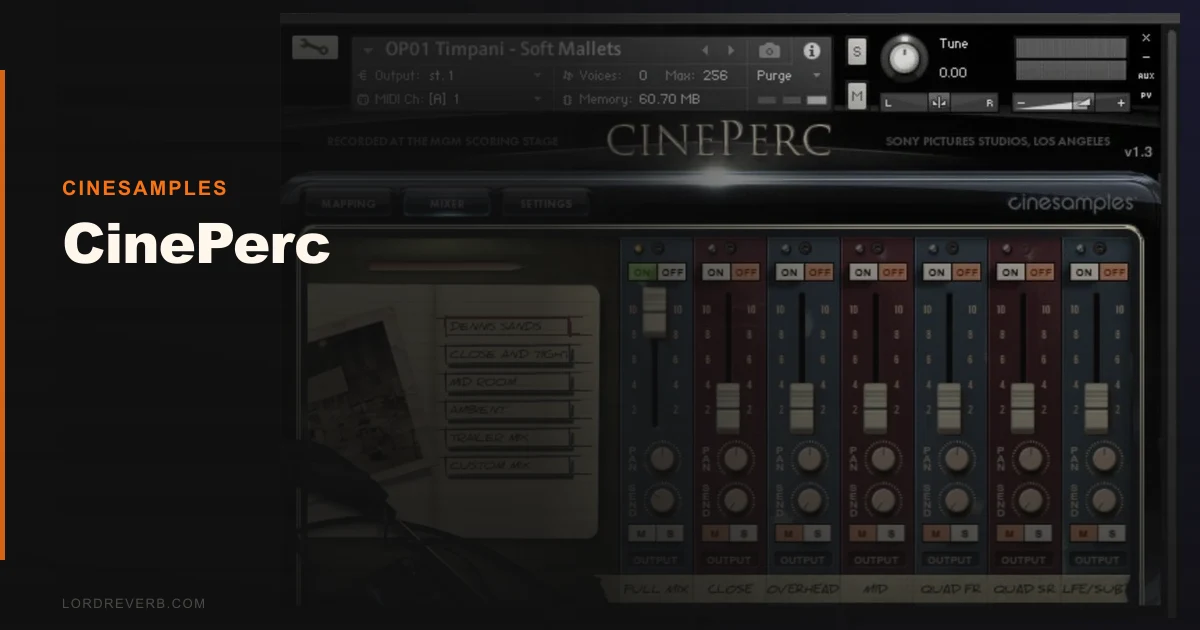
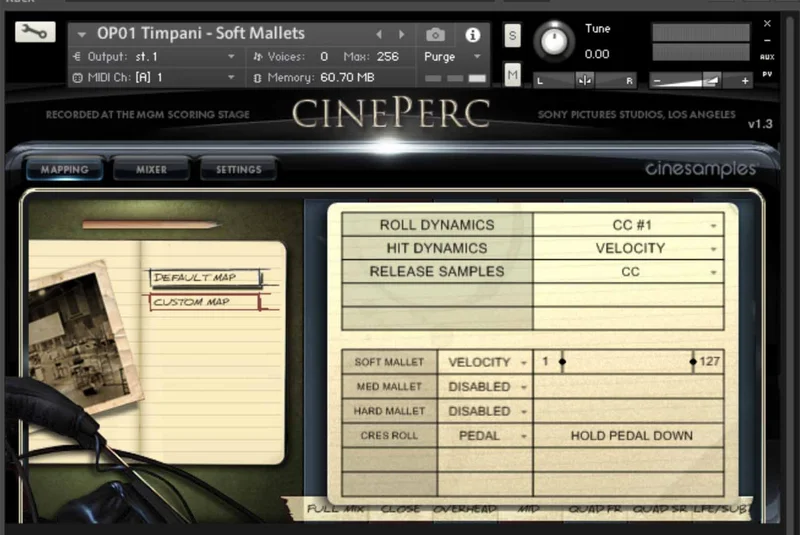
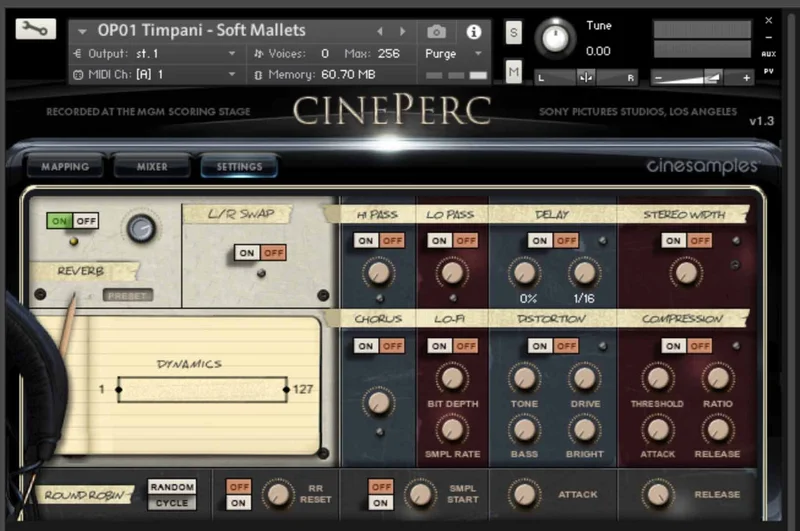
We also wish the GUI had kept pace with the library quality. Loading CinePerc next to some 2024 and 2025 releases, the interface looks dated. It’s functional. Everything you need is accessible. But it’s not the most inspiring thing to look at when you’ve just spent a serious amount of money.
Finally, the Kontakt dependency is a real constraint. If you’re not already in the Kontakt ecosystem, you’re adding that cost and complexity to the equation.
Compared to the Alternatives
Lineage Percussion from Strezov Sampling is the comparison that comes up most often. Lineage is drier. The transients are sharper on the front end, which works well for hybrid and trailer work where you’re adding your own reverb and want maximum control over the space. CinePerc has a longer, fuller tail baked into the recordings. Neither is objectively better. Lineage wins for producers who want a blank canvas. CinePerc wins for producers who want the room to be part of the sound.
True Strike from ProjectSAM is older and shows it, but it costs significantly less. If you’re early in building your library collection, True Strike review might be worth reading before you commit to CinePerc’s price point.
Best orchestral percussion libraries 2026 covers the full field if you’re still deciding.
Spitfire’s Albion series offers percussion as part of a broader orchestral package. If you need strings and brass alongside percussion and your budget is finite, Spitfire A
lbion review is worth reading before you buy percussion-only.
Who Should Buy This
✅ Buy if you score for film, TV, or trailers and need percussion that blends into a full orchestral mockup without extra reverb work.
✅ Buy if you already own CinePerc CORE and want to upgrade. The unified library makes the full bundle worth it.
✅ Buy if you can catch it on sale. On sale, this is a no-hesitation purchase for serious composers.
❌ Skip if you’re a bedroom producer on a tight budget. The storage and price requirements are not casual commitments.
❌ Skip if your work is primarily hybrid or electronic. Lineage or a drier library will serve you better.
❌ Skip if you don’t already own Kontakt. Adding that cost changes the value calculation significantly.
Score Breakdown
| Category | Score | Notes |
|---|---|---|
| Sound Quality | 4.8/5 | MGM room character is real and audible; decay tails are exceptional |
| Value for Money | 3.8/5 | Excellent quality but $699 demands a sale or a serious use case |
| Ease of Use | 4.0/5 | Interface is functional but dated; mic routing is intuitive once you're in |
| Features | 4.3/5 | 170+ instruments, multiple mic positions, full orchestral and cinematic coverage |
| CPU Efficiency | 3.8/5 | Medium load; higher with multiple mic positions active simultaneously |
| Overall | 4.4/5 | The best orchestral percussion library available, with a price that matches |
Alternatives to Consider
Lineage Percussion by Strezov Sampling. Drier recordings, sharper transients, and better for hybrid production work. Check the Lineage Percussion review for a full breakdown. It’s the first alternative we’d recommend if you want room control rather than room character.
True Strike by ProjectSAM. Older library, lower price. Not at CinePerc’s level sonically, but a legitimate starting point if you’re building from scratch. See our budget orchestral libraries guide for where it fits.
Spitfire Percussion (LABS and Albion range). If you’re not sure orchestral percussion is your main need, Spitfire’s ecosystem gives you percussion as part of a larger orchestral toolkit. Sometimes the smarter buy.
The best orchestral percussion samples don’t just record instruments. They record rooms. CinePerc recorded the MGM stage, and you can hear it on every note.
If you can get it on sale, buy it. At $699, buy it only if this is genuinely the center of your work. If you’re still building your core toolkit, wait for a promotion or start with CORE and upgrade later.
Frequently Asked Questions
Does CinePerc work with the free Kontakt Player?
Yes. CinePerc is compatible with the free Kontakt Player at version 5.8.1 or higher, so you don't need the full paid version of Kontakt to run it. That said, if you're building a serious library collection, the full Kontakt license pays for itself quickly through access to non-NKS libraries.
What's the difference between CinePerc CORE and the full bundle?
CORE covers the foundational orchestral instruments: timpani, bass drum, snare, concert toms, and cymbals. The full bundle adds PRO (extended orchestral and cinematic content), AUX (auxiliary and ethnic instruments), and EPIC (large-scale cinematic impacts and ensemble hits). If you primarily write orchestral music, CORE is a legitimate standalone starting point. If you score for trailer or hybrid work, the full bundle is worth the jump.
How does CinePerc compare to Spitfire percussion libraries?
CinePerc was recorded in a specific, identifiable acoustic environment. The MGM stage character is built into the recordings. Spitfire's libraries, including the Abbey Road range, have their own room character but lean toward a different sonic aesthetic. CinePerc sits more naturally in Hollywood-style orchestral mockups. Spitfire integrates better into the broader Spitfire ecosystem if you're already using their strings and brass.
Is 200 GB really required, or can I do a selective install?
The 200 GB figure is the full installation footprint. Kontakt libraries typically allow you to load individual instruments without the full library active in RAM, but the files still need to live on disk. If you're tight on storage, you can house CinePerc on an external SSD. We've run it off a USB-C Samsung T7 with no audible streaming issues at standard session sizes.