CineWinds Core is a good woodwind library that earns its price, but it is not the library you buy if you need serious articulation depth or section writing.
The One-Sentence Version, Expanded
CineWinds Core sits in a strange spot in 2026. It was recorded on the Sony Pictures Scoring Stage with Dennis Sands engineering, which is a genuine credential. The room sounds like a real scoring stage because it is one. But the scripting technology underneath that beautiful recording hasn’t kept pace with what competitors are now shipping at similar price points.
At the introductory price, you are buying five solo instruments: piccolo, flute, oboe, clarinet, and bassoon. That’s it. No ensembles. No multiphonics. No extended technique patches.
If your session needs a flute melody that sits warmly in a string arrangement, this delivers fast. If you need a full woodwind section sounding like it was written by a real orchestrator, you’ll hit walls quickly.
What You're Actually Getting Inside the Box
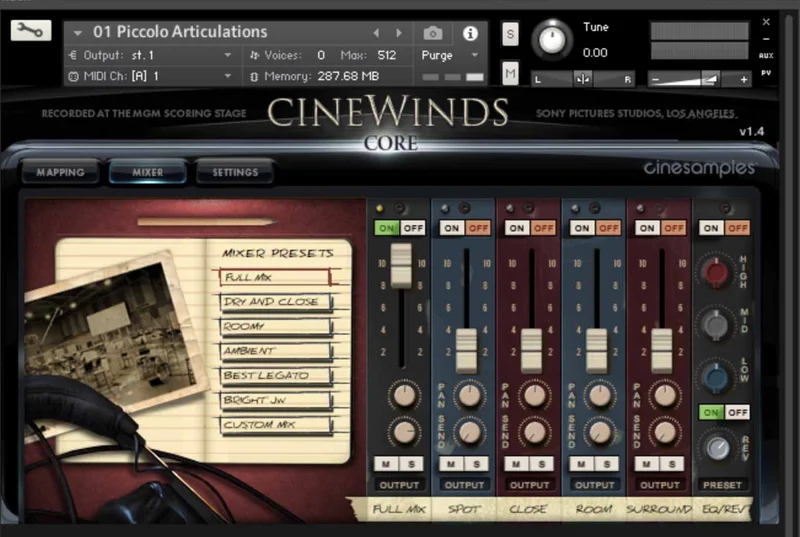
The library installs at 36GB but compresses down to roughly 18GB on your drive after the install process completes. It runs in Kontakt 5.8.1 or higher, and the free Kontakt Player is fully supported. That’s a meaningful win for producers who don’t own the full Kontakt license.
The five instruments ship in NKS format v1.4, so Komplete Kontrol hardware users get full parameter mapping out of the box.
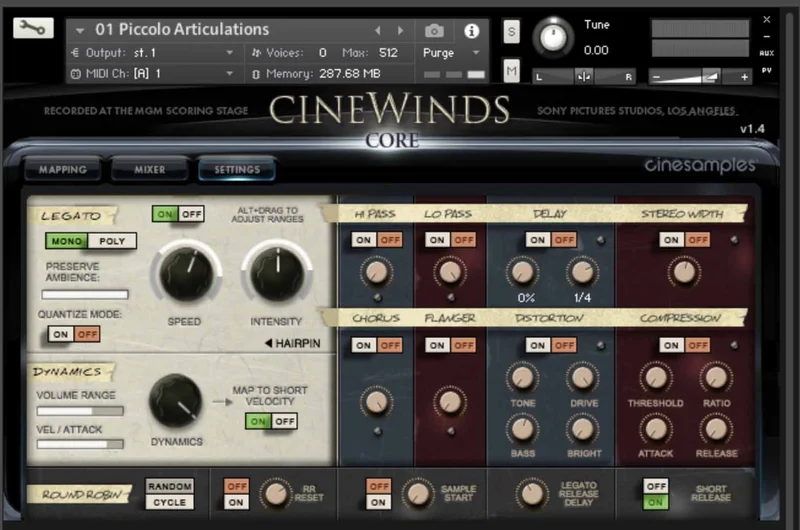
The Adaptive Legato Engine is the centerpiece feature. It detects interval size and playing speed, then selects from recorded legato transitions rather than pitch-shifting a sustain sample. When it works, it sounds like a player actually moved between notes. When it doesn’t, we’ll get to that.
The Chord Arranger assigns harmonic voicing across the five instruments automatically when you feed it chord input. It’s a clever time-saver for sketch work. Don’t expect orchestration-school voice leading. It’s a tool for getting ideas down fast.
The Good: Where CineWinds Core Earns Its Keep
The Sony Pictures Scoring Stage recording is where this library separates itself from bedroom-recorded competitors at similar prices.
We loaded the flute patch and played a simple descending phrase, C5 down to G4, at around 72bpm. The room breathed around the note decay. There’s a natural spread in the stereo image that you’d normally spend 20 minutes chasing with reverb sends. It doesn’t sound like a sample. It sounds like a player in a room.
The oboe is the library’s strongest single instrument. The legato scripting on the oboe is tighter than the rest of the roster. Transitions in the middle register, roughly D4 to A5, sit cleanly in a mix without the timing smear we noticed on the flute’s upper register passages. We ran an oboe line against a string pad and it locked in without any tuning correction needed.
The Chord Arranger genuinely saves time. We fed it a four-note chord and got all five woodwind instruments voiced across the range in seconds. It’s satisfying in a “I just avoided 20 minutes of MIDI arranging” way. For sketch composers working fast, this feature alone justifies a serious look at the library.
The Not-So-Good: Real Weaknesses, Not Nitpicks
The legato engine is inconsistent. That’s frustrating when you’ve just experienced how good it sounds on the oboe, then you load the clarinet patch and the transitions in the upper register start to smear.
We tested a clarinet run ascending from E4 to C6 at 110bpm. Three transition points produced audible artifacts. Not catastrophic, not mix-ruining, but noticeable. You’d hear them in a solo context. Annoying.
The bigger structural problem is what’s missing entirely. CineWinds Core ships with no a2 or a3 section patches. Every instrument is a single player. If your arrangement calls for two flutes in unison or a standard woodwind quintet with ensemble weight, you’re manually layering instances and fighting phase issues. Berlin Woodwinds solved this years ago. So did Spitfire’s Woodwind Ensembles.
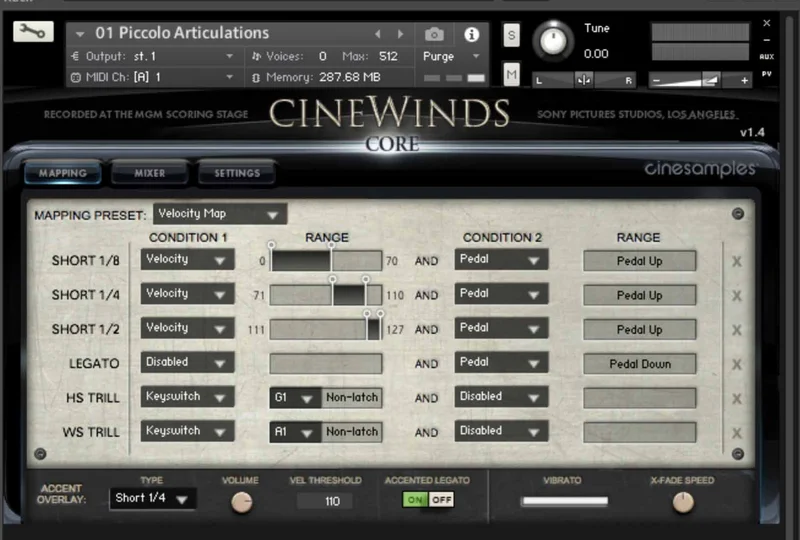
There’s also zero coverage of extended techniques. No flutter tongue. No overblown. No key clicks. For a library at this price point in 2026, that’s a real gap.
Compared to the Alternatives in 2026
Cinematic Studio Woodwinds review
Cinematic Studio Woodwinds is the honest comparison here. It’s priced similarly on sale, it covers solo instruments with better legato consistency across the full roster, and its articulation library goes deeper. If legato phrasing accuracy matters most to you, Cinematic Studio Woodwinds wins that fight.
Spitfire Audio Woodwind Ensembles review
Spitfire’s Woodwind Ensembles solves the section problem CineWinds Core ignores entirely. You get a2 and a3 voicings built in. The room character is different: Spitfire’s Air Studios sound is brighter and drier than the Sony Stage warmth in CineWinds Core.
The CineWinds Core + Pro bundle is worth considering if you know y
ou’ll eventually want the Pro expansion. Buying Core alone at $399 to later spend another $399 on Pro is the expensive path.
Best Kontakt woodwind libraries for composers
On sale, CineWinds Core beats most competitors on pure value per dollar for solo melodic writing.
Who Should Actually Buy This
- ✅ Buy if you write solo melodic lines for trailers, underscore, or hybrid scores and want a fast, realistic result without deep scripting knowledge.
- ✅ Buy if the Sony scoring stage room sound specifically matches the aesthetic of your productions.
- ✅ Buy if you are planning to eventually pick up the Core + Pro bundle and want to start with Core first.
- ❌ Skip if you need woodwind section writing. You'll be frustrated within the first session.
- ❌ Skip if advanced articulations like flutter tongue or overblown are required for your work.
- ❌ Skip if you already own Cinematic Studio Woodwinds. There's not enough differentiation to justify the cost.
Score Breakdown
| Category | Score | Notes |
|---|---|---|
| Sound Quality | 4.3/5 | Sony scoring stage recording is genuinely excellent |
| Value for Money | 3.5/5 | Strong at sale price; harder to justify at $399 given the gaps |
| Ease of Use | 4.0/5 | Chord Arranger and legato engine reduce setup time significantly |
| Features | 3.0/5 | No section patches, no extended techniques, limited articulation depth |
| CPU Efficiency | 4.0/5 | Light footprint, well-optimized for Kontakt Player use |
| Overall | 3.8/5 | Great room, great oboe, genuinely incomplete feature set for 2026 |
Alternatives to Consider
If the legato consistency issues concern you, Cinematic Studio Woodwinds is the direct replacement. It covers the same solo instruments with tighter transitions across the full roster.
Cinematic Studio Woodwinds full review
If you need section writing, Spitfire Audio’s Woodwind Ensembles fills the gap CineWinds Core can’t. The room character is different but the orchestration capability is there.
Spitfire Audio BBC Symphony Orchestra Discover review
If you want the full CineWinds experience and can stretch the budget, the Core + Pro bundle is the honest way to buy this library. Pro adds the articulation depth and ensemble content that makes Core feel incomplete on its own.
Best orchestral sample libraries for film composers
Our Final Call
We would buy CineWinds Core on sale for one specific job: solo woodwind melodic writing in a cinematic context where the room sound has to be right and speed matters more than articulation depth.
We wouldn’t buy it at $399. Not in 2026. The feature gaps that were acceptable in 2016 are harder to defend when competitors have spent the last five years filling exactly those holes.
The oboe patch alone is worth hearing. We loaded it, played a slow ascending line at 60bpm, and sat back for a second. That’s what a well-recorded scoring stage sounds like. It’s love at first phrase, frustration by the third session. Buy it knowing exactly what you’re getting.
On sale, it is worth that tension. At $399, it isn’t.
Frequently Asked Questions
Does CineWinds Core require the full version of Kontakt?
No. CineWinds Core runs on the free Kontakt Player at version 5.8.1 or higher. You don't need to own the full Kontakt license, which is a real cost saving for producers who haven't already purchased it. Native Access handles download and activation.
What's the difference between CineWinds Core and CineWinds Pro?
Core covers five solo instruments: piccolo, flute, oboe, clarinet, and bassoon. Pro expands the library with additional articulations, ensemble content, and more advanced scripting options. The bundle gets you both. Buying Core alone is the right move only if you're specifically after solo melodic writing and plan to add Pro later.
Is 36GB too large to run comfortably off a standard hard drive?
The final installed library sits at roughly 18GB, not 36GB. The 36GB figure is the space required during the installation process itself. Once installed, the compressed library is the smaller footprint. An SSD is still recommended for fast sample streaming, but it's not a demanding library in normal use.
How does the Chord Arranger work in practice?
The Chord Arranger detects the chord you're playing and automatically distributes the voicing across the five instruments in the library. It's built for fast sketch work, not precise orchestration. It saves meaningful time when you need to hear how a harmonic idea sits across the woodwind family, but it won't replace manual voice leading for finished arrangements.