
Colors: Free Version is a free Kontakt instrument worth grabbing if you make pads, ambient textures, or experimental beds, and worth skipping if you need aggressive, deeply sampled sound design. It costs nothing, which sets the bar at a very specific height: it has to earn a place in your template against every other free tool you already own. In some ways it clears that bar. In others, it doesn't, and we'll be honest about both.
The free version gives you 10 sound sources pulled from Cinematique Instruments' full Colors range, 2 from each of the 5 Colors variations. You get 15 presets built from those sources. That's a narrow window into what the full instrument offers, and the limits show up fast once you start pushing outside the ambient lane.
Still, the architecture here is more interesting than most free instruments justify. For a Colors: Free Version review, the real question isn't "is it good for free?" It's "does it earn a spot in your actual sessions?"
What You're Actually Getting
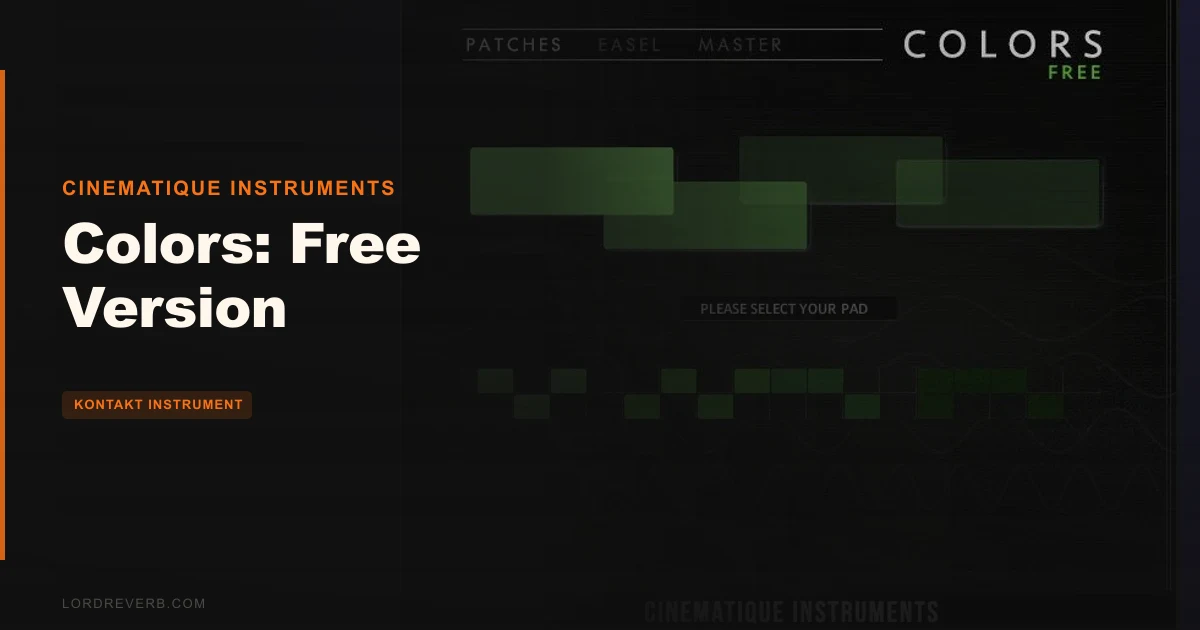
Colors is a 4-layer instrument built around an eccentric, color-coded interface. Each sound source sits in a layered stack, and you shape it through a modification engine that includes LFOs, an arpeggiator, reverb, delay, and distortion.
The random sound generation function deserves attention. Hit it and the instrument reshuffles parameters across the layers, giving you starting points you wouldn't dial in manually. Owners report it's one of the more useful creative tools in the instrument, less a gimmick and more an actual workflow accelerator for sketch sessions.
The color-based preset browser organizes everything visually rather than by category name. It's an unusual approach. You either find it satisfying or slightly annoying, depending on how your brain works.
The HALion Sonic 7 version exists as an alternative if you're in the Steinberg ecosystem and don't own Kontakt. That's a meaningful fork in the road worth knowing about before you download anything.
The Good
The modulation section punches above its weight for a free instrument. The LFOs let you dial in anything from slow, barely-there movement to something that chops and warps the sound into unrecognizable territory. You're building an ambient pad at 2am and you nudge the LFO rate up. Suddenly it's a breathing, shifting texture that didn't exist 30 seconds ago. That kind of discovery is what owners keep coming back to.
The random function is genuinely clever. Not all random generators in sample instruments are useful. This one, owners report, actually surfaces interesting combinations rather than just noise. It's a legitimate tool for breaking creative blocks.
Four layers with reverb, delay, and distortion means you're not just playing back samples. You're shaping a signal chain with real depth. For a free instrument, that's a lot of architecture to work with.
And the arpeggiator adds rhythmic movement without needing an external MIDI tool. For ambient and textural work, that's useful.
The Not-So-Good
Ten sound sources is a short list. You'll hit the walls of this free version fast. The 15 presets cover the ground those sources can cover, but you're not getting variety here. You're getting a sampler.
The sample character is thin. Owners are clear about this. Compared to deeply sampled instruments, the sources here don't hold up under scrutiny in a solo context. They work in a mix, inside a texture, buried under reverb. Pull them forward and the limitations show.
Aggressive bass design? Forget it. This instrument isn't built for it, and forcing it there produces frustrating results rather than usable sounds.
The Kontakt requirement is a real barrier. Full Kontakt 5.6.8 or higher is not free software. If you're using Kontakt Player, this instrument won't load. That cuts out a meaningful portion of producers who'd otherwise grab it.
Honestly? The "free" label carries a hidden cost if you don't already own Kontakt.
Compared to the Alternatives
Spitfire Audio and CineSamples both operate in the sampled instrument space. They offer wider ranges, broader orchestral coverage, and more realistic sample depth. Neither is a direct competitor to Colors for experimental ambient work, but they're where producers go when they need instruments that behave like the real thing under a microscope.
Colors doesn't pretend to be that. It's quirky, textural, and intentionally eccentric. The comparison that matters isn't "Colors vs. Spitfire." It's "Colors free version vs. the full Colors instrument," and on that front, the free version is a legitimate preview, not a complete tool.
If you want free ambient textures without the Kontakt dependency, there are standalone options worth checking before committing.
But if you already own full Kontakt and you make pads, Colors: Free Version is a genuine addition to your library, not just a demo token.
Who Should Buy This
- ✅ Buy if you own full Kontakt 5.6.8 or higher and need more ambient texture options.
- ✅ Buy if you produce pads, soundscapes, or experimental beds and want a creative randomizer in your toolkit.
- ✅ Buy if you want to audition the Colors concept before investing in the full version.
- ❌ Skip if you only have Kontakt Player. It won't load.
- ❌ Skip if you need realistic, deeply sampled instruments for lead or featured parts.
- ❌ Skip if aggressive bass design or dense sound design work is your main focus.
Specs & Technical Details
| Developer | Cinematique Instruments |
| Price | Free |
| Plugin Format | Kontakt Instrument (.nki) / HALion Sonic 7 |
| OS Support | Mac / Windows (via Kontakt host) |
| Activation | N/A |
| CPU Usage | N/A |
| Trial Available | N/A (free instrument) |
| Version Reviewed | N/A |
Score Breakdown
| Category | Score | Notes |
|---|---|---|
| Sound Quality | 3.0/5 | Thin sample character limits use outside ambient and textural contexts |
| Value for Money | 4.5/5 | Free is free, though it requires paid Kontakt to run |
| Ease of Use | 3.5/5 | Eccentric interface has a learning curve but the random function shortcircuits it |
| Features | 3.5/5 | 4-layer system, LFOs, arpeggiator, and effects are strong for a free instrument |
| CPU Efficiency | 3.5/5 | No data available; typical for sample-based Kontakt instruments |
| Overall | 3.5/5 | A useful free ambient instrument with real limits and a hidden entry cost |
Alternatives to Consider
If you want to stay in the Cinematique world, the full Colors instrument is the obvious next step. The free version is built as a preview, and the gaps in sound source variety make that clear.
For free ambient and textural Kontakt instruments with more depth, best free Kontakt libraries for pads and textures covers a wider field than we can cover here.
If the Kontakt requirement is a dealbreaker, standalone free VST instruments built for ambient work give you the same creative space without needing a paid host.
And if you're already budgeting for the full Colors instrument, it's worth comparing it against other mid-range Kontakt libraries that cover similar textural territory.
The Bottom Line
Colors: Free Version is free. That matters. You're not risking anything by downloading it, and the 4-layer engine with LFOs, an arpeggiator, and random generation is more than most free instruments offer in terms of raw architecture.
But "free" here comes with a condition: you need to already own full Kontakt. That's not a small thing. For producers who don't own it, this instrument costs the price of Kontakt to use, and that changes the value calculation entirely.
You're building a slow ambient pad, layering two of the sound sources, and you let the random function loose on the modulation settings. Something clicks. A texture you wouldn't have found any other way. That moment is real, and it happens with Colors. The frustrating part is that with only 10 sources to pull from, that moment becomes harder to repeat in different directions.
If you own Kontakt and make pads or ambient work, add it. It's a genuine tool, not just a marketing sampler. If you're outside that narrow brief, there are smarter places to put your time.
Related reviews: Retropolis
Frequently Asked Questions
Does Colors: Free Version work with Kontakt Player?
No. The instrument requires the full version of Kontakt 5.6.8 or higher to load. Kontakt Player is the free, limited version of Native Instruments' sampler and does not support third-party instruments like Colors. If you only have Kontakt Player, this instrument will not open.
How many sounds does Colors: Free Version actually include?
The free version contains 10 sound sources, with 2 pulled from each of the 5 Colors variations. Those sources underpin 15 presets. It's a narrow selection that represents the full instrument rather than replacing it. Owners report the modulation tools help stretch those 10 sources further, but the limits are real.
Is Colors: Free Version good for bass design or aggressive sound work?
No. Owners are consistent on this. The instrument's sample character and overall design point firmly toward pads, ambient textures, and quirky atmospheric production. Push it toward aggressive bass design and it doesn't hold up. If that's your primary use case, this instrument isn't built for it and you'll find the results frustrating.