Cherry Audio Year Two Collection is worth $100 if you already live inside Voltage Modular and want a fast route to Juno-style pads, ARP-style leads and Yamaha-style FM, and a poor buy if you don't.
That's the gap this collection fills. It's a bundle of 14 modules for Voltage Modular, and this review is built around one question: is it good value for the people who can actually use it?
What's In The Box: Fourteen Modules, One Requirement
The collection is 14 modules: SynthVoice, SynthVoice Filter, DCO-60, VCF-60, Chorus-60, AirWave, Poly AirWave, AirVector, AirStep, FM Station, Poly FM Station, EG Station, Poly EG Station and Polymode.
That list reads like three different shopping trips, and that's a fair description. There's an ARP 2600-inspired voice, a Juno-106 family, a pile of digital and sample-based oscillators, FM, envelopes and a Polymoog-inspired polysynth.
The hard requirement is Voltage Modular. None of this runs without it, and it's sold separately.
On Mac you need macOS 11 or above, and macOS 11.6 or higher for Apple silicon. Cherry Audio recommends a 3.4 GHz quad-core or M1 CPU with 8GB of RAM. Formats are AU, VST, VST3, AAX and Standalone, with native support for Apple M1 and up, including Ultra.
On Windows it's Windows 7 or above, including Windows 11, 64-bit. A quad-core machine with 8GB of RAM is the recommendation. Formats are VST, VST3, AAX and Standalone.
User patches and cabinets move freely between platforms. If you split time between a Mac laptop and a Windows desktop, that matters.
Where It Fits In Your Workflow
This isn't a plugin you drop on a channel and forget. It's a set of building blocks that live inside Voltage Modular, and your workflow is Voltage Modular's workflow.
Open a rack, drop in a module, patch it up, save it. Some modules are complete voices, like SynthVoice. Others are parts, like EG Station or VCF-60, that you wire into patches you already have.
That split decides who gets value from it. If you want finished instruments, the voice-style modules do that job. If you like building, the filters, envelopes and mixers become new parts for your own patches.
Hosting works through the formats above, so you can load Voltage Modular as a plugin in your DAW and automate from there. Or run it standalone and bounce stems when the patch is done.
Think of it as a sound-design layer rather than a preset pack. You'll use it more if you enjoy the patching and less if you only want to scroll a browser.
SynthVoice: The ARP 2600 Idea In A Rack
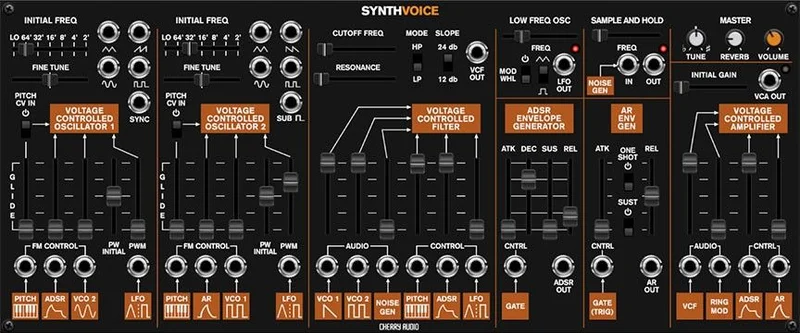
SynthVoice is the one most likely to get you hooked fast. Cherry Audio describes it as like having a classic ARP 2600 in your modular rack.
The feature list is generous for one module: two oscillators, a multi-mode filter, an LFO, dual envelope generators, sample and hold and a spring reverb.
Honestly? A complete voice with spring reverb already onboard is the clever part. You don't need to patch an effect just to hear it in a room.
SynthVoice Filter
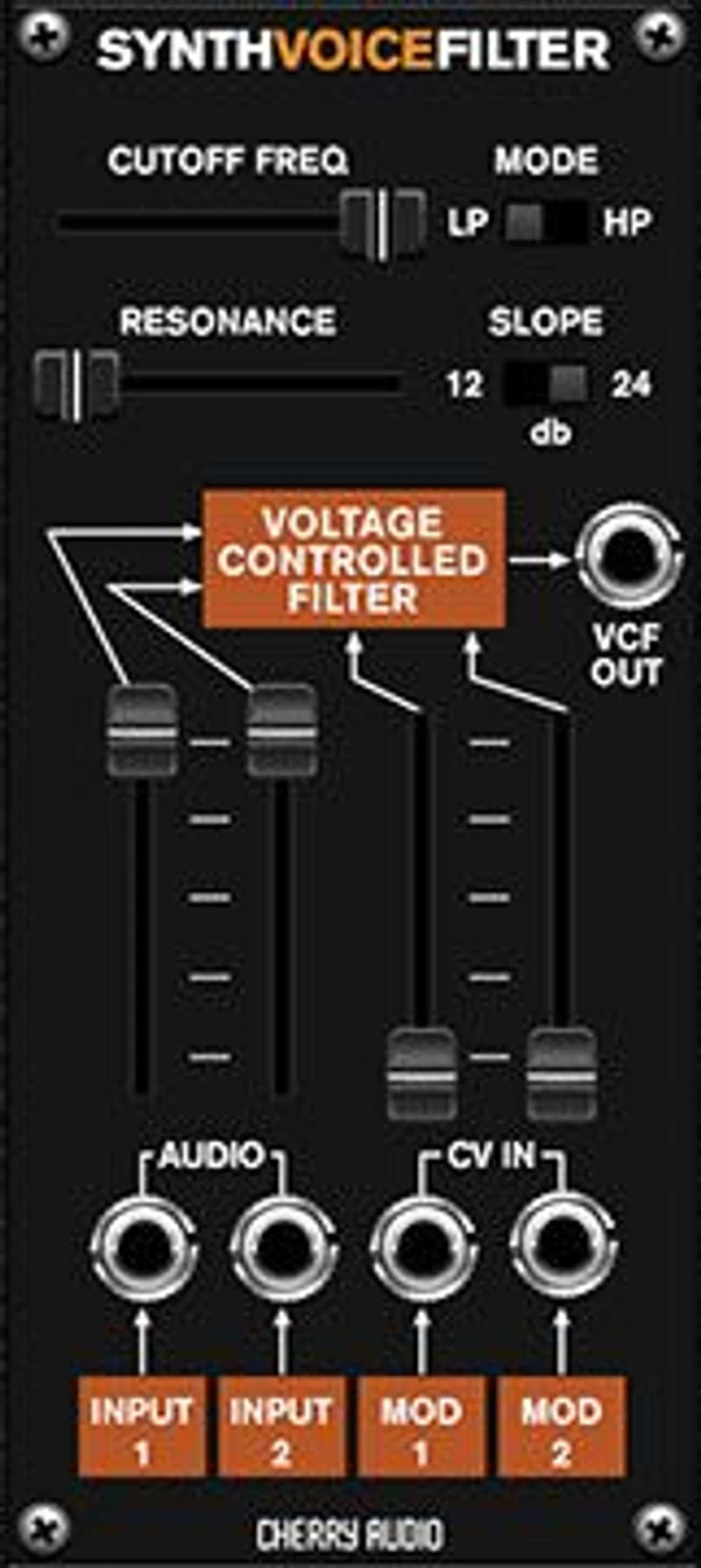
SynthVoice Filter is a separate module offering lowpass and highpass modes with selectable 12 or 24 dB/oct slopes. Cherry Audio calls it ballsy, pure analogue tonality of the ARP 2600.
That's a developer claim, and we can't verify the tone for you. What you can check is the practical bit: a switchable slope means you can go gentle on a pad and steeper on a bass.
A steeper slope removes upper harmonics faster, making sweeps tighter and less hissy.
The Juno Family: DCO-60, VCF-60 And Chorus-60
This trio is the heart of the collection for anyone who loves 80s pads. Three modules, one clear idea.
DCO-60
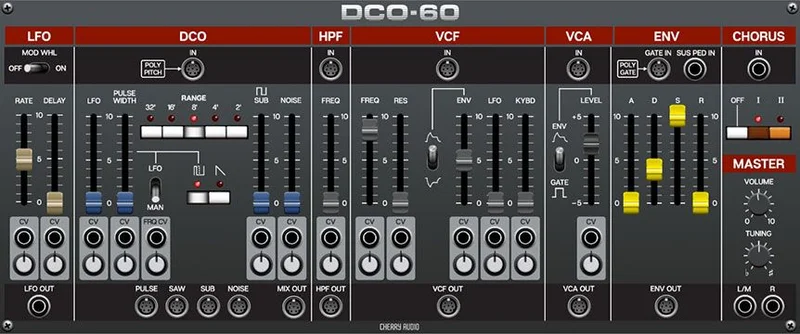
DCO-60 models the Juno-106. It includes a self-oscillating filter and a chorus effect, and it's fully polyphonic with patch points.
The part that stands out: the entire 'A' bank of the original factory presets is recreated. If you grew up on those sounds, you can recall them rather than rebuild them by ear.
Polyphonic with patch points is the useful combination. You can play chords and still route modulation and CV through the module like any other part of the rack.
Juno-style instruments are valued for the wide stereo shimmer created by the chorus effect on sustained chords.
VCF-60
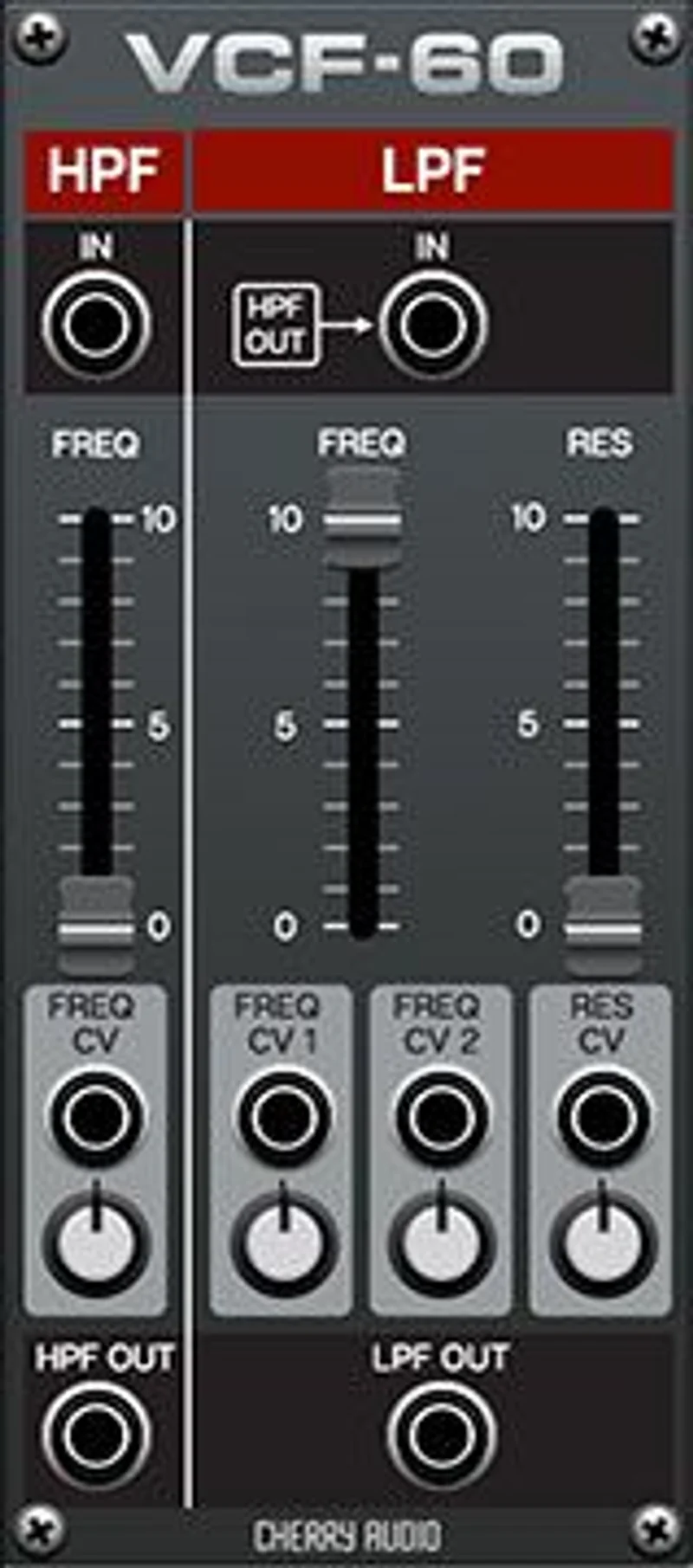
VCF-60 contains highpass and lowpass filters with independently patchable sections, plus a self-resonating lowpass section.
Independently patchable is the key phrase. You can put the highpass early in a chain to thin things out and the lowpass later for tone, or feed other sources through each separately.
Self-resonating means you can crank the resonance until the filter sings on its own. Tune it to the key of your track and you've got a sine-like tone without an oscillator.
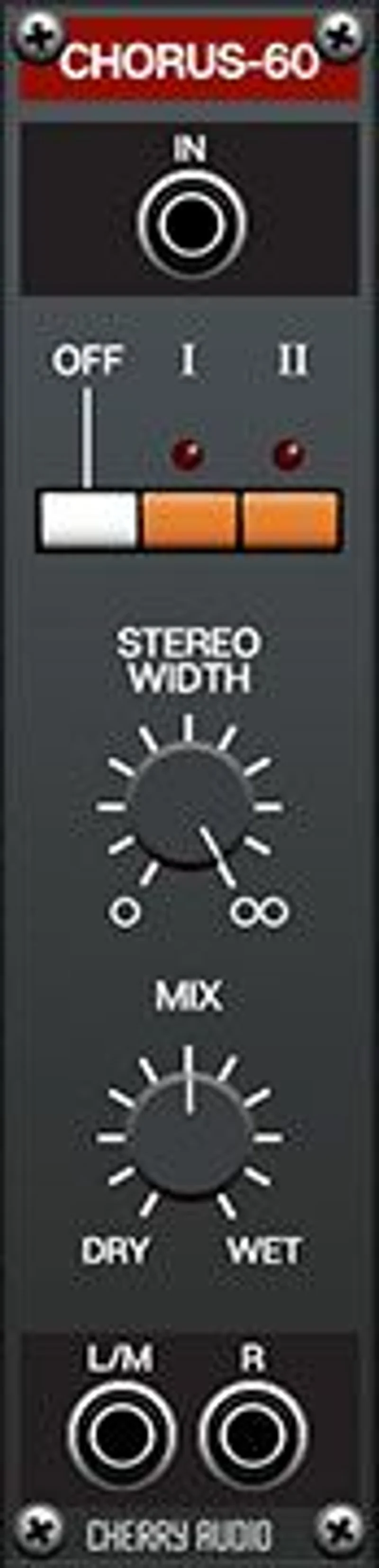
Chorus-60
Chorus-60 precisely replicates the stereo spread of classic Roland Juno synthesizers and adds wet/dry mix controls.
The wet/dry mix is the practical upgrade. The original hardware chorus was effectively all-or-nothing, so a mix knob gives you room to keep a bass tight and a pad wide.
Use it as a send-style effect on a lead and dial the mix back until the stereo width is obvious without smearing the attack.
The Air Modules: AirWave, AirVector, AirStep
This is where the collection stops being retro and gets strange. Digital, PCM-based, joystick-driven.
AirWave And Poly AirWave
AirWave is a joystick-controlled quad vector digital oscillator with over 200 looped PCM sample waves, separate outs for each wave, and a sample rate knob.
Four waves at once, blended by a joystick. Move the stick and you cross-fade between four sources. AirWave enables easy creation of radical and unearthly timbres.
Separate outs for each wave is a modular-brain feature. You can split the four sources and process each one differently before they ever meet.
The sample rate knob is the fun grit control. Drop it and the sound turns crunchy and aliased, the kind of lo-fi digital edge you'd otherwise chase with a bitcrusher.
Poly AirWave is the polyphonic version, with the same 200-plus waves, separate outs and sample rate knob. If you want to play chords through this oscillator, this is the one to grab.
AirVector
AirVector is a joystick-controlled quad vector mixer with flexible modulation and a vector envelope section.
It's a mixer, not an oscillator. Feed it four sources of your own and use the joystick and envelope to move between them over time.
The vector envelope is the interesting part. Instead of a static blend, you can program the mix to travel across the four inputs, so a note evolves from one timbre into another.
AirVector's interfaces simplify creation of complex wave sequences. We'd say check that against your own patience for joystick-driven editing.
AirStep
AirStep features over 300 onboard PCM sample waves with flexible modulation, trigger and sync options.
Wave sequencing is the idea: instead of one static waveform, the oscillator steps through a series of them. AirStep takes wave sequencing synthesis to entirely new level.
Sync it to your session tempo and you get rhythmic timbral movement that repeats in time. A single held note becomes a pattern.
Three Air modules overlap a little, and that's the point where you may feel the collection is more than you need. Pick one to learn first.
FM Station And Poly FM Station
FM Station is a digital oscillator inspired by classic Yamaha digital synths of the 80s, using frequency-modulation synthesis.
FM Station combines incredible sound quality and ease of use. FM has a reputation for being punishing to program, so ease of use is a bold claim worth testing against your own patience.
FM is the go-to for glassy bells, electric-piano tines and metallic basses. If your break needs a bell, this is the module that answers.
Poly FM Station is the polyphonic version. You'll want it for keys and chords, since a monophonic FM voice only gets you so far.
One honest caveat. FM is a genre of synthesis with its own logic, and you should expect a learning curve if you've never touched it.
EG Station And Poly EG Station
EG Station features eight fully independent ADSR envelope generators, with velocity CV inputs for envelope intensity control.
Eight envelopes in one module is generous. Instead of scattering single envelopes across your rack, you get a bank you can assign to amp, filter, pitch and anything else.
The velocity CV inputs are the expressive bit. Hit harder and the envelope intensity changes, so your playing shapes the sound rather than just the volume.
Poly EG Station offers the same eight independent ADSRs with velocity CV inputs, built for polyphonic patches. If you're running poly oscillators, you need the poly envelope to match.
Envelopes aren't glamorous. They're also the difference between a patch that feels alive and one that feels like a held organ note.
Polymode: The Polymoog-Inspired One
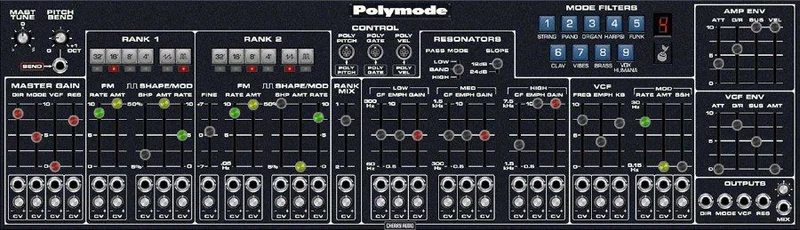
Polymode is inspired by the legendary 70s Polymoog synthesizer.
Cherry Audio says it excels at large pads, strings and vocal-esque sounds, with a unique multiple filter implementation and mod routings.
That tells you where to point it. Think slow, wide, choir-like layers rather than punchy bass.
If the Juno trio handles shimmer, Polymode handles size. Layer them and you've got a pad stack with two distinct characters.
Is It Worth The Money? The Value Case
Here's the math that matters. The collection costs $100, and Voltage Modular is a separate, required purchase on top.
That second cost is the thing people forget. If you don't already own Voltage Modular, your real entry price is higher than the tag suggests.
If you do own it, $100 for 14 modules is easy to justify. You're getting a full Juno family, an ARP-style voice, FM, wavetable-style digital oscillators, and a bank of envelopes.
The question is how many of those modules you'll actually patch. Four or five that you use constantly will pay for themselves in time saved. Fourteen that you open once is a poor deal.
So be honest with yourself. Do you want Juno pads, an ARP-style lead and FM bells? Then the bundle is cheaper than buying piecemeal and chasing each sound separately.
Do you just want a handful of presets and no patching? A simpler instrument will serve you better, and you'll skip a lot of friction.
Paying more is justified only if the vintage character is the point of your music. If you mostly want clean utility sounds, a cheaper or free route is enough, and this collection is overkill.
The Rough Edges
Start with the obvious one. You can't use any of it without Voltage Modular, so it's a poor fit for anyone who doesn't want a modular environment.
Fourteen modules is also a lot of surface area. It's annoying to open a collection and not know where to start.
Several modules are deep rather than instant. FM Station, AirVector and AirStep reward patience, and they'll frustrate you if you want instant results.
There's overlap too. Three Air-family modules and two FM and EG pairs mean you'll end up ignoring some of what you paid for.
Platform limits are real but modest. macOS versions below 11 and Windows versions below Windows 7 aren't supported, which only matters if you're on an old machine.
Your specific CPU performance may vary. The recommended specs are a quad-core with 8GB of RAM, so check your machine before you commit.
Who This Is Really For
- ✅ Buy if you already own Voltage Modular and want Juno, ARP and Yamaha-style sounds in one bundle.
- ✅ Buy if you like patching and want envelope banks, filters and oscillators to build your own instruments.
- ✅ Buy if you need polyphonic digital and FM voices for pads, keys and chords inside a modular rack.
- ❌ Skip if you don't own Voltage Modular and don't want to buy a second product just to get started.
- ❌ Skip if you want a plug-and-play preset browser rather than a patching environment.
- ❌ Skip if you'll only ever use one or two of the modules and a simpler instrument would do.
How It Compares To Doing Nothing
The honest alternative is the free route: build what you need from the modules Voltage Modular already gives you. The honest alternative is the free route: build what you need from the modules Voltage Modular already gives you.
That works. It just takes longer, and it won't hand you a Juno 'A' bank or a Polymoog-style pad on day one.
If you enjoy building, the bundle is a shortcut you may not need. If you don't, it's the thing that makes the platform worth opening.
Still deciding where to start? Check our best Voltage Modular modules for beginners guide, or see how this fits into a modular synth plugin buying guide.
Specs & Technical Details
| Spec | Detail |
|---|---|
| Developer | Cherry Audio |
| Price | $100 |
| Plugin Format | Mac: AU, VST, VST3, AAX, Standalone. Windows: VST, VST3, AAX, Standalone |
| OS Support | macOS 11 or above (11.6+ for Apple silicon); Windows 7 or above, 64-bit |
| Activation | N/A |
| CPU Usage | N/A |
| Trial Available | N/A |
| Version Reviewed | N/A |
Score Breakdown
| Category | Score | Notes |
|---|---|---|
| Sound Quality | 4.3/5 | Juno, ARP, FM and Polymoog-inspired voices cover wide ground; tone claims are the developer's |
| Value for Money | 4.0/5 | 14 modules for $100 is strong, but Voltage Modular costs extra |
| Ease of Use | 3.8/5 | Great if you patch; steep if you only want presets |
| Features | 4.6/5 | 200+ PCM waves, 8 ADSRs per EG module, full Juno 'A' bank recreated |
| CPU Efficiency | N/A | No figures to score; recommended spec is a quad-core with 8GB RAM |
| Overall | 4.2/5 | Excellent bundle for Voltage Modular owners, a poor fit for everyone else |
The Verdict: Buy It, With A Condition
If Voltage Modular is already open on your machine, buy this. At $100, the Juno trio alone justifies the spend, and the rest is bonus.
If it isn't, think twice. You'd be paying for a second product just to reach the first, and that changes the math.
We love the breadth. We're less sure about the learning curve for a few of the deeper modules, and it's ridiculous to pretend all fourteen will earn a permanent slot in your rack.
Buy it for the pads and the ARP-style voice. Grow into the FM and Air modules when you're ready.
For the right patcher, this is an underrated bundle. For anyone chasing quick presets, hard pass.
Frequently Asked Questions
Do I need Voltage Modular to use the Cherry Audio Year Two Collection?
Yes. The collection is a set of 14 modules built for Voltage Modular, and it won't run without it. Voltage Modular is a separate purchase, so budget for both.
What's included in the Cherry Audio Year Two Collection?
You get 14 modules: SynthVoice, SynthVoice Filter, DCO-60, VCF-60, Chorus-60, AirWave, Poly AirWave, AirVector, AirStep, FM Station, Poly FM Station, EG Station, Poly EG Station and Polymode. They cover ARP-style, Juno-style, digital, FM and Polymoog-inspired territory.
Does it work on Mac and Windows?
Yes. Mac needs macOS 11 or above (11.6+ for Apple silicon) with AU, VST, VST3, AAX and Standalone formats. Windows needs Windows 7 or above, 64-bit, with VST, VST3, AAX and Standalone formats.
Does it support Apple silicon?
Yes. It offers native support for Apple M1 and greater processors, including Ultra. Cherry Audio recommends a 3.4 GHz quad-core or M1 CPU with 8GB of RAM.
Can I move my patches between Mac and Windows?
Yes. User patches and cabinets are freely exchangeable across platforms. That helps if you work on a laptop and a desktop running different operating systems.