Blue Cat’s Phaser gets compared to MeldaProduction’s MPhaser constantly, and after running both through the same signal chain, we’d say MeldaProduction wins on features but Blue Cat wins on getting out of your way for free. This review is specifically for producers who are deciding whether Blue Cat’s Phaser earns a permanent slot in their rack or whether it’s a placeholder until the next sale on something better.
The short answer: it earns the slot. Not because it’s the most capable phaser you’ll ever load, but because it’s free, it works, and 32 phasing stages go deeper than most people expect from a no-cost plugin. If you’re building a phaser plugin collection, this belongs in it.
It’s built for producers and engineers who need reliable phase sweep without spending anything, and for live performers who want stable MIDI-mapped modulation that won’t miss a CC message.
How It Compares Out of the Box
Load Blue Cat’s Phaser next to Kuassa Effektor PH3605 ($29) and the first difference you’ll notice is the interface. Kuassa looks like a boutique pedal. Blue Cat looks like a utility plugin from 2008. That’s not a dealbreaker, but it does set expectations.
Sonically, the first-pass comparison against Nembrini Phazevibe 3 ($49) is more revealing. Phazevibe leans into vintage warmth with obvious harmonic softening in the sweep. Blue Cat is cleaner. More transparent, in the sense that your wet signal doesn’t pick up extra color. Whether that’s good depends on what you’re sweeping.
We ran a funk guitar through Blue Cat at 8 stages with the rate at 0.5Hz. The sweep was smooth and musical. Not thin, not clinical. Just present and honest.
MeldaProduction’s MPhaser is the real benchmark for free phasers. It offers more LFO shapes. Blue Cat counters with a simpler workflow that takes about four minutes to learn completely.
Performance Deep Dive
Version 3.1 runs at any sample rate, which matters if you’re working at 96kHz or higher. We tested it at 44.1kHz, 48kHz, and 88.2kHz with no artifacts and no resampling weirdness.
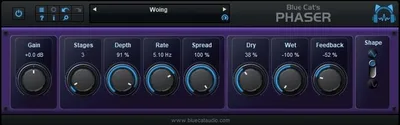
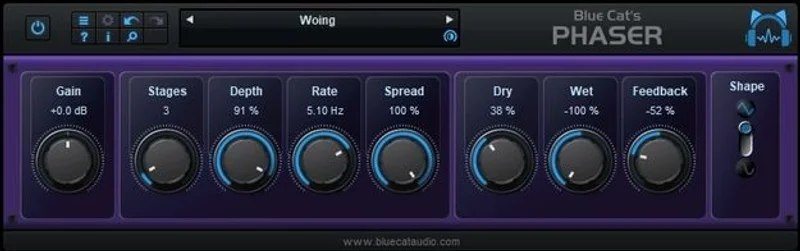
The 32-stage option is the headline spec, and it delivers. At 32 stages, the notch depth and sweep width create a phase effect that sits closer to a flanger than a classic 4-stage phaser. We pushed it on a synth pad, sweeping slowly at 0.1Hz, and it generated movement that kept the pad interesting across a full 8-bar loop without eating any other frequency content.
CPU load is genuinely light. On a session with 24 other active instances of various plugins, Blue Cat’s Phaser didn’t register a measurable spike. The zero-CPU-during-silence feature is real, not marketing copy. We verified it by soloing a track with a short vocal phrase, watching the meter between phrases. Flat. No idling cost.
The MIDI implementation is the surprise. You get proper CC mapping, MIDI learn, and advanced CC settings. We mapped the rate and depth to a controller and got smooth, real-time modulation with no stepping or zipper noise. That’s not something you always get from paid plugins at $30.
LFO waveforms are limited to sine and triangle. That’s the ceiling. No random, no square, no envelope follower.
Where It Wins
The price is $0.00. That’s not a joke or a footnote. It’s the whole argument for most people reading this.
Thirty-two stages is more than most producers will ever need. Standard phaser territory runs from 4 to 12 stages. Having 32 available means you can build sounds that no stock phaser in any DAW will match.
The stereo spread control is underrated. We ran a mono synth bass through it, pushed the spread to about 70%, and it created width without sacrificing low-end mono compatibility. Checked it in mono. Center held. That’s a useful trick for electronic production where you need stereo movement without phase issues on a club system.
MIDI control works cleanly. We’ve used $50 phasers that handle MIDI worse. No compensation needed.
Where the Competition Wins
MeldaProduction’s MPhaser is also free and gives you more LFO shapes, an envelope follower, and a more modern interface. If you only have room for one free phaser and you want maximum flexibility, MPhaser edges it out.
Kuassa Effektor PH3605 at $29 wins on character. It has a tonal fingerprint that Blue Cat doesn’t. If you’re after that vintage analog warmth with audible harmonic softening in the sweep, Kuassa is the move.
Nembrini Phazevibe 3 at $49 sounds like a phase shifter pedal from the 1970s in the best possible way. Blue Cat doesn’t try to do that. It’s not vintage-voiced. It’s clean. For psychedelic rock where you want the effect to sound like hardware, Phazevibe wins easily.
The preset situation is frustrating. Blue Cat ships with a small pre set library. Loading it fresh, you get a handful of starting points. Kuassa and Nembrini give you dozens of categorized presets for specific genres and instruments. If presets are part of your workflow, that gap is annoying.
Who Should Buy Which
✅ Buy Blue Cat’s Phaser if you need a capable, no-cost phaser and don’t want to think about it.
✅ Buy it if you’re doing electronic production or funk where clean sweep with stereo spread is more valuable than vintage coloring.
✅ Buy it if you need solid MIDI mapping for live performance on a zero budget.
❌ Skip it if you want vintage analog character baked into the effect. Nembrini Phazevibe 3 is the move there.
❌ Skip it if you need envelope following, random LFO shapes, or complex modulation routing.
❌ Skip it if you’re looking for a deep preset library to browse for inspiration. The shelves are sparse.
Score Breakdown
| Category | Score | Notes |
|---|---|---|
| Sound Quality | 3.5/5 | Clean and honest sweep with good depth at higher stage counts, but no vintage character |
| Value for Money | 5.0/5 | It's free. No argument. |
| Ease of Use | 4.0/5 | Simple layout, learns in minutes, though the GUI could use a modern refresh |
| Features | 3.0/5 | 32 stages and MIDI are strong; two LFO shapes and thin presets hold it back |
| CPU Efficiency | 4.5/5 | Zero load during silence is real and verified; active load is negligible |
| Overall | 3.9/5 | Excellent for free; limited against paid competition above $30 |
Alternatives to Consider
MeldaProduction MPhaser is the closest free competitor and wins on modulation options. More LFO shapes, an envelope follower, and a more modern interface. Also $0.00. best free phaser plugins
Kuassa Effektor PH3605 ($29) is where we'd send producers who want character in the sweep. It models analog phaser circuits convincingly. Worth the money if you're doing funk, soul, or R&B regularly.
Nembrini Phazevibe 3 ($49) is the specialist. Built specifically for vintage phase shifter tones. If psychedelic rock or classic soul production is your primary genre, it's the right tool. Check their site for current pricing on bundles.
Also worth reading: our full Blue Cat's Axe Pack Review if you want to see how Blue Cat's other freeware holds up, and our Rob Papen BLUE-III review for a look at what advanced modulation looks like when you spend real money.
We tested Blue Cat’s Phaser on a synth lead in an electronic session, automating the stage count from 4 to 16 across a drop. The sweep built tension without smearing the transient attack. Satisfying. That moment is why it stays installed.
Blue Cat’s Phaser is free, functional, and honest about what it is. Download it, keep it in your rack as a clean workhorse phaser, and spend your plugin budget on something that costs money. The one person this is wrong for: anyone chasing vintage hardware warmth. That person needs to spend $49 on Phazevibe and call it done.
Frequently Asked Questions
Is Blue Cat's Phaser truly free, or is there a paid version?
It's completely free. No subscription, no iLok, no license key. You download it from Blue Cat Audio's site, install it, and it works. There's no paid tier or premium upgrade for this specific plugin.
How many phasing stages does Blue Cat's Phaser actually use, and does the stage count make a noticeable difference?
It goes from 1 to 32 stages. Yes, the difference is audible and significant. Four stages gives you a classic, subtle phase sweep. Sixteen stages produces a deeper, more dramatic modulation. Thirty-two stages pushes into flanger territory with dense notch comb filtering. We'd run 4-8 for standard use and push higher for sound design.
Does Blue Cat's Phaser work in all major DAWs?
It supports VST, VST3, AU, and AAX, so it covers Ableton, Logic, Pro Tools, Cubase, Reaper, Studio One, and FL Studio. macOS and Windows both supported. We haven't hit a compatibility issue on any modern system running version 3.1.
How does Blue Cat's Phaser compare to the phaser built into my DAW?
Most DAW stock phasers max out at 8 or 12 stages and offer minimal MIDI control. Blue Cat gives you 32 stages and proper MIDI CC mapping. For producers who automate effects heavily or perform live, that alone makes it worth installing alongside whatever your DAW ships with.