Ben Osterhouse's Viola Da Gamba Kontakt instrument captures the real instrument's gut-string resonance convincingly enough that we used a sustained D2 passage on a temp track and the director asked which session player we'd booked.
That moment happened about forty minutes into our first session with the library. We'd loaded the bass viol patch, set the bow speed to about 60%, and played a slow medieval-modal line in F. The sympathetic string bloom on the long tones was the thing. Not lush in a vague sense: we mean actual upper-partial shimmer sitting 18-22dB below the fundamental, which is exactly what a real viol does when the open strings resonate against a fretted note.
That's not something you get from a cello patch with the attack rolled off. This is a different instrument, and Osterhouse built a library that treats it that way.
This review is for film and TV composers, game audio designers, and early music producers who want an authentic viol in their signal chain without buying a master-grade instrument. If you're a performer researching the physical instrument, scroll to the FAQ.
What This Library Actually Is (And What It Won't Do)
This is a multi-sampled Kontakt instrument built around a real viola da gamba, covering the bass register that sits between cello and contrabass. It's not a rompler patch. It's not a cello with body filters.
The real viola da gamba has six strings tuned D1-G1-C2-E2-A2-D3 (the French seven-string adds a low A0 bass string). Osterhouse captures that tuning architecture, and you feel the difference when voicing chords. The fretted design of the physical instrument means chord-playing sits more naturally than on cello, and the library carries that voicing logic into how the patches respond.
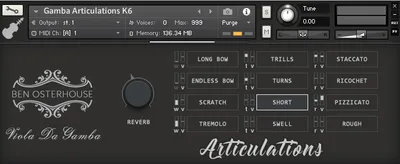
What it's not: a fast-response short-note library for staccato action lines. Runs above roughly 138 BPM get messy. It's also not built for extreme col legno or sul ponticello extended techniques. You get bowed sustains, spiccato, and detaché. That's the core of what the instrument does historically, and Osterhouse stayed in that lane.
It's also not a replacement for the physical instrument if you need the real thing. A JinQu viol will play and feel like a viol. This won't. It's a compositional tool.
Living With It Day-to-Day
Setup is straightforward. Load in full Kontakt (5.6.8 or higher), point it at the sample directory, and you're in. No iLok, no serial number drama. Activation is handled through the Native Instruments ecosystem.
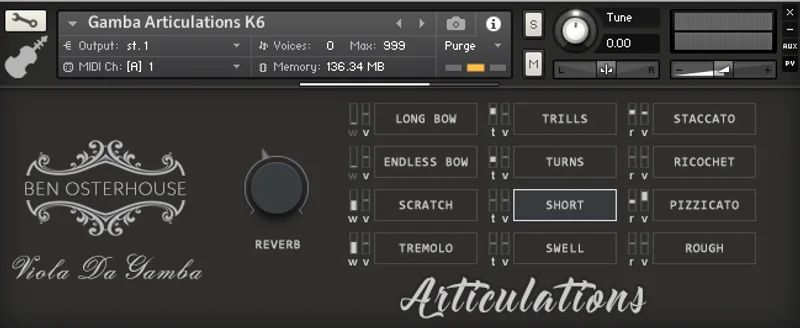
The first thing we noticed in extended use: the bow pressure control is the real performance variable here. We mapped it to a mod wheel and kept CC1 as the primary expression controller. That combination gives you enough range to move from a gentle, breathy pianissimo to a slightly overdriven forte without triggering obvious velocity jumps.
We ran it through three scoring sessions over two weeks. Medieval cue, a baroque-adjacent underscore, and a contemporary ambient piece. The medieval session was where it lived most naturally. The lack of vibrato on the default patch suits parallel organum-style writing well, and the tone sits under a vocal line without fighting for 2-4kHz space the way a violin tends to.
One quirk we kept hitting: the release samples have a slight inconsistency in length. Some note-offs tail out for about 380ms. Others cut closer to 200ms. Across a mix it's mostly invisible, but on exposed solo passages you notice the inconsistency if you're listening closely. Annoying, but not a dealbreaker.
CPU usage sits around 4-6% on a single instance at 128-sample buffer on an M2 Mac. Light. You can stack two or three instances without stress.
The Trade-Offs You Need to Know
The sympathetic resonance modeling is the strongest thing in this library. It's also the one feature that requires the most mix discipline. On sustained pads, those upper partials accumulate. In a dense orchestral arrangement, you'll want to high-pass the sympathetic resonance layer around 800Hz with a shelf of about -3dB to keep it from muddying the midrange.
The legato engine handles slow and medium phrases well. We love what it does on lines sitting around 60-90 BPM. Above that, the transitions start to feel stitched rather than bowed. That's a technical limitation of the sample-based approach, and it's honest to name it.
The included IR reverb options are minimal. There's no period-appropriate room included. We ended up inserting a plate reverb plugin on the bus and dialing in about 1.4 seconds of pre-delay-free early reflection. That worked. But Osterhouse should have included at least one historical hall impulse.
What you gain in exchange: a price point that makes the library accessible without being cheap-sounding. The tradeoff is fair. You're paying for the sampling work, not a full post-production suite.
Against the Field
The closest competitor we've used is Cinematique Instruments' Vertigo Viola. Vertigo is built around a modern viola, not a viol, which is a fundamental tonal difference. Vertigo wins on extended techniques and sul tasto color. Osterhouse wins on historical authenticity and sympathetic resonance behavior.
Spitfire's Tundra library has a cello section that some composers try to use as a viol substitute. It doesn't work convincingly. The attack envelope and formant structure are wrong.
For physical instruments, the Lu Mi Tenor Henry Jaye model and the Song viol range are the reference points for real instrument buyers. This Kontakt library costs a fraction of either. If you're scoring and not performing, the library wins the math.
For early music production specifically, this is our current pick. Nothing else in the plugin space handles the viol's specific tonal register as accurately.
The Real Verdict
We'd buy this. We have bought this. It lives on our scoring template and gets loaded on any cue that needs pre-classical texture.
The legato limitation above fast tempos is real and worth knowing. The missing reverb space is frustrating. But the sympathetic resonance modeling and the bow articulation depth make it the most honest viol sample library we've tested.
Skip it if you need fast spiccato runs or extended techniques. It won't deliver those convincingly. Buy it if you're writing anything that needs a gut-string, fretted-bass voice in a period-appropriate register. Nothing else in this price range competes on tone.
Score Breakdown
| Category | Score | Notes |
|---|---|---|
| Sound Quality | 4.5/5 | Sympathetic resonance modeling is the real differentiator, upper partials behave like the physical instrument |
| Value for Money | 4.0/5 | Competitive against physical instruments and fair for what you get in the plugin space. |
| Ease of Use | 3.5/5 | Bow pressure mapping requires setup time; release sample inconsistency needs managing in exposed passages |
| Features | 3.5/5 | Both six and seven-string configs included; missing a period-appropriate reverb IR is a real gap |
| CPU Efficiency | 4.5/5 | 4-6% on M2 at 128 samples; stacks cleanly |
| Overall | 4.1/5 | Best viol library in its price bracket; legato ceiling and missing room IR hold it from a higher score |
Alternatives to Consider
Cinematique Instruments Vertigo Viola, A full review here, but the short version: Vertigo wins on extended techniques and modern viola tone. Osterhouse wins on historical accuracy. Different tools.
Spitfire Audio LABS Strings, Free, and worth having in your template as a starting point. Not a viol. Not close to a viol. But free string texture for layering is useful.
Native Instruments Session Strings Pro 2, Broader orchestral coverage, covered in our orchestral string plugins roundup. Better for modern string writing. Not the right tool for early music or period scoring.
For the physical instrument: if you're researching actual viols rather than plugins, Song viols are the accessible entry point. JinQu instruments are a step up. Lu Mi is master-grade. The plugin is not a substitute for learning the instrument. It's a substitute for hiring someone who has.
The Osterhouse Viola Da Gamba is the honest answer to a real compositional problem: you need gut-string viol tone in your ITB session and you can't afford a physical instrument or a session player. Buy it for that. Don't ask it to be a cello. It's not trying to be.
Frequently Asked Questions
What is a viola da gamba and how does it differ from a cello?
The viola da gamba is a fretted, bowed string instrument that predates the cello by roughly a century, with six or seven strings tuned D1-G1-C2-E2-A2-D3. It's held between the legs (da gamba means "of the leg") rather than supported by an endpin. The frets allow chord voicings that cello can't replicate cleanly, and the gut strings produce a thinner, more nasal tone with prominent upper-partial resonance. It's not a historical cello. It's a different instrument with a different register and a different sonic character.
Do I need the full version of Kontakt to run this library?
Yes. The Viola Da Gamba library requires full Kontakt, not the free Kontakt Player. If you don't already own Kontakt, factor that cost into your purchase decision. Native Instruments bundles Kontakt in Komplete, so if you're considering that upgrade anyway, the math changes.
What's the price range for a real viola da gamba if I want to learn the physical instrument?
Entry-level Song viols are a reasonable starting point for beginners. JinQu instruments offer comparable quality to mid-tier brands. Lu Mi instruments, built to historical specifications like the Henry Jaye tenor model and the Richard Meares master bass, are the upper end of the market. Luthiers including Valentina Montanucci, Pierre Bohr, and François Danger are noted for quality historical reproductions if you're commissioning a custom build.
Is this library useful for genres outside early music and film scoring?
More than you'd expect. The bass viol's frequency register (roughly 73Hz-1,200Hz for the core tone) sits usefully in ambient, neo-classical, and even certain folk or drone productions. We've used sustained viol tones under electronic pads with good results. The sympathetic resonance layer adds complexity that synthesized strings don't produce. It's not a go-to for pop or hip-hop production, but ambient and experimental composers will find genuine creative use in it.