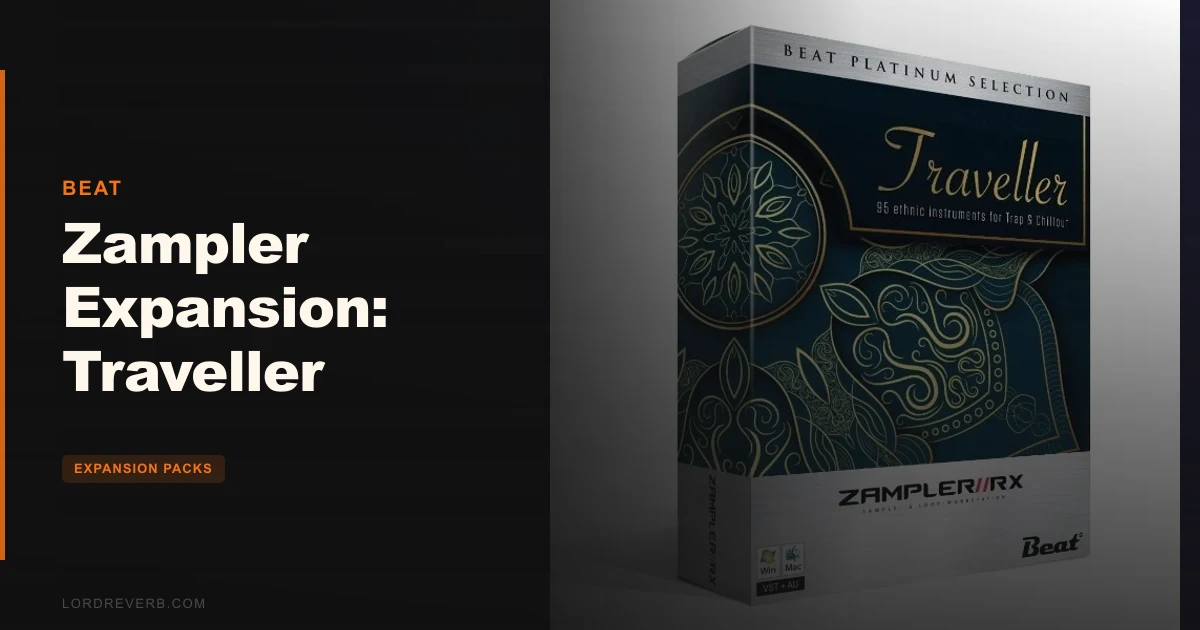
Traveller is a focused, well-stocked expansion pack for Zampler that does one thing well: it gives producers of Japanese Trap, Samurai Beats, Trip-Hop, and dark Techno a ready-made library of 95 ethnic instruments without requiring hours of sample hunting. At $16, the value equation is hard to argue with, provided you already own or plan to use Zampler.
This isn't a general-purpose toolkit. Beat built it around a specific sound world: Asian plucked instruments, rumbling bass textures, dark ambient spheres, and drum sounds that sit somewhere between ceremonial and club-ready. If your production territory sits anywhere near that description, Traveller is worth your time.
If you're making house, future bass, or anything with a bright, Western pop flavour? This pack wasn't built for you, and that's fine. Knowing what a library isn't for is as useful as knowing what it is.
What You're Actually Getting
The numbers first: 95 key groups, 1,235 samples, 1.41 GB of audio data packed into a 2.84 GB installed footprint. That gap between raw audio and installed size is normal for a sampler format that includes mapping and metadata, but it's worth knowing before you clear space on your drive.
Beat breaks the content into five instrument categories. You get 15 bass sounds, 15 drum sounds, 35 leads and synths, 20 pads, and 10 plucked instruments. The plucked category is the heart of the thing: Asian stringed and percussive tones that don't exist in most Western sample packs.
The leads and synths count of 35 is the deepest pool here. That gives you enough variation to build a whole track's melodic content without repeating yourself. The bass and drum counts are lighter at 15 each, but drum and bass patches are also easier to supplement from other sources if Traveller's selection doesn't cover every pocket you need.
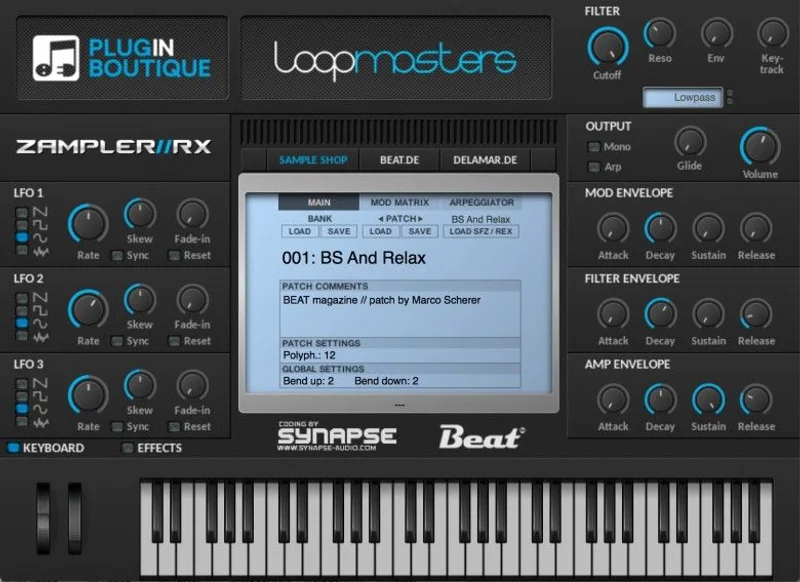
Everything loads inside Zampler 1.0.2 or higher. No standalone mode. No drag-and-drop WAV access. It's a sampler expansion, which means the Zampler plugin is the instrument, and Traveller is the sound set you load into it. Keep that dependency in mind.
The Sonic Character: What This Pack Actually Sounds Like
Start with the plucked instruments. These are the pieces that justify the pack's identity. You're getting the kind of tones associated with koto-adjacent instruments, high-register plucks with natural decay that tail off quickly and leave space in the high-mids. Drop one into a sparse trap beat and the tonal character becomes immediately apparent.
The "dark spheres" category in the pads section earns its name. These are slow-moving textures with a lowered centre of gravity. Think of what happens when you layer a pad underneath a plucked lead: the sphere fills the space the pluck leaves behind. That combination is exactly the sound the developer describes as foundational to Japanese Trap's aesthetic, and the patches here support that workflow directly.
The rumbling bass sounds are designed for sub-heavy formats. If you're working in Trip-Hop or minimal Techno, you want bass that moves air without cluttering the midrange. These bass sounds respond well to EQ adjustment and sit cleanly in the mix when shaped for your arrangement. The point is they respond the way a bass designed for this function should.
Drums at 15 patches might feel thin on paper. In practice, these are textured, not typical. You won't find a straight 808 or a bright pop snare here. What you'll find are sounds with ceremonial weight: hits that decay in interesting ways, tonal kick elements that carry pitch, and top-end percussion that sounds more like struck wood or metal than a drum machine. Brilliant for hypnotic Techno. Less useful if you need a clean, tight trap snare.
The 35 leads and synths are where Traveller's range stretches. Some sit close to the plucked tones, synthesised versions of acoustic attack-and-decay shapes. Others move into darker, more abstracted territory. For Trance or hypnotic Techno, these are the patches that carry the melodic thread over a long arrangement without wearing out their welcome.
The Value Question: Is $16 Honest Pricing?
Here's where the conversation gets direct. At $16, Traveller is priced at the "low enough to not overthink it" end of the expansion pack market. For 95 key groups and 1,235 samples built around a genuinely underserved sonic niche, that's a fair exchange.
What would it cost to build this yourself? Finding, recording, or licensing authentic Asian instrument samples, editing them to key groups, mapping them in a sampler, and making them mix-ready takes hours. Days, if you want 95 usable instruments. Even cheap sample packs rarely cover this terrain with any depth.
The caveat is Zampler. If you don't own it, add that cost to the equation. Traveller is worth $16 on its own merits. Whether the combined cost of host plugin plus expansion fits your budget is your calculation to make, not ours.
What's missing at this price? Honestly, not much that's surprising for the category. You don't get MIDI patterns, construction kits, or mix-ready loops. You get instruments. You play them or program them. That's the right approach for a sample library at this level: give producers raw materials, not finished ideas.
The 2.84 GB installation footprint is the one friction point. On a laptop with a 256 GB SSD that's already half full with a session and plugins, finding 3 GB for an expansion you might use on one or two projects requires a genuine decision. For most producers with a dedicated sample drive, it's a non-issue. For someone working tight on storage, factor it in.
Workflow Realities: Three Moments You'll Hit
You're starting a Samurai Beats track. You've got a drum loop but nothing melodic is landing. Load a plucked instrument from Traveller and play a single-note phrase, two or three notes spread over two bars. The natural decay fills the beat without competing with the kick. That's the pack working as advertised, and it works fast.
You're in a Trip-Hop session and the arrangement needs a bridge texture. Pull up one of the dark sphere pads, drop the playback rate, and let it sustain under the main riff for eight bars. The sphere doesn't draw attention to itself. It just makes the room feel larger. Satisfying when it clicks, and with 20 pads to work through, you'll find one that fits.
Here's the less smooth moment. You're scoring a minimal Techno track and you want a subtle lead melody that drifts over four bars. You load one of the 35 leads, but you want to modulate the filter gradually. That's a Zampler feature question, not a Traveller question. The expansion is the sound set. Traveller doesn't control how deep the modulation options go. Check Zampler's feature set separately if that kind of playback flexibility is core to your process.
The Not-So-Good
The Zampler dependency is the one thing that could make Traveller useless to you, and it's non-negotiable. If you're invested in a different sampler ecosystem, this pack doesn't transfer. That's not a criticism of the expansion's quality. It's a hard limit worth stating plainly.
The drum count of 15 patches is the section most likely to frustrate. Fifteen drum sounds is a starting point, not a complete toolkit. For most producers, Traveller's drums will work best as texture and colour layered over a main drum source, rather than as the sole percussion palette. That's a legitimate creative approach, but it means the drum category can't carry a whole project on its own.
The content scope is tight by design. That's a strength when it matches your genre. It's annoying when you want to stretch the pack slightly outside its lane. A Traveller plucked instrument doesn't suddenly become a Latin guitar or an African kora. The thematic identity is consistent, and consistent means narrow. Some producers will love that. Others will hit a wall.
Compared to the Alternatives
Beat's own expansion library gives the clearest comparison points. Black Hole, Supreme, Robo#txtr, and The Matriark are sister expansions, all running inside the same Zampler host.
Black Hole operates with a different sonic focus. If Traveller is geographic and cultural in its palette, Black Hole points somewhere else entirely. The choice between them comes down to which sound world fits your current project, not which is technically superior. They're built for different purposes inside the same tool.
Supreme and Robo#txtr carry their own identities, again distinct from Traveller's ethnic instrument lean. The Matriark adds another option in the same ecosystem. For a producer working across multiple genres, owning two or three of these expansions side-by-side makes practical sense. They don't overlap much by design, and the cost of multiple expansions at this price point stays manageable.
The honest position: if your specific need is Asian-influenced textures for Japanese Trap, Samurai Beats, or dark Techno, none of the sister packs replicate what Traveller does. It occupies its corner of the map without much competition inside the Zampler family.
Who Should Buy This
- ✅ Buy if you produce Japanese Trap, Samurai Beats, or Samurai-aesthetic hip-hop and want a purpose-built instrument set
- ✅ Buy if Trip-Hop, Chillout, or hypnotic Techno is your main territory and you need textured pads and plucked leads that sit in dark-leaning arrangements
- ✅ Buy if you already own Zampler and want to expand its palette without paying for a full new sampler instrument
- ❌ Skip if you don't own Zampler and aren't planning to add it to your rig
- ❌ Skip if your genres run bright and Western: pop, future bass, house, or any style where Asian ethnic texture is a mismatch
- ❌ Skip if 2.84 GB of disk space is genuinely scarce for you and you'd only use this pack occasionally
Specs & Technical Details
| Developer | Beat |
| Price | $16 |
| Plugin Format | N/A (Zampler expansion, format determined by Zampler host) |
| OS Support | N/A |
| Activation | N/A |
| CPU Usage | N/A |
| Trial Available | N/A |
| Version Reviewed | Compatible with Zampler 1.0.2 or higher |
| Sample Count | 1,235 samples across 95 key groups |
| Library Size | 1.41 GB audio / 2.84 GB installed |
| Instrument Categories | 15 bass, 15 drums, 35 leads & synths, 20 pads, 10 plucked |
Score Breakdown
| Category | Score | Notes |
|---|---|---|
| Sound Quality | 4.0/5 | Ethnic plucked instruments and dark sphere pads are the standout patches; drum count is thin |
| Value for Money | 4.5/5 | 95 instruments in a niche category at this price is hard to beat if you own Zampler |
| Ease of Use | 4.0/5 | Loads cleanly inside Zampler; no workflow complexity beyond the host plugin itself |
| Features | 3.5/5 | Good instrument variety across five categories; no MIDI or loop content; drum pool is limited |
| CPU Efficiency | N/A | Host-dependent; determined by Zampler, not the expansion |
| Overall | 4.0/5 | A well-priced, sonically focused expansion that delivers on its specific promise |
Alternatives to Consider
Beat Zampler Expansion: Black Hole
A sister expansion inside the same Zampler ecosystem with a different sonic focus. If Traveller doesn't match your genre direction but you want to stay in the Zampler family, Black Hole is the next one to check. The two packs don't duplicate each other.
Beat Zampler Expansion: The Matriark
Another sister pack from Beat. Different sonic identity again, which means it's worth stacking with Traveller if you produce across multiple styles. Having both loaded in Zampler covers more genre ground without leaving the ecosystem.
Beat Zampler Expansion: Robo#txtr
Robo#txtr sits at a different point on the sonic map from Traveller. If you need something more mechanical and less ethnic in flavour, this is where you'd look next inside the Beat expansion catalogue.
The Bottom Line
Traveller is the kind of pack you either need or you don't. There's no middle-ground use case here. If Japanese Trap, Samurai Beats, Trip-Hop, or dark hypnotic Techno is your lane, 95 ethnic instruments across 1,235 samples is a genuinely clever investment. The plucked instrument section alone, combined with the dark sphere pads, gives you the core of an entire sub-genre's sound palette in a single purchase.
The drum selection is light. The Zampler dependency is absolute. And if your productions run in any other stylistic direction, you'll load this once and never open it again.
But for producers who've been stitching together Asian-textured beats from scattered, mismatched samples, Traveller is the library that was missing. Buy it, load the plucked instruments first, and build from there.
Frequently Asked Questions
Does Zampler Expansion: Traveller work as a standalone plugin?
No. Traveller is an expansion pack that requires Zampler version 1.0.2 or higher to function. It has no standalone mode and no drag-and-drop WAV access. You need the Zampler sampler plugin installed and active before the expansion is usable.
How much disk space does Traveller need?
The sample audio itself runs 1.41 GB, but the full installed size is 2.84 GB once the expansion is set up. That gap is normal for a format that includes mapping, metadata, and key group data alongside the raw audio files. Clear at least 3 GB to be safe before downloading.
What genres is Traveller best suited for?
Beat built Traveller for Japanese Trap, Samurai Beats, Chillout, Trip-Hop, Trance, minimal Techno, and hypnotic Techno. The common thread is dark, atmospheric production with Asian tonal influences. It won't fit bright Western pop, house, or future bass workflows.
How does Traveller compare to the other Beat Zampler expansions?
The sister packs, Black Hole, Supreme, Robo#txtr, and The Matriark, each carry their own distinct sonic identity. Traveller is the one focused on ethnic Asian instruments and dark textures. The packs don't duplicate each other, so owning multiple expansions from the range gives you genuinely different palettes to work from inside a single sampler host.