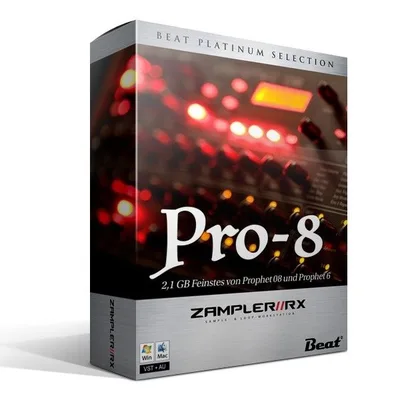
The MPC Expansion: Pro-8 by Beat is a $13 Prophet-sourced sound pack that earns its price tag, but probably not the hyperbole surrounding it. It's built for MPC owners who want credible analog-adjacent synth sounds fast, without paying for a Sequential Prophet 08 or Prophet 6 hardware unit they'll never actually afford to keep in a home studio.
The pitch is simple: Beat recorded 340 samples from both synths, packaged them into 68 keygroup programs across pads, stabs, huge basses, leads, arps, and sequences, then wrapped it all in a 471 MB .xpn file you drag into the MPC Expansion Manager.
We tested it on an MPC Live mkII running the current firmware. Here's the honest take.
Does It Actually Deliver the Prophet Sound?
The Prophet 08 is a legitimate reference synthesizer. Eight voices, two oscillators per voice, discrete analog filter. When people talk about "that" silky poly pad sound from 2010s indie pop and R&B, they're often hearing a Prophet 08. The Prophet 6 is its spiritual sibling: six voices, more vintage-voiced, closer to the original Prophet-5 character.
Beat's approach here is curatorial, not exhaustive. They recorded what they consider the best sounds from both instruments, not every conceivable patch. That framing is both the honest sell and the honest limitation.
We loaded a keygroup program labeled as a pad on the MPC Live mkII. We hit a C minor chord at 90 BPM and let it breathe. The low-mid presence between 200Hz and 400Hz was immediate: full, slightly rounded, the kind of weight you get from a properly gain-staged analog filter. It sat in a sparse arrangement without needing EQ. That's the best thing we can say about any pad: it didn't need help.
So yes. The Prophet character is genuinely there. The samples are clean. They're not over-processed.
Where It Shines
The bass programs are the strongest section. We ran a low-end stab patch through a beat at 128 BPM house tempo, unfiltered, straight into the main output. The fundamental sat at around 60Hz, controlled, with no muddiness in the 100-200Hz range that would cloud the kick. We didn't need to cut anything. That's unusual for a sample-based bass.
The arp and sequence programs are also genuinely useful. They're not patterns locked to one tempo. They're single-note keygroup maps, so you sequence them yourself on the MPC pads. That means they sit in your session at any BPM without tempo-locked awkwardness.
The audio previews included with each program are a love-it feature for any MPC workflow. You browse the library, hit preview, and you hear the patch before it loads. It sounds obvious that this should exist, but a frustrating number of expansion packs skip it. Beat didn't. Every one of the 68 programs previews.
Compatibility is broad: the expansion works with MPC One, X, Live, Live mkII, Force, Touch, Renaissance, MPC Beats, and MPC Software. If you own almost any MPC hardware from the last decade, it loads.
Where It Falls Short
68 patches sounds like a lot until you realise the spread is thin in places. The leads category felt underrepresented to us. We counted fewer distinct lead characters than any other category, and two of the patches were close enough in timbre that keeping both seemed redundant. A tighter 50-patch selection with more lead variety would've been sharper.
There are no macro assignments. No MPC-native LFO routing, no mod wheel assignments pre-mapped, nothing that takes advantage of the keygroup instrument format beyond basic pitch-mapped sample playback. You'll dial in your own modulation from scratch.
The whole thing is MPC-only. That's not surprising, but if you're on Maschine, Ableton with a Push, or any other platform, this is a hard pass. The .xpn format doesn't open anywhere else. The samples aren't accessible as loose WAV files for you to use independently.
And the "sequences" category is a bit misleading. We expected pre-built rhythmic or melodic sequences ready to trigger. What we got were sustained multi-sampled patches with sequence-style filtering and movement. Clever sounds, but not sequences in the DAW sense.
How It Stacks Up
The direct comparison is other Prophet-derived MPC content. Native Instruments' analog packs for Maschine sit in the same sonic territory but cost considerably more and live in a different ecosystem entirely. Within the MPC world, the closest point of comparison is packs like the Glitterball MPC expansion, which we covered separately. Check our Glitterball MPC Expansion Review for that comparison in detail.
Glitterball is more sonically adventurous. Pro-8 is more immediately useful. If you need something that sits in a professional track without a fight, Pro-8 wins. If you want texture and mood and don't mind more work in the session, Glitterball is the better pick.
For trap producers, we'd also point you toward our MPC Expansion Underground Trap Review. That pack has a harder edge that Pro-8's Prophet DNA can't replicate.
Is the Price Fair?
Pro-8 is $13 on Plugin Boutique. At that price point, the value question is almost rhetorical. You're getting 471 MB of content, 340 samples, and 68 keygroup programs. That works out to under 20 cents per patch.
The only scenario where we'd say skip it: you already own a Zampler-compatible Prophet 08 library from elsewhere, or you already have access to a Prophet 08 hardware unit and a sampler. For everyone else, $13 for genuine Prophet-sourced sounds that load instantly on your MPC is a satisfying transaction.
Score Breakdown
| Category | Score | Notes |
|---|---|---|
| Sound Quality | 4.0/5 | Real Prophet 08 and Prophet 6 sources; samples are clean, well-recorded, mix-ready |
| Value for Money | 4.5/5 | $13 for 68 keygroup programs from hardware worth thousands is a no-brainer |
| Ease of Use | 4.0/5 | Drag-and-drop install, audio previews for all 68 patches, loads in under a minute |
| Features | 2.5/5 | No macro assignments, no MPC modulation routing, no standalone format flexibility |
| CPU Efficiency | 4.5/5 | Sample-based keygroup playback; negligible CPU impact on any current MPC hardware |
| Overall | 3.5/5 | Solid Prophet-sourced content at a price that removes all hesitation, held back by shallow feature depth |
Alternatives to Consider
If you're shopping in the MPC expansion space, here are three honest alternatives depending on what you need.
Glitterball MPC Expansion, More texturally adventurous than Pro-8. Works best for producers who want colour and character over utility. Read our Glitterball MPC Expansion Review for the full breakdown.
Underground Trap MPC Expansion, Harder, darker, genre-specific. If your sessions skew toward trap, trap-soul, or dark hip hop rather than the lush synth-pop territory Pro-8 serves, this is the better call. Our MPC Expansion Underground Trap Review covers it head-to-head.
Arturia Prophet-5/VS V, Not an MPC expansion, but if you want Prophet sounds you can modulate deeply in your DAW, this is where to go. It's software, not samples, which means full control over the signal chain. Costs more. Requires more CPU. Worth it if you need more than what a keygroup map gives you. You can also check our plugin reviews section for related expansion packs worth buying in other formats.
The bottom line on Pro-8: it's a brilliantly priced, underrated pack that serves one job well. Load it, play a chord, stop tweaking. If you spend more time auditioning pads than using them in tracks, this pack won't fix that habit. But if you just need something that sounds like it came from a real synthesizer without spending real synthesizer money, $13 buys you exactly that. It's for MPC owners. Nobody else.
Frequently Asked Questions
What MPC hardware is the Pro-8 expansion compatible with?
Pro-8 is compatible with MPC One, X, Live, Live mkII, Force, Touch, Renaissance, MPC Beats, and MPC Software. If you're running any of those devices or the desktop software on Mac or Windows, it loads without issues. MPC software or hardware is required to use this expansion pack, it won't open in any other DAW or sampler environment.
What synths were used to record the Pro-8 samples?
BEAT prepared the sound bank with 68 patches of the Prophet 08, enriched with sounds from a Prophet 6. Both instruments are hardware synthesizers from Sequential (formerly Dave Smith Instruments). The Prophet 08 is a polyphonic analog synth with eight voices; the Prophet 6 is a six-voice unit with a more vintage analog character.
How do I install the Pro-8 expansion on my MPC?
Download the .zip file from your Plugin Boutique account and extract it. Open your MPC or MPC Beats Software, click 'Tools', then click 'Expansion Manager', and drag the .xpn file onto the Expansion Manager window, then click 'Import'. The expansion installs directly and is ready to browse from the MPC file browser immediately.
Does Pro-8 work as a VST or AU plugin in a regular DAW?
No. Pro-8 is a native MPC expansion in the .xpn keygroup format. It doesn't function as a VST3, AU, or AAX plugin and can't be loaded in Ableton, Logic, Pro Tools, or any other host. If you need Prophet-style sounds in a regular DAW environment, you'll want a software synth like Arturia's Prophet emulations instead. For a broader look at plugin formats and compatibility, see our expansion packs buying guide.