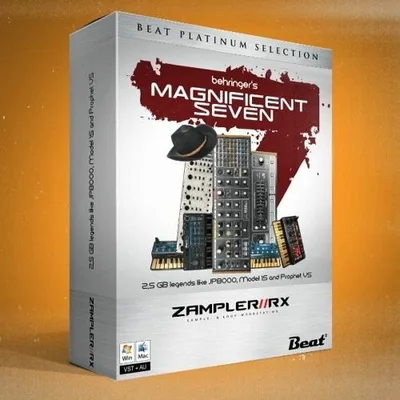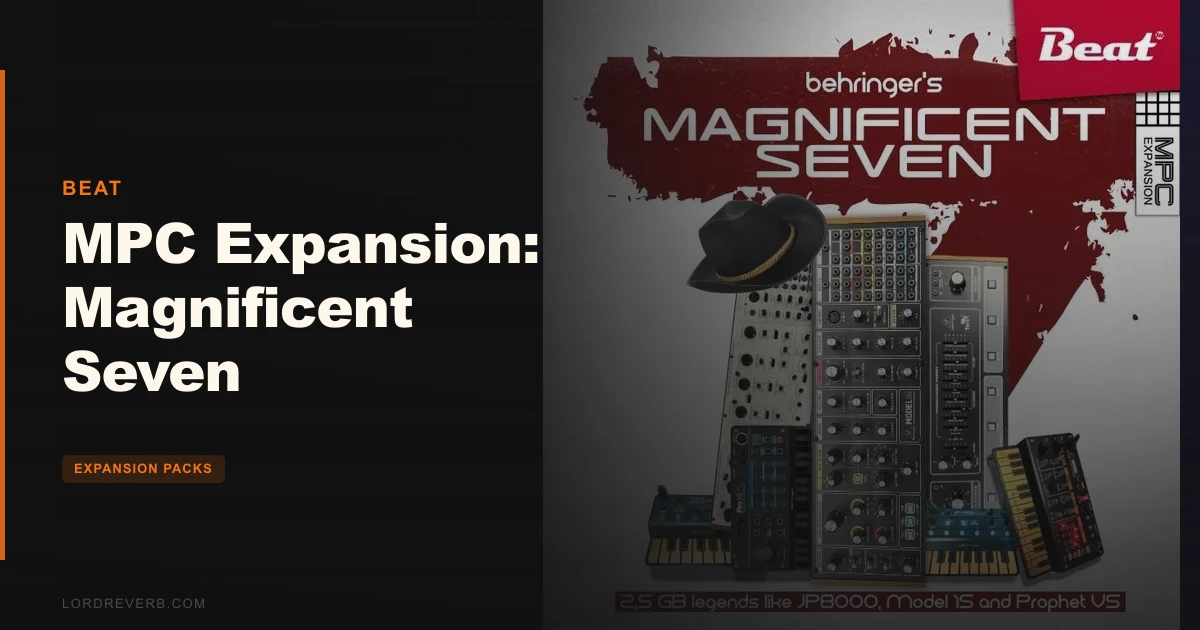
The real question with any sample-based MPC expansion is whether the source material is actually worth the disk space, or whether you're paying for a logo and a PDF. With MPC Expansion: Magnificent Seven, the answer leans yes. This is a $16 collection of 495 samples across 99 Key Group Programs, modeled from seven synthesizers ranging from the Roland JP-8000 to the Moog Taurus, and it's built to live inside your MPC without friction. If you own MPC hardware or software and you want a deep analog-flavored synth palette without building it yourself, this is a focused, reasonable buy.
The catch is real: if you don't already own something in the MPC family, this doesn't work at all. Not even a little. Keep that in mind before you read a single word further.
Does It Actually Deliver on the Seven-Synth Promise?
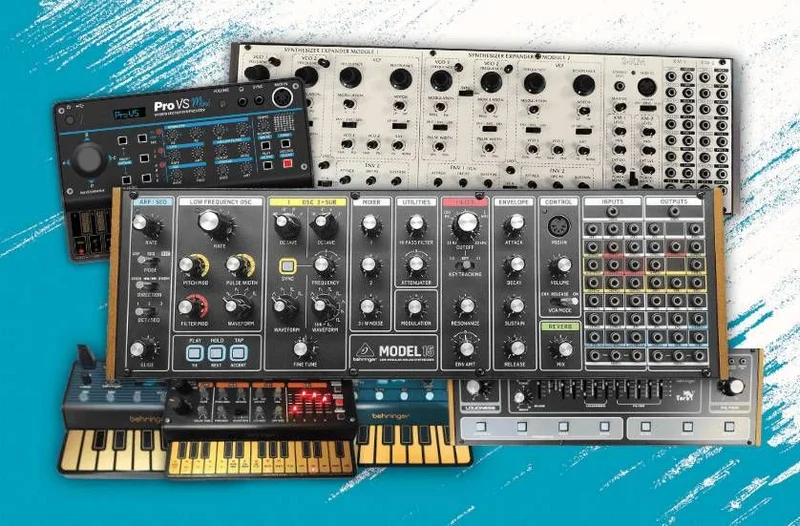
Beat built this expansion around a specific concept: take seven synthesizers, sample them thoroughly, and give MPC producers access to that character without needing the hardware. The seven sources are the Roland JP-8000, Roland Jupiter-80, Moog Taurus, Moog Model 15, Oberheim Matrix 6, Oberheim SEM 2-Voice, and a set of Behringer instruments including the JT-4000, Toro, UB-1, 2-XM, Model 15 emulation, Saturn Soul, and Pro VS Mini.
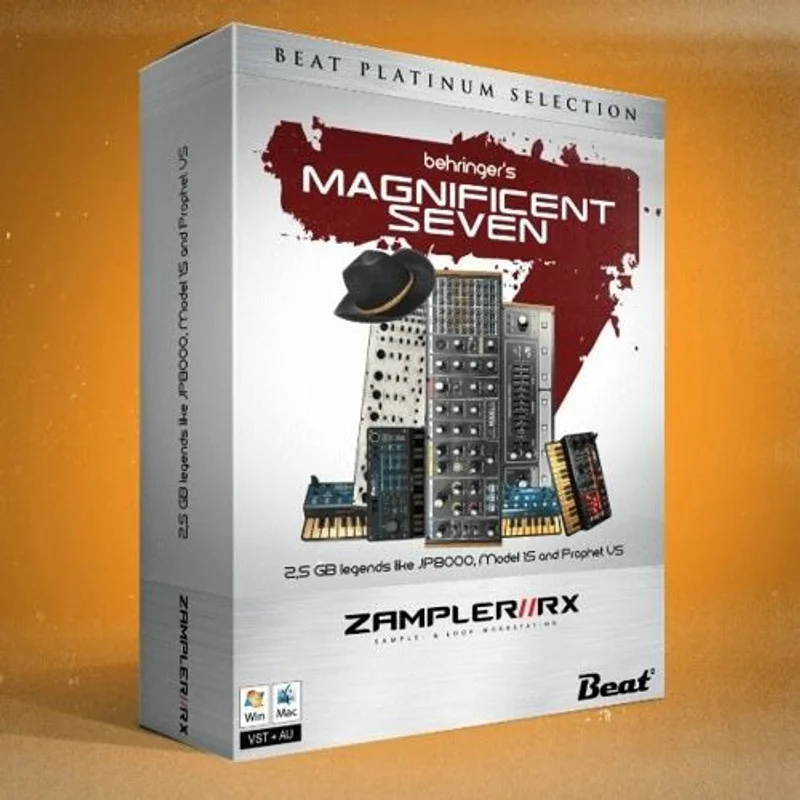
That's actually more than seven instruments when you count them, which makes the "Magnificent Seven" branding a bit loose. But the spirit holds. These are all analog or analog-modeled sources with distinct characters. The JP-8000 brings that hybrid paraphonic quality and 12-bit texture. The Taurus is a pure analog bass monster. The Oberheim gear has that SEM-filter thickness that sits nowhere else in a mix.
The 99 Key Group Programs are organized into 30 bass, 30 lead, 17 pad, and 22 synth programs. That breakdown makes sense. Bass and leads are the workhorses, so they get the most real estate. Pads are fewer but they're there when you need width and atmosphere.
Each Key Group comes with audio demos. That's not a given with sample packs, and it matters. You can hear what you're loading before you load it.
Where It Shines: The Sounds Themselves
Start with the bass programs. Thirty of them, sourced from the Taurus and the Behringer Toro. The Taurus has a pure analog signal path with two VCOs and a ladder filter, a character captured in the sampled programs here. You get the low-mid weight that sits underneath a kick without competing with it.
The lead programs are where the JP-8000 sources do the most work. That 12-bit hybrid character gives leads a texture that sits between clean digital and gritty analog. It's not trying to be either. If you've ever wanted a lead that cuts without going thin on a phone speaker, these programs get close. Thirty leads gives you real variety: you're not cycling through the same waveform with the filter moved a notch.
The pad section is the shortest at 17 programs, but the Jupiter-80 and Oberheim SEM sources give pads a harmonic density that's satisfying in a way that pure digital pads often aren't.
Audio demos per Key Group are a genuinely clever inclusion. You're not guessing. You load the demo, you hear the arc of the sound, and you decide whether it fits your track. Saves time. That matters when you've got 99 programs to assess.
The Source Instruments in Detail
Roland Sources: JP-8000 and Jupiter-80
The JP-8000 is described as a four-voice hybrid paraphonic synthesizer with two analog-modeled oscillators. That paraphonic quality means chords have a shared envelope, which gives them a slightly different envelope behavior than fully polyphonic synths. In a sample, you're capturing a moment in that envelope. The 12-bit character adds a texture that's a touch grainy at the top end without being harsh.
The Jupiter-80 contributes to the pad section mainly, and its contribution is width and smoothness. It's a modern Roland with a different character than the JP, and having both in the same pack gives the pads more range than if Beat had sourced everything from one instrument.
Moog Sources: Taurus and Model 15
The Taurus is the bass weapon here. Pure analog, two VCOs, ladder filter. For bass programs, the ladder filter is what makes the difference between a synth bass that sounds like furniture and one that sounds alive. The Model 15 is semi-modular with dual oscillators and filters. Its sounds in the synth category add something more experimental. Patch in a Key Group from the Model 15 section and you'll find sounds that aren't sitting in any obvious genre box.
Oberheim Sources: Matrix 6 and SEM 2-Voice
The Matrix 6 has that mid-frequency push that makes synth lines cut on small speakers. It's an older, denser-sounding instrument than the Rolands, and its programs here sit differently in a mix. The SEM 2-Voice is a two-oscillator voice with the SEM filter, which has a particular quality: it doesn't thin out as you close it the way some ladder filters do. It rounds. That makes these programs useful in denser arrangements where a harder filter sweep would conflict with other elements.
Behringer Instruments
The Behringer instruments, the JT-4000, Toro, UB-1, 2-XM, Model 15 emulation, Saturn Soul, and Pro VS Mini, are emulations of classic hardware. The Toro is a Eurorack format analog with two VCOs and a ladder filter. The UB-1 adds an arpeggiator, which means the source material can include rhythmic movement baked in. The 2-XM goes further: four VCOs and four envelopes means complex motion and thick stacked oscillators.
Using emulations as sources is a reasonable approach. The circuit designs are based on the originals, and the sonic character largely follows. If you're worried about whether these are "real" enough, listen to the demos. That's what they're for.
Who This Expansion Actually Suits
The MPC Hardware User
You've got an MPC One, X, Live, or Live mkII sitting on your desk. You want synth programs that load instantly, play responsively across pads or a MIDI keyboard, and don't require a computer to function. This is exactly that. Drag it over, load a Key Group, and your MPC becomes a synth workstation for that session. The 99 programs give you enough range to build a full track without needing a second source.
Buy it. At $16, this is less than the cost of a single patch for most hardware synths.
The MPC Software / Beats User
You're working in the MPC software or MPC Beats DAW on a Mac or PC. Maybe you don't own hardware yet. This still works. The expansion is compatible with both software environments, and the Key Group format integrates directly. You get the same 99 programs, the same 495 samples, the same audio demos.
The workflow is the same. Load, play, build. The value holds.
Buy it here too, especially if your current software synth library is thin on analog character.
The Producer Who Doesn't Own MPC Software or Hardware
Frustrating answer: this doesn't work for you. At all. The expansion requires MPC software or hardware. There's no VST version, no standalone player, no workaround. This is not a complaint about the pack's quality. It's a hard compatibility wall.
Skip it. Come back if you pick up MPC hardware or grab MPC Beats.
The Sound Designer Looking for Modular/Experimental Texture
The Model 15 and 2-XM sources in the synth category give you 22 programs that aren't genre-locked. Four-VCO complexity from the 2-XM, semi-modular character from the Model 15. If you want raw material for experimental productions or you're building hybrid tracks that sit between electronic and acoustic, these programs give you texture to work with.
Worth it for this specific purpose, with the MPC compatibility caveat in place.
Where It Falls Short
The ecosystem lock is the biggest limitation. We understand why it exists: Key Group Programs are an MPC-native format and that's the product. But it means the potential audience for this expansion is defined entirely by who already owns an MPC. If you've got friends asking whether to buy this for their Ableton rig, the answer is no.
The 1.27 GB footprint is light for seven source instruments. Sampling across the full range of a synthesizer, with multiple velocity layers, multiple round-robins, and multiple patches per instrument, can run into many gigabytes on its own. At 495 samples across 99 Key Group Programs, that's roughly five samples per program on average. It suggests the sampling depth is conservative, which may mean some velocity transitions are more noticeable than others on certain programs.
Annoying, but not a dealbreaker at this price point.
You're working with sampled snapshots, so real-time filter control or LFO modulation inside the Key Group depends on what the MPC software itself lets you do with the program.
Is the Price Fair?
At $16, this is a low-risk purchase for anyone already in the MPC world. Seven source instruments, 99 playable programs, 495 samples, audio demos, and native compatibility with nearly every MPC hardware and software product made in the last several years. The price is low enough that even if half the programs don't fit your sound, the other half will pay for the purchase several times over.
It's fairly priced for the depth and scope on offer.
But fair for who it's for. For the producer without an MPC, the price is irrelevant because it simply doesn't run.
Specs & Technical Details
| Developer | Beat |
| Price | $16 |
| Plugin Format | MPC Key Group Program (not a plugin format, requires MPC software or hardware) |
| OS Support | Mac / Windows (via MPC software); native on MPC hardware |
| Activation | N/A |
| CPU Usage | N/A |
| Trial Available | N/A |
| Version Reviewed | N/A |
| Total Samples | 495 |
| Key Group Programs | 99 |
| File Size | 1.27 GB |
| Program Breakdown | 30 Bass, 30 Lead, 17 Pad, 22 Synth |
| Source Instruments | Roland JP-8000, Jupiter-80; Moog Taurus, Model 15; Oberheim Matrix 6, SEM 2-Voice; Behringer JT-4000, Toro, UB-1, 2-XM, Model 15, Saturn Soul, Pro VS Mini |
| Compatible Hardware | MPC One, X, Live, Live mkII, Force, Studio, Touch, Renaissance |
| Compatible Software | MPC Software, MPC Beats |
Score Breakdown
| Category | Score | Notes |
|---|---|---|
| Sound Quality | 4.0/5 | Classic analog sources, well-captured; sampling depth is conservative |
| Value for Money | 4.5/5 | 99 programs from seven instruments at this price is a straightforward win for MPC users |
| Ease of Use | 4.5/5 | Native Key Group format loads without setup; audio demos reduce guesswork |
| Features | 3.5/5 | No real-time modulation built in; sounds are snapshots, not instruments |
| CPU Efficiency | N/A | Sample-based; CPU load is determined by MPC environment, not the pack itself |
| Overall | 4.0/5 | Solid, focused expansion for MPC producers who want analog character without the hardware cost |
Our Verdict
If you produce on an MPC, Magnificent Seven earns its place in your library. Thirty bass programs from Taurus and Toro sources alone make the download worth it. You add the leads, the Oberheim pads, the Model 15 experiments, and you've got a synth palette that covers most of what a track needs in terms of synthesized layers.
You could spend three times $16 on a single preset bank for a software synth and get less coverage. That math works in Beat's favor here.
But this expansion is honest about what it is. It doesn't pretend to be a modular synth or a real-time instrument. It's a sampled, organized, playable collection of sounds from instruments most producers will never own. That's the job. It does the job well.
If you don't own MPC hardware or software, don't even open this page. If you do, there's no real argument against adding it.
Frequently Asked Questions
What MPC hardware is compatible with Magnificent Seven?
The expansion works with MPC One, MPC X, MPC Live, MPC Live mkII, MPC Force, MPC Studio, MPC Touch, and MPC Renaissance. It also works with MPC Software and MPC Beats on Mac and Windows.
Can I use this expansion in Ableton Live, FL Studio, or another DAW?
No. The programs are in MPC Key Group format, which only runs inside the MPC hardware or software environment. There's no VST, AU, or AAX version. This is a hard compatibility limit, not a workaround situation.
What does "Key Group Program" mean in practice?
A Key Group Program maps samples across a keyboard range inside the MPC software. Each program is ready to play via MIDI pads or an attached keyboard without any additional setup. The samples are already assigned to note ranges, velocities, and groups. You load it and play it.
Are the Behringer instruments good enough sources for a professional library?
The Behringer instruments in this pack, including the Toro, UB-1, and 2-XM, are circuit-based designs modeled on classic analog hardware. The Toro uses real analog VCOs and a ladder filter. Whether you care about the brand on the front panel or the circuit in the box is a personal call, but the sonic character of analog filters and oscillators is what the sampling captures. Listen to the audio demos per Key Group and make your call based on what you hear.
How many samples does each Key Group Program actually contain?
The pack contains 495 samples spread across 99 Key Group Programs, which averages roughly five samples per program. The distribution may not be even across all programs, and some instruments may be sampled at more velocity layers or pitch points than others. The 1.27 GB total file size suggests a focused rather than exhaustive sampling approach.