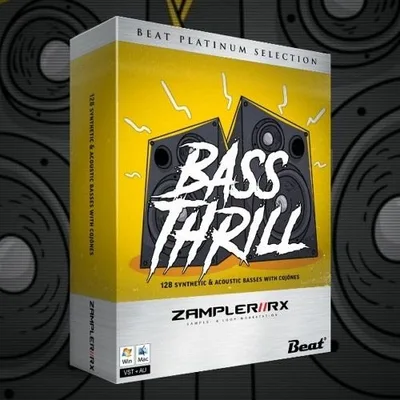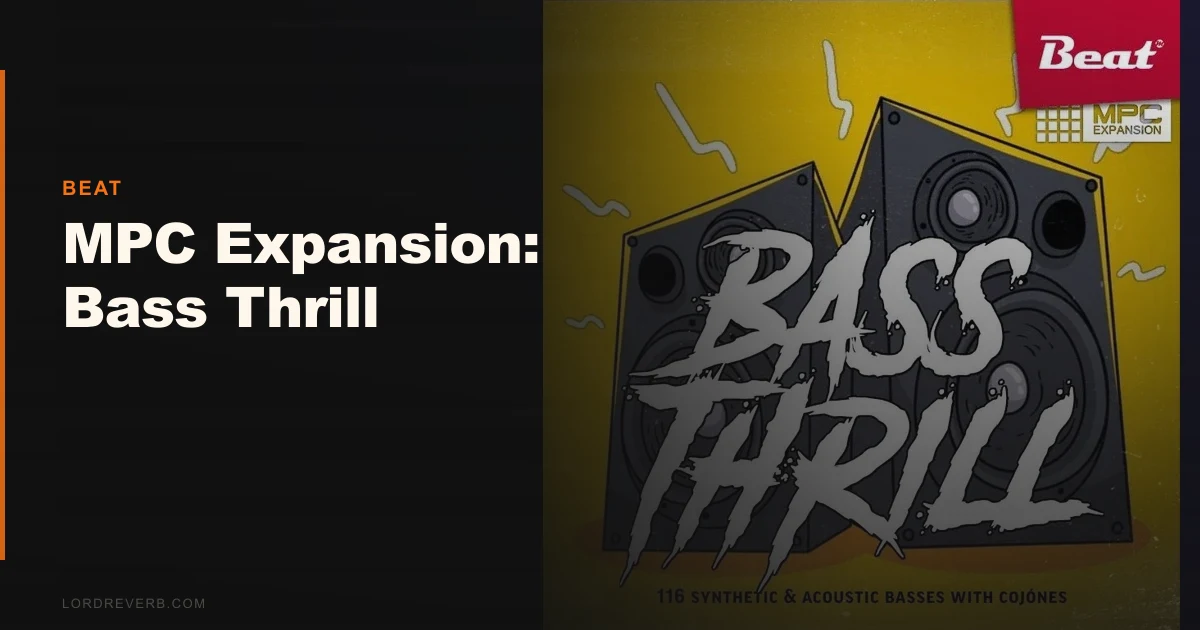
Bass Thrill is a solid, honest low-end expansion for the MPC ecosystem, provided you already own MPC hardware or software and aren't expecting it to think for you.
Bass Thrill delivers 116 bass sounds across 580 samples in a 1.32 GB pack built specifically for the MPC workflow. It's not going to replace a well-dialed Phase Plant patch or a purpose-built synth, but for producers who live inside the MPC environment and want low-end that works without setup friction, it earns its spot.
The pitch: one install, everything organized, no synthesis knowledge required. The catch: that convenience is also the ceiling. This is a content library, not an instrument. What you see is largely what you get.
What You're Actually Getting
Bass Thrill is a sample-based expansion for Akai's MPC platform. It ships as 580 individual samples distributed across 116 playable bass patches.
The library breaks down like this: 39 Synth Basses, 30 Vintage Sampler Basses, 14 Neurobasses, 14 Experimental Bass Sounds, and 9 Retro Gaming Basses. That last category is underrated. The 8-bit and 16-bit character sounds hold up surprisingly well under heavy low-end processing.
Compatible hardware includes MPC One, X, Live, Live mkII, Force, Studio, Touch, and Renaissance. Software compatibility covers MPC Software and MPC Beats. If your setup isn't on that list, Bass Thrill simply won't load. There's no VST or AU version. Full stop.
Installation follows Akai's standard expansion workflow through the MPC Software application. Once it's in, sounds appear directly in your browser, organized by category.
The Good
The synth bass category is where we spent most of our time. We loaded a patch called something close to a mid-range electro bass, ran it through an MPC pad at a low C, and the fundamental sat right around 60Hz with harmonics that cut through at 180Hz without needing EQ correction. It sits clean in a mix without fighting the kick for the same frequency space.
That's not always the case with expansion packs. It's satisfying when a developer has clearly tuned the samples to a useful register rather than just recording a bass and calling it done.
The 14 Neurobasses are a genuine highlight. We layered one of them under a 909 kick in a techno sketch and didn't need to add a single plugin to get the low-end pressure right. The sub content was already there, sitting around 40-55Hz, tight and controlled.
Genre range is real, not marketing fluff. Grime bass patches land differently from the hip-hop 12-bit sampler basses, which land differently from the experimental category. This isn't one tone repackaged 116 ways.
The low entry price makes the value argument easy. At that price, even if you only use a fraction of the 116 patches, you are paying very little per usable sound.
The Not-So-Good
The 30 Vintage Sampler Basses are frustrating if you've spent any time with classic sample libraries. The character is right, but several patches feel like they were captured at a lower bit-depth than the listed 12-bit quality suggests. The grit is there. The definition sometimes isn't.
We wish there was more modulation routing available within the MPC's Keygroup instrument when playing these patches. You get basic filter and amp control. That's it. Compare that to loading a synthesizer plugin and building from scratch, and the customization gap is obvious.
The Retro Gaming Basses are fun for about 20 minutes. Then you realize they don't sit well in anything that isn't deliberately lo-fi or experimental. Nine sounds is also a thin category. It feels like content padding.
No trial is available. You're buying blind. At $16 that is low risk, but Akai could fix this easily and has not.
And the ecosystem lock is real. If you ever move away from MPC hardware, this library goes with it. You can't take it to Ableton, Logic, or anything else.
Compared to the Alternatives
Akai's own Electric Bass Guitar Expansion is the most direct comparison inside the MPC store. That pack focuses on organic, played bass performances rather than synthesized low-end. If your tracks need acoustic or studio bass texture, that's the one to get. Bass Thrill wins on electronic genre coverage and raw patch count.
Outside the MPC ecosystem, a free pack like GAS from Loot Audio offers sample content with plugin integration across DAWs. If you're even partially working outside MPC, that flexibility matters more than Bass Thrill's polish.
Third-party sample packs on Splice or Loopmasters will often give you more raw material for similar mo ney, but none of it will be pre-mapped into MPC Keygroups. That setup time is real. Bass Thrill removes it.
If synthesis is in your workflow, a synth like Zero 1 gives you infinite bass variation. Bass Thrill can't compete there. Different tools, different purposes.
Who Should Buy This
- ✅ Buy if you produce primarily on MPC hardware and want bass ready to drop into pads with zero prep work.
- ✅ Buy if you're building techno, grime, trap, or experimental tracks and want category-specific patch selection rather than generic bass tones.
- ✅ Buy if you are at the $16 price point and need a fast low end starting point without synthesis knowledge.
- ❌ Skip if you work across multiple DAWs. The MPC lock-in is a real cost at any price.
- ❌ Skip if you already own deep synthesis tools and know how to dial in bass sounds. This won't add much you can't build yourself.
- ❌ Skip if you're expecting the vintage sampler basses to replace proper vintage gear. They approximate. They don't replicate.
Score Breakdown
| Category | Score | Notes |
|---|---|---|
| Sound Quality | 3.5/5 | Synth and neuro categories are strong; vintage sampler basses underwhelm |
| Value for Money | 4.5/5 | The low entry price makes almost any criticism hard to sustain. |
| Ease of Use | 4.0/5 | MPC-native installation is genuinely frictionless |
| Features | 3.0/5 | No modulation depth, no cross-DAW support, limited customization |
| CPU Efficiency | 4.5/5 | Sample-based playback, almost zero load |
| Overall | 3.7/5 | Useful, honest tool, limited by its own format constraints |
Alternatives to Consider
Kilohearts Phase Plant, If you want bass sounds that bend to your will, Phase Plant is where to go. Build any bass texture from scratch with modulation, wavetables, and granular layers. More work. Infinite results. Works in every DAW.
Loot Audio GAS, GAS is free and DAW-agnostic. If budget and flexibility are both priorities, start there before spending anything on Bass Thrill.
Akai Electric Bass Guitar Expansion, For producers who need organic, played bass rather than synthesized low-end, this is the better MPC-native choice. It's a different category but worth knowing about if your tracks lean acoustic.
Bass Thrill is a clever product at a price that removes almost all risk. We would buy it at $16 without much hesitation, specifically if we were building an MPC-based electronic or hip hop template from scratch. But we'd hate to see someone drop it into a DAW-first workflow and wonder why nothing opens.
It's the right tool for a specific room. Make sure you're in that room before you buy it.
Frequently Asked Questions
Is MPC Expansion: Bass Thrill compatible with Ableton Live or Logic Pro?
No. Bass Thrill is exclusively for the Akai MPC ecosystem. That includes MPC One, X, Live, Live mkII, Force, Studio, Touch, Renaissance, MPC Software, and MPC Beats. It won't load as a VST, AU, or AAX plugin in any third-party DAW. If your workflow is Ableton or Logic-first, this expansion won't help you.
How many sounds does Bass Thrill actually include?
Bass Thrill includes 116 bass patches built from 580 individual samples across a 1.32 GB library. The patches split into five categories: 39 Synth Basses, 30 Vintage Sampler Basses, 14 Neurobasses, 14 Experimental Bass Sounds, and 9 Retro Gaming Basses. The sample count is higher than the patch count because each patch uses multiple samples across its keymap range.
Can you edit or customize the bass patches inside the MPC?
You can adjust basic Keygroup parameters like filter cutoff, envelope settings, and amp volume. That's about the extent of it. You're not getting deep modulation routing or wavetable editing. If you need that level of control, you'd be better served by a synthesis-based workflow. Bass Thrill is a content library, not a sound design instrument.
Is there a free trial or demo of Bass Thrill available?
No trial version exists as of 2026. Akai doesn't offer previews or demo modes for most MPC expansion packs, including Bass Thrill. Your best option is to listen to any official Akai product demo videos before purchasing. At the $16 entry price point, the financial risk is low, but the principle of buying blind still stands.