Glass by AudioThing: A Focused Tool With Real Limits
The first thing we played through Glass was a single long tone, a bowed wine glass note, sustained at middle C, with the mod wheel pushed halfway up. It was beautiful for about four seconds. Then we started layering it, pushed the velocity harder, and noticed the cracks: the velocity response flattened out, the harmonic shimmer turned thin, and what felt like a living texture started sounding like a loop.
That moment set the tone for the whole review. Glass, AudioThing's Kontakt-based instrument built around sampled glass and metallic resonances, is a focused, honest tool. It does one specific thing well. It runs out of depth faster than you'd hope. And whether it earns a place in your template folder depends entirely on how often you need what it does.
This review is for producers who work in ambient, cinematic, or experimental spaces and want a quick, credible glass-texture source without deep-sampling a wine rack themselves.
What It Is (and What It's Not)
Glass is a sample-based Kontakt instrument from AudioThing that captures the resonant, spectral character of struck, bowed, and rubbed glass objects. Wine glasses, glass bowls, bottles, recorded, mapped, and wrapped in a simple performance interface.
It's not a reverb plugin. It's not a synthesis tool. You can't sculpt new timbres from scratch inside it.
What you get is a playable, chromatic instrument built from real glass recordings. Think of it as a prepared piano for the fragile end of the frequency spectrum: high-mid shimmer, slow attacks, long inharmonic tails that sit beautifully under pads or above a sparse ambient bed.
It's not built for percussive, transient-heavy work. Stick a glass hit under a trap snare and it disappears. This instrument wants space. It wants slow tempos and open mixes. If your sessions tend to run dense and loud, Glass will frustrate you. You'll wonder why you bought it.
Living With It
Setup is painless if you already own full Kontakt. Drag the NKI into Kontakt, load the samples, and you're playing in under two minutes. No iLok. No serial number gymnastics.
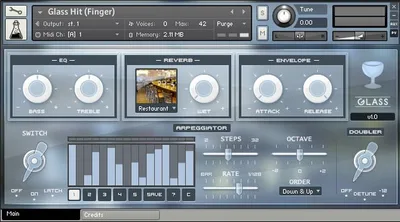
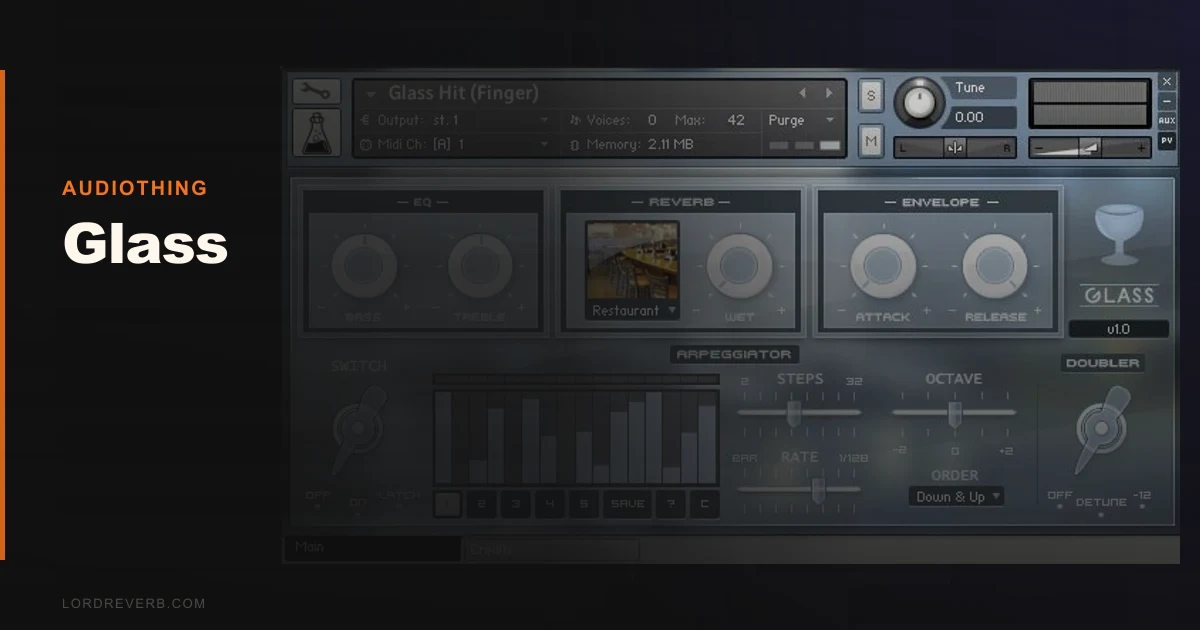
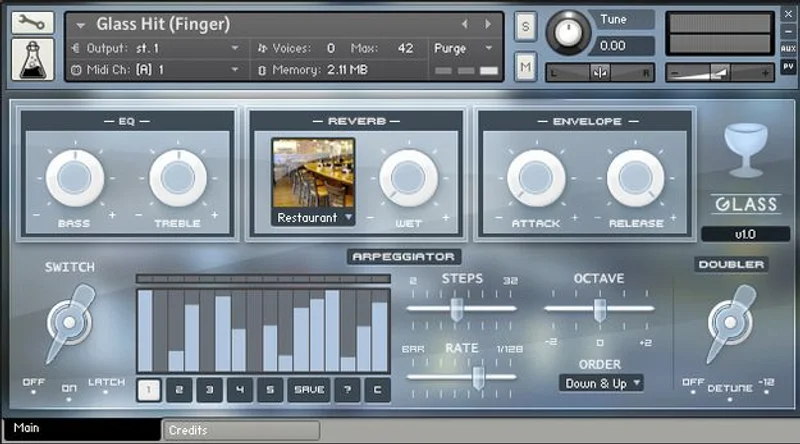
The interface is clean. One page, no deep menu-diving. You get attack, release, a simple filter, reverb send, and a few performance controls. It's approachable to the point of feeling slight.
We spent a week dropping it into different session types. In a slow, 70 BPM ambient track, it clicked immediately. We ran a glass bowl sample through a long hall send, automated the filter cutoff from around 3kHz down to 800Hz over eight bars, and it sat under a drone like it was made for that session. Satisfying.
In a mid-tempo cinematic cue, results got shakier. The higher velocity hits exposed the limited layering. At forte dynamics, the samples start to feel like samples rather than a performance. The inharmonic shimmer that makes glass beautiful in a quiet passage turns brittle and artificial when pushed.
We also noticed pitch-stretching artefacts beyond two octaves from the root. That's not a Glass-specific problem, it's a sample-instrument reality. But the mapped range feels narrower than it should, and AudioThing doesn't stretch it aggressively enough to hide the gaps. You'll hit a note that sits between two samples and wince.
Daily use verdict: reliable for texture work, limited for melodic leads. best Kontakt instruments for ambient production
The Trade-Offs
The love-it-or-hate-it tension in Glass comes down to depth versus accessibility. AudioThing made something that anyone can load and immediately play. That's clever. The interface isn't intimidating. The samples are recorded well, clean, neutral room, good signal-to-noise ratio. You can hear that care was taken in the source recording.
But accessible and deep are competing goals, and Glass landed hard on accessible. The velocity layers we counted suggest a relatively sparse sample map in the expressive middle range. A bowed glass note at mezzo-forte sounds close to the same note at piano. Nuance dies there.
If you want to write a delicate melodic phrase that breathes dynamically, you'll hit the ceiling. If you want a textural layer in a pad stack, something to add that spectral high-mid shimmer without overcomplicating your signal chain, Glass is genuinely useful. That's the trade. You don't get both.
CPU load is light. We saw minimal impact in a session with 40+ tracks. That's a real win for a sample-based instrument. how to reduce CPU load in Kontakt sessions
Against the Field
The clearest competitor is Spitfire Audio's Felt Piano or their free LABS instruments, specifically LABS Glass Harmonica, which covers adjacent timbral ground and costs nothing. If you haven't downloaded LABS Glass Harmonica yet, do that first before spending money here.
Versilian Studios' Ultra Sforzando packs cover glass and crystal instruments with more velocity l
ayers for a similar price point. If dyna
mic realism matters to you, that’s worth investigating. Versilian Studios review
For cinematic glass and metallic textures with more sound-design depth, Heavyocity's Novo or Native Instruments' Straylight reach further, but at significantly higher price points. Those tools synthesise and manipulate; Glass only plays back.
Glass wins on simplicity and load time. It loses on depth. If your existing library already includes LABS Glass Harmonica, buying Glass needs a stronger justification than it currently earns. Spitfire LABS review
The Real Verdict
Glass works. It's not overrated because nobody's overhyping it, it exists quietly in AudioThing's catalogue as a specialist tool, and it delivers on its narrow brief.
For ambient texture layers, it's an honest, CPU-light option with a clean interface and genuinely usable source recordings. We'd keep it in a template session as a supporting instrument.
We wouldn't reach for it as a lead melodic voice. We wouldn't buy it if we had LABS Glass Harmonica already installed and weren't finding gaps it couldn't fill. And if your productions rarely venture into slow, spacious territory, skip it entirely.
Check the AudioThing site for current pricing before buying. At a low or free price point, it's an easy yes for experimental producers. At a higher price, you would want to confirm it covers ground your existing library does not.
Score Breakdown
| Category | Score | Notes |
|---|---|---|
| Sound Quality | 3.5/5 | Source recordings are clean; velocity layering is the limiting factor |
| Value for Money | 4.0/5 | Low price point makes the limited depth more forgivable |
| Ease of Use | 4.5/5 | Load and play, minimal learning curve |
| Features | 2.5/5 | Thin editing depth; no standalone; modest preset count |
| CPU Efficiency | 4.5/5 | Barely registers in a full session |
| Overall | 3.8/5 | Solid specialist tool that hits its ceiling too early for regular use |
Alternatives to Consider
Spitfire LABS Glass Harmonica, free, covers overlapping timbral ground, and should be your first stop before spending anything. Spitfire LABS Glass Harmonica review
Versilian Studios Chamber Orchestra, if you want glass and crystal instruments with more expressive velocity response, Versilian's sample sets go deeper. best free Kontakt instruments
Native Instruments Straylight, if you want to actually shape and evolve glass-adjacent textures rather than just play them back, Straylight is the upgrade path. It's more expensive, but the granular engine turns source material into something Glass can't approach. Native Instruments Straylight review
Glass is the instrument you keep in a template because it loads fast, sounds fine, and never crashes. It won't be the reason anyone listens to your record twice. But it'll earn its disk space on the right session.
If your library has gaps in the glass-and-metal texture zone and you want to fill them without fuss, buy it. If you're already sorted, there's no urgent reason to add it. That's the honest answer.
Frequently Asked Questions
Does Glass by AudioThing work with Kontakt Player (free version)?
No. Glass requires the full version of Native Instruments Kontakt. It won't load in Kontakt Player's free mode. That's an annoying requirement if you don't already own full Kontakt, and it should factor into your buying decision before checkout.
Is Glass good for melodic leads or is it strictly a texture instrument?
It's primarily a texture instrument. The velocity layering is thin enough that dynamic melodic lines lose expressiveness fast. You can play simple, slow melodic phrases at moderate dynamics and it holds up. Push for anything rhythmically active or wide in dynamic range and the cracks show. For leads, look at instruments with denser sample maps.
What genres or production styles suit Glass best?
Ambient, drone, cinematic underscore, and experimental electronic are the strongest use cases. It works in any production that has space and a slow tempo, sessions where you need spectral shimmer and long inharmonic tails without clutter. It's wrong for dense, competitive mixes where it'll disappear anyway.
How does Glass compare to free alternatives like Spitfire LABS?
Spitfire LABS Glass Harmonica covers similar territory and costs nothing. If you haven't downloaded it yet, that's genuinely your first move. Glass earns its place if you've tried the LABS options and found specific gaps in your texture palette that they don't fill. Don't buy it before checking the free alternatives first.