
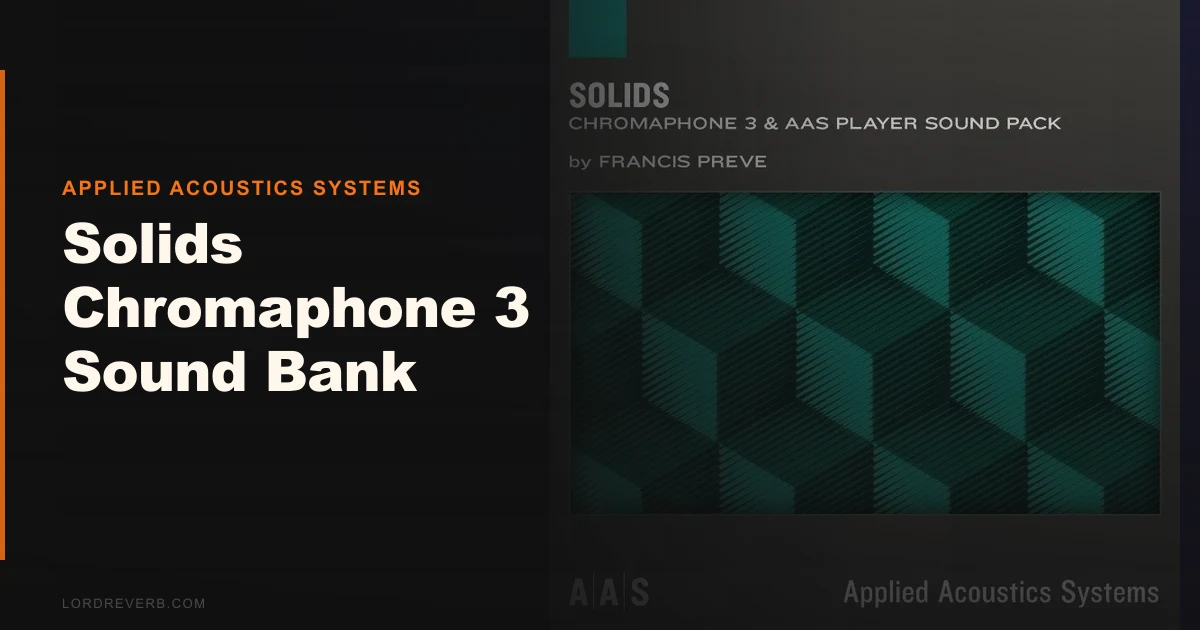
The doubt going into this one is obvious: why pay for a third-party sound bank when Chromaphone 3 already ships with a factory library? Solids earns its price by going somewhere the factory library mostly avoids, delivering a tighter stylistic focus on synthwave textures, house organs, and cinematic plucks that sit differently in a mix than anything AAS includes by default.
Solids is a 102-patch collection designed by Francis Preve of Symplesound, compatible with both the full Chromaphone 3 synthesizer and the free AAS Player plug-in. That second point matters. You don't need to own an expensive synth to load these sounds.
The collection blurs the boundary between analogue-style synthesis, FM, and physical modelling in a way that's hard to pull off cleanly. Preve mostly pulls it off. But there are caveats worth knowing before you spend anything on this.
Does It Actually Deliver on the Physical Modelling Promise?
Chromaphone 3's core trick is resonant body simulation. Strings, membranes, plates, and tubes all interact with a mallet or exciter signal to produce sounds that feel physically grounded without sounding like a sample library.
Preve built Solids to push that character toward modern production contexts. We loaded the pack and went straight for the bass patches. The low-end shapes are punchy in a specific way: transient attack hits around 80-120Hz with a natural sag on the tail that compression alone can't fake. That's the physical modelling doing real work.
The original patches were designed for Chromaphone 2 and remastered for Chromaphone 3. The remaster added performance macros to each patch, which is genuinely useful. But "remastered" is doing some lifting here. The architecture is older, and on a handful of patches you can hear the ceiling of what Chromaphone 2's engine could handle before the update.
Overall: yes, it delivers. With reservations about the vintage architecture underneath.
Where Solids Actually Shines
The bells and chimes category is the strongest part of this library. Full stop.
We dropped a tuned bell patch into a sparse cinematic cue, ran it at a 16th-note pattern, and it sat without masking the strings beneath it. The high-frequency shimmer sits above 6kHz without the harsh resonant peaks you get from FM bell patches in general-purpose synths. That's a specific win for post-production and trailer work.
The electric piano patches are the second highlight. They're not Fender Rhodes clones. They're electric-piano-adjacent: slightly metallier in the upper harmonics, physically plausible rather than sample-accurate. Works brilliantly for lo-fi and synthwave contexts where you want the character without the nostalgia.
Performance macros across all 102 patches mean you can map Macro 1-4 to a controller and have meaningful real-time control immediately. We mapped Macro 2 on the "Elastic" pad patch to a mod wheel and got a filter-breath movement that would take twenty minutes to program from scratch. That's satisfying workflow payoff.
Genre sweet spots: synthwave, lo-fi, cinematic underscore, and hybrid electronic scoring. Outside those four, the library thins out fast.
Where It Falls Short
No official patch-category breakdown is frustrating. Anywhere. Not in the manual, not on the product page.
We had to load every patch manually to map the library. That's annoying when you're on a deadline and need a specific texture. Competing packs like Hover and Epicycles from the same Chromaphone 3 +PACKS bundle include at least a rough category guide in the preset browser naming.
The "house organ" patches feel like the weakest area. They're functional but thin compared to dedicated organ libraries. If Hammond-style organ is your primary use case, Solids won't satisfy you at any price.
The Chromaphone 2 lineage also shows in CPU terms when you stack patches in a dense arrangement. We ran eight instances of Solids patches in a 128-sample buffer session. Nothing dramatic, but it ran slightly warmer than equivalent patches built natively in Chromaphone 3. Not a dealbreaker. Worth knowing.
And the library is stylistically narrow. That's by design, but if you produce across genres, 102 patches that peak in synthwave and cinematic contexts leave a lot of the Chromaphone engine's range unexplored.
How It Stacks Up Against Other Chromaphone 3 Packs
Preve's Solids competes most directly with two packs inside AAS's own +PACKS ecosystem: Hover by Ivo Ivanov and Epicycles by Adam Pietruszko. Chromaphone 3 sound bank comparison
Hover leans harder into ambient and textural territory. If you want slow evolving pads and atmospheric swells, Hover is the stronger buy. Solids wins on rhythmic content and playable keyboard patches.
Epicycles focuses on tuned percussion and mallet instruments. It's more focused than Solids, and that focus pays off. For anyone whose primary output is film scoring with orchestral-adjacent textures, Epicycles is a sharper tool.
Solids sits between those two: more playable than Hover, wider than Epicycles, but not the definitive choice for either camp. If you produce synthwave specifically, Solids wins that three-way comparison clearly. best Chromaphone 3 presets
Is $39 a Fair Price?
Yes. Barely.
At this price you're paying a small amount per patch, and most patches are genuinely production-ready. That math works. But the Chromaphone 3 +PACKS full bundle delivers 2,410+ presets for a much lower per-patch cost if you're buying multiple packs anyway. AAS Chromaphone 3 full review
Buy Solids as a standalone purchase if synthwave or cinematic production is your focus and you only want targeted content. Buy the bundle if you're building a complete Chromaphone 3 library from scratch.
Score Breakdown
| Category | Score | Notes |
|---|---|---|
| Sound Quality | 4.0/5 | Bells, plucks, and basses are excellent; house organs are weak |
| Value for Money | 3.5/5 | Fair at $39 standalone; bundle math undercuts it at scale |
| Ease of Use | 3.0/5 | No patch category documentation makes browsing slower than it should be |
| Features | 3.5/5 | Performance macros on all patches are a real workflow win |
| CPU Efficiency | 3.5/5 | Light in isolation; slight overhead on stacked Chromaphone 2-era patches |
| Overall | 3.9/5 | Solid specialist purchase for synthwave and cinematic producers; not a general-purpose buy |
Alternatives Worth Checking
Hover (AAS +PACKS): Better for ambient and textural work. More patient sound design, less playable but more atmospheric. Hover Chromaphone 3 sound bank review
Epicycles (AAS +PACKS): Tighter focus on tuned percussion and mallet instruments. Film scorers will love it more than Solids. Epicycles Chromaphone 3 review
Chromaphone 3 +PACKS Full Bundle: If you're buying more than two or three individual packs, the bundle math wins. 2,410+ presets at a lower total cost. Check AAS's site for current bundle pricing. AAS Chromaphone 3 bundle deals
Solids is the right buy if you produce synthwave or cinematic hybrid music, own or plan to own Chromaphone 3, and want a focused pack that delivers immediately without deep programming. Skip it if you need broad genre coverage or if you're planning to buy the full bundle anyway. At $39, the floor is low enough that the risk is small. But go in knowing it's a specialist tool, not a complete library.
The bells alone almost justify the price. Almost.
Frequently Asked Questions
Do I need to own Chromaphone 3 to use the Solids sound bank?
No. Solids works with the free AAS Player plug-in, which you can download from the Applied Acoustics Systems website without purchasing Chromaphone 3. You only need the full Chromaphone 3 synth if you want to edit the patch architecture beyond the performance macros. For most producers, the AAS Player version is perfectly functional.
Was Solids originally designed for Chromaphone 2 or 3?
Solids was originally created by Francis Preve for Chromaphone 2 and later remastered for Chromaphone 3. The remaster added performance macros to each patch but didn't rebuild the underlying synthesis architecture. The sounds work well, but you're running Chromaphone 2-era patch design through the Chromaphone 3 engine.
How does Solids fit into the broader AAS Chromaphone 3 +PACKS ecosystem?
Solids is one of 22 packs in the AAS Chromaphone 3 +PACKS series. The full bundle contains over 2,410 presets. If you're planning to build a comprehensive Chromaphone 3 library, the bundle delivers a lower cost-per-patch than buying Solids standalone. Buy Solids individually only if synthwave and cinematic textures are your primary production focus.
Is Solids useful for genres outside synthwave and cinematic production?
It's workable but not optimised for other genres. The electric piano patches cross over into lo-fi and jazz-adjacent production reasonably well. The bass patches have enough character for house and downtempo. But the library's centre of gravity is firmly in synthwave and film scoring. If those aren't your primary genres, a wider-scope pack like Deconstruction from the same series would serve you better.