
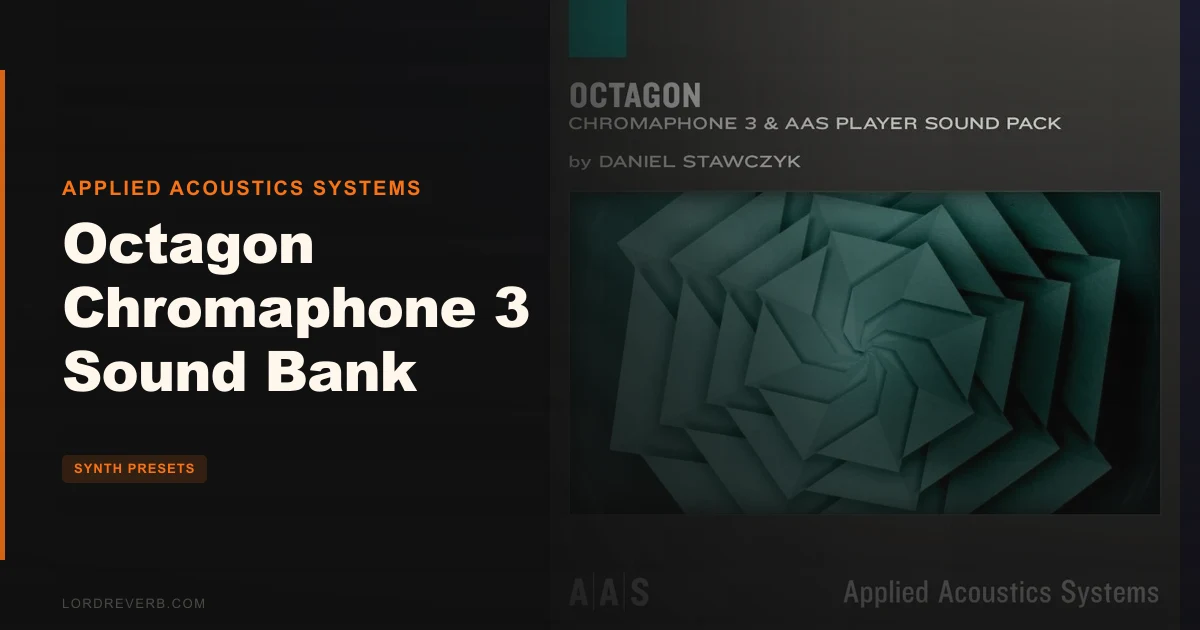
The Octagon Chromaphone 3 Sound Bank is a 148-preset library built for Applied Acoustics Systems' Chromaphone 3, and it's one of the most complete arpeggiated texture packs available for the engine at $19.
You're halfway through building a track. The groove is locked, the kick sits right, but the mid-layer is hollow. You want something moving, something that breathes and shifts without you having to program every note. You've got Chromaphone 3 installed, or you're about to install the free AAS Player, and you need material that actually does something interesting without three hours of patch-building.
That's exactly where Octagon lands. It doesn't pretend to be a general-purpose synth collection. It's targeted: arpeggiated layered sounds, physically-modelled textures, and evolving pads with an acoustic logic underneath them. If that's the gap in your session right now, keep reading.
Quick verdict: Octagon is a satisfying, well-focused library for producers who work in electronic, cinematic, or experimental spaces. The sound quality is brilliant. The CPU behaviour is annoying enough to flag before you buy. At $19, the ask is low and the return is high, as long as you're not expecting it to cover analog territory it was never designed for. Score: 4.0/5.
What's Actually In The Pack
The 148 presets break into seven named categories: 24 Bass Arpeggiators, 15 Basses, 8 Chords, 21 Flows, 9 Stabs, 41 Synthesizers, and 31 Special Effects.
That's not a random spread. The Synthesizers and Special Effects categories alone account for nearly half the library. The Bass Arpeggiators are the headline feature, built to show off exactly what Chromaphone 3's arpeggiator can do with density and intricacy dialled up.
The AAS Player plug-in comes free with the purchase. It runs in VST, AU, AAX, and RTAS formats, and it also works as a standalone application. So even if you don't own Chromaphone 3, you can load and play every preset without spending anything extra on the instrument itself.
If you do have Chromaphone 3, Octagon adds to it automatically once installed. You buy it, enter the serial number, follow the installation instructions, and the presets appear inside the instrument. No fuss.
The one thing to be clear about: the AAS Player is a preset player. It lets you browse, load, and perform the sounds. It won't let you open up the synthesis engine and redesign a patch from scratch. For that, you need Chromaphone 3.
Where Octagon Sits In A Real Session
Picture this. You're building the drop of an electronic track and you need a mid-layer that's constantly moving, something the ear follows without you sequencing every note manually. Open the Bass Arpeggiators category and start scrolling. The presets are already arpeggiated, meaning the movement is baked in. You play a chord, the preset handles the pattern.
That's the core workflow advantage here. You're not modulating LFOs or drawing automation to create motion. The motion is in the sound design itself, layered and timed within Chromaphone 3's arpeggiator. For sketching and finishing tracks quickly, that matters.
The Flows category is where you'll spend time if you produce ambient or cinematic material. These presets are designed to evolve slowly. Hold a note and let the tail develop. The results form a lush, luxurious sonic palette unlike anything a traditional subtractive synth generates, which reflects what physically-modelled resonators actually do. The harmonic behaviour changes over time in a way that oscillator-based synthesis generally doesn't replicate.
The Stabs and Chords categories are shorter interactions. Hit a key, get a defined event. Useful for arrangement punctuation, less useful as the centrepiece of a section. Nine stabs is a thin selection if that's your primary need, but as support material it's fine.
Your DAW needs to be able to host VST, AU, AAX, or RTAS plug-ins. Those four formats cover almost everything in current use, but check your setup before buying if you're on something unusual.
What It Does Better Than You'd Expect
The sound quality is the argument for buying this. Owners consistently describe Chromaphone 3's sonic character as brilliant, with version 3's palette reaching deeper than the earlier iterations. Arpeggiated mallet lines layered over sustained drones are the kind of textures that take days to build from scratch in most synths. Here they're presets you can load, play, and immediately decide if they fit.
The Special Effects category is genuinely clever design. Thirty-one presets built around angular, unusual timbres: sounds that don't sit neatly in any traditional category. If you produce music that needs sonic material that doesn't sound like every other producer's library, this is where Octagon earns its place.
The Synthesizers category at 41 presets is the largest single section. These cover a wide arc of character. Some sit closer to melodic pitched material, others push into more abstract territory. Owners report the interface in Chromaphone 3 is super clean, intuitive, and resizable, which helps when you're browsing quickly under session pressure.
Ease of use is a real strength here. Load a preset, play it. The AAS Player handles the heavy lifting. If you want to tweak macro controls at the top level, you can. If you want to leave the preset exactly as it shipped, that works too. No learning curve on the Player side at all.
The Bass Arpeggiators deserve a specific mention. Twenty-four presets built to demonstrate what Chromaphone 3's arpeggiator does with layered, rhythmically dense material. Hold a single note and you get interlocking patterns. Play a two-note pattern and the texture compounds. These aren't simple arpeggios. The developer describes them as taking full advantage of the arpeggiator's density and intricacy, and owners back that up.
The Rough Edges
The CPU issue is real. Multiple owners report high utilization causing actual sound dropouts, even on machines with solid specs. The specifications describe a light CPU and RAM footprint for the full plugin, but the reports from owners of dropout behaviour suggest Chromaphone 3's physical modelling is doing heavier work under the hood than the headline numbers imply. Frustrating when you're running a dense project.
No MPE support. If you're performing with an MPE controller, expecting per-note pitch bend and pressure to shape the physically-modelled resonators in real time, you won't get it here. That's a hard limit of the current engine.
The three effects chains in Chromaphone 3 only give you two selectable effects slots each. Reviewers describe this as somewhat arbitrary. It's not a dealbreaker for most sessions, but if you're used to routing freely, the constraint will feel tight. This affects Chromaphone 3 owners more than AAS Player users, who aren't editing chains at all.
And then there's the category that's genuinely missing. If you need convincing analog basses or supersaws, stop here. Reviewers are clear that Chromaphone 3's engine is weak at classic subtractive and analog sounds. That's not a criticism of Octagon specifically; it's the nature of physically-modelled synthesis. But if half your production work involves fat, warm, analog-style low end, this library isn't the answer.
The underlying instrument also has a steep learning curve if you want to design sounds from scratch. The presets hide that complexity. But the moment you want to go deeper and understand why a sound behaves the way it does, you'll need patience and probably the Chromaphone 3 manual open alongside.
Who This Is Really For
- ✅ Buy if you produce electronic, ambient, cinematic, or experimental music and need arpeggiated, evolving textures that standard subtractive synths don't cover well.
- ✅ Buy if you already own Chromaphone 3 and want to expand its preset library with a focused, high-quality pack that integrates automatically.
- ✅ Buy if you're new to Chromaphone 3 and want to explore the engine without committing to deep sound design. At $19, the AAS Player plus 148 presets is a low-risk entry point.
- ❌ Skip if your sessions live on analog-style basses, supersaws, or classic subtractive sounds. Chromaphone 3's engine won't get you there regardless of which preset pack you load.
- ❌ Skip if you're already fighting CPU headroom in your projects. Adding Chromaphone 3's physical modelling on top of a full session can push things to dropout territory.
- ❌ Skip if you need MPE expressivity as part of your performance workflow. The engine doesn't support it.
Specs & Technical Details
| Developer | Applied Acoustics Systems |
| Price | $19 |
| Plugin Format | VST / AU / AAX / RTAS (AAS Player); works as standalone |
| OS Support | N/A |
| Activation | Serial number |
| CPU Usage | Reported high by some owners despite light RAM footprint |
| Trial Available | N/A |
| Version Reviewed | N/A |
Score Breakdown
| Category | Score | Notes |
|---|---|---|
| Sound Quality | 4.5/5 | Owners consistently report brilliant, lush, distinctive timbres unlike standard subtractive engines |
| Value for Money | 4.5/5 | 148 presets with AAS Player included at $19 is a genuinely low-risk buy |
| Ease of Use | 4.0/5 | AAS Player itself is simple; Chromaphone 3 sound design from scratch is steep |
| Features | 3.5/5 | Strong preset range but no MPE, limited effects slots, no analog sound coverage |
| CPU Efficiency | 3.0/5 | Multiple owners report dropout behaviour; physical modelling can be taxing in dense sessions |
| Overall | 4.0/5 | A focused, high-quality library that delivers exactly what it promises if you're in the right genre space |
Alternatives To Consider
If Octagon doesn't fit, these four synths come up regularly in the same conversation. They all approach synthesis from different paradigms, which is the key distinction.
Tone2 Saurus 4 operates on a different synthesis model entirely. If you want thick, aggressive electronic sounds that lean harder into analog character, it's a different tool for a different job.
U-He Diva is the go-to for producers who specifically need convincing analog emulation. It's the opposite of Chromaphone 3 in sonic character. If your sessions live on warm, fat oscillator-based pads and basses, Diva is what you're actually looking for.
Rob Papen Predator 3 and Lennar Digital Sylenth1 both sit in the classic subtractive and virtual-analog camp. Sylenth1 in particular is a staple for dance music production precisely because it does the warm, wide, slightly processed sound that Chromaphone 3 won't replicate. If that's your world, Octagon is the wrong library.
None of these alternatives replace what Octagon does. Physically-modelled resonance, arpeggiated layered acoustic-logic textures: that's a specific lane. But if you're on the fence because your music spans both territories, be honest about which side you spend more time on.
The Bottom Line
Octagon is a love-it-or-leave-it library, and whether you love it depends almost entirely on what you're making.
Producers working in electronic, ambient, or cinematic spaces who want textures that don't sound like everyone else's preset browser? This is a brilliant, underrated buy at $19. The arpeggiated layered sounds do something physically-modelled synthesis does better than almost any other approach: they breathe, they develop, they hold interest over time in a way a static oscillator can't.
But if you're producing four-to-the-floor techno, hip-hop, or anything that depends on convincing analog low end, Octagon will sit unused. That's not a failure of the pack. It's just the wrong tool.
The CPU overhead is the only thing that genuinely clouds the picture. Owners experiencing dropouts on capable machines is worth knowing before you load it into an already-busy session. Plan a track with Octagon as a featured element rather than layering it over everything at once.
At the price, the risk is low. But the reward is real only if you're producing in the right territory. Know which side of that line you're on, and the decision makes itself.
Frequently Asked Questions
Do I need to own Chromaphone 3 to use the Octagon sound bank?
No. The free AAS Player plug-in is included with the purchase and lets you load and play all 148 presets without owning Chromaphone 3. The AAS Player runs in VST, AU, AAX, and RTAS formats and also works as a standalone application. If you do own Chromaphone 3, Octagon integrates into it automatically after installation.
What categories of sounds are in the Octagon library?
The 148 presets cover seven categories: 24 Bass Arpeggiators, 15 Basses, 8 Chords, 21 Flows, 9 Stabs, 41 Synthesizers, and 31 Special Effects. The Synthesizers and Special Effects sections are the largest. The library is built around arpeggiated layered sounds with an emphasis on textures that take full advantage of Chromaphone 3's arpeggiator.
Is Octagon suitable for producers who want analog-style basses and classic synth sounds?
Honestly, no. Reviewers are clear that Chromaphone 3's physical modelling engine is weak at producing convincing analog basses or supersaws. That's a fundamental characteristic of the synthesis approach, not a gap in this specific preset pack. If analog-style sounds are your priority, a different synthesis paradigm would serve you better.