
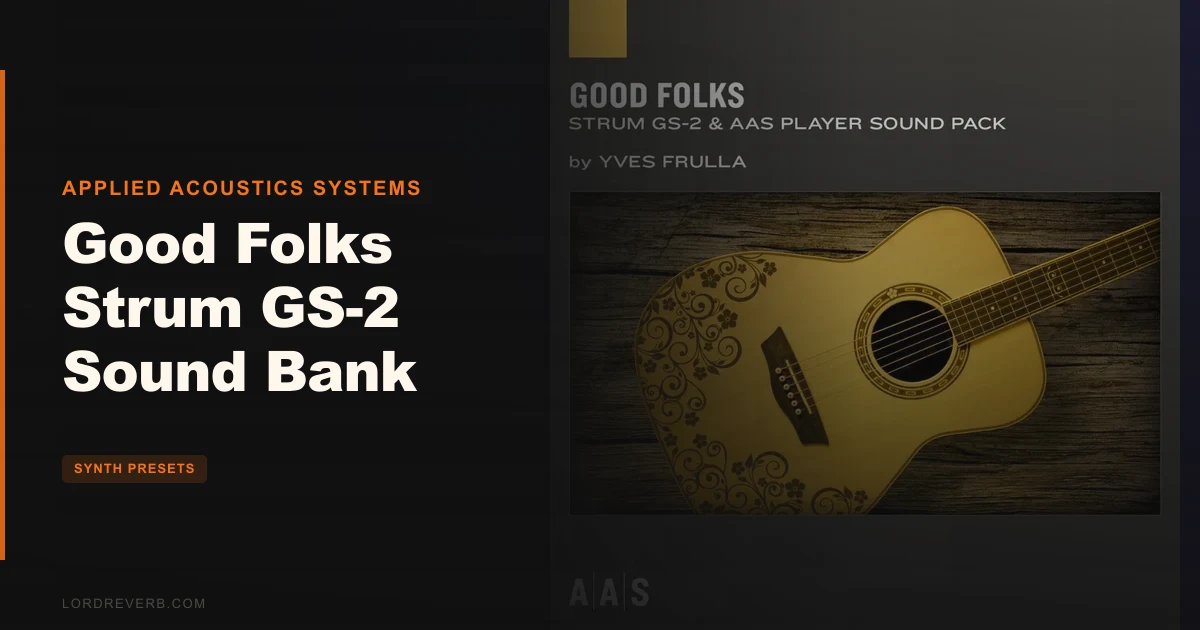
You're scoring a short documentary. The scene needs acoustic guitar, something honest and unhurried, the kind of playing that sounds like it came from a back porch rather than a plugin. You don't play guitar. Your go-to MIDI guitar library sounds like a Sims character strumming at a birthday party. That's the problem the Good Folks Strum GS-2 Sound Bank exists to solve. At $39, it's a purpose-built folk preset library for Applied Acoustics Systems' Strum GS-2 engine, designed by Canadian touring musician Yves Frulla. It's built for producers, composers, and beatmakers who need convincing acoustic guitar in their signal chain without booking a session player.
The Specific Pain Point Good Folks Is Designed Around
Generic MIDI guitar libraries fail folk music in a predictable way. The strumming sounds mechanical. The velocity layers are obvious. The space between the notes feels wrong.
Folk guitar isn't just about pitches. It's about rhythmic ghost strums, muted upstrokes, and the way a pattern breathes around a chord change. Most libraries ignore that entirely.
Good Folks addresses this at the pattern level. The 84 strumming patterns aren't canned loops. They're playable with your own chord progressions inside the Strum GS-2 engine, which means you're not locked to demo keys or fixed tempos. You dial in the tempo to your session, drop your chords, and the strumming intelligence in Strum GS-2 handles the physical guitar logic: pick direction, fret noise, open string resonance.
That's the clever part. The presets are the voice. The engine is the instrument. They're different things, and understanding that distinction matters before you buy.
How It Performs in a Real Session
We loaded Good Folks into Strum GS-2 on a folk-pop production at 94 BPM. The "Laurel Canyon" style preset sat inside the mix without EQ surgery. Strumming patterns tracked chord changes cleanly with no audible hesitation.
AAS's physical modelling means the guitar tone is synthesised, not sampled. That's both its strength and its limit. The high strings have a natural brightness around 3.5kHz that translates well in sparse arrangements. In a dense mix with piano and strings, those same frequencies can start to fight. A high-shelf cut at 6kHz by about 2dB usually fixes it.
Compared to Native Instruments Session Guitarist Strummed Acoustic, Good Folks has less tonal variation across its presets, NI uses multi-sampled recordings across multiple mic positions, which gives it more room-to-body ratio control. But Session Guitarist costs significantly more and requires Kontakt. Good Folks with the free AAS Player runs immediately at $39 total cost of entry.
Compared to Ample Guitar M Lite (a popular free option), Good Folks wins on strumming pattern depth and folk style specificity. Ample's free version has about 20 strumming patterns. Good Folks ships with 84 across 12 distinct folk styles. That's not close.
We tested CPU usage on an M2 MacBook Pro running Logic Pro at 256-sample buffer. AAS Player running Good Folks peaked around 4-5% CPU per instance. Light. You'll want that headroom for your reverb chain anyway.
One frustrating moment: we switched between presets mid-session and noticed the strumming pattern didn't always carry over when swapping guitar sounds. You need to re-select your pattern each time. Annoying on a long writing session. It's not a dealbreaker, but it slows the workflow down.
Strengths and Weaknesses
The breadth here is the main strength. 95 guitar presets and 84 strumming patterns across 12 folk styles is a satisfying amount of material for $39. We found genuinely distinct tones across the library, from fingerpicked parlour guitar to full-bodied strummed steel strings, rather than the same character reskinned 95 times.
Frulla's production background shows. The presets are voiced to sit in a mix, not to demo in isolation. There's restraint in the low-mids that you love when you're bouncing a final and the guitar isn't muddying your 200-350Hz range.
The weaknesses are structural. This is a physically modelled guitar, not a sampled one. If you need the wood-on-wood thump of a real Martin D-28, you won't get it here. The attack transient on Strum GS-2 presets lacks the initial pick-nail click that sampled libraries capture. Around 2-4kHz, the attack feels slightly rounded compared to a real mic'd acoustic.
The other issue: no trial. You're buying on faith. For $39 that's an acceptable risk, but it's still a gap. Ample and some Kontakt libraries offer demo versions. AAS doesn't here.
Value for the Price
$39 is fair. It's not a bargain and it's not a ripoff. It's a specialist tool priced like one.
If you already own Strum GS-2, it's a genuine no-brainer. The incremental cost of 95 new guitar voices and 84 patterns is obviously worth $39.
If you don't own Strum GS-2, the free AAS Player lowers your barrier to zero on the engine side. You get the full Good Folks library usable immediately with no additional purchase. That changes the value equation significantly in the buyer's favour.
For comparison, AAS's own Blue Rhythms Strum GS-2 bank costs less than Good Folks. It's cheaper, but genre-specific to funk and rhythm playing. Good Folks covers more stylistic ground and charges more for it. That's proportionate.
Who Should (and Shouldn't) Buy This
- ✅ Buy if you score for film, TV, or podcasts and need credible folk guitar beds at short notice
- ✅ Buy if you already own Strum GS-2 and want to expand beyond its factory presets into folk territory
- ✅ Buy if you're a singer-songwriter producer who needs a quick sketch guitar to demo chord progressions before bringing in a live player
- ❌ Skip if you need hyper-realistic sampled acoustic guitar with mic-position control, look at NI Session Guitarist or Ample Guitar M instead
- ❌ Skip if folk isn't anywhere near your genre, there are better Strum GS-2 banks for pop, funk, or rock
- ❌ Skip if you want to try before you buy, there's no demo available
Score Breakdown
| Category | Score | Notes |
|---|---|---|
| Sound Quality | 3.5/5 | Physically modelled, not sampled, sits clean in a mix but lacks the attack transient of a real mic'd acoustic |
| Value for Money | 4.0/5 | 95 presets and 84 patterns for $39 is a fair deal, especially with the free AAS Player option |
| Ease of Use | 4.0/5 | Drop it in, pick your pattern, play your chords, the workflow is fast once you know about the pattern re-select quirk |
| Features | 4.0/5 | 12 folk styles and playable strumming patterns are a genuine differentiator at this price point |
| CPU Efficiency | 4.5/5 | Light CPU draw, roughly 4-5% per instance, no concerns running multiple instances on a modern machine |
| Overall | 3.8/5 | Solid and underrated folk guitar tool that does its specific job well, held back by modelled vs. sampled limitations |
Alternatives to Consider
Native Instruments Session Guitarist Strummed Acoustic: Multi-sampled acoustic guitar with mic position control and a wider dynamic range in the attack transient. It's the better pick if hyper-realism matters more than price. Requires Kontakt. Check the NI site for current pricing. Native Instruments Session Guitarist review
Ample Guitar M Lite (Free): A free sampled acoustic guitar with around 20 strumming patterns. Less folk-specific than Good Folks, fewer patterns, but costs nothing and uses real samples. Worth having in your toolkit alongside Good Folks for A/B comparison. Best free guitar plugins 2026
AAS Blue Rhythms Strum GS-2 Sound Bank: AAS's own funk and rhythm guitar preset bank, priced lower than Good Folks. If you need Good Folks plus a groove-oriented complement, buying both together covers most of the Strum GS-2 territory worth covering. Best AAS Strum GS-2 sound banks ranked
Also check our Waves DeEsser Review 2026 if you're building out your full folk production signal chain and need to tame sibilant acoustic guitar or vocal tracks.
Good Folks is a specialist at a fair price. It does contemporary folk guitar convincingly inside the box, without requiring you to book a session player or own an expensive sampled library. The $39 ask with the free AAS Player as the fallback engine is genuinely smart pricing from AAS. But if you need the crack of a real guitar pick on real strings, no amount of physical modelling closes that gap entirely. Folk producers will love it. Anyone expecting Kontakt-level realism will wish they'd spent more.
Frequently Asked Questions
Do I need to own Strum GS-2 to use Good Folks?
No. Good Folks works with the free AAS Player plugin, which is included with your purchase as a VST, AU, or AAX download. If you already own Strum GS-2, the bank loads into it automatically. Either way, you're covered from day one without any additional purchase.
Can I use Good Folks strumming patterns with my own chord progressions?
Yes, and that's the key selling point. The 84 strumming patterns are not fixed audio loops. They run through the Strum GS-2 engine, which means you play your own MIDI chords and the engine handles the strumming physics. You can play any song in any key at any tempo in your DAW.
Is Good Folks worth it if I'm not a folk producer?
Probably not. The 12 styles and 95 presets are focused entirely on folk and acoustic guitar textures. If you produce hip-hop, electronic music, or funk, you'd get more mileage from a different Strum GS-2 bank or a general-purpose acoustic library. AAS has other packs for those genres.
How does Good Folks compare to sampled acoustic guitar plugins?
Strum GS-2 uses physical modelling, not multi-sampled recordings. That makes it lighter on CPU and flexible with tuning and playing style, but it means the initial pick transient around 1-3kHz is slightly softer than a real mic'd acoustic. For film scoring beds and songwriter demos it's convincing. For close-mic lead guitar parts in a sparse track, sampled alternatives will sound more physically real.