
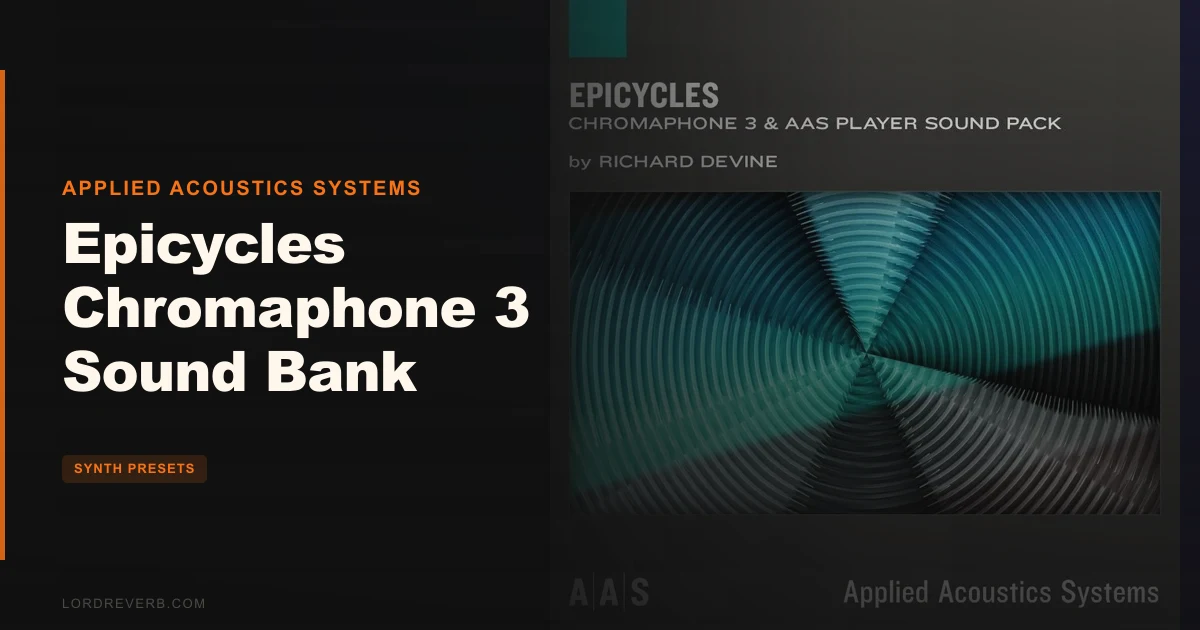
You open your DAW at midnight, you've got a sync brief due at noon, and your go-to cinematic patches sound like every other trailer on YouTube. You need textures that feel genuinely unsettling, physically organic, and not lifted from a Spitfire library. That's the exact gap the Epicycles Chromaphone 3 Sound Bank by Applied Acoustics Systems fills. It's 111 presets built by Richard Devine inside the physical modelling engine of Chromaphone, covering everything from haunted plucked strings to subterranean percussion clusters. At $39 USD on Plugin Boutique, it's aimed squarely at film composers, sound designers, and experimental producers who want sounds that a traditional subtractive or wavetable synth simply can't produce.
The Dark Palette Nobody Else Is Filling
Most preset banks for physical modelling synths play it safe. You get polished piano replacements, clean mallets, friendly pads. Boring.
Epicycles goes the other direction entirely. Richard Devine's history is scoring for TV and film, designing sound for video games, and building audio identities for companies like Apple, BMW, Nike, and Audi. He approaches Chromaphone as an acoustic physics engine, not a soft synth with pretty presets.
The result is a library that lives in tension. The Soundscapes category's 11 patches sit between identifiable instrument and environmental noise. We pulled up one preset called "Clanks & Pipes" and the sound opened on a low metallic resonance around 80Hz, then spread upward through rattling overtones that decayed across roughly 4 seconds. Nothing about it sounds sampled. Everything about it sounds broken in an interesting way.
That's the problem this bank solves: you cannot fake this character with filters and reverb on a standard synth. Physical modelling produces these textures from first principles. Devine knew that, and built the whole library around it.
How It Performs Across the 9 Categories
The 111 presets split into 9 categories, and the distribution tells you something about Devine's priorities.
Percussion is the biggest category at 27 presets. That's not an accident. Chromaphone's resonator model excels at struck, bowed, and plucked physical objects, and the percussion bank uses every corner of that. We cycled through these with a simple 16-step pattern at 130 BPM. About two-thirds of the 27 presets gave us something we'd actually use in a session. Several had transient peaks above 6dB hotter than the pads, so gain stage carefully before you bus these to a drum group.
Strings and Pads (12 presets) and Arps (12 presets) are the most immediately musical categories. These sit in the mix without fighting the midrange. Load the arp patches and hold a chord: the internal Chromaphone sequencing creates movement without you touching the MIDI. That's satisfying when you're working fast.
The Soundscapes (11 presets) and Effects (11 presets) categories are the most niche. We love them. You'll either love them or never open them again, depending on your genre.
The Chromaphone 3 remaster added performance macros to the presets. These map key sound parameters to a handful of knobs, so you can dial in character without going deep into the synth's architecture. Clever addition. The original Chromaphone 2 version had none of that, and the difference in playability is real.
Compared to packs like Deconstruction (Amon Tobin's bank, 102 presets) or the AAS Synbiosis bank (130 presets), Epicycles is narrower in genre scope but tighter in sonic identity. If you need variety, Synbiosis has more range. If you need a specific dark, physical character, Epicycles wins.
Strengths and Weaknesses
The strongest part of this library is the percussion section. 27 presets is a serious investment in that category, and these sounds do things sampled drums never will: the resonance tail is mathematically derived from the object's physical properties, not truncated from a recording. We layered one of the metallic percussion patches under a hip-hop kick at 808Hz. The overtones of the physical model sat at 1.6kHz and 3.2kHz, filling a frequency gap that the kick left empty. It worked without an EQ touch.
The plucked strings (10 presets) are also brilliant. Ethereal is an underused descriptor here because it means something specific: fast transient attack between 5 and 15ms, then a long amplitude decay that drops below -40dB after roughly 3 to 6 seconds depending on the preset. The result feels like a gut-string instrument played in a reverberant chamber, except none of it is reverb.
Weaknesses? The bass category is frustrating. Nine presets is thin, and several overlap in character. For a library from a designer of Devine's calibre, the bass section feels rushed. It's also worth being direct about the experimental bias: the Basses, Soundscapes, and Effects categories will annoy anyone who works in mainstream pop or commercial EDM. That's not a flaw in the library. It's a genre mismatch. Know yourself.
Value for the Price
At $39 for 111 presets, each one costs well under a dollar. That's not the cheapest in the category. AAS's own in-house banks sometimes carry similar counts at lower prices during sales.
But designer packs carry a premium, and Devine's credit sheet is legitimate. The free AAS Player compatibility is genuinely useful: you don't need a full Chromaphone 3 licence to use this bank. That changes the value calculation meaningfully. If you already own Chromaphone 3, it's a low-risk $39 spend. If you don't, the free player route gets you access for nothing beyond the bank cost itself.
Worth it. Not extraordinary. Exactly what it says it is.
Who Should (and Shouldn't) Buy This
- ✅ Buy if you score for TV, film, or games and need dark, physics-based textures that don't sound like anyone else's library.
- ✅ Buy if you make IDM, experimental electronic, or ambient music and Chromaphone 3 is already in your signal chain.
- ✅ Buy if you want the free AAS Player route and need a curated, high-pedigree starting point for the engine.
- ❌ Skip if you make pop, EDM, or hip-hop and need bread-and-butter sounds. Wrong tool entirely.
- ❌ Skip if you're hoping for a comprehensive bass library. Nine presets won't cover you.
- ❌ Skip if you've never used Chromaphone and want to learn the synth through presets. The presets are too abstract to teach you the architecture.
Score Breakdown
| Category | Score | Notes |
|---|---|---|
| Sound Quality | 4.5/5 | Physically modelled source material gives the presets a character no sample-based library can replicate |
| Value for Money | 3.5/5 | $39 is fair for Devine's pedigree, but the bass category and no-trial policy hold it back |
| Ease of Use | 4.0/5 | Performance macros added in the Chromaphone 3 remaster make real-time shaping fast; raw Chromaphone architecture is still complex underneath |
| Features | 4.0/5 | 111 presets, 9 categories, strong percussion depth at 27 presets, but bass category is underweight at 9 |
| CPU Efficiency | 4.5/5 | Preset pack adds negligible overhead; CPU is the host synth engine's business, not this bank's |
| Overall | 4.1/5 | A brilliantly specific library with a clear audience, and a hard skip for everyone outside that audience |
Alternatives to Consider
If Epicycles' experimental bias is too heavy for your workflow, there are three places worth looking.
AAS Synbiosis is the obvious first stop. It's another Chromaphone bank, this time with 130 presets and a wider tonal range that covers more accessible harmonic territory. AAS Synbiosis review
Chromaphone 3 Factory Library ships free with the synth itself and covers the accessible end of the spectrum well. If you need bread-and-butter physical modelling sounds before buying any third-party bank, start there. Chromaphone 3 review
Predator 2 sound banks offer a different angle entirely. If you like the idea of designer-curated presets with character but want something more genre-versatile, Andy Lee House Synth Presets for Predator review shows what a strong designer bank looks like on a more immediately accessible synth engine.
For broader exploration of physical modelling presets and what's available in the category, our best Chromaphone sound banks guide covers the full landscape.
Epicycles is $39, it's Richard Devine's name on it, and it sounds unlike anything built from wavetables or samples. If that's the gap in your library, buy it without hesitation. If you make anything that needs to sound warm and familiar in a chorus, leave it alone.
Frequently Asked Questions
Do I need to own Chromaphone 3 to use the Epicycles sound bank?
No. The Epicycles bank works with the free AAS Player plug-in, which you can download directly from Applied Acoustics Systems at no cost. You only need Chromaphone 3 if you want to edit the presets at a deeper synthesis level beyond the performance macros. The free player gives you full access to all 111 presets.
Is Epicycles compatible with Chromaphone 2 as well as Chromaphone 3?
Yes, though the experience differs between versions. The presets were originally created for Chromaphone 2, and the Chromaphone 3 remaster added performance macros on top of the original patch architecture. If you're still running Chromaphone 2, the core sounds are there. You just won't get the macro controls that make real-time performance shaping fast.
What genre is the Epicycles sound bank built for?
Film scoring, sound design, IDM, experimental electronic, and dark ambient. This is not a pop or EDM bank. The character across most of the 111 presets is intentionally opaque and unsettling, which is exactly right for sync work and exactly wrong for a mainstream radio track. Check the demo audio on Plugin Boutique before you buy to confirm the vibe is what you need.
How does the percussion category compare to other Chromaphone banks?
At 27 presets, Epicycles' percussion section is the largest single category in the library, and it's the strongest. These are physically modelled struck and resonant sounds, not sampled drums, so the tail behaviour and overtone structure differ from anything in a standard drum sample pack. If you're buying Epicycles for one reason, this is the one worth buying it for.