
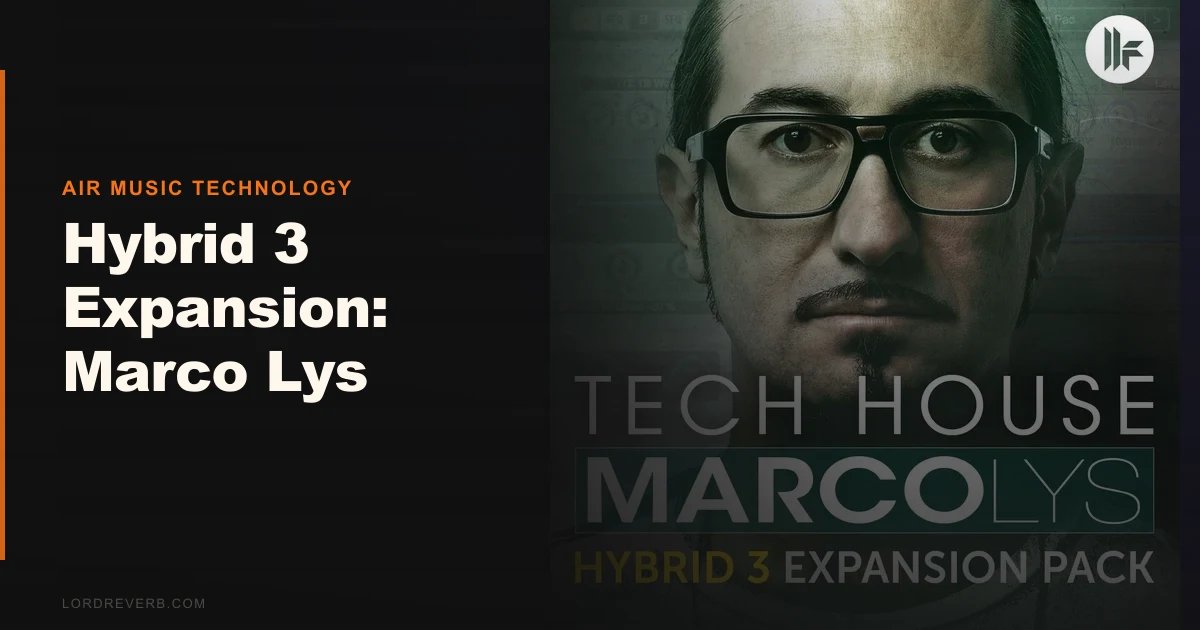
The Marco Lys Hybrid 3 expansion is a lean 64-preset pack built for electro-tinged house production, and if that sentence describes your work, it's worth $29. If it doesn't, skip it entirely.
The Marco Lys Hybrid 3 expansion does one job: drop 64 electro-house presets into your Hybrid 3 library and get you closer to the sound Marco Lys built his name on. It's not a teaching tool. It's not a versatile sound design starter pack. It's a genre-specific shortcut, priced at $29, and it earns that price if you're making the kind of music it was built for.
Marco Lys forged his reputation on electro-tinged house production with a recognisable sound: driving sub basses with grit on top, arpeggiated sequences that sit cleanly in a crowded mix, and pads that feel wide without eating headroom. These 64 patches are an extension of that aesthetic. Nothing more.
We'd buy this if Hybrid 3 is already in our signal chain and we need to move fast on a project with that flavour. We'd skip it if we're hoping it expands what Hybrid 3 can do. It doesn't. It fills a lane.
What You're Actually Getting
Sixty-four patches. That's it. The file size is 80.85 KB, which tells you everything about what you're paying for: there are no samples, no wavetables, no audio files. Just preset data that maps onto Hybrid 3's existing synthesis engine.
The patches break across five categories: TechBasses, Sub Basses, Pads, Arpeggiator Sequences, and Transition FX drops. The balance leans heavily toward the low end. Roughly 40 of the 64 slots are bass-oriented in some form, which is consistent with Marco Lys's production identity but does leave the pads and FX sections feeling thin by comparison.
This is soundware. It requires Hybrid 3 to run. It works on macOS and Windows. Installation means dropping the presets into Hybrid 3's preset folder, and they show up in the browser immediately. No drama there.
Originally released in 2015 as part of AIR's Toolroom Artist Series, the pack launched at a lower price. It's currently $29 through most storefronts.
The Good
The sub basses are the strongest section. We loaded three of them onto a kick-and-bass project at 127 BPM, routed them through the same bus, and checked phase relationships. They sit naturally. The low-frequency content centres around the 40-60Hz range with harmonic presence up around 120-160Hz that stops the bass sounding hollow on smaller speakers.
That's not an accident. Those are production decisions made by someone who's mixed these sounds in a proper room and on proper speakers.
The TechBass patches are where we spent most of our time. They're grimier than the sub patches, with a mid-range bite that places them in the 300-600Hz range. They cut through without needing aggressive EQ. We found one that sat perfectly against a 4/4 kick without any gain staging adjustments. That's satisfying when it happens.
The arpeggiator sequences are pre-programmed rather than blank templates, which we found more useful than expected. They give you movement immediately. You can break them apart and rebuild them inside Hybrid 3's sequencer, but they work right out of the preset browser as starting points.
Transition FX drops: there are a handful, they're functional, and they save time. Not clever, but useful.
The Not-So-Good
Sixty-four patches in 2026 is a small library. Competing packs on other synths regularly ship 150-200 presets at similar price points. The gap is noticeable.
There's no documentation. Zero. We don't know which patches were built using Hybrid 3's FM section versus the analogue-modelling oscillators. We don't know which modulation routings Marco Lys used, which means learning anything from these presets requires reverse-engineering them yourself. For the price that's annoying rather than a dealbreaker. But it's still annoying.
The pads section is underbuilt. We counted fewer than ten pad patches, and several of them are similar enough that two could have been replaced with genuinely different textures. The pad coverage feels like an afterthought next to the bass-heavy weighting of the rest of the pack.
Most storefronts don't offer a demo. You're buying blind. That's a frustrating product decision for a pack that is so deliberately genre-specific. If your project doesn't fit the electro-house template, you'll know within about three patches and you won't recover what you spent.
Compared to the Alternatives
AIR released several Hybrid 3 Artist Series packs alongside this one. The Rene Amesz pack targets the same tech-house lane. The D. Ramirez pack leans more minimal. The Tocadisco pack goes broader with electro and synth-pop textures.
Across those four packs, the structure is identical: 64 patches per pack, same price bracket, same file size profile. They're not competing with each other so much as carving up subgenres. If your work sits closer to minimal techno, D. Ramirez is the smarter buy. If you want breadth across multiple electronic subgenres, you'd need to stack multiple packs, which gets expensive fast.
Outside the Hybrid 3 ecosystem, Serum expansion packs offer significantly more patches per dollar. But those require Serum, not Hybrid 3, so direct comparison only matters if you're choosing between synths rather than expanding one you already own.
If Hybrid 3 is already in your setup, the Marco Lys pack competes against the Rene Amesz pack, not against Serum content. Head-to-head on bass patches specifically, we'd call it a tie.
Who Should Buy This
- ✅ Buy if you make electro-tinged house and Hybrid 3 is already in your DAW.
- ✅ Buy if you want production-ready sub basses that require minimal gain staging adjustment.
- ✅ Buy if spending $29 on a set-and-forget preset library is an easy call for your budget.
- ❌ Skip if you're outside the electro-house and tech-house genres.
- ❌ Skip if you want to learn synthesis technique from a preset library. There's no teaching material here.
- ❌ Skip if you don't already own Hybrid 3. This is not a reason to buy the synth.
Score Breakdown
| Category | Score | Notes |
|---|---|---|
| Sound Quality | 3.5/5 | Bass patches are production-ready; pads are thin |
| Value for Money | 2.5/5 | 64 presets at the current price is below market average for patch count |
| Ease of Use | 4.0/5 | Drop-in installation, works immediately in Hybrid 3's browser |
| Features | 2.0/5 | No documentation, no demo, no bonus content |
| CPU Efficiency | N/A | Soundware only, CPU load belongs to Hybrid 3 |
| Overall | 3.4/5 | Niche and lean, but honest about what it is |
Alternatives to Consider
Hybrid 3 Artist Series: Rene Amesz, The closest sibling pack. Similar bass-forward focus, slightly more minimal in character. If you work across both tech-house and minimal techno, Rene Amesz Hybrid 3 expansion review gives you a direct comparison.
Hybrid 3 Artist Series: D. Ramirez, Better choice if your productions sit closer to minimal. Less electro grit, more driving groove textures. Worth checking D. Ramirez Hybrid 3 expansion review if you're choosing between the two.
Third-party Hybrid 3 preset banks from Loopmasters and Producerbox, These regularly ship 100-200 patches at competitive prices. More volume, less artist curation. See our best Hybrid 3 expansion packs roundup for a full breakdown of where Marco Lys's pack sits in the field.
The Marco Lys pack isn't a bad product. It's a specific one. The sub basses are genuinely good. The TechBass patches work fast. But 64 presets with no documentation and no demo preview is a hard sell when the market has moved on. At $29 it's a low-risk decision for the right producer. For everyone else, it's money spent on presets that'll sit unused in a folder.
Buy it if house music with a dark electro edge is your bread and butter. Skip it if you're hoping it'll stretch Hybrid 3 into new territory. It won't. What it does, it does well enough. What it doesn't cover is most of what you might need.
The sub bass that convinced us is patch #7 in the TechBass folder. That one alone is worth the price of admission if you make this music. But only if you make this music.
Frequently Asked Questions
Does the Marco Lys Hybrid 3 expansion work without owning Hybrid 3?
No. This is preset data, not a standalone plugin. It requires AIR Music Technology's Hybrid 3 synthesizer to run. If you don't already own Hybrid 3, you'd need to purchase that separately before these patches are usable. Don't buy this pack as a route into Hybrid 3 ownership.
How many patches are in the Marco Lys Hybrid 3 expansion, and what categories do they cover?
There are 64 patches total, spread across TechBasses, Sub Basses, Pads, Arpeggiator Sequences, and Transition FX drops. The pack is heavily weighted toward bass content, with roughly 40 of the 64 patches falling into bass-related categories. Pads and FX are underrepresented relative to the bass sections.
Is the Marco Lys Hybrid 3 expansion worth buying in 2026?
At $29, it's worth it if you produce electro-tinged house music and Hybrid 3 is already in your signal chain. The sub bass and TechBass patches hold up. If you work outside that specific genre space, or you're looking for a large, versatile preset library, competing packs offer better value per patch. Check whether a demo is available on the storefront you're buying from before committing.
How do you install the Marco Lys presets into Hybrid 3?
Installation is straightforward. After purchase, you'll download a small preset file (80.85 KB total). Drop the preset files into Hybrid 3's designated preset folder on your system, relaunch Hybrid 3, and the patches appear in the browser automatically. AIR's documentation for Hybrid 3 covers the exact folder path for both Mac and Windows if you need a reference point.