Affiliate disclosure: the "Get this deal" button is an affiliate link to the store. If you buy through it we earn a commission at no extra cost to you. Full policy

The Oxford SuprEsser Black Friday deal is 75% off, which brings this Sonnox De-Esser plugin to $60 until Dec 17, 2026.
The Oxford SuprEsser is a professional De-Esser and a Dynamic EQ in one plugin. It has a simple mode for quick fixes and an advanced mode for fine-tuning.
As a De-Esser, it is designed for sibilance and fricatives in vocals, plus unwanted whistles and 'spirant' artefacts on wind instruments.
It works across the full spectrum, 20Hz to 20kHz. That means plosives and other problem peaks can be treated too, so it does more than a basic De-Esser.
You take out a peak only when it happens, unlike a fixed EQ cut applied to the whole channel.
At its core is an enhanced version of the compressor from Oxford Dynamics, which the maker describes as precise and transparent on peaks.
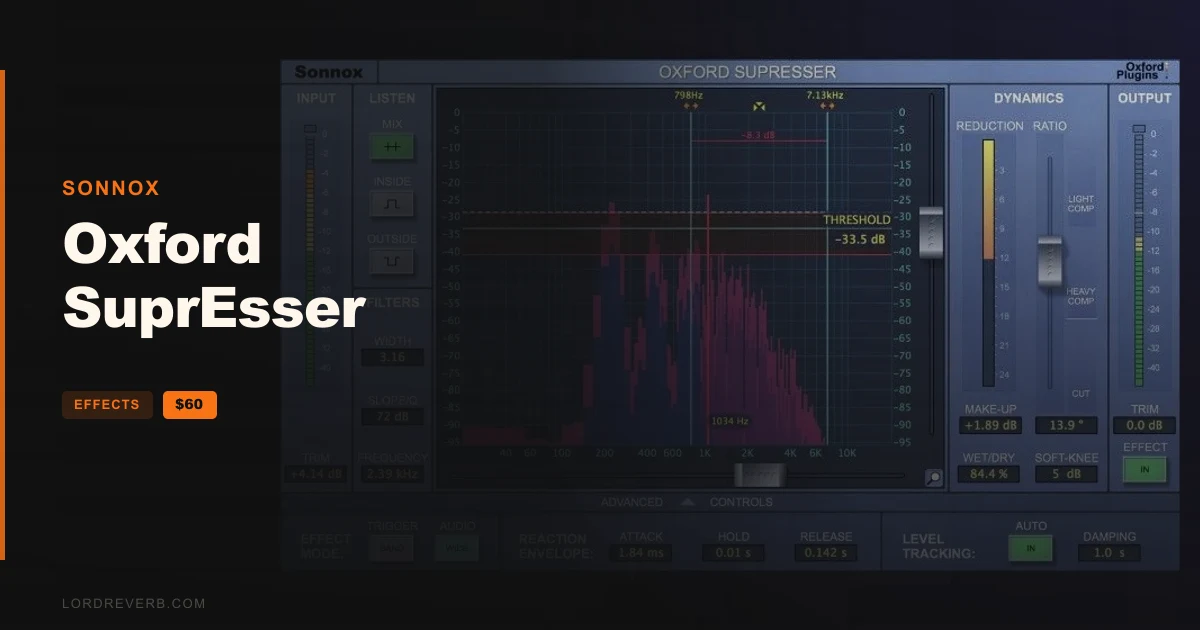
A pair of crossover filters around it make the compressor react only to the band you define. Those linear phase filters are modelled on the Oxford EQ filters, so it suits mastering as well as mixing.
By default, only the defined band is compressed and the rest of the spectrum is left alone. You can also pick 'Wide' for full-band compression that reacts to specific frequencies, or mix Band and Wide to set when the compressor reacts and what it compresses.
Once the band is set, lower the threshold fader until the gain reduction meter kicks in. Auto Level Tracking then moves the threshold with the signal level. A vocalist who is louder in the chorus gets the same relative de-essing as in the verse, with no threshold automation.
The 'More' button opens every control, for precise correction or creative use.
The plugin is 64-bit and comes as AAX, AU and VST3. On macOS you need 10.12 or later, with Intel and M1 Apple Silicon supported, and AU is available there. On Windows you need Windows 10 or later, with AAX Native and VST3. It runs in Pro Tools 11 or above, or any desktop host that supports AU or VST3.
Licensing runs through iLok, either a machine, an iLok2 or iLok3 device, or iLok Cloud. Each licence gives 2 activations.

Yes. The Oxford SuprEsser Black Friday deal is 75% off, which puts the Sonnox plugin at $60. The deal ends Dec 17, 2026.
It treats sibilance and fricatives in vocals, and whistles and 'spirant' artefacts from wind instruments. It also works as a linear phase Dynamic EQ across 20Hz to 20kHz, so plosives and other harsh peaks can be tamed.
It is a 64-bit plugin in AAX, AU and VST3 formats. AU is for macOS 10.12 or later, and Windows 10 or later gets AAX Native and VST3. It runs in Pro Tools 11 or above and in hosts that support AU or VST3.
The plugin follows the general signal level and moves the threshold with it. That keeps the relative amount of gain reduction the same as the signal rises or falls, so a louder chorus is not over de-essed. You can switch it off for a fixed threshold.
Prices and end dates are checked at publishing time and can change, so confirm them at the store before you buy.