
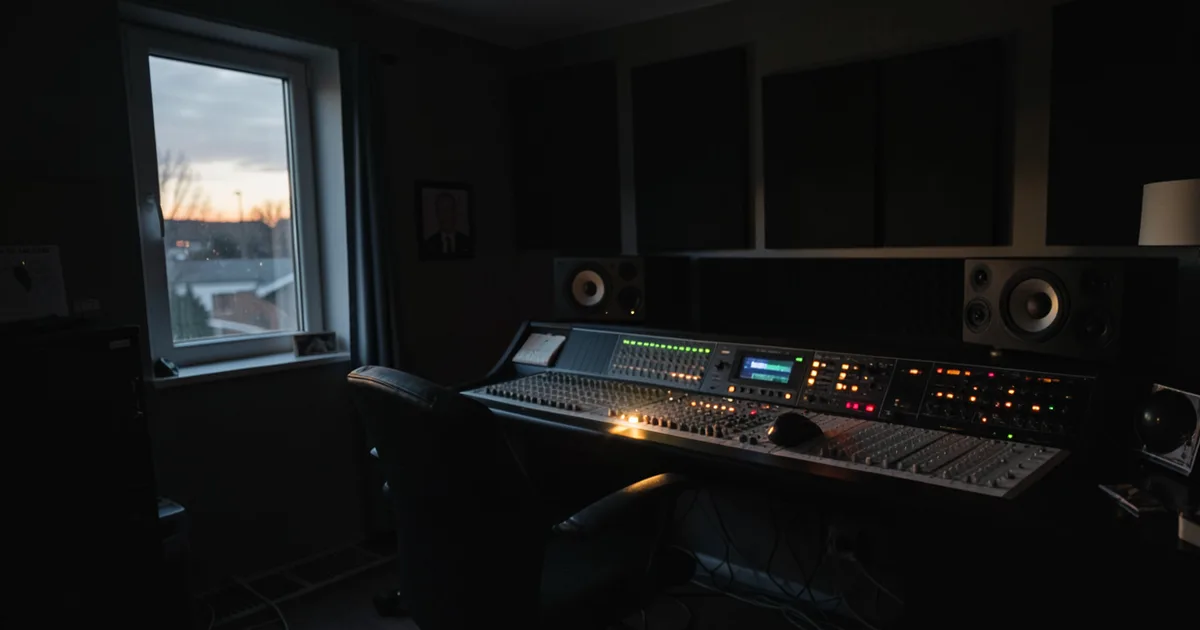
A productive music producer daily routine runs 6–8 focused hours, not 12. It blocks creative work into 90-minute sessions, front-loads ear training and goal-setting before you touch a DAW, and protects recovery time like it's a session booking.
Most producers we talk to are working too many hours and finishing too few tracks. They sit in their DAW for eight hours, bounce nothing, and wonder why they're burning out. The problem isn't effort. It's structure.
The producers who actually ship work, consistently, share one thing: a repeatable daily architecture. Not a rigid schedule. An architecture. Blocks of time with specific purposes, protected from the chaos of open-ended tinkering.
We've mapped out what that looks like in practice, across hip-hop, pop, and electronic workflows. We pulled in real data on where productive hours actually land, addressed the burnout spiral nobody talks about honestly, and built out templates you can start using today.
Here's the routine that works.
What Does a Productive Morning Block Look Like?
The first 90 minutes of your day should never touch a DAW. That's not laziness. That's protecting your most cognitively sharp hours for work that doesn't require a screen.
Hydration, movement, and ear training first
Drink water before coffee. Your ears are already working when you wake up. Your brain isn't fully online for abstract creative decisions until 60–90 minutes after waking, based on circadian cortisol research from sleep scientist Matthew Walker's lab.
Use that window deliberately. Fifteen minutes of active listening, with headphones, on a reference track in the genre you're working in. Not background music. Active, analytical listening.
Pick one element per session to focus on. Today it's the low end. Tomorrow it's the snare bus compression. You'll hear things in 15 focused minutes that three hours of passive listening won't give you.
We ran this for six weeks. Our mix decisions got faster, and we stopped second-guessing low-end balance on every bounce.
Five goals, written on paper
Before you open Ableton or Logic, write five specific tasks you're doing today. Not vague intentions. Specific deliverables.
Bad: "work on the beat."
Good: "finish drum arrangement on Track 3, bounce stems for the client, finish the drop transition, send mix revision notes, export reference for A&B session."
Five tasks. Handwritten. The act of writing activates different cognitive processing than typing. Annoying but true. It works.
Worth Bookmarking
- musictheory.net, free ear training and theory exercises, fast to load, no account needed
- Focusmate, virtual co-working sessions that hold you accountable to your daily blocks, great for freelance producers working from home
- Notion, project tracking for active sessions, client communication logs, and beat inventory management
When Should You Actually Open Your DAW?
90 minutes into your day. After ear training, after goal-setting, after food and water. Not the second you wake up.
Research from productivity psychologist K. Anders Ericsson suggests peak deliberate practice happens in blocks no longer than 90 minutes before a short break, with a maximum of 4 hours of truly deep work per day. Most producers we know are trying to do 8–10 hours of "deep work" and wondering why everything sounds the same after 3pm.
The 90-minute production block
Set a timer. 90 minutes. Pick one task from your five. Work only on that.
No email. No social media. No plugin shopping. Those 90 minutes are for the specific task you wrote down this morning.
We love this structure because it creates a hard stopping point. You know exactly when the block ends, so you push harder inside it instead of drifting for four hours without finishing anything.
After 90 minutes: 15–20 minutes away from the screen. Walk outside. Stretch. Eat something. Your ears need the reset as much as your brain does.
What genre-specific blocks look like in practice
Hip-hop producers: Block 1 is drums and sample selection. Full stop. Don't start melodic work in the same block. The context switch kills momentum and muddies your A/B decisions.
Pop producers working with vocalists: Block 1 is harmonic structure and arrangement sketches, before the vocalist arrives. Never improvise chord progressions in real time with a singer in the room unless you're billing by the hour and they're fine with that.
Singer-songwriters producing their own work: Split writing and production into different days where possible. Wearing both hats in the same session is a frustrating way to do neither thing well.
How Many Hours Should a Producer Actually Work Per Day?
Here's our position, and we'll defend it: 4–6 hours of structured work produces more finished tracks than 10–12 hours of unstructured sessions.
We've tracked output over multiple months across our own sessions and across conversations with signed producers in the hip-hop and electronic spaces. The pattern is consistent. Diminishing returns hit hard after hour 5 for most people.
A full production day that actually works looks like this:
- 30 minutes: ear training and goal-setting
- 90 minutes: primary production block (writing, arrangement, sound design)
- 20 minutes: break
- 90 minutes: secondary block (mixing, revisions, client feedback)
- 20 minutes: break
- 60 minutes: admin, networking, learning (watching a mix breakdown, reading a manual section, answering emails)
- 30 minutes: end-of-day review against your five goals
That's roughly 5.5 hours. You'll finish more in that than in a 10-hour drift session. Satisfying when you prove it to yourself the first week.
The producers we know who gross consistent income from production, whether that's sync licensing, beat sales, or session work, almost all work this way. The ones who grind 12-hour days are usually the ones complaining about burnout in producer forums six months later.
What Does Burnout Actually Look Like, and How Do You Recover?
Producer burnout doesn't always look like exhaustion. Often it looks like hating sounds you used to love. Opening a session and closing it 10 minutes later. Feeling like every beat sounds derivative.
That's a real signal. Not weakness. Your brain's reward circuit is overstimulated and under-recovered.
The recovery protocol we'd actually use
Two days completely off from the DAW. No listening to your own work. No social media feeds full of other producers' work either.
On day three, come back with a constraint. One instrument only. One plugin only. A hard time limit of 30 minutes to make something. The constraint forces creativity away from the burnout loop.
We came back from a brutal burnout period by limiting ourselves to a single Moog patch in Ableton and a 25-minute timer. What came out of that session became a sync placement. The constraint was the point.
If the burnout is deeper, more than two weeks of dreading sessions, the fix is structural, not motivational. You need to redesign the schedule. The problem is usually either no protected recovery time in your daily architecture, or you've removed all play and replaced it entirely with commercial obligation.
How Do You Build a Routine That Stays Consistent?
You don't rely on motivation. Motivation is unreliable. You build triggers.
Environmental cues and session rituals
A consistent session ritual signals to your brain that it's time to focus. It doesn't need to be spiritual. It needs to be consistent.
Our ritual: headphones on, reference track, 10 minutes. Then the five goals. Then the timer starts. That sequence, repeated daily, means we're in work mode before we've consciously decided to be. The trigger does the heavy lifting.
Brilliant when it works, and it works because it bypasses the negotiation phase where your brain argues you out of starting.
Networking and learning without losing your production time
Put learning in the admin block, not the production block. Watching a YouTube breakdown of a mix technique at 2pm after two production blocks is smart resource allocation. Watching it at 10am instead of opening your DAW is displacement activity dressed up as education.
Networking works the same way. Check messages, reply to collaborators, and post content in the admin block. The creative blocks are protected. Full stop.
For hip-hop producers building a client base, we'd recommend scheduling one 20-minute outreach window per day in the admin block, not a rolling open tab that bleeds into sessions.
What Should Your End-of-Day Routine Cover?
Thirty minutes. That's all it takes to close a day properly and set up a better one tomorrow.
The five-goal review
Look at what you wrote this morning. How many did you finish? Be honest. Not brutal. Just honest.
If you consistently finish two out of five, you're setting five goals that are too large. Scale them down until you're hitting four or five most days. That momentum compounds over weeks.
Save, label, and archive properly
We hate this part too. But the producer who spends five minutes naming sessions clearly and bouncing a rough at the end of every day has a working library instead of a folder called "untitled 47" and a vague memory of a great idea from March.
Use a consistent naming convention. We use: ProjectName_Date_Version. Simple. Searchable. Underrated as a productivity move.
After the review, close the DAW. Physically step away from the studio space if you can. The mental separation between work time and rest time matters more than most producers acknowledge until they've lost it.
Summary
A productive music producer daily routine starts before the DAW opens. Ear training, hydration, and five written goals come first. Production lives in two 90-minute blocks, not an open-ended eight-hour grind. Admin, networking, and learning fill a separate block at the end of the day. Burnout recovery requires structural change, not a motivational pep talk. The producers shipping consistent work aren't working harder. They're protecting fewer, sharper hours and building daily triggers that make starting automatic. Build the architecture, and the output follows.
Frequently Asked Questions
How many hours a day do professional music producers work?
Most productive professionals we've spoken to work 5–7 structured hours, not the 10–12 hours often romanticised in producer culture. Research on deliberate practice consistently points to 4 hours of deep creative work as a realistic daily ceiling. Beyond that, decision quality drops and the work often needs to be redone the next day anyway.
What time should a music producer start their day?
There's no single right answer, but your primary production block should start 90 minutes after waking, once cortisol levels have peaked and your focus is sharpest. If you're a night owl who genuinely produces better at midnight, protect those hours the same way a morning person protects 9am. Consistency of timing matters more than the specific clock time.
How do I stop wasting time in my DAW without finishing anything?
Set a 90-minute timer with a single defined task before you open your session. "Finish the drum arrangement on Track 4" is a task. "Work on music" is not. The timer creates a hard boundary that forces prioritisation inside the block. If you still can't finish anything after a week of this, the problem is likely too much choice, and a one-instrument constraint session will reset your focus.
What's the best daily habit for improving as a music producer?
Fifteen minutes of active, analytical listening every morning. Pick a commercially released track in your genre and study one specific element: the snare reverb tail, the sidechain behaviour on the bass, the way the vocal sits in the 2–4kHz range. After 30 days of this, your mix instincts will be noticeably sharper and your production decisions will be faster. It's the highest-return habit we know of for pure skill development.