The first preset we loaded was something labelled deep groove, late night energy. We hit play. The chord voicing sat in a minor pentatonic pattern with an open fifth on the root. It breathed correctly. The rhythmic offset on the melodic layer landed about 16ms behind the kick anchor, which is exactly where Black Coffee’s arrangements tend to leave space. We sat back. That was the moment we thought: okay, someone who actually listens to this music built these.
That said, 40 presets at the intro price (until February 10, 2026, then $19.90) only matters if you own InstaComposer 3 review. Without it, this pack is nothing. Literally nothing. There’s no standalone plugin here, no sample library, no MIDI loops. It is preset data for one specific tool. Know that before clicking.
What This Pack Actually Is, and What It Isn't
Afro House for InstaComposer 3 is a 40-preset expansion for W. A. Production’s InstaComposer 3, a procedural composition tool that generates chord progressions and song structures through what the developer calls transparent algorithmic composition. You drive it. It suggests. You accept or reject.
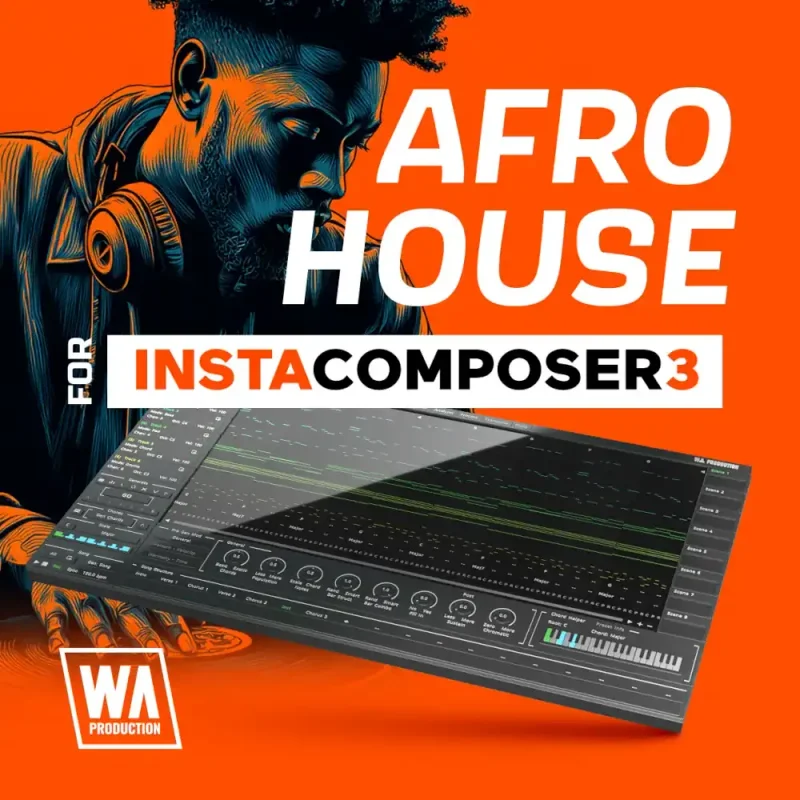
These presets configure InstaComposer 3’s Song Section Architecture, which organizes arrangements into multiple song parts with unique scenes and per-track control. Loading a preset doesn’t hand you a finished track. It hands you a scaffolded framework tuned to Afro House harmonic logic, groove placement, and sectional flow.
It is not a sample pack. Not a synth. Not an Amapiano pack wearing Afro House clothes. The genre framing here is specific: deep, hypnotic, melodically expressive, rooted in the same musical DNA as artists like Osunlade and Black Coffee rather than filtered through a generic “tribal house” template. That specificity is either its biggest strength or irrelevant to you, depending on what you make.
Living With These Presets Across a Session
We ran three separate sessions with this pack across different production contexts.
Session one: building a club-focused arrangement from scratch. We loaded preset 12, a mid-energy builder with clear A and B section differentiation. InstaComposer 3’s Song Section Architecture let us assign different chord scenes to the drop versus the breakdown. The preset had already configured this split. We spent about four minutes adjusting the melodic density in the breakdown section down by two voices and hit bounce. The raw MIDI output needed minimal editing before it sat in the mix correctly.
Session two: we tried to use it for something closer to Afro Tech, harder and more percussive. Frustrating. The presets are tuned for warmth and melodic space. Pushing them toward a tighter, more industrial groove required fighting the harmonic structure rather than working with it. That’s not a flaw exactly, but it’s a wall you’ll hit.
Session three: atmospheric breakdowns. This is where the pack shines. Four or five presets are clearly built for sustained, floating sections with wide harmonic movement. We layered one over a 909-pattern at 124 BPM and the progression resolved in a way that felt natural rather than generated.
Setup is zero-friction. Load InstaComposer 3, browse presets, click. There’s no activation drama because the presets live inside the plugin ecosystem. If InstaComposer 3 is already in your signal chain, this adds maybe 30 seconds to your workflow per session.
The best InstaComposer 3 presets question is real though. Not all 40 of these are session-ready. We’d call roughly 10 to 12 excellent, another 15 usable with edits, and the remaining 13 or so more like sketches than finished configurations.
The Real Trade-Offs
The intro price is clever pricing. At that number, it’s hard to argue against buying it if you already own InstaComposer 3. The mental barrier is lower than a coffee. $19.90 is still reasonable for 40 presets from a developer who clearly did genre research.
But here’s the honest trade-off: the pack’s value is tied entirely to how much you trust InstaComposer 3’s generation engine. If you love the way InstaComposer 3 outputs MIDI and you’re already building Afro House, this is a no-brainer purchase. If you’re ambivalent about InstaComposer 3’s results, buying more presets for it won’t fix that ambivalence.
We also wish the preset naming gave more sonic information. “Evocative Horizon” tells us nothing about tempo range, harmonic density, or intended section type. A label like “104-120 BPM, low harmonic density, breakdown” would save time. Annoying oversight on a pack this genre-specific.
The Song Section Architecture integration is the strongest feature. Presets that pre-configure multiple song parts with distinct scenes are genuinely useful for producers who struggle with arrangement, which is most of us.
Against the Field
The direct comparison is other Afro House MIDI packs and tools, not other InstaComposer 3 expansion packs.
Standalone Afro House MIDI packs from producers like Capsun Pro Audio or W. A. Production’s own sample lines give you fixed MIDI files. You get exactly what’s in the pack. No generation engine. No variation. Afro House for InstaComposer 3 wins on replayability: every time you regenerate inside InstaComposer 3 using these preset frameworks, you get a different output within the same harmonic and structural rules.
Competing MIDI packs typically run in a similar or higher range for similar content volume. This pack is competitive on price for the output quantity, though those MIDI packs work in any DAW without a host plugin dependency.
If you’re not already an InstaComposer 3 user, buy a MIDI pack. If you are, this wins.
The Real Verdict
Buy this if you already use InstaComposer 3 and produce Afro House or adjacent genres like Deep House or Organic House. At the intro price it is an obvious yes. At $19.90 it’s still a reasonable yes, assuming you’ll actually use it.
Skip it if you don’t own InstaComposer 3. There’s no path to value without the host plugin. Also skip it if you’re chasing Afro Tech or Amapiano. The pack is tuned for warmth and melodic depth, not hard groove or gqom-influenced percussion work.
The presets that work are genuinely satisfying. The ones that don’t are easy to ignore.
Score Breakdown
| Category | Score | Notes |
|---|---|---|
| Sound Quality | 3.8/5 | Top third of presets are genuinely well-voiced; bottom third feel underbaked |
| Value for Money | 4.5/5 | The intro price removes almost all financial risk for InstaComposer 3 owners |
| Ease of Use | 4.0/5 | Zero-friction setup if you own the host; preset naming could be more informative |
| Features | 3.5/5 | Song Section Architecture integration is clever; no value outside InstaComposer 3 |
| CPU Efficiency | N/A | Preset file, no additional CPU draw |
| Overall | 3.8/5 | Solid for the right buyer; completely wrong for producers without the host plugin |
Alternatives to Consider
If you want Afro House harmonic tools without the InstaComposer 3 dependency, check best Afro House MIDI packs 2026 for standalone MIDI options that drop straight into any DAW without a host plugin requirement.
For producers exploring adjacent genres, best Deep House preset packs covers expansion content with broader instrumental compatibility, including several packs that cross over into Afro House territory.
And if you’re on the fence about InstaComposer 3 itself, read our InstaComposer 3 full review before spending anything on expansion packs for it. Buy the tool you believe in first.
The bottom line: if InstaComposer 3 is already open in your DAW sessions, add this at the intro price and don’t think twice. If it isn’t, this pack doesn’t change that equation at all.
Frequently Asked Questions
Does Afro House for InstaComposer 3 work without owning InstaComposer 3?
No. The pack is pure preset data built for InstaComposer 3's architecture. There's no standalone plugin, no MIDI export without the host, and no workaround. You need InstaComposer 3 installed and activated before any of this is useful to you.
What is the difference between the intro price and the regular $19.90?
The content is identical. W. A. Production is running an introductory launch discount until February 10, 2026. After that date, the price moves to $19.90. Both prices buy you the same 40 presets. Buy it before the deadline if you're already an InstaComposer 3 user.
Can these presets work for Amapiano or Afro Tech productions?
Not comfortably. The presets are voiced and configured for Afro House: warm harmonic movement, melodic depth, mid-tempo groove. Pushing them toward Amapiano's log drum-driven low end or Afro Tech's tighter, more aggressive structure requires fighting the preset logic rather than working with it. Use genre-specific tools for those styles.
How does Song Section Architecture affect how these presets are organized?
InstaComposer 3's Song Section Architecture lets you divide an arrangement into multiple song parts, each with its own scene and per-track settings. These presets pre-configure that structure for Afro House, so you load a preset and already have a differentiated intro, build, drop, and breakdown framework rather than a single looping pattern. It's the most useful feature in the pack for producers who struggle with arrangement flow.